
Swamp Currant (Ribes lacustre)
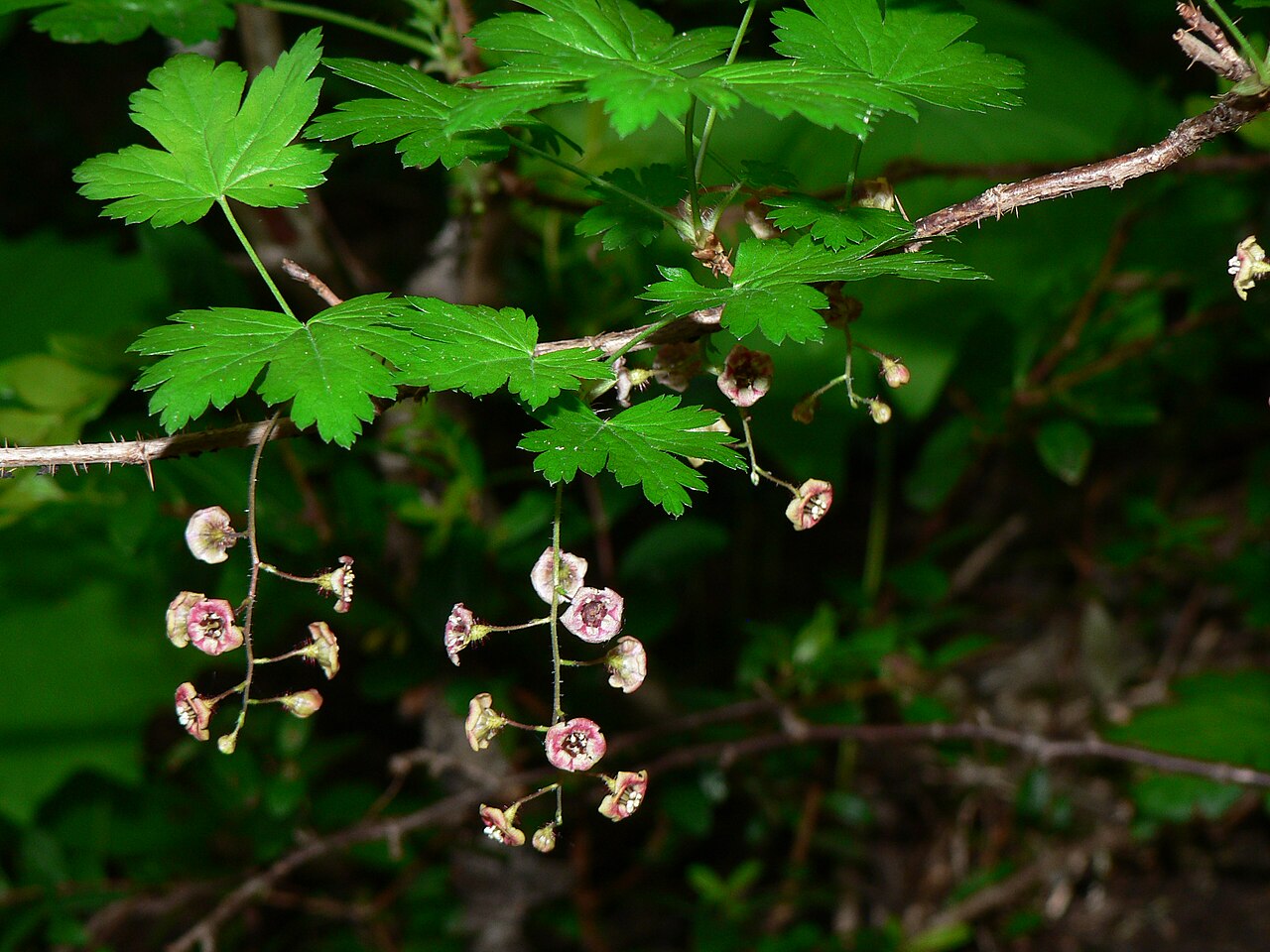
Ribes lacustre, known as Swamp Currant, is a spiny, deciduous shrub of cool, moist forests across northern North America. USDA PLANTS calls it prickly currant, and it is also known as black swamp gooseberry and bristly black currant. It grows from Alaska and Newfoundland south in the mountains to California, Colorado and the central Appalachians. It belongs to the currant and gooseberry family (Grossulariaceae).
It usually grows 3 to 5 feet tall, with arching stems densely covered with fine bristles and sharper spines at each leaf node, and maple-like leaves with three to five deep lobes. In late spring it hangs strings of small, saucer-shaped, pinkish to maroon flowers beneath the branches, followed in summer by small, bristly, dark purple-black berries. Although it is spiny like a gooseberry, its flowers and fruit in long clusters are more like a currant.
Swamp currant is a useful shrub for wet, shady woodland gardens, streambanks and wildlife plantings in cool climates. Like other Ribes, it is an alternate host of white pine blister rust, a disease of five-needle pines, so gardeners near white pines should check local guidance before planting it.
Identification
Look for a spiny, bristly shrub in a moist forest with maple-like leaves, drooping strings of small reddish flowers and bristly black berries.
Growth Habit
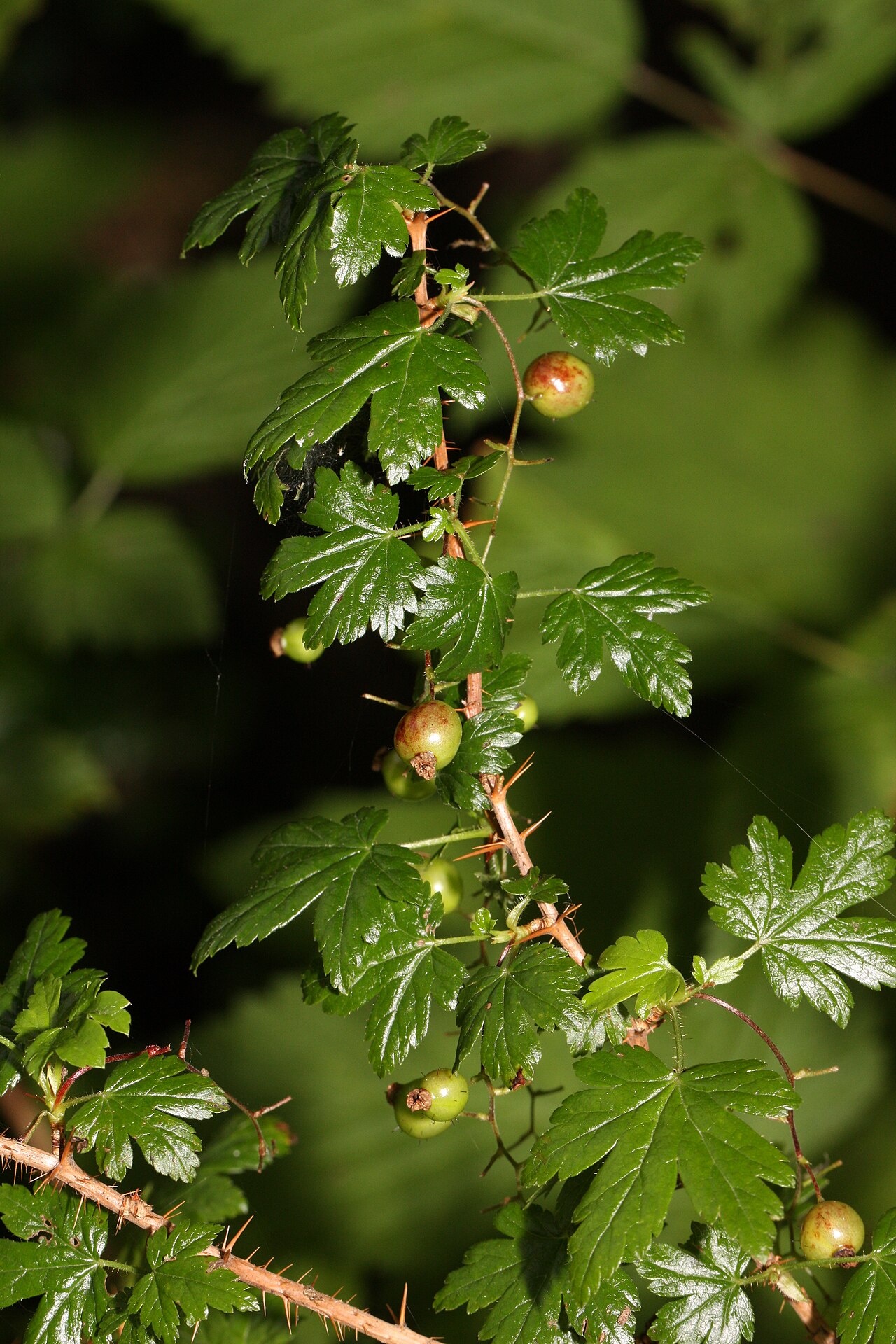
Swamp currant is an erect to spreading deciduous shrub, usually 3 to 5 feet tall and occasionally to about 6 feet, with arching branches that can root where they touch the ground. Young stems are densely covered with fine bristles, and each node has a cluster of three to seven longer, sharp spines. Older bark is reddish-brown to gray and peeling.
Leaves
The leaves are alternate, 1 to 2 1/2 inches wide, and maple-like, deeply cut into three to five toothed lobes. They are bright green, smooth or slightly hairy, and turn yellow to orange in fall.
Flowers
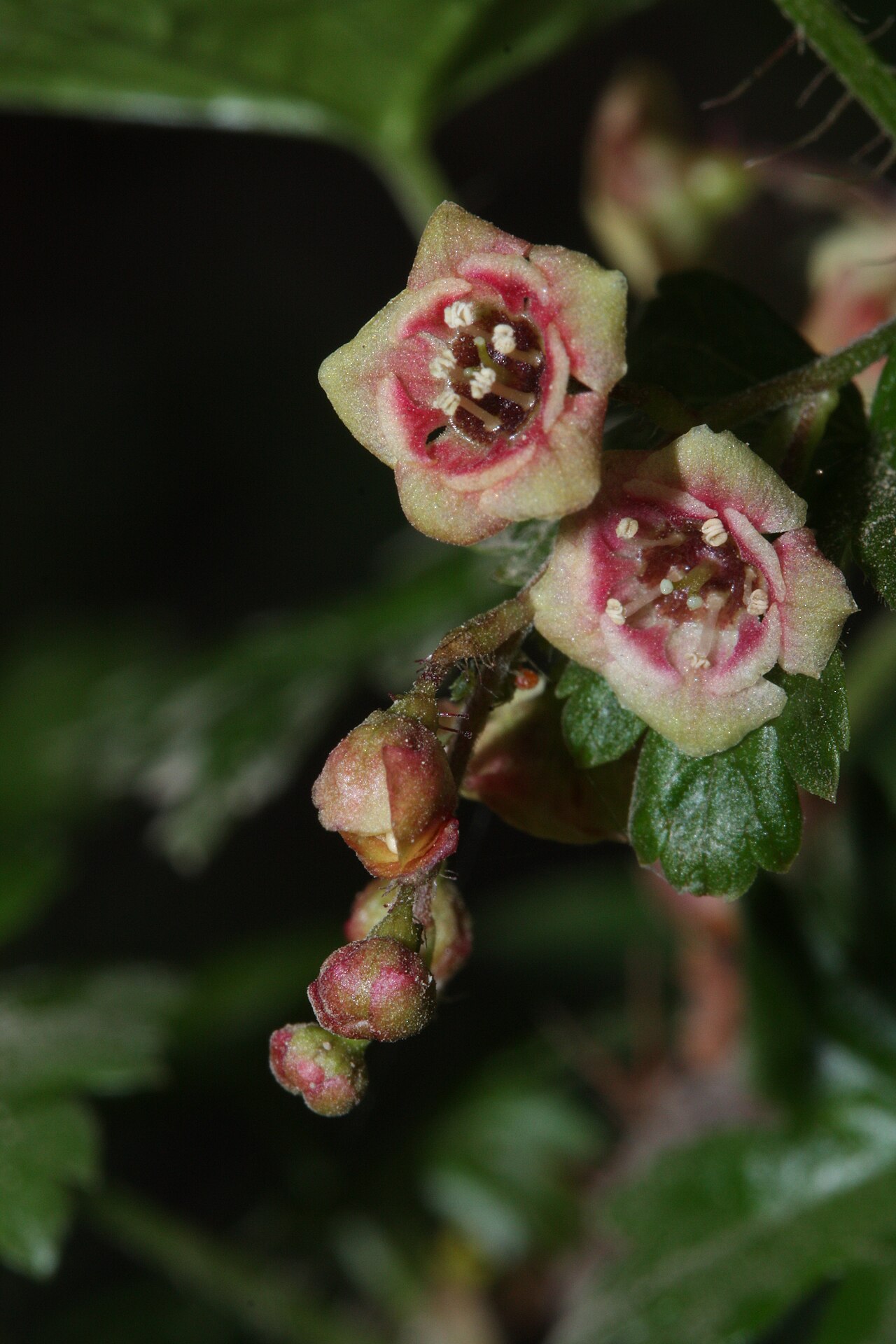
The flowers hang in drooping racemes of about 7 to 15 flowers, 1 1/2 to 3 inches long, from late spring to early summer, usually May to July. Each flower is saucer-shaped, about 1/4 inch across, with five spreading, pale pink to greenish sepals and smaller pinkish to maroon petals around a dark red disk. The flower stalks are glandular-hairy.
Fruit
The berries are round, about 1/4 inch across, dark purple to black and covered with gland-tipped bristles. They ripen from mid to late summer. They are edible but not very flavorful, and the bristles make them unpleasant to eat raw in quantity.
Look-alikes
Most gooseberries, such as American gooseberry (Ribes hirtellum), have flowers in clusters of one to three and smooth or prickly fruit, not long strings of flowers. Skunk currant (Ribes glandulosum) has similar flowers and fruit but no spines, and its leaves smell skunky when crushed. Devil’s club is also spiny and grows in similar wet forests, but it is much larger, with huge maple-like leaves and red berries.
Quick Facts
| Scientific Name | Ribes lacustre |
| Family | Grossulariaceae (currant and gooseberry family) |
| Plant Type | Deciduous spiny shrub |
| Mature Height | 3–5 ft |
| Mature Spread | 3–5 ft |
| Growth Rate | Moderate |
| Sun Exposure | Part shade to shade; sun in cool climates |
| Water Needs | Medium to high; moist to wet |
| Soil Type | Moist, humus-rich loam; swamps, streambanks and wet woods |
| Soil pH | Acidic to neutral (about 4.5–7.0) |
| Bloom Time | May–July |
| Flower Color | Pinkish to maroon, with pale sepals |
| Fall Color | Yellow to orange |
| Fruit | Bristly dark purple-black berry |
| Deer Resistant | Moderately; spiny stems discourage browsing |
| USDA Hardiness Zones | 2–7 |
Native Range
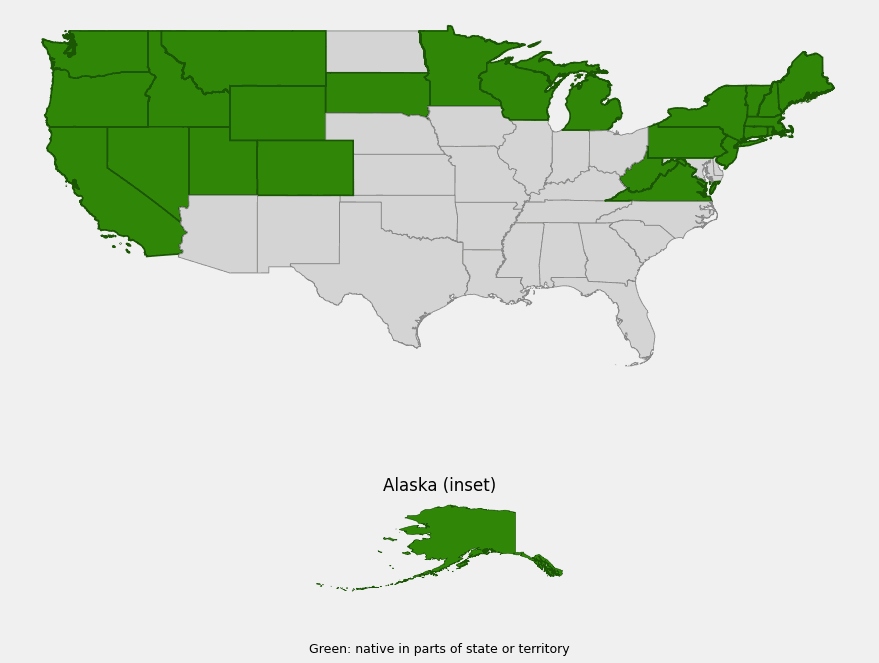
Swamp currant has one of the widest ranges of any North American currant. USDA PLANTS lists it as native in every Canadian province and in Alaska, the Pacific Northwest, the northern Rocky Mountains and Great Basin, the upper Midwest and the Northeast: Alaska, California, Colorado, Connecticut, Idaho, Maine, Massachusetts, Michigan, Minnesota, Montana, Nevada, New Hampshire, New Jersey, New York, Oregon, Pennsylvania, Rhode Island, South Dakota, Utah, Vermont, Virginia, Washington, West Virginia, Wisconsin and Wyoming.
It is most common in the Pacific Northwest, British Columbia, Alaska and the northern Rockies, where it grows on both sides of the Cascades, from the coastal rainforests to the eastern slopes and the Blue Mountains. In the Midwest and Northeast it grows in the northern forests of Minnesota, Wisconsin, Michigan, New York and northern New England. It reaches south as rare, outlying populations in high, cool places, including the Black Hills of South Dakota, the mountains of Pennsylvania, West Virginia and Virginia, and southern New England, where it is rare or historical.
Its habitat is cool, moist to wet places: coniferous and mixed forests, swamps and bogs, streambanks, seeps, avalanche tracks, moist talus slopes and subalpine forest openings. It often grows under spruce, fir, hemlock and cedar, from near sea level in the north to about 11,000 feet in the Rockies.
📋 Regional plant lists featuring Swamp Currant: New York, Pennsylvania & Northern New Jersey · Idaho, Eastern Oregon & Eastern Washington · Montana & Wyoming · Michigan, Wisconsin & Eastern Minnesota · Utah & Western Colorado · Connecticut, Massachusetts & Rhode Island · New Hampshire, Maine & Vermont · Maryland, Virginia & West Virginia · Delaware, Southern New Jersey & Long Island · Alaska · North Dakota, South Dakota & Western Minnesota · Western Oregon & Western Washington · California & Nevada
Growing & Care Guide
Swamp currant is an easy, adaptable shrub for cool, moist, shady places where many shrubs struggle. Its spines make it a good barrier plant, but plant it away from paths.
Light
Part shade to full shade. In cool, northern or high-elevation gardens it also grows in sun if the soil stays moist.
Soil & Water
Give it moist to wet, humus-rich soil. It tolerates poorly drained soils, streambanks and seasonal flooding. Water during dry spells, especially in its first two years.
Planting Tips
Plant in spring or fall, 3 to 4 feet apart for a thicket. Wear thick gloves; the bristles and spines are sharp. Before planting, check whether your state or county restricts Ribes planting because of white pine blister rust, and avoid planting it near eastern white pine, western white pine or other five-needle pines.
Pruning & Maintenance
Prune in late winter, removing the oldest stems at ground level every few years to keep the shrub vigorous. Little other care is needed.
Propagation
Grow it from seed sown outdoors in fall, or given about three months of cold, moist stratification. Semi-hardwood cuttings in summer and layering of low branches also work.
Landscape Uses
- Shade and woodland gardens: for moist, shaded sites under conifers
- Streambank and wetland plantings: helps stabilize wet, shady banks
- Wildlife gardens: berries feed birds and small mammals
- Barrier hedges: dense, spiny stems discourage foot traffic
- Forest restoration: suited to moist forest understory restoration in cool climates
Wildlife & Ecological Value
Swamp currant feeds pollinators in spring and birds and mammals in summer, and its spiny thickets give cover to small animals.
For Pollinators
Its small flowers are visited by bees, flies and other insects. Ribes species are caterpillar host plants for several moths and for anglewing butterflies such as the gray comma.
For Birds
Its berries are eaten by thrushes, grouse, jays and other birds in summer and early fall, and the spiny thickets provide nesting cover.
For Mammals
Bears, chipmunks, squirrels and other small mammals eat the berries. Deer and elk browse the foliage lightly; the spines discourage heavy browsing.
Ecosystem Role
Swamp currant is an alternate host for white pine blister rust (Cronartium ribicola), a fungal disease introduced from Eurasia that kills five-needle pines such as western white pine, whitebark pine and eastern white pine. The rust needs both a Ribes and a pine to complete its life cycle. In the 20th century, foresters tried to control the disease by removing wild currants and gooseberries from large areas of forest.
Cultural & Historical Uses
The genus name Ribes comes from an old Arabic or Persian name for a sour-tasting plant, later applied to currants. The species name lacustre means “of lakes,” a reference to the wet places where it grows.
Indigenous peoples of the Pacific Northwest and elsewhere ate the berries fresh or dried, though they are less valued than other currants and gooseberries. Some people find that the spines cause skin irritation, so handle the plant with care.
From the 1920s to the 1960s, crews in national forests pulled up millions of wild currant and gooseberry plants to protect white pines from blister rust. The program was eventually ended because it was not effective enough, but some areas still regulate Ribes planting.
Frequently Asked Questions
Are swamp currant berries edible?
Yes, but they are small, bristly and rather bland. They are better cooked or mixed with other fruit than eaten raw.
Is swamp currant the same as prickly currant?
Yes. Prickly currant is the name USDA PLANTS uses for Ribes lacustre. It is also called black swamp gooseberry.
Can swamp currant spread disease to pine trees?
It is an alternate host of white pine blister rust, which damages five-needle pines. Avoid planting it near white pines, and check local rules before planting.
Does swamp currant grow in shade?
Yes. It grows well in part to full shade, especially in moist soil.
Is swamp currant thorny?
Yes. Its stems are densely bristly, with sharper spines at each node, so wear gloves when handling it.

Looking for a nursery that carries Swamp Currant?
Browse our native plant nursery directory: Alaska · California · Colorado & Connecticut · Idaho · Maine, Massachusetts, Michigan, Minnesota & Montana · Nevada, New Hampshire, New Jersey & New York · Oregon · Pennsylvania, Rhode Island, South Dakota, Utah, Vermont & Virginia · Washington · West Virginia, Wisconsin & Wyoming

