
Five-leaf Dwarf Bramble (Rubus pedatus)
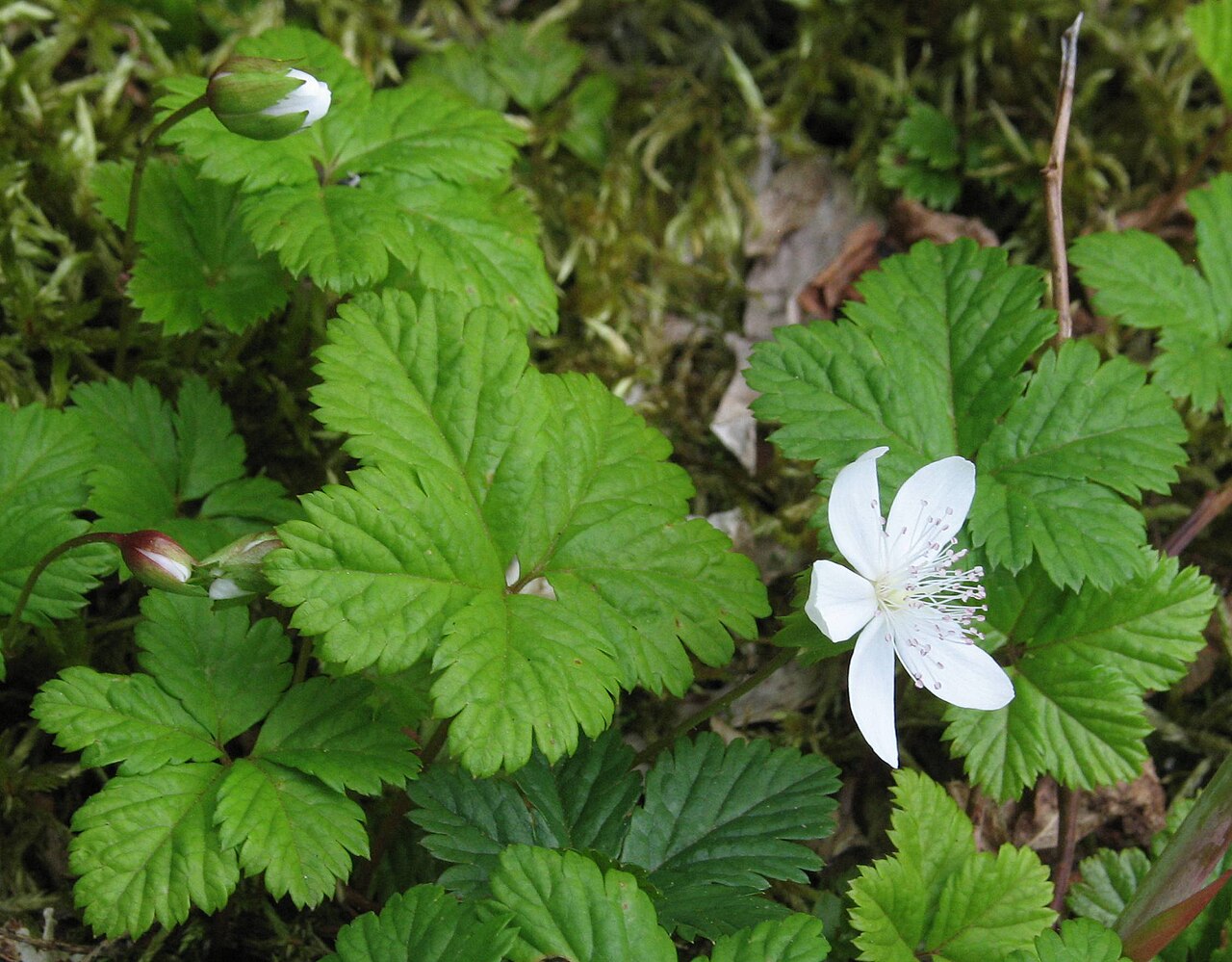
Rubus pedatus, known as Five-leaf Dwarf Bramble, strawberryleaf raspberry (the USDA name), creeping raspberry or five-leaved bramble, is a tiny, thornless, creeping relative of raspberries and blackberries. It spreads across mossy forest floors on slender runners, with small leaves divided into five toothed leaflets, single white flowers in early summer, and a few juicy red drupelets in late summer.
It belongs to the rose family (Rosaceae). Unlike its prickly relatives, it is a soft, ground-hugging plant only a few inches tall, which grows among mosses in cool, moist coniferous forests. The species name pedatus means “like a bird’s foot”, describing the way the leaflets spread from the top of the leaf stalk.
Five-leaf dwarf bramble is native to Alaska, western Canada and the northern Rocky Mountains and Pacific Northwest of the United States, and it also grows in Japan and the Russian Far East. This guide covers how to identify it, where it grows, how to grow it as a woodland groundcover, and its value to wildlife.
Identification
Five-leaf dwarf bramble is easy to overlook until it flowers. Look for small, bright green leaves with five sharply toothed leaflets scattered through moss in shady, damp conifer forests, often with runners trailing between them.
Growth Habit
It is a small, herbaceous to slightly woody perennial, usually only 1 to 4 inches tall, with long, slender, creeping stems (stolons) that root at the nodes. These runners can form loose mats many feet across. The stems have no prickles.
Leaves
The leaves arise singly or in small groups from the runners on long stalks. Each leaf is divided into three leaflets, but the two side leaflets are split nearly to the base, so the leaf appears to have five leaflets. The leaflets are about 1/2 to 1 1/2 inches long, wedge-shaped to oval, with coarsely toothed edges. They often turn red or bronze in fall.
Flowers
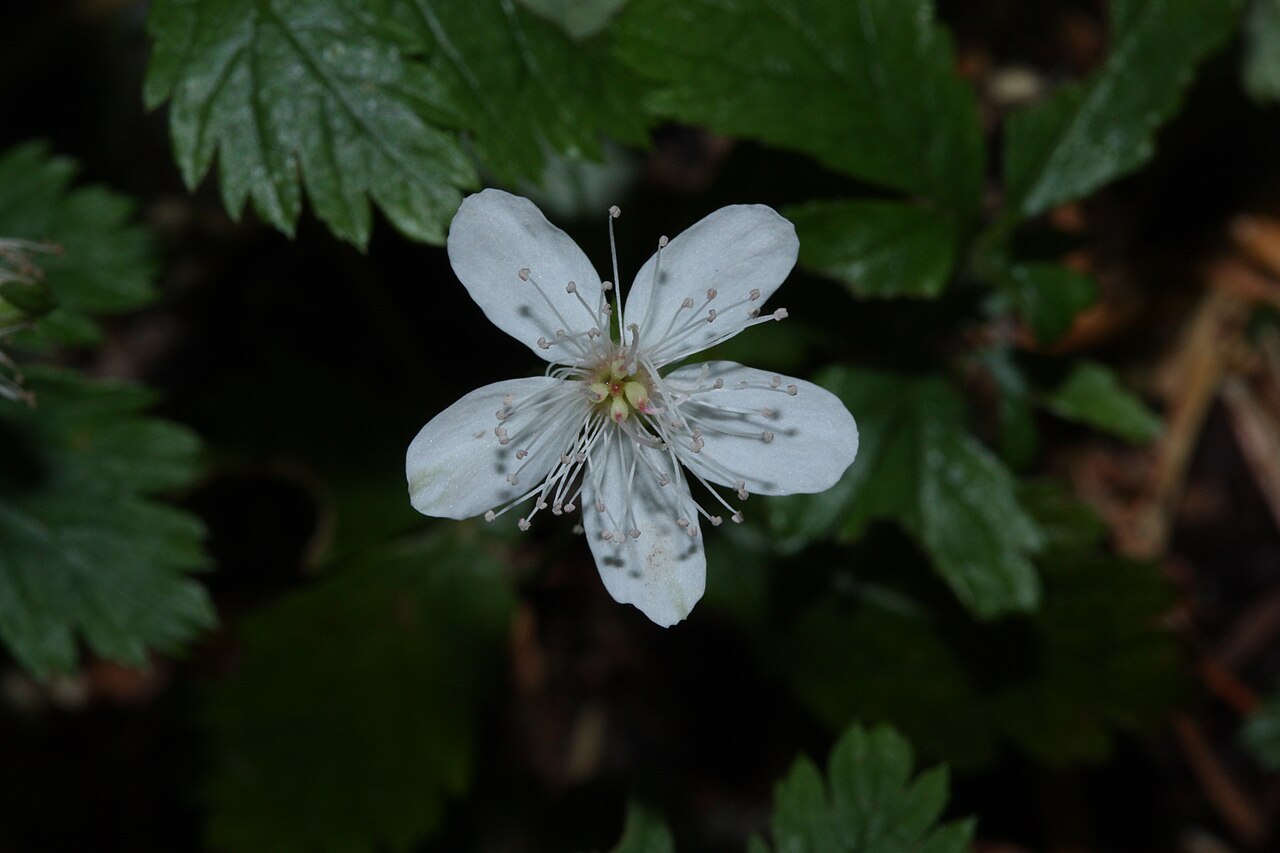
The flowers are borne singly on slender stalks above the leaves. Each is about 1/2 to 3/4 inch across, with five white, narrow, often spreading or slightly bent-back petals and many stamens. Bloom time is mainly June to August, depending on elevation and latitude.
Fruit & Seeds
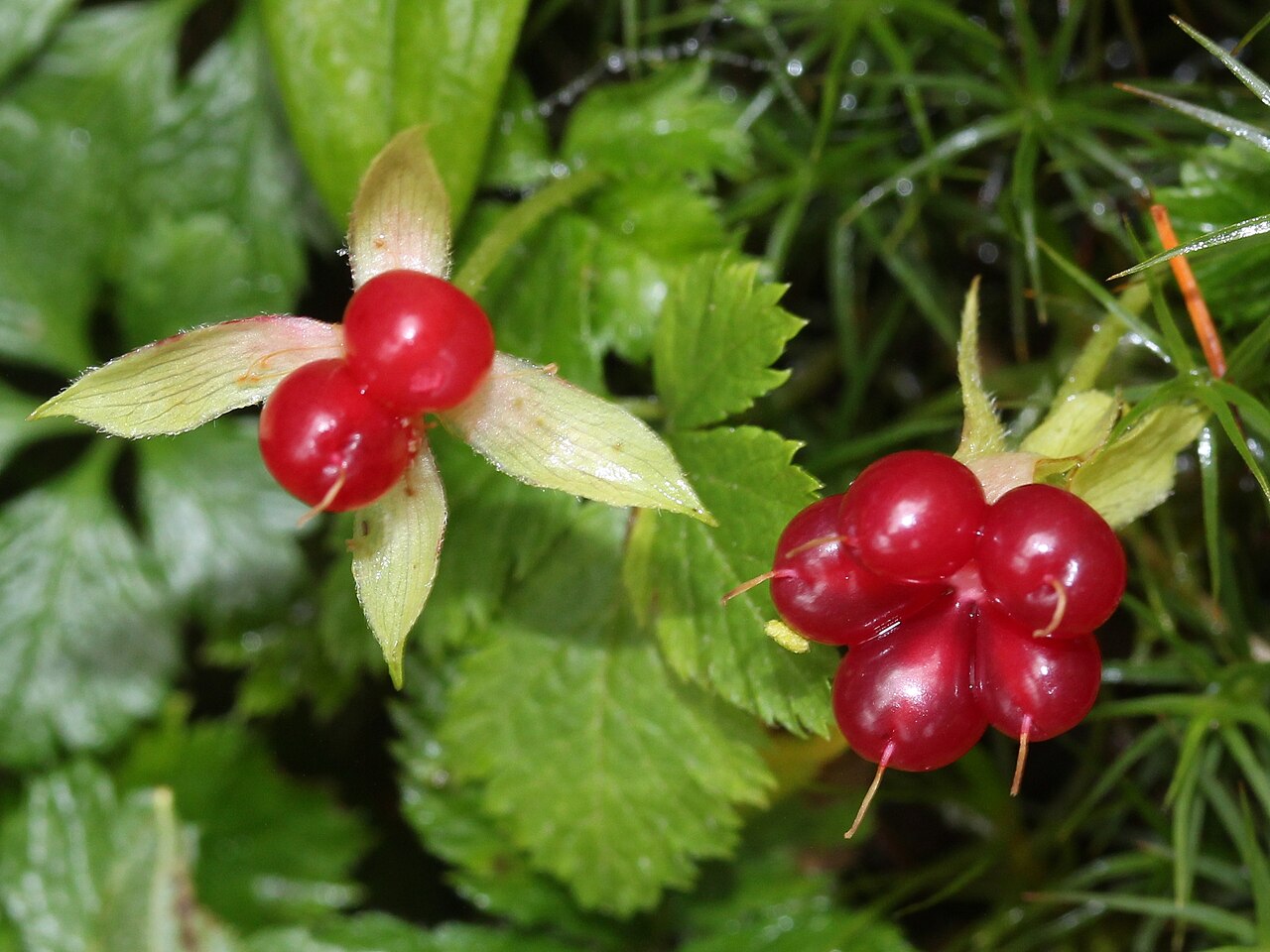
The fruit is a small cluster of one to six glossy, bright red drupelets, much smaller than a raspberry, ripening from late July to September. The drupelets are juicy and edible, with a pleasant raspberry flavor, but there are rarely enough to make a meal.
Look-alikes
Dwarf bramble (Rubus lasiococcus) has leaves with three shallow lobes rather than five leaflets and hairy fruits. Strawberries have three leaflets and fruits with seeds on the outside. Goldthread has shiny, three-parted leaves and different white flowers.
Quick Facts
| Scientific Name | Rubus pedatus Sm. |
| Family | Rosaceae (rose family) |
| Plant Type | Creeping perennial groundcover (subshrub) |
| Mature Height | 1–4 in |
| Mature Spread | 1–3 ft or more by runners |
| Growth Rate | Slow to moderate |
| Sun Exposure | Part shade to full shade |
| Water Needs | Medium to high; constantly moist soil |
| Soil Type | Moist, humus-rich, acidic forest soils and moss mats; well-drained but not dry |
| Soil pH | About 4.5–6.0 (acidic) |
| Bloom Time | June–August |
| Flower Color | White |
| Fall Color | Leaves turn red to bronze |
| Fruit | Small cluster of 1–6 red, edible drupelets |
| Deer Resistant | Not well documented; low and easily overlooked |
| USDA Hardiness Zones | 2–7 |
Native Range
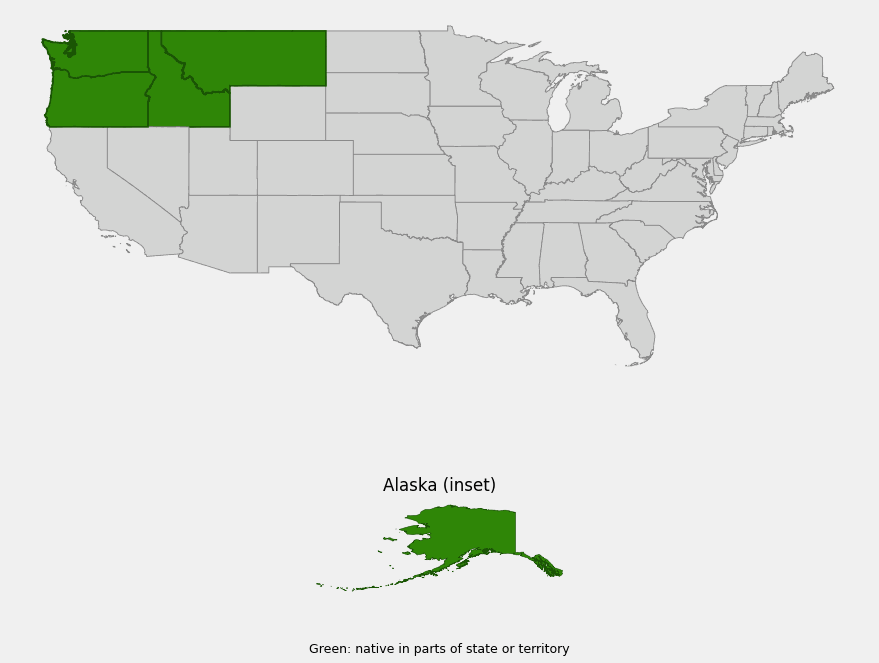
Five-leaf dwarf bramble is native to northwestern North America and northeastern Asia. USDA PLANTS lists it in Alaska, Washington, Oregon, Idaho and Montana, and in British Columbia, Alberta and Yukon. Outside North America it grows in Japan and the Russian Far East.
In Alaska it is common in coastal and southern forests, including the Southeast and Southcentral regions and the Aleutian chain. In Washington and Oregon it grows in the Olympic Mountains, the Cascades and the Coast Range, mostly at middle to subalpine elevations, and it extends into northeastern Washington, northern Idaho and northwestern Montana in moist, inland cedar and hemlock forests.
It grows in cool, damp, shady places: moist coniferous forests of hemlock, fir, spruce and cedar, mossy stream banks, forest bogs and subalpine meadows and heath. It ranges from near sea level in Alaska and British Columbia to subalpine elevations in the mountains farther south.
📋 Regional plant lists featuring Five-leaf Dwarf Bramble: Idaho, Eastern Oregon & Eastern Washington · Montana & Wyoming · Alaska · Western Oregon & Western Washington
Growing & Care Guide
Five-leaf dwarf bramble is a charming, thornless groundcover for cool, shady woodland gardens, moss gardens and rock crevices in the Pacific Northwest and Alaska. It is not widely sold, but it is occasionally offered by native plant nurseries. It needs conditions close to those of its native forests: shade, cool temperatures, steady moisture and acidic, humus-rich soil.
Light
Plant it in part to full shade. Morning sun is fine in cool coastal gardens, but hot afternoon sun will scorch it.
Soil & Water
Grow it in moist, acidic soil rich in organic matter, such as decaying conifer needles, rotting wood or moss. Keep it evenly moist all year, especially in summer. It does not tolerate drought, heat or heavy clay.
Planting Tips
Plant it in spring or fall among mossy logs and stumps, at the base of conifers or along a shady path where its small flowers and berries can be seen up close. It mixes well with bunchberry, twinflower, foamflower, oak fern and other small woodland natives.
Pruning & Maintenance
No pruning is needed. Mulch lightly with conifer needles or leaf mold, and keep more vigorous groundcovers from overrunning it. It is best suited to cool-summer climates; in hot inland gardens it rarely thrives.
Propagation
The easiest method is to root runners: pin a runner to moist soil or moss, and once it has formed roots, cut it from the parent and transplant it. It can also be grown from seed taken from ripe drupelets, cleaned and given a period of cold, moist stratification before sowing.
Landscape Uses
- Woodland groundcover: a thornless, creeping plant for shady, moist forest gardens
- Moss and fern gardens: small leaves and white flowers among moss, logs and ferns
- Wildlife gardens: berries for birds and small mammals
- Edible landscaping: a few tasty red drupelets in late summer
- Forest restoration: a native understory plant for cool coniferous forests
Wildlife & Ecological Value
Although small, five-leaf dwarf bramble is a common part of the understory in northern and mountain forests, where its flowers and fruits are used by a variety of animals.
For Pollinators
The open white flowers offer pollen and nectar to small bees, flies and other insects active in cool forest understories in early summer.
For Birds
Grouse, thrushes and other ground-foraging birds eat the red drupelets. Birds also help disperse the seeds.
For Mammals
Small mammals such as voles, mice and chipmunks eat the fruits, and bears and deer may take the berries and leaves while foraging in the forest understory.
Ecosystem Role
Its creeping runners help bind the moss layer and forest litter on the ground. It is a typical plant of mature, moist coniferous forests, where it grows with other small understory plants such as bunchberry, twinflower and foamflower.
Cultural & Historical Uses
Several Indigenous peoples of the Pacific Northwest and Alaska ate the small berries when they found them, though they were usually too scarce to gather in quantity. Hikers today often enjoy them as a trailside snack in late summer; pick only a few and leave the rest for wildlife.
The species was described by the English botanist James Edward Smith in the early nineteenth century, based on specimens collected on the Northwest Coast during early European voyages of exploration. Its name pedatus refers to the bird’s-foot-like arrangement of its leaflets.
Its many common names, including strawberryleaf raspberry, creeping raspberry, trailing raspberry and five-leaved bramble, reflect the plant’s combination of strawberry-like runners and leaves with raspberry-like fruits.
Frequently Asked Questions
Are five-leaf dwarf bramble berries edible?
Yes. The small red drupelets are edible and taste like raspberries, but each plant produces only a few, so there are rarely enough to gather.
Does five-leaf dwarf bramble have thorns?
No. Unlike most raspberries and blackberries, it is a soft, thornless, creeping plant only a few inches tall.
Where does five-leaf dwarf bramble grow?
It grows in moist, mossy coniferous forests and subalpine meadows from Alaska and Yukon south to Oregon, Idaho and Montana, and also in Japan and the Russian Far East.
Can I grow five-leaf dwarf bramble in my garden?
Yes, in cool, shady gardens with constantly moist, acidic, humus-rich soil. It struggles in hot, dry or sunny sites.
How do I propagate five-leaf dwarf bramble?
The easiest way is to root its runners in moist soil or moss and then separate them. It can also be grown from cold-stratified seed.

Looking for a nursery that carries Five-leaf Dwarf Bramble?
Browse our native plant nursery directory: Alaska · Idaho · Montana · Oregon · Washington

