
Herbwilliam (Ptilimnium capillaceum)
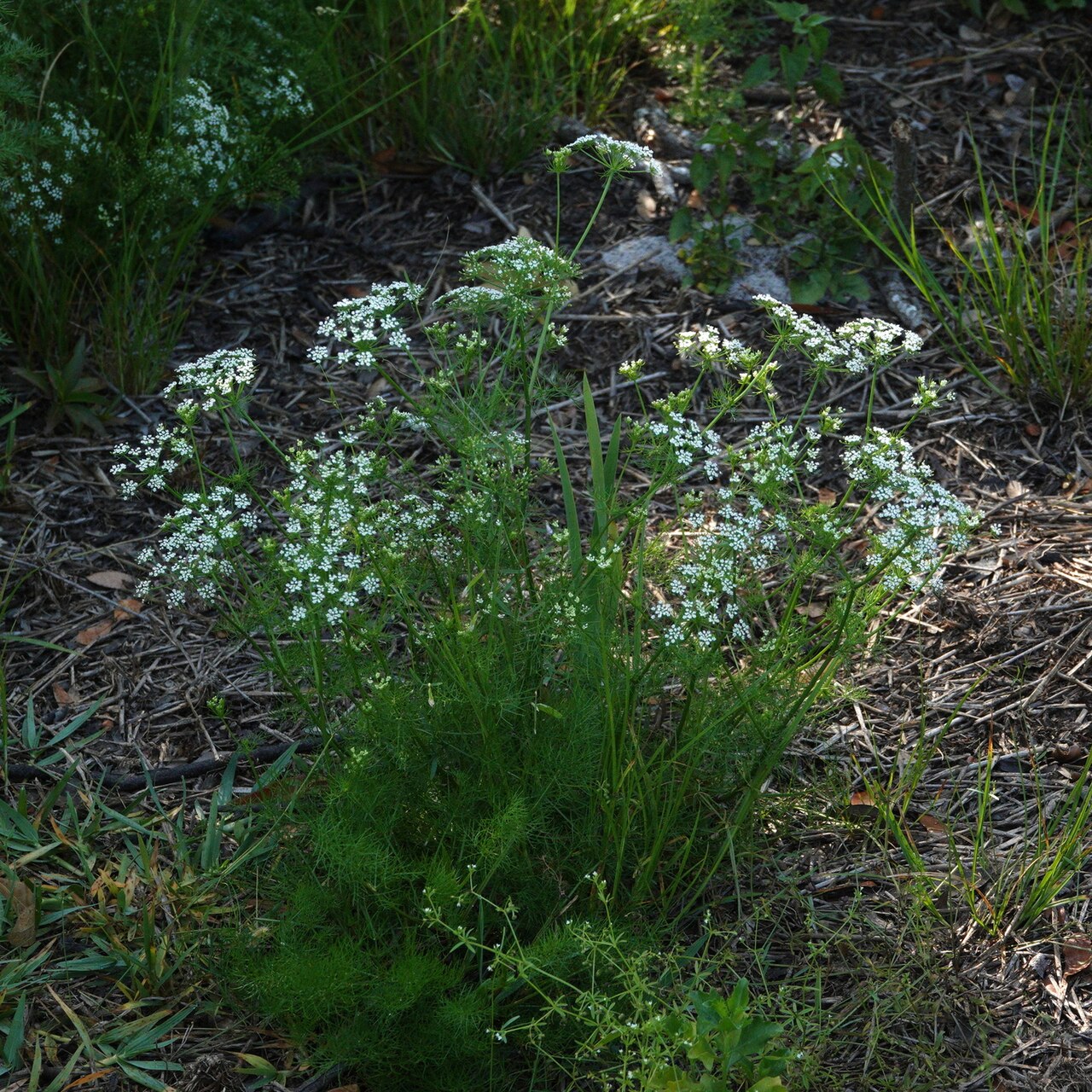
Ptilimnium capillaceum, known as Herbwilliam and also as mock bishopweed or thread-leaf mock bishopweed, is a delicate native annual of wet places in the eastern and south-central United States and Puerto Rico. It belongs to the carrot family (Apiaceae) and looks like a miniature, airy version of Queen Anne’s lace: slender stems with leaves cut into hair-fine segments carry small, lacy umbels of tiny white flowers from late spring through fall.
Herbwilliam grows in freshwater and brackish marshes, wet ditches, pond and lake margins, wet pine flatwoods and tidal shores, from Massachusetts and Rhode Island south to Florida and west to Texas, Oklahoma and Arkansas. It often grows in large numbers, sprinkling wet meadows with a white haze.
Although it is rarely sold, it is easy to grow from seed in wet, sunny spots, rain gardens and pond edges, where it self-sows. It feeds many small pollinators and is a host plant for black swallowtail caterpillars. Because some members of the carrot family, such as water hemlock, are deadly poisonous, never eat wild plants of this family.
Identification
Look in wet, sunny ground for a slender annual with leaves divided into thread-like segments and small, flat-topped clusters of tiny white flowers on wiry stems.
Growth Habit
Herbwilliam is an annual, usually 6 inches to 3 feet tall, with a single slender, smooth, hollow stem that branches in its upper part. Plants growing in the open become bushy, while those in dense marsh vegetation are tall and sparse. The plant is hairless throughout and has a faint carrot-like scent when crushed.
Leaves
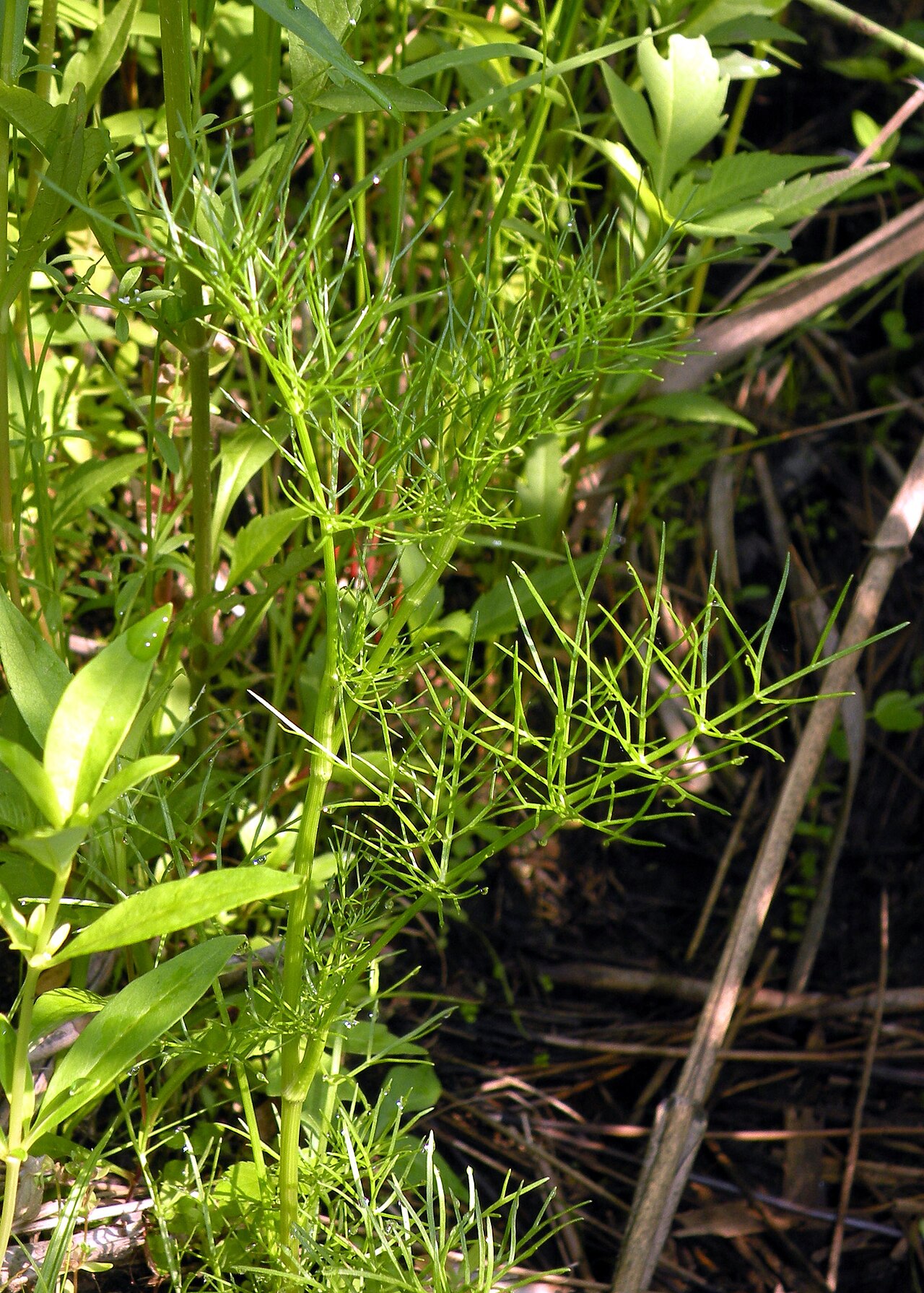
The leaves are alternate and finely divided, pinnately cut into many thread-like segments only about 1/32 inch wide and up to an inch or more long. They look feathery, almost like dill or fennel. The lower leaves have a short, sheathing stalk; the upper ones are smaller and stalkless.
Flowers
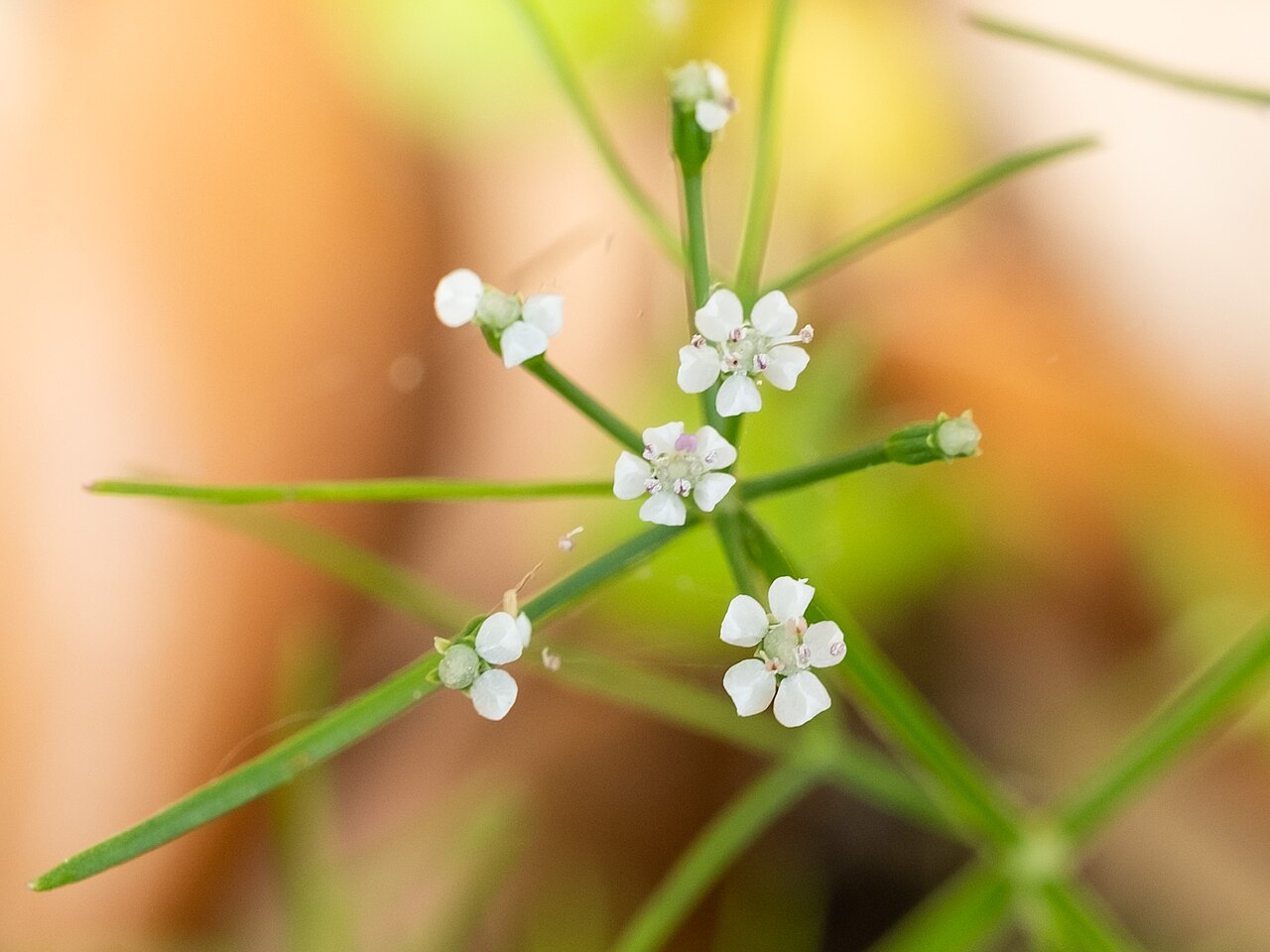
The flowers are tiny, about 1/8 inch across, with five white petals and five stamens. They are grouped in small umbels, which are in turn grouped into compound umbels about 1/2 to 2 inches across with 5 to 20 thin rays. Below each compound umbel is a ring of bracts that are divided into thread-like segments, a useful identification feature. Flowering runs from about May to September in most of the range, and nearly year-round in Florida and Puerto Rico.
Fruit
The fruits are small, egg-shaped, ridged schizocarps about 1/16 to 1/8 inch long, with pale, slightly corky lateral ribs. They split into two one-seeded halves that can float, helping the plant spread along shores and ditches.
Look-alikes
Nuttall’s mock bishopweed (Ptilimnium nuttallii) grows farther west and has bracts that are not divided. Water hemlock (Cicuta maculata), which grows in similar wet places, is much larger, with broader, toothed leaflets and a thick, chambered base; it is extremely poisonous. Introduced bishop’s weed (Ammi majus) has larger, coarser umbels. Fennel and dill have yellow flowers.
Quick Facts
| Scientific Name | Ptilimnium capillaceum |
| Family | Apiaceae (carrot family) |
| Plant Type | Annual wildflower (wetland) |
| Mature Height | 6 in–3 ft |
| Mature Spread | 6–12 in |
| Growth Rate | Fast |
| Sun Exposure | Full sun to part shade |
| Water Needs | High; wet to moist soil |
| Soil Type | Wet sand, muck, silt or clay; fresh to slightly brackish |
| Soil pH | Acidic to neutral (about 5.0–7.5) |
| Bloom Time | May–September (nearly all year in Florida) |
| Flower Color | White |
| Fall Color | None notable (annual) |
| Fruit | Small ribbed schizocarp |
| Deer Resistant | Moderate |
| USDA Hardiness Zones | 5–11 (grown as an annual) |
Native Range
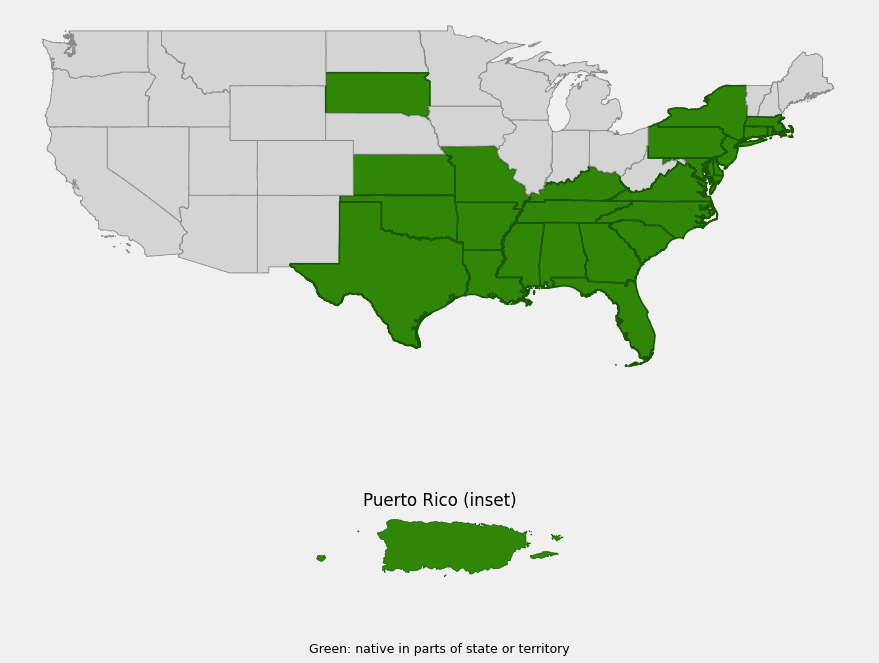
Herbwilliam is native to the eastern and south-central United States and Puerto Rico. USDA PLANTS records it from 24 states. It is most common on the Atlantic and Gulf Coastal Plains, from New Jersey, Delaware and Maryland south through the Carolinas and Georgia to Florida and west through Alabama, Mississippi and Louisiana to eastern Texas. Along the Atlantic coast it reaches north to New York, Connecticut, Rhode Island and Massachusetts, where it grows mainly near the coast, including Cape Cod.
Inland it extends through Tennessee, Kentucky and Arkansas to southeastern Missouri, eastern Oklahoma and southeastern Kansas, where herbarium records are scattered. In Texas it is most frequent in the east but also reaches central and south-central Texas, around San Antonio and the Coastal Bend. USDA also lists South Dakota, but this is an outlying record far from the rest of the range, with few if any specimens to support it.
Its habitats are freshwater and brackish marshes, wet meadows and savannas, wet pine flatwoods, ditches, swales, the edges of ponds, lakes and streams, and the upper edges of tidal marshes. It favors open, disturbed wet ground and often appears in large numbers after flooding or fire.
📋 Regional plant lists featuring Herbwilliam: New York, Pennsylvania & Northern New Jersey · Kentucky & Tennessee · Nebraska, Kansas & Eastern Colorado · Connecticut, Massachusetts & Rhode Island · New Hampshire, Maine & Vermont · Maryland, Virginia & West Virginia · Delaware, Southern New Jersey & Long Island · Illinois, Iowa & Missouri · Alabama, Georgia & Mississippi · North & South Florida · Puerto Rico · North & South Carolina · Arkansas, Louisiana, Eastern Oklahoma & Eastern Texas · South & West Texas
Growing & Care Guide
Herbwilliam is an easy annual for wet, sunny places. It is rarely sold as plants, but seed is occasionally offered by native seed suppliers in the Southeast, and once established it reseeds on its own.
Light
Full sun to light shade. It flowers most heavily in full sun, and in shade it becomes tall and sparse.
Soil & Water
It needs consistently moist to wet soil and tolerates shallow standing water for part of the year, as well as slightly brackish conditions near the coast. Sand, muck, silt or clay are all fine. It does poorly in dry garden beds.
Planting Tips
Sow seed in fall or late winter on bare, moist soil at the edge of a pond, rain garden, bioswale or wet meadow, pressing it into the surface. Seedlings appear in spring (or in winter in Florida). Plant it among taller wetland perennials, where its fine texture fills gaps.
Pruning & Maintenance
No pruning is needed. Leave plants standing until the seeds have dropped if you want it to return the next year. Keep some bare, moist soil available for seedlings, since dense mulch or turf prevents reseeding.
Propagation
By seed. Collect the small, ribbed fruits when they turn brown and sow them fresh outdoors, or store them dry and sow in late winter. A period of cold, moist conditions improves germination in northern areas.
Landscape Uses
- Rain gardens and bioswales: a fine-textured annual for the wettest zone
- Pond and stream edges: fills open, muddy margins with lacy white flowers
- Wet meadow restoration: a quick-growing native annual for disturbed wet ground
- Butterfly gardens: host plant for black swallowtail caterpillars
- Coastal gardens: tolerates slightly brackish soil near marsh edges
Wildlife & Ecological Value
Herbwilliam provides a long season of tiny flowers for small pollinators and food for swallowtail caterpillars in wetlands.
For Pollinators
The tiny, open flowers offer easily reached nectar and pollen to small native bees, wasps, flies and beetles. Like other members of the carrot family, it is especially attractive to small wasps and flies that are overlooked as pollinators.
For Birds
Its seeds are small and eaten only occasionally by seed-eating birds, but the insects it attracts are food for wrens, warblers and other marsh birds.
For Mammals
It is of minor value to mammals. Deer and rabbits may browse it lightly.
Ecosystem Role
As a member of the carrot family, herbwilliam can serve as a larval host for the black swallowtail butterfly. Its quick growth from seed lets it colonize newly exposed mud and disturbed wet soil, helping to hold soil until perennial wetland plants fill in.
Cultural & Historical Uses
The name herbwilliam is an old English plant name, and was also applied to the related bishop’s weed (Ammi), which explains the alternative name mock bishopweed for this native plant.
The genus name Ptilimnium is often explained as coming from the Greek for “feather” and “marsh,” a fitting description of a feathery-leaved marsh plant. The species name capillaceum means “hair-like,” referring to the thread-like leaf segments.
Several close relatives of herbwilliam are rare, including the federally endangered harperella (Ptilimnium nodosum) of Appalachian streams. Safety note: the carrot family includes some of the most poisonous plants in North America, such as water hemlock and poison hemlock. Do not eat herbwilliam or any wild plant of this family unless you are certain of its identity and edibility.
Frequently Asked Questions
Is herbwilliam an annual?
Yes. It grows from seed each year, flowers and dies, but it reseeds readily in wet, open ground.
Is herbwilliam the same as mock bishopweed?
Yes. Mock bishopweed and thread-leaf mock bishopweed are other common names for Ptilimnium capillaceum.
Is herbwilliam poisonous?
Its toxicity is not well known, but it grows alongside water hemlock, one of North America’s most poisonous plants. Do not eat any wild carrot-family plant.
Does herbwilliam attract butterflies?
Yes. Many small pollinators visit the flowers, and black swallowtail caterpillars can feed on the leaves, as on other members of the carrot family.
Where can I see herbwilliam?
Look in wet ditches, marsh edges, wet pine flatwoods and pond margins on the Atlantic and Gulf Coastal Plain from late spring through fall.

Looking for a nursery that carries Herbwilliam?
Browse our native plant nursery directory: Alabama & Arkansas · Connecticut, Delaware, Florida & Georgia · Kansas · Kentucky, Louisiana, Maryland, Massachusetts, Mississippi & Missouri · New Jersey, New York, North Carolina & Oklahoma · Pennsylvania, Rhode Island, South Carolina, South Dakota, Tennessee, Texas & Virginia

