
Whitestem Blazingstar (Mentzelia albicaulis)
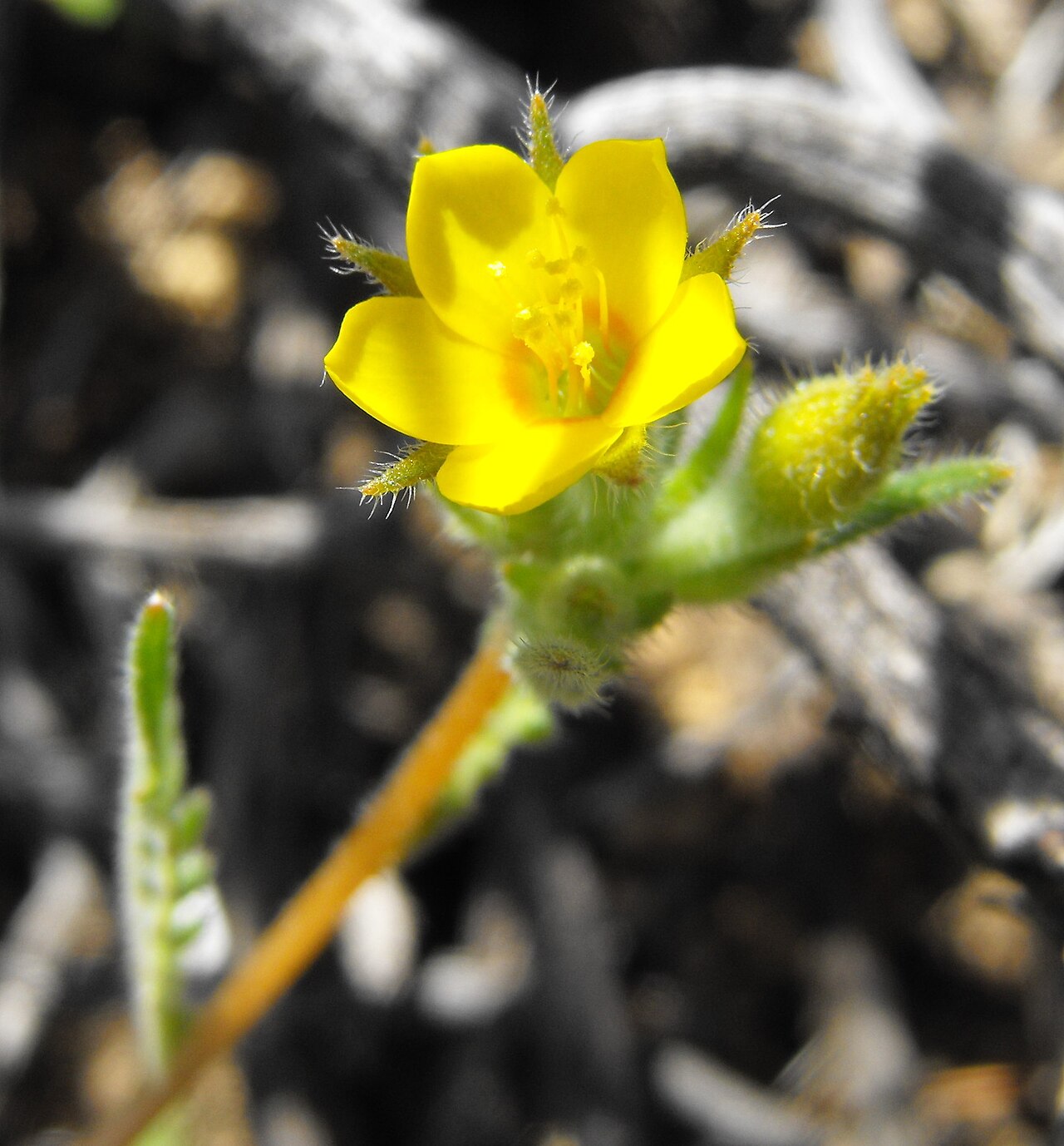
Mentzelia albicaulis, known as Whitestem Blazingstar, whitestem stickleaf or little blazingstar, is a small annual wildflower of the stickleaf or loasa family (Loasaceae). It is one of the most widespread and abundant spring annuals of the arid West, growing from southern British Columbia south through the Great Basin, Columbia Plateau, Colorado Plateau and Rocky Mountain basins to the Mojave and Sonoran deserts and northern Mexico.
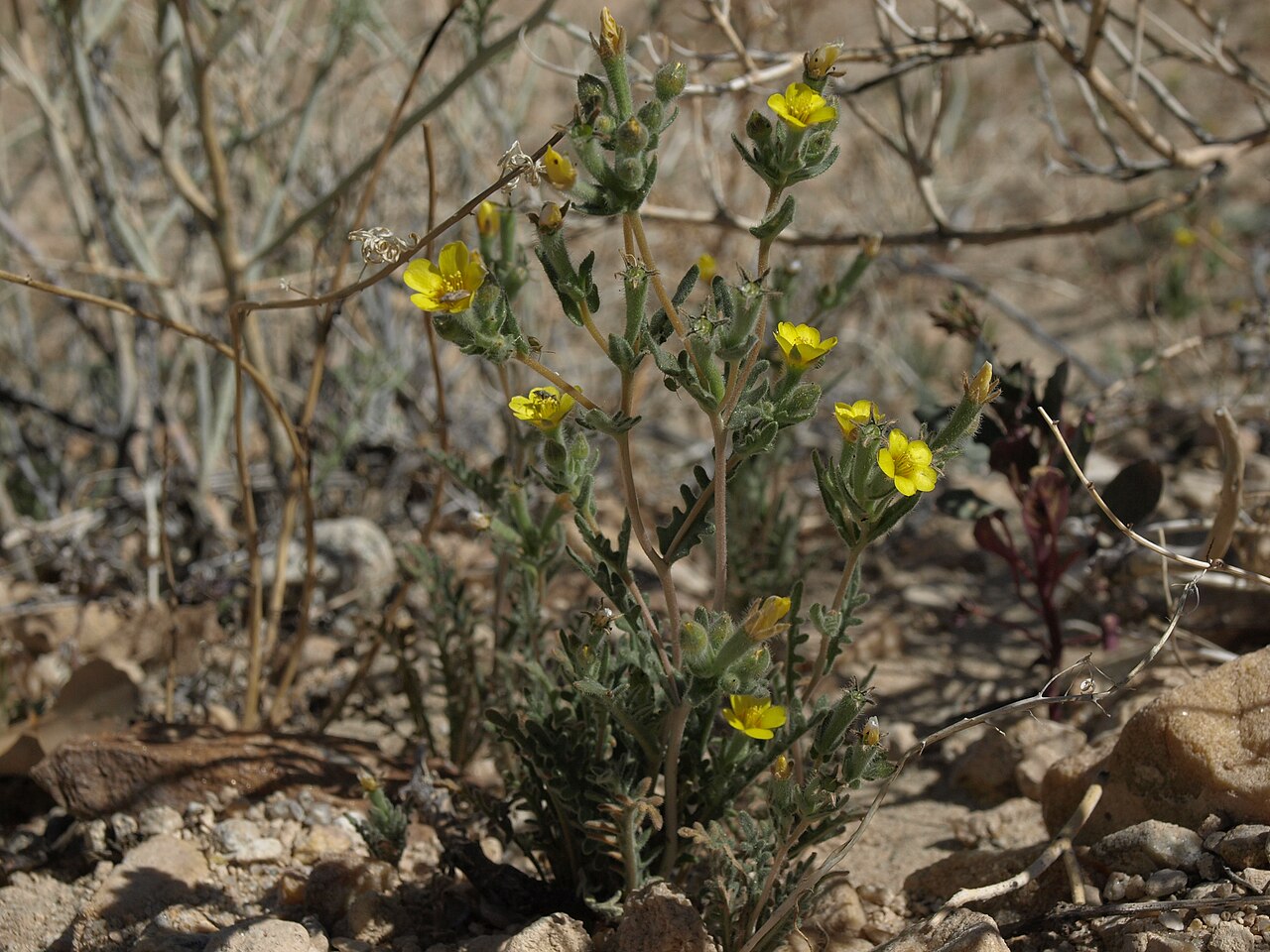
The plant is usually only 2 to 16 inches tall, with shiny, whitish stems (the source of its names) and narrow, deeply lobed leaves. Its small, glossy, bright yellow flowers, about 1/4 to 1/2 inch across, open in the sun. Like other stickleafs, the leaves and stems are covered with tiny barbed hairs that make the plant cling to clothing, fur and each other like Velcro.
Whitestem blazingstar grows in sandy and gravelly soils in sagebrush steppe, desert scrub, pinyon-juniper woodland and open, disturbed ground, often in great numbers after a wet winter. This guide covers how to identify it, where it grows, how to grow it from seed in a dry native garden, and its value to wildlife.
Identification
Whitestem blazingstar belongs to a group of small, yellow-flowered annual blazingstars that are hard to tell apart without a hand lens. In the field, look for a low annual with whitish, shiny stems, lobed, sticky-rough leaves and small, glossy yellow five-petaled flowers.
Growth Habit & Stems
It is a winter or spring annual that grows from a slender taproot. Plants range from a single small stem to a bushy, branched plant 2 to 16 inches tall, depending on moisture. The stems are smooth to finely hairy, shiny and white to pale straw-colored, often peeling slightly with age.
Leaves
The leaves are alternate, narrow, 1 to 4 inches long, and usually deeply cut into narrow, comb-like lobes, though upper leaves may be less lobed. They are gray-green and covered with tiny, stiff, barbed hairs that make them feel rough and cause them to stick to fabric. The bracts under the flowers are narrow and pointed.
Flowers
The flowers are borne singly or in small clusters at the ends of the branches. Each has five glossy, bright yellow petals, often orange at the base, and many yellow stamens, and is about 1/4 to 1/2 inch across. They open in sunshine, often in late morning or afternoon, and close in the evening. Bloom time runs from late winter in the low deserts to early summer in the northern sagebrush country.
Fruit & Seeds
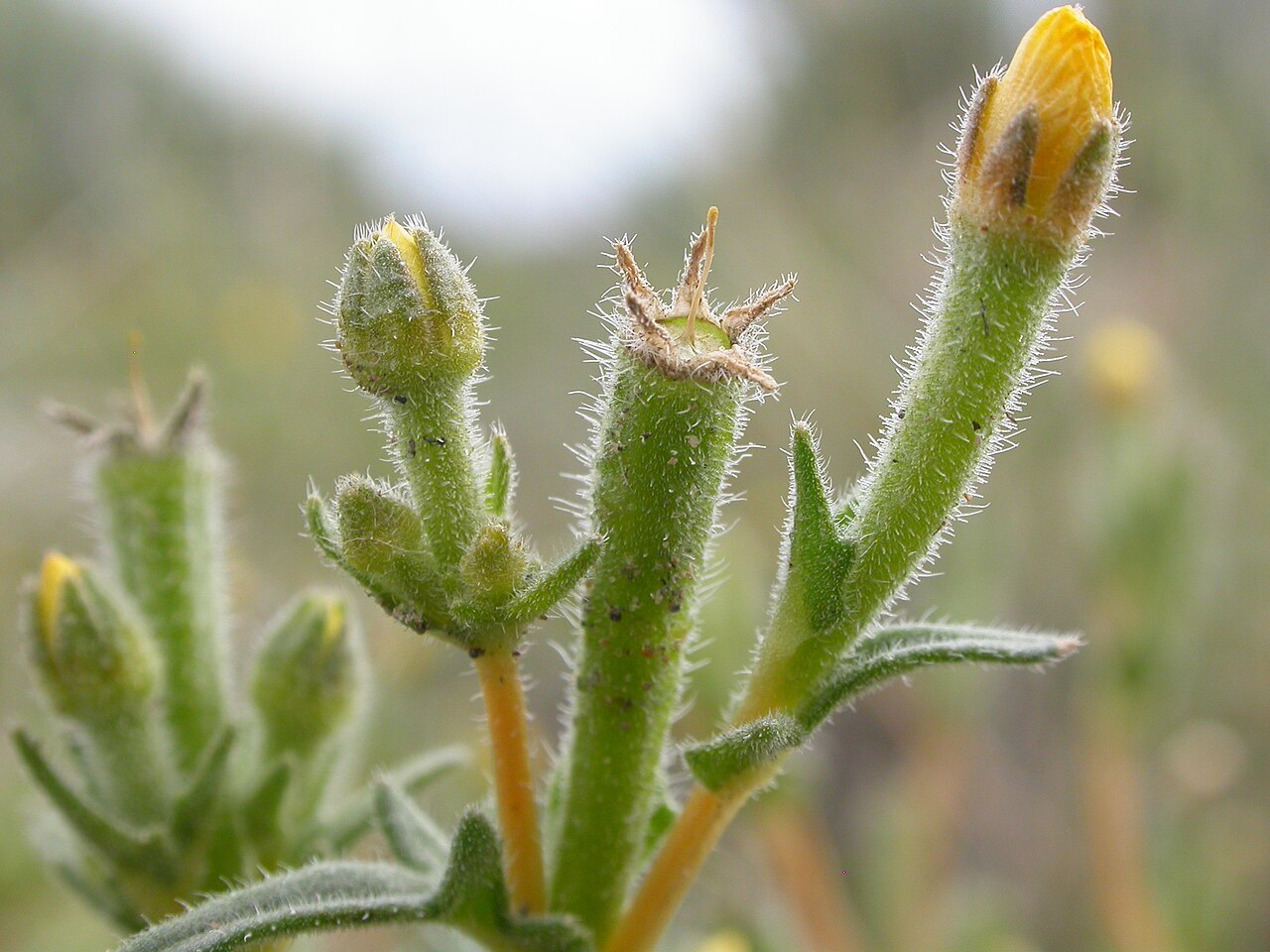
The fruit is a slender, cylindrical capsule about 1/2 to 1-1/4 inches long, covered with barbed hairs and topped by the persistent sepals. It contains many tiny, angular seeds arranged in rows; the seeds have a finely bumpy surface visible under magnification.
Look-alikes
Several other small annual blazingstars (Mentzelia section Trachyphytum) look very similar and are separated by seed details. The large perennial smoothstem blazingstar (Mentzelia laevicaulis) has big, pale yellow, star-shaped flowers several inches across. Chickenthief or stickleaf (Mentzelia oligosperma) is a perennial of the plains and Southwest with larger, more open flowers. Whitestem blazingstar’s small size, white stems and lobed leaves are good clues.
Quick Facts
| Scientific Name | Mentzelia albicaulis (Douglas ex Hook.) Douglas ex Torr. & A. Gray |
| Family | Loasaceae (stickleaf family) |
| Plant Type | Annual herb |
| Mature Height | 2–16 in |
| Mature Spread | 2–12 in |
| Growth Rate | Fast (annual) |
| Sun Exposure | Full sun |
| Water Needs | Very low; relies on winter and spring rain |
| Soil Type | Sandy, gravelly or rocky well-drained soils |
| Soil pH | About 6.5–8.5 |
| Bloom Time | March–July, depending on region and elevation |
| Flower Color | Glossy bright yellow |
| Fall Color | None; dies after setting seed |
| Fruit | Slender, bristly capsule with many tiny seeds |
| Deer Resistant | Yes; barbed hairs deter browsing |
| USDA Hardiness Zones | Annual; grows in zones 4–10 |
Native Range
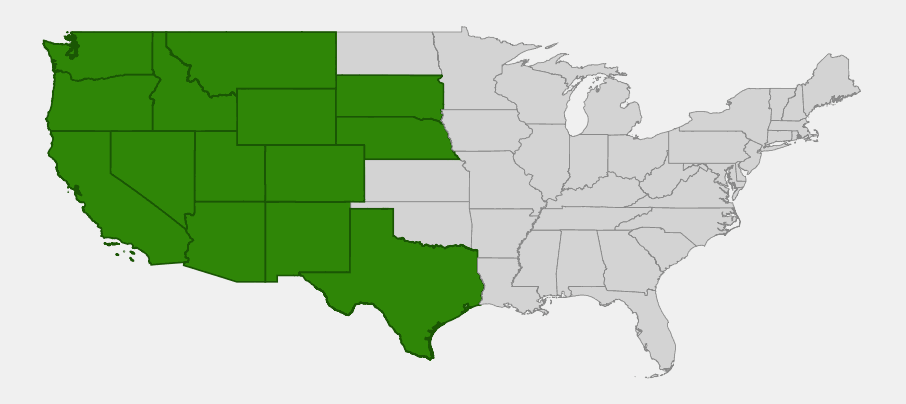
Whitestem blazingstar is native across the arid West. USDA PLANTS lists it in 14 states: Arizona, California, Colorado, Idaho, Montana, Nebraska, New Mexico, Nevada, Oregon, South Dakota, Texas, Utah, Washington and Wyoming. It also grows in southern British Columbia, and south into northern Mexico.
Its core range is the Great Basin, Columbia Plateau, Snake River Plain, Colorado Plateau and the Mojave and Sonoran deserts, including eastern Oregon and Washington, southern Idaho, Nevada, Utah, western Colorado, Arizona, New Mexico and much of eastern and southern California. At the eastern edge it reaches western Wyoming and Montana, and there are outlying records from the Nebraska panhandle (Scotts Bluff and Dawes counties), South Dakota and far western Texas around El Paso.
Typical habitats are open, dry, sandy or gravelly places: sagebrush steppe, desert scrub with creosote bush or blackbrush, Joshua tree and pinyon-juniper woodland, desert washes, dunes, burned areas and disturbed roadsides. It ranges from low desert valleys into the lower mountains.
📋 Regional plant lists featuring Whitestem Blazingstar: Idaho, Eastern Oregon & Eastern Washington · Montana & Wyoming · Nebraska, Kansas & Eastern Colorado · Utah & Western Colorado · Arizona & New Mexico · South & West Texas · North Dakota, South Dakota & Western Minnesota · California & Nevada
Growing & Care Guide
Whitestem blazingstar is rarely offered for sale, but it is easy to grow from seed in a dry, sunny garden within its range. It suits wildflower meadows, desert and sagebrush gardens, and restoration of dry, open ground, where it can reseed itself.
Light
Give it full sun. The flowers open only in bright light, and the plants become weak and leggy in shade.
Soil & Water
It needs well-drained sandy, gravelly or rocky soil and does best with little competition. Winter and spring rain is enough; do not water in summer, when the plants have finished their life cycle. Rich, moist soil encourages weeds that crowd it out.
Planting Tips
Sow seed on bare, open ground in fall so that winter moisture can trigger germination. Scatter the tiny seeds on the surface and press them in lightly, or mix them with sand for even spreading. Combine it with other annual and perennial wildflowers and bunchgrasses that share its dry conditions.
Pruning & Maintenance
No pruning is needed. Let the plants dry and drop their seed before tidying up. Wear gloves when handling the plants, since the barbed hairs cling to skin and clothing.
Propagation
It is grown only from seed. Collect the capsules when they turn tan in late spring or early summer and shake out the seeds. Store them dry and sow in fall. In the wild, germination varies greatly from year to year depending on winter rain, and seeds can remain dormant in the soil for several years.
Landscape Uses
- Desert and sagebrush gardens: bright spring flowers with no irrigation
- Wildflower meadows: a reseeding annual for dry, open ground
- Habitat restoration: an early colonizer of disturbed, sandy and gravelly soils
- Pollinator plantings: pollen and nectar for native bees in spring
- Rock and gravel gardens: a small, delicate annual among stones
Wildlife & Ecological Value
Whitestem blazingstar is a small plant, but in good years it blooms by the millions across the arid West, providing an important food source for spring insects and seed-eating animals.
For Pollinators
The glossy yellow flowers are visited by native bees, as well as flies and beetles. Because the flowers open in the warmth of the day, they are most active with insects from late morning onward.
For Birds
The tiny seeds are eaten by sparrows, finches and other ground-foraging birds, and quail and doves pick seeds from open ground.
For Mammals
Kangaroo rats, pocket mice and other desert rodents gather and cache the seeds. The barbed hairs make the foliage unpalatable to most browsers, and the plants hitch rides in animal fur.
Ecosystem Role
As a fast-growing annual, whitestem blazingstar quickly fills open ground between shrubs after wet winters and after fires, helping stabilize soil and adding to the seed bank that sustains desert and steppe wildlife in dry years.
Cultural & Historical Uses
The genus Mentzelia honors the 17th-century German botanist Christian Mentzel. The species name albicaulis means “white-stemmed”. The plant was collected by the Scottish botanist David Douglas on his travels in the Pacific Northwest in the 1820s and was formally published by John Torrey and Asa Gray.
The seeds of small annual blazingstars were an important food for many Native peoples of the Great Basin and the deserts. They were gathered with seed beaters and baskets, parched and ground into an oily meal. Today, the plants are best left for wildlife and for the next year’s bloom.
The common name “stickleaf” refers to the barbed hairs that make the leaves cling to clothing and fur, a dispersal strategy shared by many members of the loasa family.
Frequently Asked Questions
Why is it called whitestem blazingstar?
Its stems are shiny white or pale straw-colored, and its yellow flowers are a small version of the larger blazingstars. It is also called whitestem stickleaf and little blazingstar.
Why does it stick to my clothes?
The leaves, stems and capsules are covered with tiny barbed hairs that cling to fabric and fur like Velcro. This helps spread the seeds.
Is whitestem blazingstar an annual?
Yes. It germinates after fall and winter rains, blooms in spring or early summer and dies after setting seed.
Where does it grow?
Across the arid West from southern British Columbia to northern Mexico, especially in the Great Basin, Columbia Plateau, Colorado Plateau and the Mojave and Sonoran deserts, in sandy and gravelly soils.
Can I grow it in my garden?
Yes, in a dry, sunny spot with well-drained soil within its native range. Sow seed in fall on open ground and do not water in summer.

Looking for a nursery that carries Whitestem Blazingstar?
Browse our native plant nursery directory: Arizona · California · Colorado · Idaho · Montana · Nebraska, Nevada & New Mexico · Oregon · South Dakota, Texas & Utah · Washington · Wyoming

