
Slender Ladies’ Tresses (Spiranthes lacera)
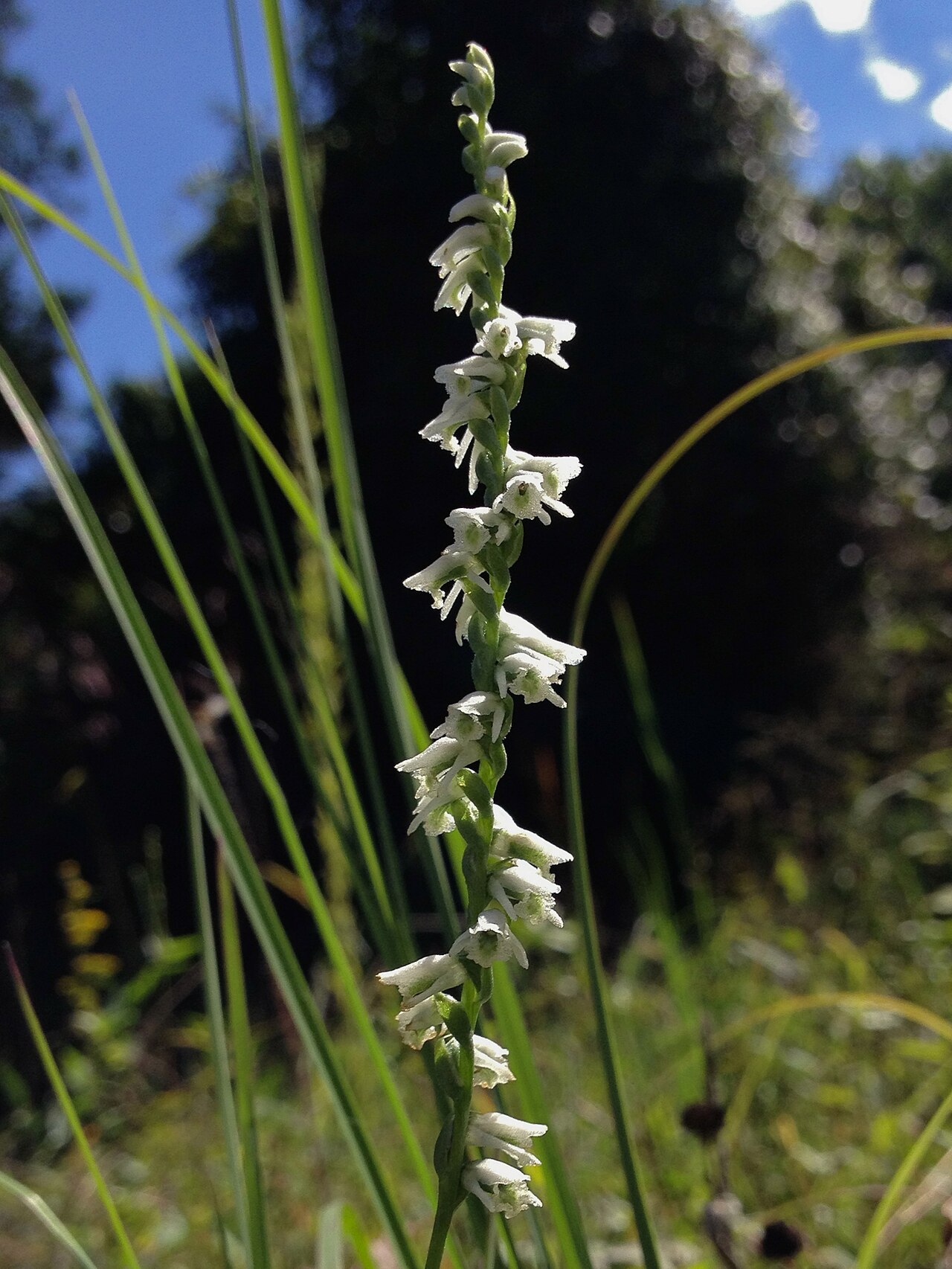
Spiranthes lacera, known as Slender Ladies’ Tresses, is a small native orchid of eastern North America. From mid to late summer it sends up a thin, wiry stem 8 to 24 inches tall, wrapped by a single tight spiral of tiny white flowers, each with a bright green spot in the center of its lip. It is one of the most widespread native orchids in the East, and one of the few that turns up in lawns, cemeteries, old fields and roadsides.
It ranges from the Maritime Provinces and southern Canada west to Saskatchewan and Alberta, and south through the eastern and central United States to Florida and East Texas. USDA PLANTS recognizes two varieties: the northern slender ladies’ tresses (var. lacera) of the North, and the southern slender ladies’ tresses (var. gracilis), a taller plant that is common from New England south to the Gulf Coast.
Like all orchids, it depends on soil fungi to germinate and grow, so it cannot be dug up and moved. Never dig slender ladies’ tresses from the wild: transplanted plants almost always die, and digging removes them from the places where they can survive. If you want this orchid, buy only lab-propagated plants from a reputable grower, or better still, protect any plants that already appear in your lawn or meadow.
Identification
Look in late summer for a very slender spike of small white flowers arranged in a single, neat spiral, each flower with a green center on its lip. The leaves are often gone by flowering time.
Growth Habit
Slender ladies’ tresses is a perennial terrestrial orchid that grows from a small cluster of fleshy, tuberous roots. Each year it produces a small rosette of leaves and, in mature plants, a single slender, green flowering stem 8 to 24 inches tall (sometimes taller in the South). Plants can be dormant or produce only leaves for one or more years, so the number of flowering stems in a colony changes from year to year.
Leaves
The basal leaves are small, oval to broadly egg-shaped, about 1/2 to 2 inches long, and lie close to the ground in a small rosette. They usually wither by the time the plant flowers, especially in the southern variety, so most flowering plants look leafless apart from a few small, sheathing bracts on the stem. New leaves appear again in fall and remain through winter or spring.
Flowers
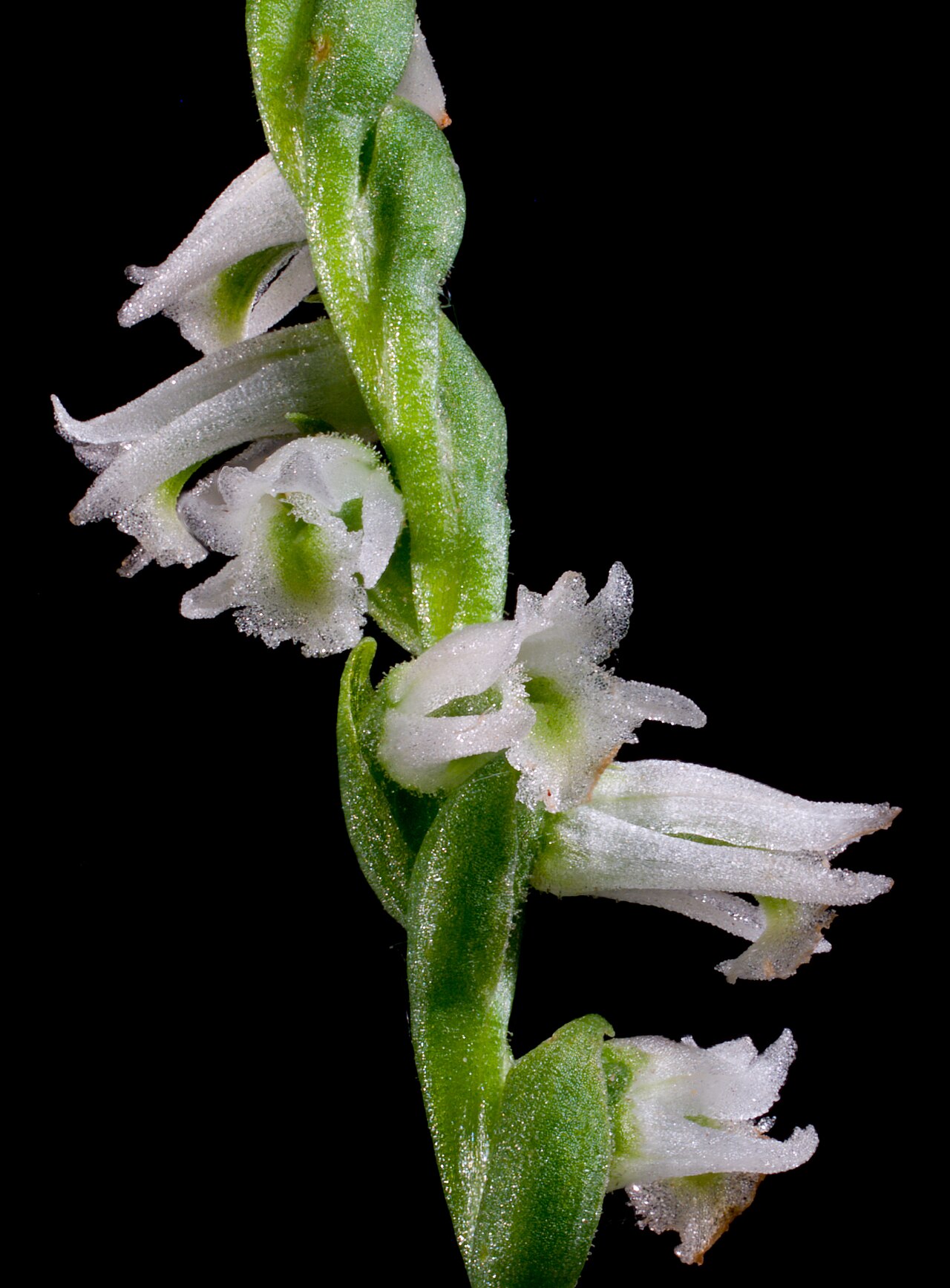
The flowers bloom from July to September in the North and from August into October in the South. They are small, about 1/4 inch long, white and tubular, with a downward-curving lip whose edge is wavy and finely torn or fringed (the meaning of the species name lacera). The center of the lip has a distinct green spot or stripe. The flowers are arranged in a single row that spirals tightly around the slender stem, so the spike looks like a twisted braid. Flowers open from the bottom of the spike upward. The stem and the upper part of the spike are usually smooth or nearly so.
Fruit & Seeds
Each pollinated flower forms a small, upright capsule that splits in fall to release thousands of dust-like seeds. The seeds carry almost no food reserves and can germinate only with the help of specific soil fungi, which supply nutrients to the young plant.
Look-alikes
Several other ladies’ tresses grow in the same areas. Little ladies’ tresses (Spiranthes tuberosa) is also leafless at flowering but has pure white flowers with no green on the lip. Nodding ladies’ tresses and Great Plains ladies’ tresses have larger, creamy flowers in several spiral rows, bloom later in fall, and lack the green lip spot. Spring ladies’ tresses blooms earlier in summer, has grass-like leaves at flowering, and has a hairy spike with a yellowish center to the lip.
Quick Facts
| Scientific Name | Spiranthes lacera |
| Family | Orchidaceae (orchid family) |
| Plant Type | Perennial terrestrial orchid |
| Mature Height | 8–24 in |
| Mature Spread | 2–4 in |
| Growth Rate | Slow |
| Sun Exposure | Full sun to part shade |
| Water Needs | Low to moderate; dry to moist soil |
| Soil Type | Sandy, gravelly or thin loam, often poor |
| Soil pH | Acidic to neutral (about 5.0–7.0) |
| Bloom Time | July–October |
| Flower Color | White with a green center on the lip |
| Fall Color | None notable |
| Fruit | Small capsules of dust-like seeds |
| Deer Resistant | Low |
| USDA Hardiness Zones | 3–9 |
Native Range
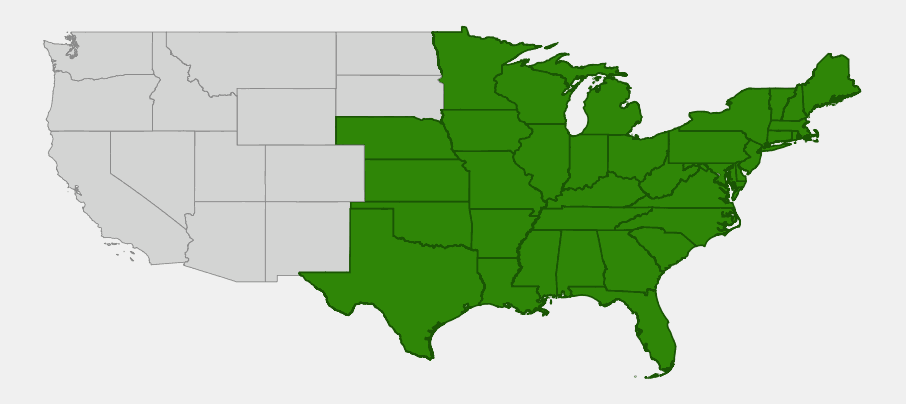
Slender ladies’ tresses is native to eastern and central North America. In the United States, USDA PLANTS lists it from 35 states, from Maine to Minnesota and south to Florida, Louisiana and East Texas, including Kansas, Nebraska and Oklahoma on the western edge of its range. In Canada it grows from Nova Scotia, New Brunswick and Prince Edward Island west through Quebec and Ontario to Manitoba, Saskatchewan and Alberta.
The northern variety (var. lacera) grows mainly in the Great Lakes states, New England and southern Canada, often in sandy jack pine and oak openings and dry meadows. The southern variety (var. gracilis) is common across the Southeast and the Atlantic and Gulf Coastal Plains, west to the Ozarks and the eastern edges of the Great Plains, and north into the Midwest and New England, where the two varieties overlap.
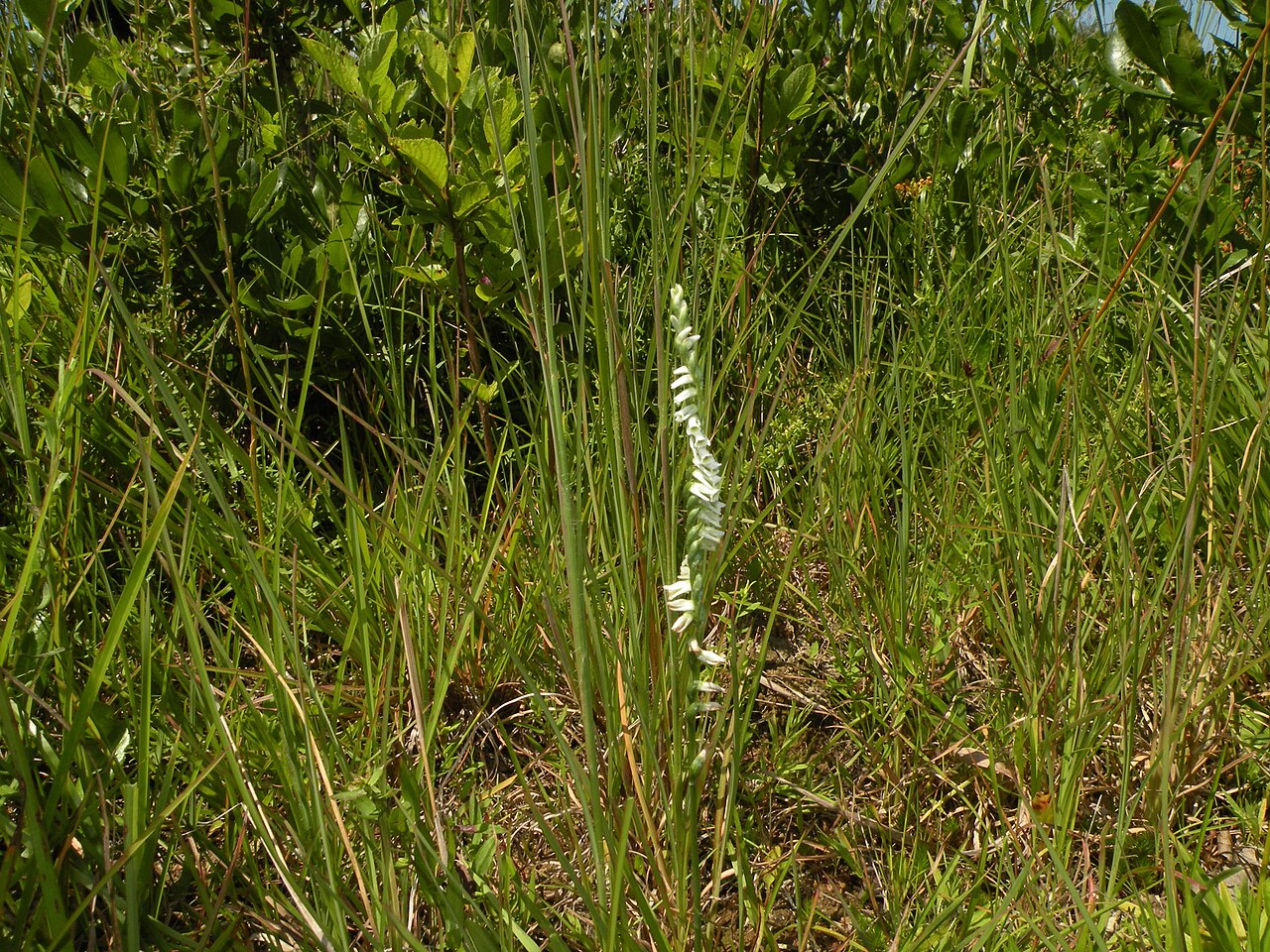
It favors open, sunny places with sparse vegetation and thin, often sandy or gravelly, acidic soil: dry to moist meadows, old fields, pine and oak barrens, glades, prairies, sandy roadsides and powerline cuts. It is well known for appearing in unfertilized lawns, cemeteries and churchyards that are mowed regularly, where the short grass keeps taller plants from shading it out.
📋 Regional plant lists featuring Slender Ladies’ Tresses: New York, Pennsylvania & Northern New Jersey · Ohio & Indiana · Michigan, Wisconsin & Eastern Minnesota · Kentucky & Tennessee · Nebraska, Kansas & Eastern Colorado · Connecticut, Massachusetts & Rhode Island · New Hampshire, Maine & Vermont · Maryland, Virginia & West Virginia · Delaware, Southern New Jersey & Long Island · Illinois, Iowa & Missouri · Alabama, Georgia & Mississippi · North & South Florida · North & South Carolina · Arkansas, Louisiana, Eastern Oklahoma & Eastern Texas
Can You Grow It?
Slender ladies’ tresses is a native orchid, and it is best appreciated where it already grows. It needs specific soil fungi, so it is very difficult to establish in a garden, and plants dug from the wild almost never survive. Never dig it from the wild. If you want to try growing it, buy only plants propagated from seed in a laboratory by a reputable native orchid grower, and ask the seller how the plants were produced.
Light
Full sun to light shade. In the wild it disappears when shrubs and trees close in, so it needs an open site with short, sparse vegetation.
Soil & Water
It grows in lean, well-drained to seasonally moist, sandy, gravelly or thin, acidic soil. Rich, fertilized garden soil favors competing plants and is not suitable. Established plants need no watering, and the plant tolerates dry summers by going dormant after flowering.
Planting Tips
Lab-propagated plants are sometimes offered by specialty orchid nurseries. Plant them in a sunny, sparse meadow, a native lawn or a sandy, low-fertility bed with low grasses, not in a crowded perennial border. Do not fertilize or use herbicides nearby, as both can harm the plant and the fungi it depends on.
Pruning & Maintenance
The best way to grow this orchid is often to protect a colony that appears on its own. If ladies’ tresses come up in your lawn, stop mowing that patch from midsummer until the seed capsules split in fall, and mark the spot so the plants are not mowed or trampled. Regular mowing at other times of year is fine and keeps the grass short and open, which is the reason it thrives in lawns and cemeteries.
Propagation
It cannot be propagated by division in a home garden, and it must never be dug from the wild. Seed germination requires laboratory techniques or the right soil fungi. Letting plants set seed where they already grow is the best way to help a colony spread.
Where to See It & How to Protect It
- Old fields and meadows: look in sunny, sparse, grassy places in late summer
- Lawns and cemeteries: it often appears in unfertilized, regularly mowed turf
- Barrens and glades: sandy pine and oak barrens and rocky glades
- Protecting a colony: pause mowing from midsummer until the seeds are shed
- Native lawns: avoid fertilizers and herbicides where orchids appear
Wildlife & Ecological Value
Ladies’ tresses flower late in the season, when bumblebees are still busy and many other flowers have faded.
For Pollinators
The flowers are pollinated mainly by bumblebees and other long-tongued bees, which land at the bottom of the spike and work upward. Because the youngest flowers at the top produce pollen and the older lower flowers are ready to receive it, this habit helps carry pollen from one plant to another.
For Birds
The plant is too small to be an important food for birds, but the open, grassy habitats it needs also support ground-nesting and seed-eating birds.
For Mammals
Deer, rabbits and other herbivores sometimes nibble the flowering stems. Small mammals have little interest in the tiny, dry seeds.
Ecosystem Role
Slender ladies’ tresses depends on mycorrhizal fungi in the soil, especially as a seedling, when the fungus supplies all its food. Its presence is a sign of an open, low-fertility habitat with healthy soil fungi. It is a pioneer of open ground and often appears in young meadows and old fields, then fades as shrubs and trees move in.
Cultural & Historical Uses
The genus name Spiranthes comes from the Greek speira, a coil, and anthos, a flower, describing the spiral flower spike. The species name lacera means “torn” and refers to the ragged, finely fringed edge of the lip.
“Ladies’ tresses” compares the twisted flower spike to a braid of hair. The name is shared by about two dozen Spiranthes species in North America, several of which are hard to tell apart.
Because it grows in mowed lawns and cemeteries, slender ladies’ tresses is one of the native orchids most often found by people who are not looking for orchids at all. Many colonies survive in old churchyards and lawns that have been mowed for decades without fertilizer or herbicide.
Frequently Asked Questions
Can I dig up slender ladies’ tresses and move it to my garden?
No. Never dig it from the wild. Like all native orchids, it depends on soil fungi, and transplanted plants almost always die. Digging native plants is also illegal on public land and without the landowner’s permission. Buy only lab-propagated plants, if any.
Why are there orchids growing in my lawn?
Slender ladies’ tresses likes short, open, low-fertility turf. If you avoid mowing the patch from midsummer until fall, the plants can flower and set seed.
How do I tell slender ladies’ tresses from other ladies’ tresses?
Look for a single, tight spiral of small white flowers, each with a green center on the lip, on a slender stem that is usually leafless at flowering.
When does slender ladies’ tresses bloom?
From July to September in the North and from August into October in the South.
Where does slender ladies’ tresses grow?
In open meadows, old fields, barrens, glades, sandy roadsides, lawns and cemeteries across the eastern and central United States and southern Canada.

Looking for a nursery that carries Slender Ladies’ Tresses?
Browse our native plant nursery directory: Alabama & Arkansas · Connecticut, Delaware, Florida & Georgia · Illinois, Indiana, Iowa & Kansas · Kentucky, Louisiana, Maine, Maryland, Massachusetts, Michigan, Minnesota, Mississippi & Missouri · Nebraska, New Hampshire, New Jersey, New York, North Carolina, Ohio & Oklahoma · Pennsylvania, Rhode Island, South Carolina, Tennessee, Texas, Vermont & Virginia · West Virginia & Wisconsin

