
Native Mulberries (Morus)
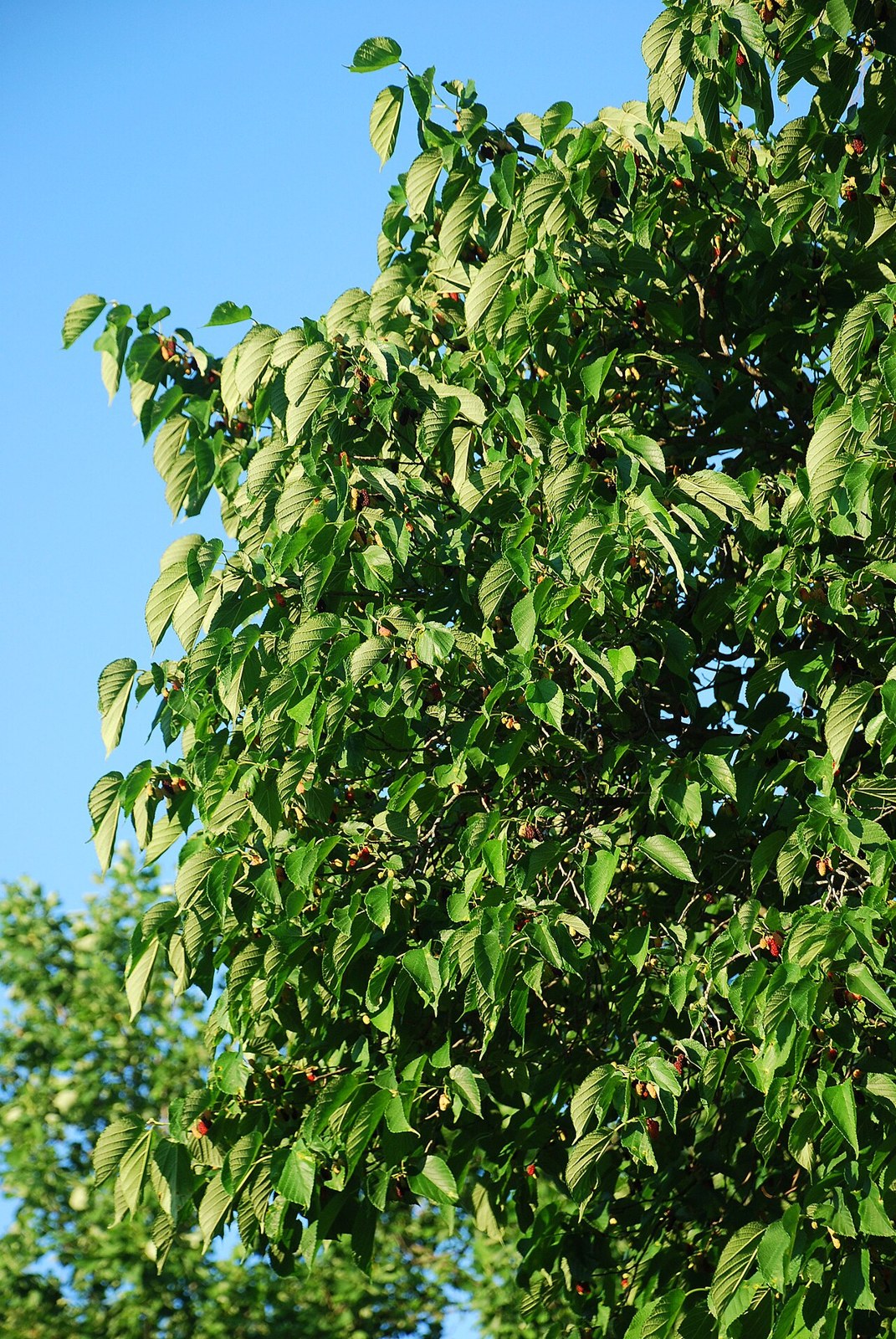
Mulberries (genus Morus) are deciduous trees and shrubs in the fig family (Moraceae), grown for their sweet, blackberry-like fruit and fast shade. The genus has roughly 10 to 15 species, most of them in Asia. Only two are native to the United States: red mulberry (Morus rubra), a forest tree of the eastern half of the country, and Texas mulberry (Morus microphylla), a small tree of dry canyons and hillsides in Texas, Oklahoma, New Mexico and Arizona.
Most mulberries growing in American yards, along fencerows and in vacant lots are not native. White mulberry (Morus alba), brought from China in colonial times to start a silk industry, has spread across every state and is now far more common than red mulberry in many areas. It also crosses freely with red mulberry, and the hybrids are slowly swamping the native species in parts of its range. Black mulberry (Morus nigra), from southwestern Asia, is grown for fruit in mild climates.
If you came here from our list of ornamental trees for Florida, the native choice is red mulberry, which grows wild in hammocks and floodplain forests throughout much of Florida. Many fruiting mulberries sold in Florida nurseries are selections or hybrids of Asian white mulberry. This page explains how to tell the native from the imports, why it matters, and how to grow a native mulberry for fruit and wildlife.
Identification
Mulberries are recognized by their toothed, often lobed leaves, milky sap and multiple fruits that look like elongated blackberries. Telling red mulberry from white mulberry takes a look at the leaf surface and the fruit.
Bark & Form
Red mulberry is usually a medium-sized tree, 35 to 50 feet tall (occasionally to 70 feet), with a short trunk and broad, rounded crown. Its bark is gray-brown, with long, flat, scaly ridges. White mulberry has orange to yellowish-tan bark showing in the furrows and inner bark, and orange roots. Texas mulberry is a shrub or small tree, usually 10 to 25 feet, with smooth to scaly gray bark. All mulberries have milky sap in their leaves and twigs.
Leaves
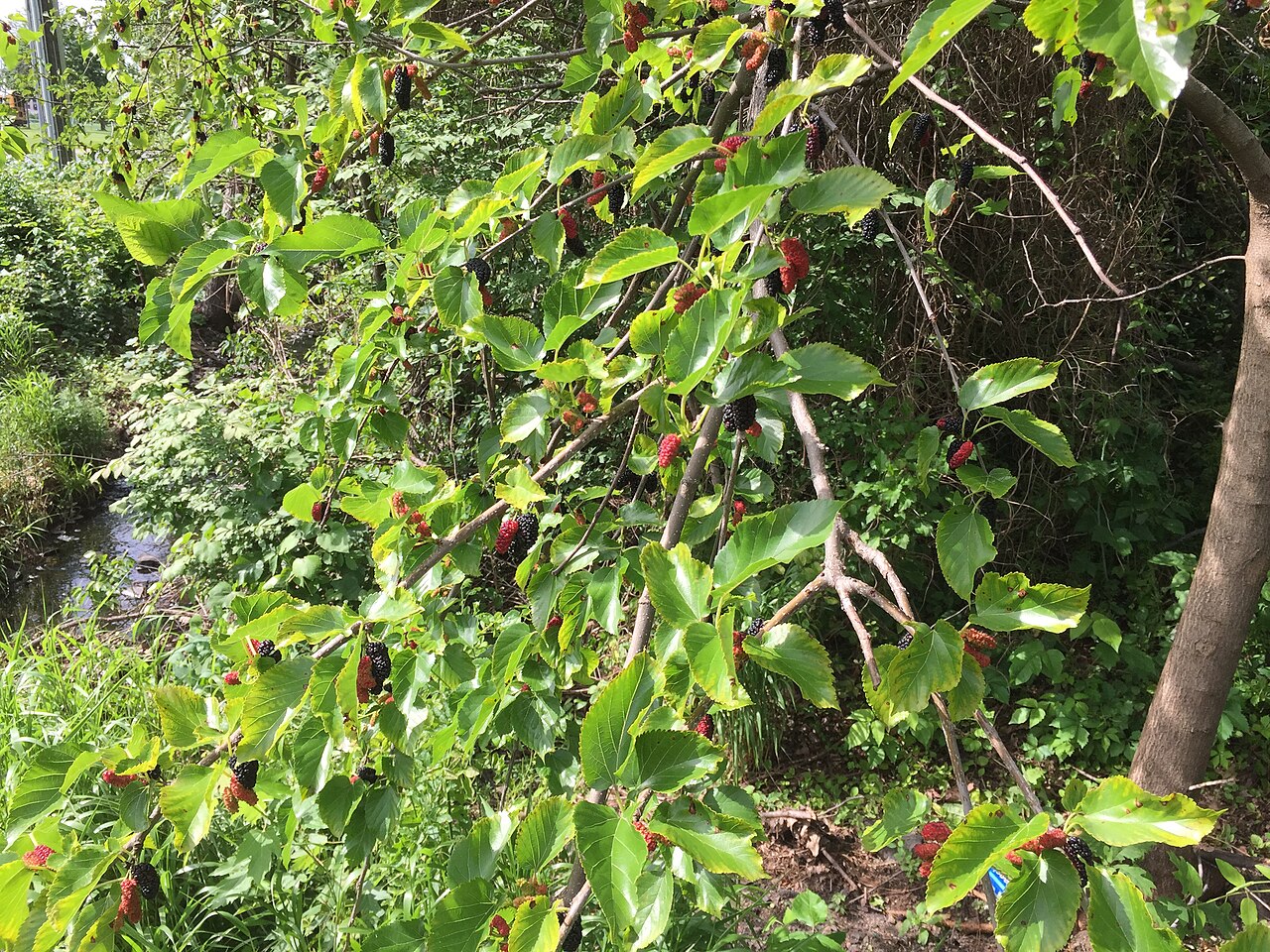
Mulberry leaves are alternate, coarsely toothed and highly variable in shape: on the same tree you may find unlobed, heart-shaped leaves and leaves with one to five lobes, like a mitten. Red mulberry leaves are large, 3 to 8 inches long, with a long, tapering tip, a rough, sandpapery upper surface and soft hairs below. White mulberry leaves are usually smooth and glossy above, smaller and more often deeply lobed. Texas mulberry leaves are small, 1 to 3 inches, rough on both sides and often lobed.
Flowers
Flowers are small, greenish and inconspicuous, in short, dangling catkin-like spikes in spring as the leaves emerge. Most native mulberries are dioecious, with male and female flowers on separate trees, so only female trees bear fruit; some red mulberries carry both.
Fruit
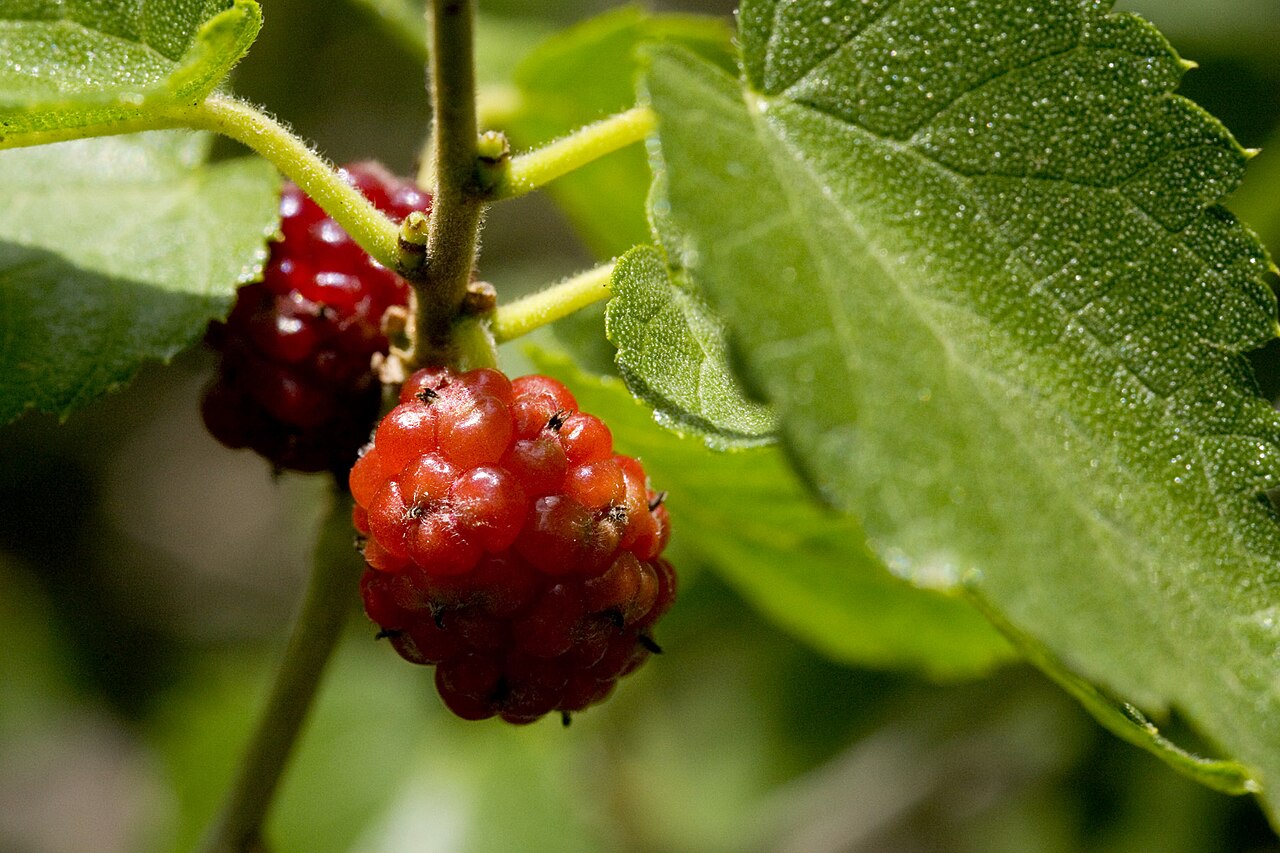
The fruit is a multiple fruit, 1 to 1 1/4 inches long in red mulberry, made of many small, juicy drupelets. Red mulberry fruit ripens from green to red to dark purple-black in late spring and early summer; Texas mulberry fruit is smaller, about 1/2 inch, red to black and sweet-tart. White mulberry fruit may ripen white, pink, lavender or black, so color alone does not separate it from red mulberry; check the leaves.
Quick Facts
| Scientific Name | Morus (genus) |
| Family | Moraceae (Fig/Mulberry) |
| U.S. Native Species | Two: red mulberry (M. rubra) and Texas mulberry (M. microphylla) |
| Plant Type | Deciduous trees and large shrubs |
| Mature Height | 35–50 ft (red mulberry); 10–25 ft (Texas mulberry) |
| Mature Spread | 30–40 ft (red); 10–20 ft (Texas) |
| Growth Rate | Moderate to fast |
| Sun Exposure | Full sun to part shade; red mulberry is shade tolerant |
| Water Needs | Moderate (red mulberry, moist soils); low (Texas mulberry) |
| Soil Type | Rich, moist loams and floodplains (red); rocky limestone and canyon soils (Texas) |
| Soil pH | About 5.5–8.0 |
| Bloom Time | Spring (March–May), inconspicuous |
| Flower Color | Greenish |
| Fall Color | Yellow |
| Fruit | Edible multiple fruits ripening red to dark purple-black, May–July |
| Deer Resistant | No; deer browse leaves and young twigs |
| USDA Hardiness Zones | 5–9 (red mulberry); about 7–9 (Texas mulberry) |
Native Range
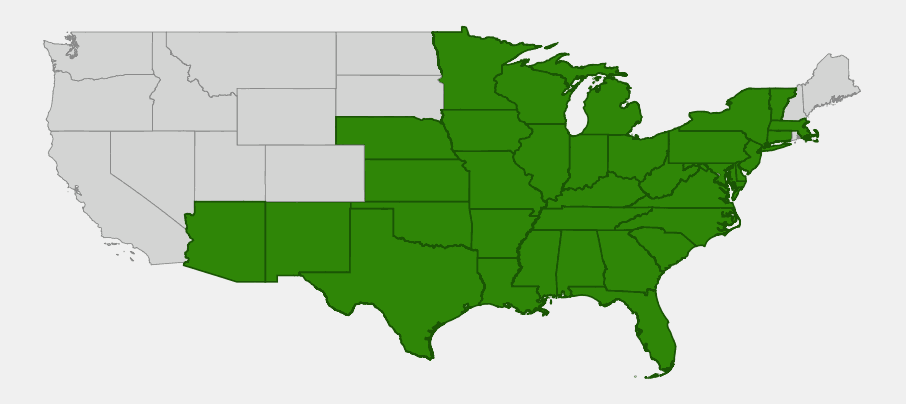
red mulberry is native across the eastern United States, from western Vermont, Massachusetts and New York west through southern Michigan, Wisconsin and southeastern Minnesota to eastern Nebraska and Kansas, and south to Florida and central Texas. It grows mostly as an understory or edge tree in rich bottomland forests, floodplains, ravines and moist hammocks. It is rare at the northern edge of its range and is listed as endangered in Canada, where most remaining trees in southern Ontario are threatened by hybridization with white mulberry.
Texas mulberry grows in the Southwest: central and western Texas, western and central Oklahoma, New Mexico and Arizona, mostly on limestone hills, canyon bottoms and rocky slopes between about 1,500 and 6,000 feet, extending into northern Mexico. It is the only native mulberry in the dry Southwest.
White mulberry, by contrast, has naturalized in every one of the lower 48 states as well as southern Canada, wherever birds have spread its seeds. Black mulberry is planted in California, the Southeast and Southwest but rarely escapes. Neither is native, and in the West, Great Plains, northern New England and the Northwest, any wild mulberry you find is almost certainly white mulberry.
📋 Regional plant lists covering native mulberry ranges: Maine, New Hampshire & Vermont · Southern New England · New York, Pennsylvania & Northern New Jersey · Delaware, Southern New Jersey & Long Island · Maryland, Virginia & West Virginia · North Carolina & South Carolina · Georgia, Alabama & Mississippi · Arkansas, Louisiana, Eastern Oklahoma & East Texas · Kentucky & Tennessee · Ohio & Indiana · Illinois, Iowa & Missouri · Michigan, Wisconsin & Eastern Minnesota · Nebraska, Kansas & Eastern Colorado · South & West Texas · Arizona & New Mexico
Native Species
Only two mulberries are native to the United States. Both are described below, followed by a note on the hybrids that complicate identification.
Red Mulberry (Morus rubra)
Native to: the eastern United States, from Vermont and Minnesota to Florida and Texas, and west to eastern Nebraska and Kansas. A 35- to 50-foot shade-tolerant tree with large, sandpapery leaves and sweet, dark purple fruit in June and July. Prefers rich, moist soil and grows well as an understory or edge tree. Plant a female or self-fruitful tree for fruit; male trees make a fruitless shade tree. Increasingly hard to find in pure form, so buy from native-plant nurseries that know their seed source.
Texas Mulberry (Morus microphylla)
Native to: central and West Texas, western and central Oklahoma, New Mexico and Arizona. A shrub or small tree, 10 to 25 feet, with small, rough, often lobed leaves and small red to black fruit. Very drought and heat tolerant, it suits xeric gardens on rocky, alkaline soil and feeds birds in early summer.
Red × white mulberry hybrids (Morus rubra × M. alba)
Native to: wherever the two species meet, which is now much of the East. Hybrids have intermediate leaves and fruit and are fertile, so they continue to cross with both parents. Some named fruiting varieties, such as ‘Illinois Everbearing’, are generally described as hybrids. They are productive fruit trees but are not native.
Other native members of the fig family in the United States include Osage-orange (Maclura pomifera), whose large green “hedge apples” are related to mulberries, and the native strangler fig and shortleaf fig of South Florida.
Non-Native Look-Alikes
White Mulberry (Morus alba) – invasive
Native to China, white mulberry was introduced to the American colonies in the 1600s and 1700s as food for silkworms. The silk industry failed, but the tree thrived and now grows wild along roadsides, fencerows, forest edges and vacant lots throughout the country. It is listed as invasive in several states. Its leaves are smooth and glossy above (red mulberry’s are rough), often deeply and irregularly lobed, and its fruit may be white, pink or black. It grows fast, tolerates almost any soil, and spreads readily by bird-dropped seeds. Its greatest threat to native trees is hybridization: white mulberry pollen fertilizes red mulberry flowers, and in many areas, including southern Ontario, pure red mulberry is becoming rare. Fruitless (male) white mulberries, once popular shade trees in the Southwest, shed very large amounts of allergenic pollen, and several desert cities, including Las Vegas and Tucson, restrict new plantings for that reason. Weeping white mulberry (‘Pendula’) is a common ornamental form.
Black Mulberry (Morus nigra)
A small, slow-growing tree from southwestern Asia, grown for its large, very dark, intensely flavored fruit in California, the Southeast and other mild-winter regions. Its heart-shaped leaves are thick, very rough above and densely hairy below, and its fruit is held on very short stalks. It is hardy only to about zone 7, rarely escapes cultivation and is not considered invasive, but it is not native.
Paper mulberry (Broussonetia papyrifera)
An Asian tree in the same family, often called mulberry, with velvety, deeply lobed leaves and round, orange-red fruit balls. It spreads aggressively by root suckers and is invasive in parts of the Southeast and mid-Atlantic. Its leaves are fuzzy on both sides, unlike any true mulberry.
Growing & Care Guide
Native mulberries are easy, fast-growing trees that provide summer fruit for people and birds. The main challenges are finding true native stock and placing the tree where falling fruit will not be a nuisance.
Light
Red mulberry grows in full sun to fairly deep shade; in sun it grows faster, denser and fruits more heavily. Texas mulberry needs full sun to light shade.
Soil & Water
Red mulberry prefers rich, moist, well-drained soils such as floodplain loams but adapts to most garden soils, including clay and the sandy, alkaline soils of much of Florida if mulched and watered while young. Texas mulberry thrives in rocky, alkaline, well-drained soil and needs little water once established. Water both regularly for the first two summers.
Planting Tips
Buy red mulberry from native-plant nurseries that grow from verified local seed, since many trees sold as “red mulberry” are hybrids or white mulberry. If you want fruit, ask for a known female or fruiting tree. Plant it away from driveways, patios, sidewalks and parked cars: ripe mulberries stain, and birds that eat them leave purple droppings. A spot at the edge of a lawn, woodland or wildlife garden is ideal. Give red mulberry 30 to 40 feet of space.
Pruning & Maintenance
Prune in late winter while dormant, removing dead, crossing or crowded branches; mulberries bleed sap if pruned in spring. Young trees can be trained to a single trunk with a few wide-angled scaffold branches. In gardens where both species grow, remove volunteer white mulberry seedlings so they do not cross with native trees.
Pests & Problems
Mulberries have few serious pests. Leaf spots and a bacterial blight cause cosmetic damage in wet years, and popcorn disease (a fungus that swells individual drupelets) affects fruit in the Southeast. Fall webworms may web branch tips. The biggest “problem” is fruit drop and seedlings from bird-dropped seed.
Propagation
Mash ripe fruit, rinse out the tiny seeds and sow them in fall, or stratify them in the refrigerator for 30 to 90 days before spring sowing. Seedlings vary and may be male or female. Hardwood or softwood cuttings root fairly easily and preserve a tree’s sex and fruit quality.
Landscape Uses
- Fruit tree for edible and wildlife gardens
- Understory or woodland-edge tree in moist, shady sites (red mulberry)
- Xeric and wildlife gardens in the Southwest (Texas mulberry)
- Bird gardens: fruit ripens when many birds are feeding young
- Streamside and floodplain restoration within the native range
Wildlife & Ecological Value
For Pollinators
Mulberries are wind-pollinated, so their flowers offer little to bees beyond some pollen. They are, however, host plants for the caterpillars of several native moths.
For Birds
Mulberries are among the most important early-summer fruits for birds. More than 40 species eat them, including gray catbirds, northern mockingbirds, brown thrashers, American robins, wood thrushes, cedar waxwings, orioles, cardinals, red-bellied and red-headed woodpeckers, and in Florida many migrating songbirds. A fruiting tree is one of the best bird-watching spots in a yard in June.
For Mammals
Raccoons, opossums, foxes, squirrels, box turtles and even black bears eat fallen fruit. Deer browse the leaves and twigs.
Ecosystem Role
Red mulberry is a characteristic understory and edge tree of eastern bottomland forests, contributing summer fruit to a food web that otherwise depends heavily on spring and fall fruits. Its decline through hybridization is a conservation concern across much of its northern range, and protecting pure stands means removing nearby white mulberries.
Cultural & Historical Uses
Red mulberry fruit was gathered fresh and dried by many Indigenous peoples of the eastern United States. Early Spanish and English accounts from the Southeast describe cloth woven from the fibrous inner bark of mulberry trees. Texas mulberry fruit was gathered by Indigenous peoples of the Southwest.
White mulberry arrived with the colonial dream of an American silk industry. Virginia’s colonial government encouraged planting mulberry trees for silkworms in the 1600s, and a “mulberry mania” swept the Northeast in the 1830s, when speculators planted millions of trees of an Asian mulberry variety before the market collapsed. The silk industry never succeeded, but the trees remained and spread.
Mulberry wood is durable in contact with soil and was used for fence posts, and the fruit is still enjoyed fresh, in pies, jams and wine.
Frequently Asked Questions
Is the mulberry tree native to Florida?
One mulberry is: red mulberry (Morus rubra) is native to much of Florida, growing in hammocks and floodplain forests. Many mulberries sold for fruit in Florida are selections or hybrids of Asian white mulberry, which is not native.
How can I tell red mulberry from white mulberry?
Feel the leaves. Red mulberry leaves are large, with a rough, sandpapery upper surface, soft hairs underneath and a long, tapering tip. White mulberry leaves are smooth and glossy on top. White mulberry also has orange-tinged bark and roots, and its fruit can be white, pink or black.
Is white mulberry invasive?
Yes. White mulberry is an Asian tree that has escaped across the United States and is listed as invasive in several states. It also hybridizes with native red mulberry, which threatens the native species in much of its range.
Are mulberries edible?
Yes. Ripe red, Texas, white and black mulberries are all edible and sweet. Unripe fruit and the milky sap of the leaves and stems can cause stomach upset or skin irritation, so eat only fully ripe fruit.
Do I need two mulberry trees to get fruit?
Native mulberries are mostly separate male and female trees, so a female tree needs a male nearby to set full crops, although some trees fruit on their own. In much of the East, wild mulberries nearby usually provide pollen. Fruitless shade trees are males.
Will mulberries stain my patio or car?
Yes. Ripe mulberries fall in quantity and stain concrete, decks and cars purple, and birds that eat them leave purple droppings. Plant mulberries away from paved areas and parking spots.

Looking for a nursery that carries Native Mulberries?
Browse our native plant nursery directory: Alabama, Arkansas & Arizona · Connecticut, Delaware, Florida & Georgia · Iowa, Illinois, Indiana & Kansas · Kentucky, Louisiana, Massachusetts, Maryland, Michigan, Minnesota, Missouri & Mississippi · North Carolina, Nebraska, New Jersey, New Mexico, New York, Ohio & Oklahoma · Pennsylvania, South Carolina, Tennessee, Texas, Virginia & Vermont · Wisconsin & West Virginia

