
Native Manzanitas (Arctostaphylos)
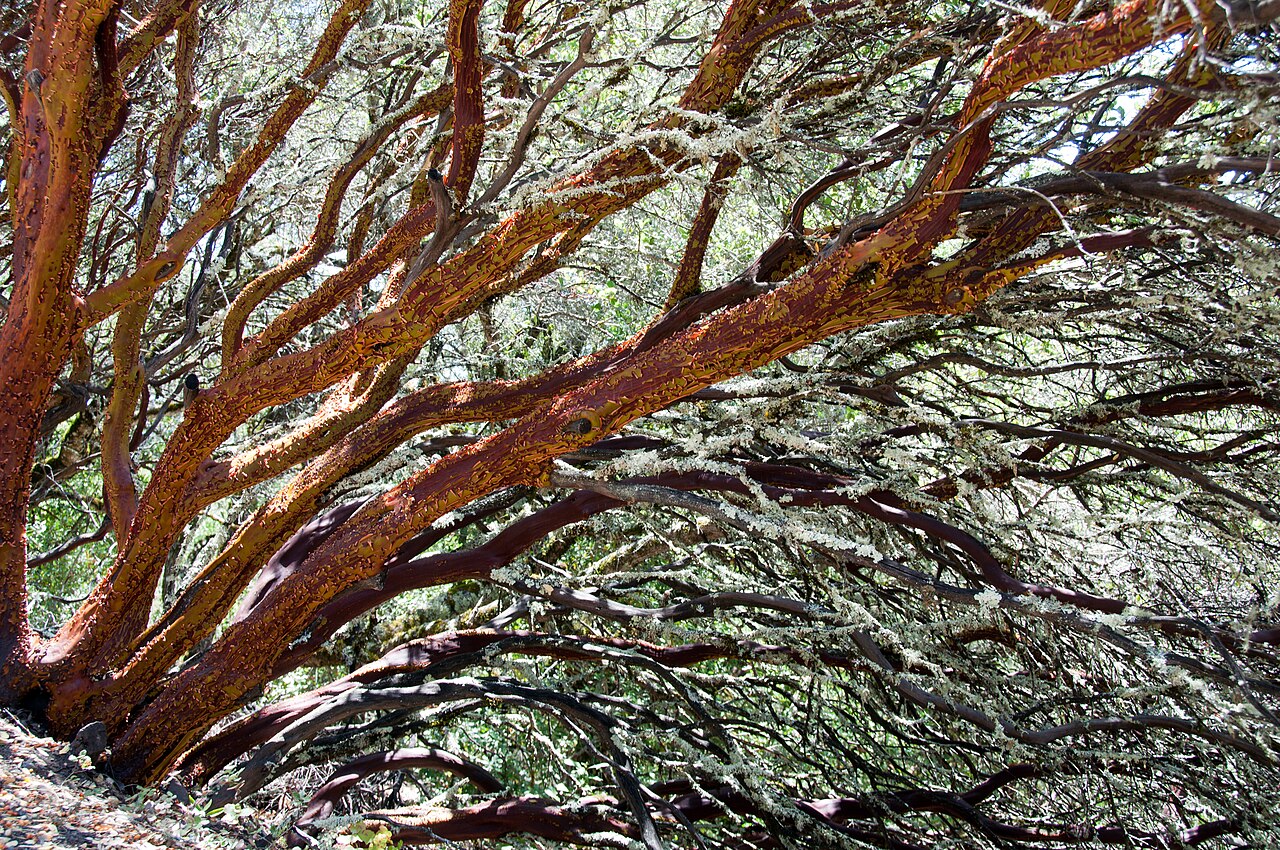
Manzanitas (genus Arctostaphylos) are evergreen shrubs and small trees with smooth, red to purple bark, stiff leathery leaves, nodding clusters of white to pink urn-shaped flowers in winter and early spring, and small apple-like berries. The name is Spanish for “little apple.” Nearly all of the world’s manzanitas are native to western North America, and the great majority grow only in California, where they are one of the defining plants of chaparral, foothill woodland and coastal scrub.
The genus is large and still being sorted out by botanists. Current treatments recognize roughly 60 species, about 100 kinds when subspecies are counted, and many are rare plants restricted to a single mountain, coastal bluff or soil type. A few range more widely: greenleaf and pointleaf manzanita reach into the Great Basin and Southwest, and one species, kinnikinnik or bearberry (Arctostaphylos uva-ursi), is a low groundcover that grows across Alaska, Canada and the northern United States all the way to New England.
This guide introduces the most important and garden-worthy native manzanitas, explains where each grows, and covers the popular garden selections such as ‘Howard McMinn’ and ‘Emerald Carpet’. If you came here from a list of California native flowering shrubs, the short version is this: manzanitas want full sun, fast drainage and almost no summer water once established, and in return they give winter flowers for hummingbirds and bees, beautiful bark all year and very little maintenance.
Identification
Manzanitas are easy to recognize as a group and often difficult to identify to species. As a group, look for the combination of smooth red-brown bark, stiff evergreen leaves often held edgewise to the sun, and drooping clusters of small urn-shaped flowers. To tell species apart, botanists look at whether the plant has a burl at its base, leaf color and hairiness, the shape of the flower bracts, and whether the twigs and fruit are sticky.
Bark & Stems
The bark of most manzanitas is smooth, polished and red, maroon or purple-brown, and it peels in thin curls each summer to reveal fresh green or orange bark beneath. Branches twist and turn into sculptural shapes. A few species, including brittleleaf manzanita, have shreddy gray bark on older stems. Some species grow from a woody burl at ground level and resprout after fire; others have a single trunk and no burl, and are killed by fire and come back only from seed.
Leaves
Leaves are evergreen, leathery, usually ½ to 2 inches long, and range from bright glossy green (greenleaf manzanita, kinnikinnik) to gray-green or nearly white with a powdery coating (whiteleaf and bigberry manzanita). On many species the leaves are held vertically, which reduces heat and water loss in summer sun. Kinnikinnik has small, spoon-shaped, glossy leaves on long trailing stems. Pointleaf manzanita, as its name suggests, has leaves ending in a sharp point.
Flowers
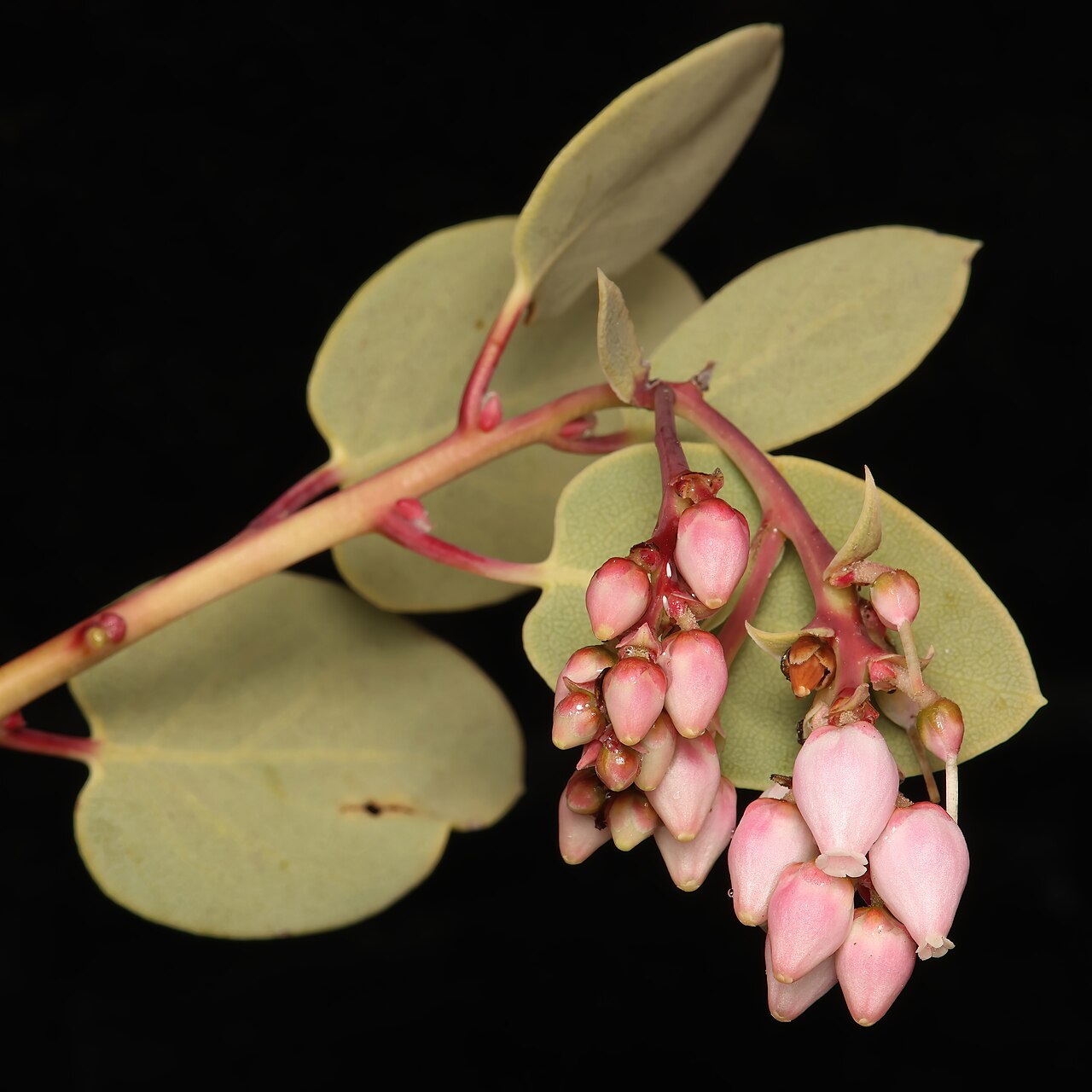
Flowers are small, urn-shaped and hang in clusters at the branch tips, white to soft pink. Many California manzanitas bloom from December to March, when few other plants are flowering; mountain species and kinnikinnik bloom in spring and early summer. The flower buds form in late summer and fall, so you can see the coming bloom months ahead.
Fruit & Seeds
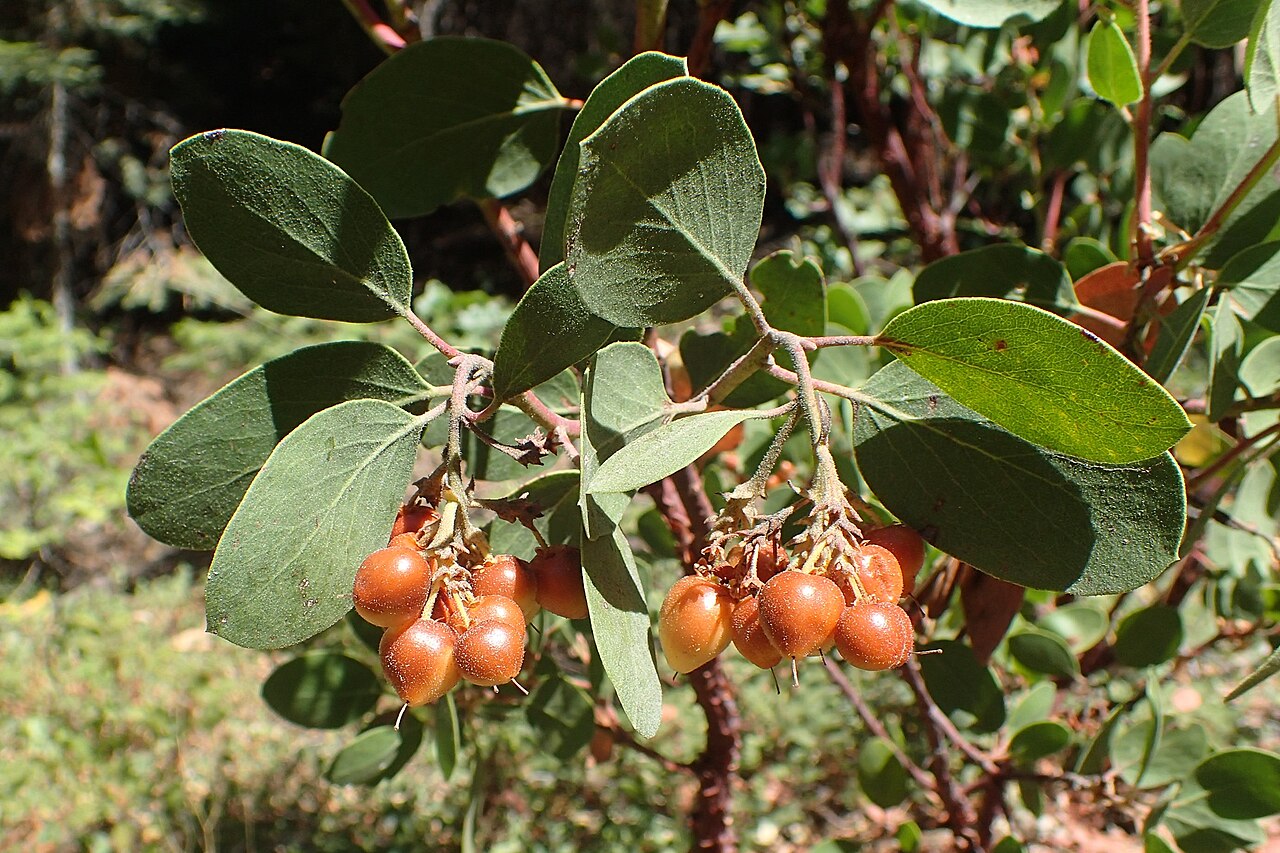
The fruit is a small berry-like drupe, ¼ to ½ inch across in most species and up to about ¾ inch in bigberry manzanita, ripening from green to red, reddish brown or orange-brown in summer. Inside are several hard nutlets, sometimes fused into a single stone. The fruits are mealy and dry rather than juicy. Seeds of many species germinate only after fire, after being exposed to heat, smoke and charred wood.
Quick Facts
| Genus | Arctostaphylos |
| Family | Ericaceae (Heath family) |
| U.S. Native Species | Roughly 60 species (about 100 taxa with subspecies), most found only in California |
| Growth Forms | Evergreen groundcovers, mounding shrubs and small multi-trunked trees |
| Mature Height | From under 1 ft (kinnikinnik, pinemat) to about 20 ft (common and bigberry manzanita) |
| Sun Exposure | Full Sun to Part Shade; most need full sun inland |
| Water Needs | Low; most California species need no summer water once established |
| Soil Type | Fast-draining sandy, gravelly or rocky soils; some grow on serpentine or old sand dunes |
| Soil pH | Mostly acidic to neutral |
| Bloom Time | December – April for most California species; spring to early summer in the mountains and north |
| Flower Color | White to pink |
| Bark | Smooth red, mahogany or purple bark that peels in summer |
| Fruit | Small mealy red to brown berries eaten by birds and mammals |
| Wildlife Value | Winter nectar for hummingbirds and queen bumblebees; host plant for elfin butterflies |
| Deer Resistant | Generally yes once established; young plants may be browsed |
| USDA Hardiness Zones | About 2–7 for kinnikinnik; mostly 7–10 for California species |
Native Range
California is the heart of manzanita country. Manzanitas grow from the coast to the high Sierra Nevada and from the Oregon border to the Mexican border, and many species are endemic to tiny areas: Monterey Bay sandhills, the serpentine barrens of the Coast Ranges, single peaks such as Mount Diablo. A smaller set of species extends north into the Siskiyou Mountains and Cascades of Oregon and Washington, including hairy, greenleaf, whiteleaf and pinemat manzanitas.
East of the Sierra Nevada, greenleaf manzanita grows in mountain pine forests of Nevada, Utah, Arizona, Colorado and New Mexico, and pointleaf manzanita covers chaparral and pinyon-juniper slopes from Southern California across Arizona to New Mexico, southern Utah and Nevada, with a rare outpost in far West Texas, continuing south into Mexico. Pink-bract manzanita (A. pringlei) is common in central Arizona chaparral.
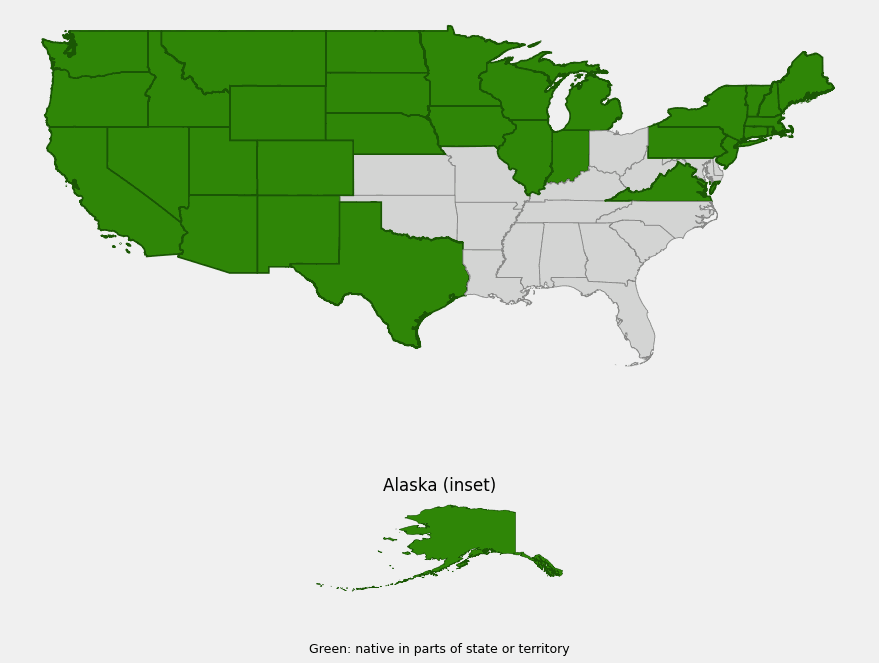
Kinnikinnik is the outlier. This low, trailing species is circumpolar and grows in sandy pine barrens, rocky slopes and dunes across Alaska, the Rocky Mountains and the northern tier of states, reaching Minnesota, Wisconsin, Michigan, the Great Lakes dunes of Illinois and Indiana, and New England, New York, New Jersey and Pennsylvania, with rare populations as far south as Virginia. No manzanita is native to the Southeast or most of the central Plains. The map below shows states where at least one species is native.
📋 Regional plant lists covering native manzanita country: California & Nevada · Western Oregon & Washington · Idaho, Eastern Oregon & Washington · Arizona & New Mexico · Utah & Western Colorado · Montana & Wyoming · Dakotas & Western Minnesota · Michigan, Wisconsin & Eastern Minnesota · New Hampshire, Maine & Vermont · Connecticut, Massachusetts & Rhode Island · New York, Pennsylvania & Northern NJ · Delaware, Southern NJ & Long Island · Alaska
Native Species
These are some of the most widespread and most frequently grown native manzanitas. Names with links go to our full plant profiles.
Common Manzanita (Arctostaphylos manzanita)
One of the largest manzanitas, often a small multi-trunked tree 10 to 20 feet tall with dramatic mahogany-red branches. It grows in the inner Coast Ranges and Sierra Nevada foothills of Northern California, has no burl and blooms white to pale pink in late winter. ‘Dr. Hurd’ is a well-known tree-form selection that tolerates more garden water than most.
Bigberry Manzanita (Arctostaphylos glauca)
A tall shrub or small tree, up to about 20 feet, with striking blue-gray leaves and the largest fruits in the genus, sticky berries up to about ¾ inch across. It grows in chaparral from the Mount Diablo area south through Southern California into Baja California and is very drought and heat tolerant.
Whiteleaf Manzanita (Arctostaphylos viscida)
A shrub 3 to 12 feet tall with pale gray-white leaves and sticky flower stalks, common in Sierra Nevada foothill woodland and north into southwestern Oregon. Its pink-tinged flowers and pale foliage make it one of the showiest foothill shrubs in late winter.
Greenleaf Manzanita (Arctostaphylos patula)
A mounding shrub 3 to 6 feet tall with bright green, rounded leaves, common in open ponderosa and Jeffrey pine forests of the Sierra Nevada, Cascades and the mountains of Nevada, Utah, Arizona, Colorado and New Mexico. It forms a burl and resprouts after fire. It is one of the hardiest manzanitas, a good choice for mountain gardens.
Pointleaf Manzanita (Arctostaphylos pungens)
The manzanita of the Southwest: a rounded shrub 3 to 10 feet tall with bright green, sharp-pointed leaves, common in chaparral and pinyon-juniper woodland in Arizona, New Mexico, southern Utah and Nevada, and Southern California, and rare in West Texas. It tolerates heat, alkaline soils and drought.
Eastwood Manzanita (Arctostaphylos glandulosa)
A variable, burl-forming shrub, usually 3 to 8 feet, with gray-green, often glandular-hairy leaves. It grows in coastal and foothill chaparral from southern Oregon through California to Baja California and resprouts vigorously after fire.
Brittleleaf Manzanita (Arctostaphylos tomentosa)
A coastal species of the Central Coast around Monterey Bay, 3 to 8 feet tall, with shreddy gray bark on older stems and a burl at the base. Its subspecies crustacea is widespread in coastal chaparral and maritime scrub.
Hairy Manzanita (Arctostaphylos columbiana)
The common manzanita of the Pacific Northwest coast, from northwestern California through western Oregon and Washington to southern British Columbia. It grows 3 to 10 feet tall with gray-green, hairy leaves and bristly twigs, often on rocky bluffs and in clearings with Douglas fir.
Pinemat Manzanita (Arctostaphylos nevadensis)
A low, spreading mat usually under 1 foot tall, growing in rocky ground under open conifers at middle and high elevations in the Sierra Nevada, Cascades and Klamath Mountains. It is a cold-hardy groundcover for mountain gardens and blooms in late spring and early summer.
Kinnikinnik or Bearberry (Arctostaphylos uva-ursi)
A trailing groundcover usually 6 to 12 inches tall with small glossy leaves, pink-white spring flowers and bright red fall berries. It is the only manzanita native outside the West, growing across Alaska and the northern United States from Washington to Maine. It is extremely cold hardy and grows well on sandy, acidic, well-drained slopes, including northern and eastern gardens far from California.
Vine Hill Manzanita (Arctostaphylos densiflora)
In the wild, this species survives only on a single sandstone ridge in Sonoma County and is listed as endangered by the state of California. In gardens, it is famous as the parent of ‘Howard McMinn’, one of the most widely planted manzanitas: a dense, rounded shrub about 5 to 7 feet tall and wider, with pale pink flowers in late winter. ‘Howard McMinn’ tolerates heavier soil and occasional summer water better than most manzanitas, which makes it a good first manzanita for gardeners.
Monterey Manzanita (Arctostaphylos hookeri)
A low, mounding shrub of the Monterey Bay area, usually 1 to 4 feet tall, with small glossy leaves. It is a parent of several mounding garden selections and a useful low shrub for coastal gardens.
Pink-bract Manzanita (Arctostaphylos pringlei)
A shrub of Arizona chaparral, the mountains of Southern California and northern Mexico, with gray-green, glandular leaves and showy pink flowers with conspicuous bracts. It is one of the characteristic shrubs of the Mogollon Rim and central Arizona chaparral.
Garden Hybrids and Selections
Manzanitas hybridize readily, and nurseries sell dozens of named selections, all derived from native species. ‘Emerald Carpet’ is a low groundcover about 1 foot tall with small, bright green leaves; it is believed to be a natural hybrid involving kinnikinnik and the coastal glossyleaf manzanita (A. nummularia) and is best in coastal gardens or light afternoon shade inland. ‘Sunset’ (Monterey manzanita × Pajaro manzanita), ‘Louis Edmunds’ (a selection of Baker’s manzanita), ‘John Dourley’ and ‘Pacific Mist’ are other common garden manzanitas. They are native-derived cultivars rather than wild populations, but they feed the same hummingbirds and bees.
Non-Native Look-Alikes
The manzanita genus is almost entirely North American, so there are no common non-native manzanitas in the garden trade. The plants most often mistaken for manzanitas are their cousins in the heath family:
- Strawberry tree (Arbutus unedo), from the Mediterranean and Ireland, and its hybrid Arbutus ‘Marina’. These are widely planted as street and patio trees in California and the Pacific Northwest. They have reddish peeling bark and urn-shaped white or pink flowers like manzanita, but their leaves are larger (2 to 4 inches), toothed, and dark green, and their fruits are round, bumpy, red “strawberries” that ripen in fall and winter. They are not invasive in most of California, though they occasionally self-seed.
- Pacific madrone (Arbutus menziesii) is a native relative, a large tree with similar red peeling bark but big, glossy leaves 3 to 6 inches long.
- Mission manzanita (Xylococcus bicolor) and summer holly (Comarostaphylis diversifolia) are native Southern California shrubs that look like manzanitas but belong to different genera. Mission manzanita has dark green leaves with rolled edges and white woolly undersides.
- Alpine bearberry (Arctous alpina, formerly Arctostaphylos alpina) is a native arctic and alpine relative of kinnikinnik in Alaska and the far north, with deciduous, wrinkled, toothed leaves.
The bigger risk for gardeners is not a look-alike species but disease: manzanitas sold from infected nursery stock can carry Phytophthora root rots, which can spread to wild plants. Buy from nurseries that follow clean-stock practices, especially near wildlands.
Growing & Care Guide
Light
Most manzanitas need full sun, especially inland. Coastal species and selections such as ‘Emerald Carpet’, Monterey manzanita and hairy manzanita accept part shade, particularly afternoon shade in hot inland gardens. In too much shade, manzanitas become sparse and stop flowering.
Soil & Water
Drainage matters more than anything else. Manzanitas want sandy, gravelly or rocky soil that drains within hours after rain. In heavy clay, plant on a mound or slope and choose tolerant selections such as ‘Howard McMinn’ or ‘Dr. Hurd’. Do not add compost or fertilizer. Water deeply every two to three weeks through the first dry season, then taper off; most California species should get no summer water at all after their second year, and summer watering combined with warm soil is a common cause of sudden death from root rot. Kinnikinnik in northern and eastern gardens needs only rainfall once established and prefers acidic, sandy soil.
Planting Tips
Plant from fall to early winter in California, so winter rains establish the roots before summer. Plant small container plants (1-gallon or smaller) rather than large ones; they establish faster. Set the crown slightly above the surrounding soil and keep mulch a few inches away from the stems. Gravel or coarse wood chip mulch both work well.
Pruning & Maintenance
Manzanitas need little pruning. Remove dead or crossing branches in summer, when the plants are dormant and fungal spores are less active, and disinfect pruners between cuts. Many gardeners lift the lower branches of larger species to show off the bark. Do not shear manzanitas or cut into bare old wood on species without a burl; they will not resprout. Branch dieback caused by fungal cankers is common in stressed plants; cut out dead branches well below the damage.
Propagation
Manzanitas are difficult to grow from seed: the hard nutlets need fire, smoke treatment and long periods of stratification, and germination is low and slow. Most nursery plants are grown from semi-hardwood cuttings taken in fall or winter, treated with rooting hormone and rooted under mist. Groundcover types such as kinnikinnik can be propagated by layering, pinning a trailing stem to the soil until it roots.
Landscape Uses
- Dry, summer-dry gardens in California and southern Oregon: almost any local species
- Groundcover on slopes and banks: kinnikinnik, pinemat, ‘Emerald Carpet’ and other low selections
- Specimen shrubs and small trees for sculptural bark: common manzanita, bigberry, ‘Dr. Hurd’
- Hummingbird and winter bee gardens
- Sandy, acidic sites in the North and Northeast: kinnikinnik
- Mountain and fire-adapted landscapes, with appropriate spacing from buildings in fire-prone areas
Wildlife & Ecological Value
For Pollinators
California manzanitas bloom in the middle of winter, when they are among the only plants flowering. Queen bumblebees, early native bees such as mason and mining bees, and honey bees depend on them on warm winter days. Manzanitas and kinnikinnik are larval host plants for the brown elfin and hoary elfin butterflies and for many moths.
For Birds
Anna’s hummingbirds rely heavily on manzanita nectar in winter, and their nesting season in California overlaps the manzanita bloom. The berries feed quail, grouse, wild turkeys, band-tailed pigeons, mockingbirds, thrashers and other birds, and the dense shrubs provide year-round cover and nesting sites.
For Mammals
Black bears, coyotes, foxes and many rodents eat manzanita and kinnikinnik berries; the scientific name uva-ursi means “bear’s grape.” Deer browse young growth and resprouts after fire but usually leave mature plants alone.
Ecosystem Role
Manzanitas are central to fire-adapted chaparral. Species without burls are killed by fire but leave behind seed banks that germinate in huge numbers after a burn; burl-forming species resprout. Their roots form partnerships with soil fungi that help them grow on very poor soils, and their evergreen cover holds steep slopes in place. Many rare manzanitas grow on specialized soils such as serpentine and old sand dunes and are protected by state or federal law.
Cultural & Historical Uses
Manzanita berries were an important seasonal food for many Native Californian peoples, who historically gathered the ripe fruit and ground it into meal or soaked it in water to make a sweet-tart drink, sometimes described as manzanita cider. The fruits are dry and mealy, and the hard seeds were usually removed. The berries of kinnikinnik were eaten by Indigenous peoples across the North, often cooked with fat or preserved with other foods.
The word kinnikinnik comes from an Algonquian word for a smoking mixture, and dried bearberry leaves were widely mixed with tobacco or used in its place. Manzanita wood is very hard and dense; it was used for tools and fuel, and the sculptural branches are now prized for bird perches, aquarium decor and crafts. Please collect only dead wood, and only where permitted.
Manzanitas became garden plants in the twentieth century through the work of California botanists and nursery growers such as Howard McMinn, for whom the popular cultivar is named. Today they are among the signature shrubs of water-wise California gardens.
Frequently Asked Questions
Are manzanitas hard to grow?
They are easy if you give them what they need: full sun, fast-draining soil and very little summer water once established. Most failures come from too much water, rich amended soil, or poor drainage. ‘Howard McMinn’ and ‘Dr. Hurd’ are the most forgiving choices.
Can I grow manzanita outside California?
Kinnikinnik grows wild across the northern US and Alaska and is the best choice for northern and eastern gardens. Greenleaf and pointleaf manzanita are good in the mountain West and Southwest. California species are generally hardy only in mild, summer-dry climates, roughly zones 7 to 10.
When do manzanitas bloom?
Most California manzanitas bloom between December and March. Mountain species bloom in spring and early summer, and kinnikinnik flowers in spring.
Do manzanitas need pruning?
Very little. Remove dead wood in summer and lift lower branches if you want to show off the bark. Avoid shearing, and do not cut back into bare wood on species without a burl.
Is ‘Emerald Carpet’ a native plant?
It is a garden selection of native parentage, believed to be a natural hybrid involving kinnikinnik and glossyleaf manzanita from coastal California. It is a good native-derived groundcover for coastal gardens and partly shaded sites inland.

Looking for a nursery that carries native manzanitas?
Browse our native plant nursery directory: Alaska & Arizona · California · Colorado & Connecticut · Idaho, Illinois, Indiana & Iowa · Maine, Massachusetts, Michigan, Minnesota & Montana · Nebraska, Nevada, New Hampshire, New Jersey, New Mexico, New York & North Dakota · Oregon · Pennsylvania, Rhode Island, South Dakota, Texas, Utah, Vermont & Virginia · Washington · Wisconsin & Wyoming

