
Jewels of Opar (Talinum paniculatum)
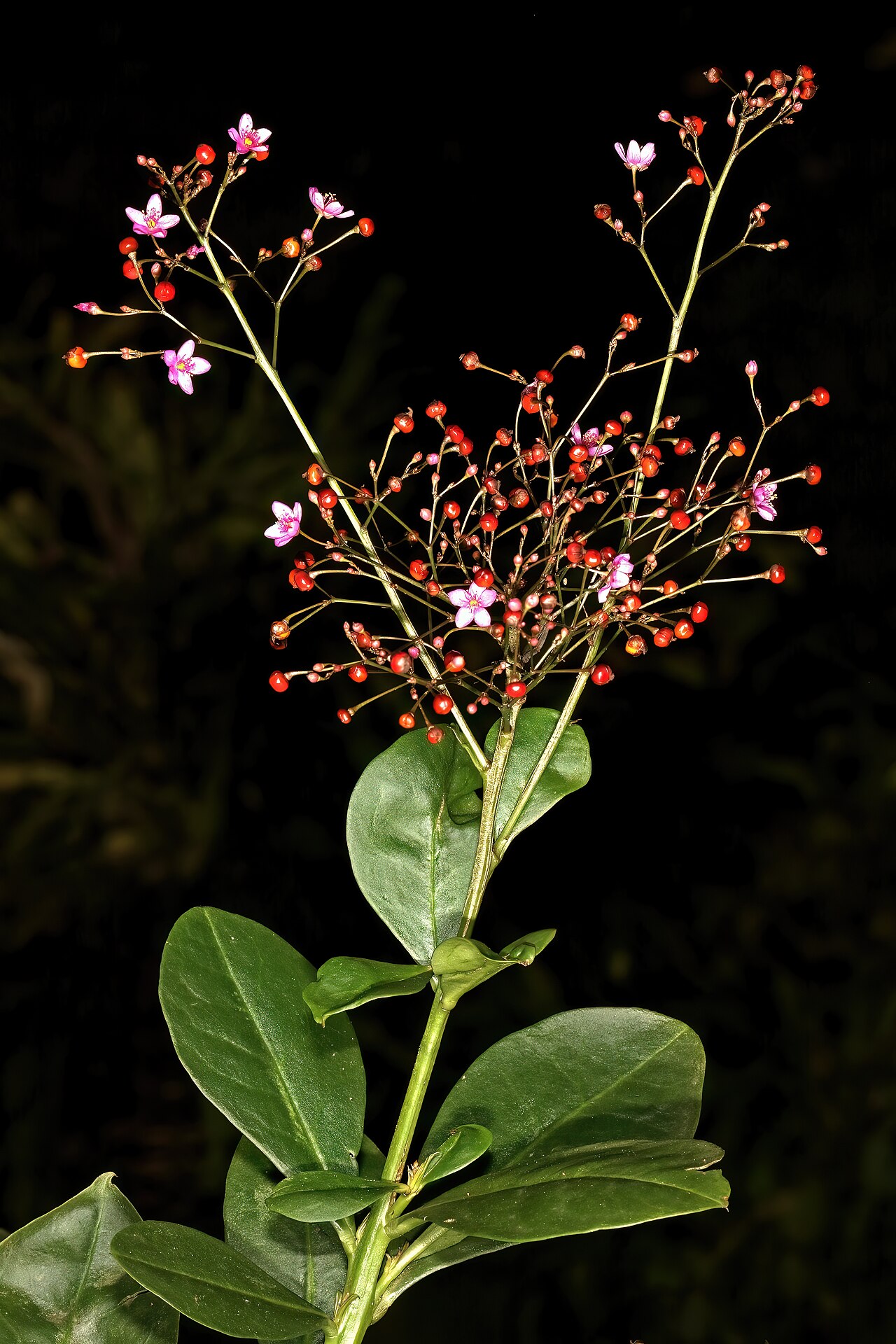
Talinum paniculatum, best known as Jewels of Opar and also called pink baby’s-breath or fameflower, is a succulent perennial native to the southern United States, Puerto Rico and much of tropical America. From a thick orange root it produces rosettes of glossy, fleshy leaves, and from summer into fall it sends up wiry, branching flower stalks 1 to 3 feet tall. These hold clouds of tiny pink flowers followed by round, shiny fruits that change from green to red, orange and finally tan, like strings of tiny beads.
The playful common name comes from the 1916 adventure novel Tarzan and the Jewels of Opar by Edgar Rice Burroughs, and gardeners took it up because the glossy fruits really do look like small gemstones. Botanically it belongs to the fameflower family (Talinaceae), which used to be included in the purslane family. Cultivars with chartreuse or variegated leaves, such as ‘Kingwood Gold’ and ‘Limón’, are popular in containers and summer borders.
Jewels of Opar is easy, heat-loving and drought-tolerant, and in hot climates it reseeds freely, sometimes too freely. Its leaves are eaten as a cooked green in parts of Africa, Asia and Latin America, and in Southeast Asia its root is sold as “Javanese ginseng.” This guide covers how to identify it, where it grows wild, how to grow it in the garden or in pots, and how to keep its self-sowing under control.
Identification
Jewels of Opar is easy to spot in late summer, when its airy pink and red flower sprays stand well above the leaves. Out of flower it can be confused with the closely related Ceylon spinach or waterleaf (Talinum fruticosum), a tropical leaf vegetable with larger flowers on short, unbranched stalks.
Roots & Stems
The plant grows from a thick, fleshy, carrot-like taproot that is orange to brown on the outside and can grow very long. In frost-free areas the short base becomes somewhat woody, so the plant behaves like a small subshrub; in colder areas the top dies to the ground or the plant grows as an annual. Stems are smooth and succulent.
Leaves
Leaves are alternate but crowded near the base of the stems, forming a loose rosette. They are elliptic to oval, roughly 2 to 4 inches long, thick, smooth, hairless and shiny, bright to medium green (gold or white-edged in some cultivars). They taste mildly sour and are slightly mucilaginous when chewed, a trait shared with purslanes.
Flowers
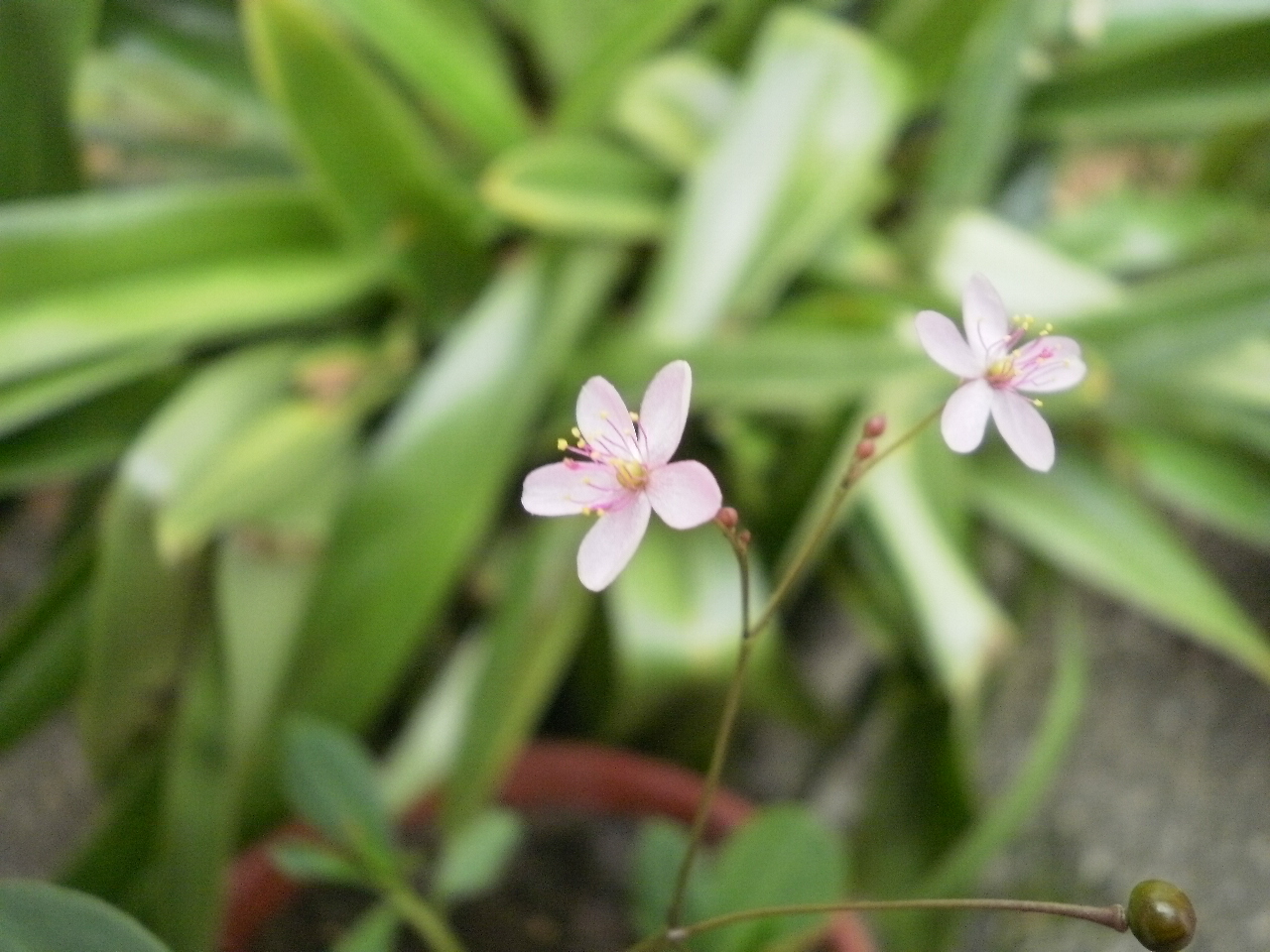
The flower stalks rise well above the foliage and branch repeatedly into a loose, open panicle, which is the meaning of the species name paniculatum. Each tiny flower is about ¼ inch across, with five rounded pink to reddish petals and a cluster of yellow stamens. Flowers usually open in the afternoon and close the same day, so a plant may look like it is “only fruiting” in the morning. Bloom continues from early summer until frost in the South, and nearly year-round in the tropics.
Fruit & Seeds
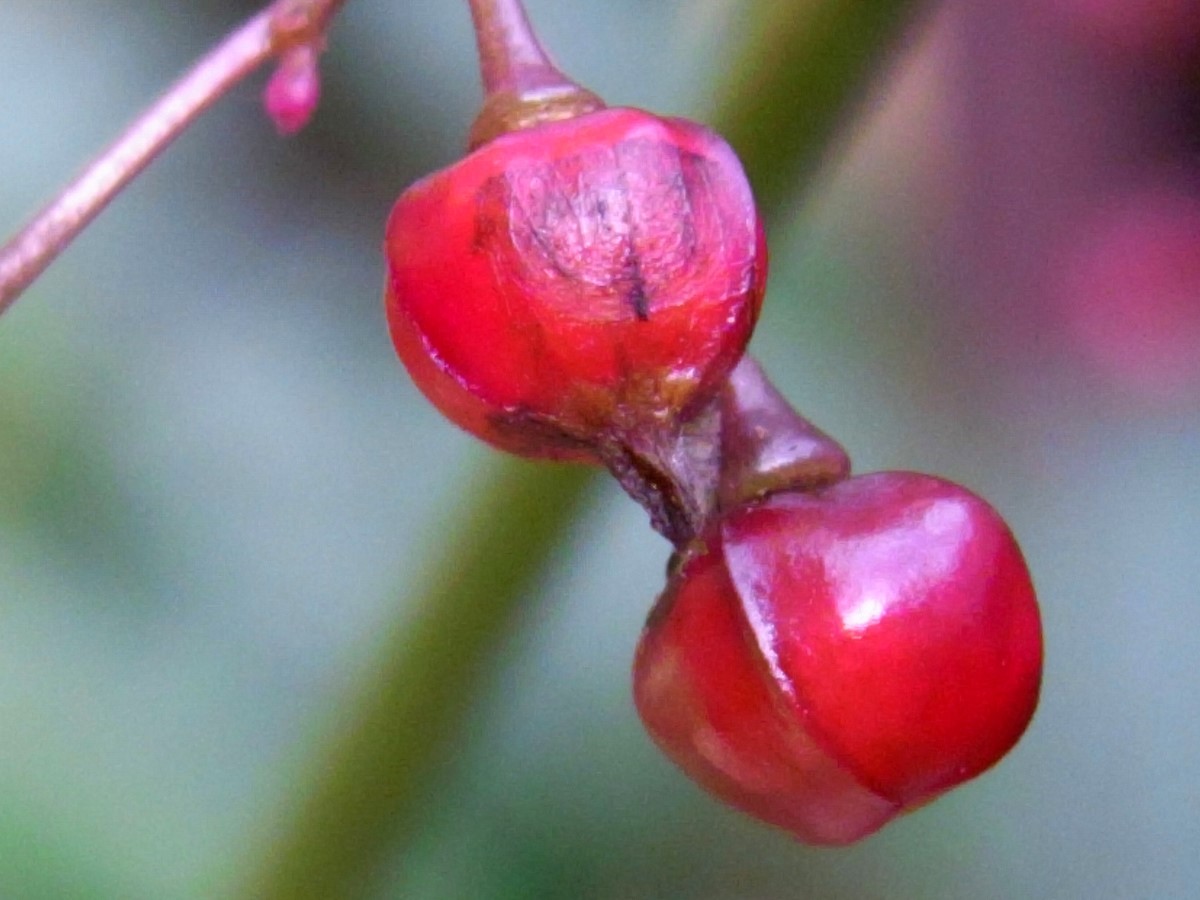
The fruits are round capsules about ⅛ to ¼ inch across, held on thin stalks. They are glossy green at first, then turn red, orange or purplish, and finally fade to tan as they ripen and split, releasing many tiny, shiny black seeds. Because flowers and fruits of every age appear together, a single spray shows a whole range of colors at once.
Quick Facts
| Scientific Name | Talinum paniculatum (Jacq.) Gaertn. (syn. Portulaca paniculata Jacq.) |
| Family | Talinaceae (fameflower family; formerly Portulacaceae) |
| Plant Type | Succulent herbaceous perennial or subshrub; annual in cold climates |
| Mature Height | 1–3 ft in flower (rarely to about 5 ft) |
| Mature Spread | 1–2 ft |
| Growth Rate | Fast |
| Sun Exposure | Full sun to part shade |
| Water Needs | Low to moderate; drought tolerant once established |
| Soil Type | Sandy, rocky or loamy, well-drained soil |
| Soil pH | About 6.0–8.0 |
| Bloom Time | Summer to frost (nearly year-round in the tropics) |
| Flower Color | Pink to reddish pink |
| Fall Color | None; leaves may redden slightly in cool weather |
| Fruit | Glossy round capsule, green to red-orange, ripening tan |
| Deer Resistant | Moderately; occasionally browsed |
| USDA Hardiness Zones | 8–11 as a perennial (grown as an annual elsewhere) |
Native Range
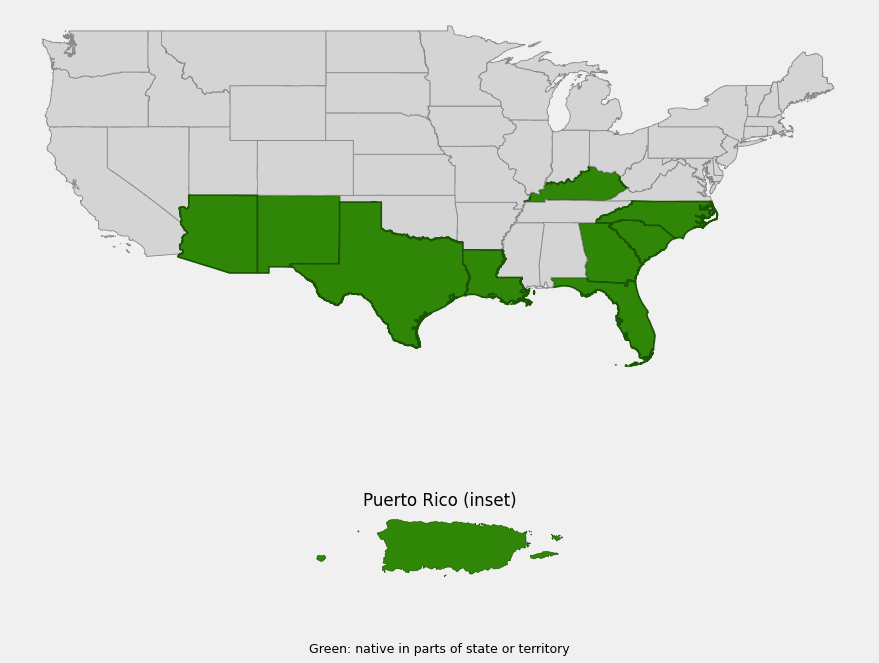
USDA PLANTS lists jewels of Opar as native in the lower 48 states, Puerto Rico and the U.S. Virgin Islands. The Lady Bird Johnson Wildflower Center records it from Arizona, Florida, Georgia, Kentucky, Louisiana, New Mexico, North Carolina, South Carolina and Texas. Its center of abundance in the United States is southern and western Texas, southern Arizona and New Mexico, and Florida, where it grows in rocky, sandy and open ground.
The records from Georgia, the Carolinas and Kentucky are outlying and scattered, and plants there are often found near gardens and towns, so some of them may represent garden escapes. Because no reliable flora we found classes them as introduced, they are shown on the map as part of the USDA range. In Hawaii the species is introduced. Beyond the United States it ranges through Mexico, Central America, the Caribbean and South America to Argentina, and it has naturalized in Africa, Asia and Australia, where it can be weedy.
In Puerto Rico it is a familiar plant of roadsides, pastures, rocky slopes, old walls and gardens, mostly in the drier lowlands but also in moister areas. In Texas it grows in thornscrub, on caliche and limestone outcrops, along brushy fencerows and at the edges of woods, often in partial shade beneath shrubs.
📋 Regional plant lists featuring Jewels of Opar: South & West Texas · Arkansas, Louisiana, Eastern Oklahoma & Eastern Texas · Arizona & New Mexico · North & South Florida · Alabama, Georgia & Mississippi · North & South Carolina · Kentucky & Tennessee · Puerto Rico
Growing & Care Guide
Jewels of Opar is one of the easiest flowering plants you can grow in a hot, sunny garden. It tolerates heat, humidity, poor soil and dry spells, needs no fertilizer, and keeps blooming until frost. The only thing to manage is its enthusiasm for reseeding.
Light
Full sun gives the most compact plants and the most flowers. It also does well in part shade, especially in the hottest parts of Texas and Arizona, where afternoon shade keeps the leaves glossy. Gold-leaved cultivars such as ‘Kingwood Gold’ show their best color in morning sun with some afternoon shade. Indoors it needs a very bright, sunny window or a grow light, and it is happiest outdoors for the summer.
Soil & Water
Any well-drained soil works, from sand and gravel to ordinary garden loam. It grows in limestone and slightly acidic soils alike. Water new plants regularly for the first few weeks, then only during long dry spells. The succulent leaves and thick root store water, and too much water and rich soil make the plant floppy and prone to rot. In containers, use a free-draining potting mix and let the top inch dry out between waterings.
Planting Tips
Plant nursery transplants after the last frost, spacing them about 12 to 18 inches apart. Jewels of Opar looks best where its airy flower sprays can be seen against a darker background or mixed with coarser plants, such as along a path, in a rock garden, in mixed containers or between larger succulents. In zones 8 to 11 it returns from the root each year; in colder areas treat it as an annual or dig the root in fall and keep it in a pot on a bright windowsill or in a cool, frost-free garage.
Pruning & Maintenance
Little maintenance is needed. Cut off old flower stalks once most fruits have ripened if you want to reduce self-sowing, or leave a few if you want new plants next year. Seedlings are easy to pull while small, but larger plants have deep roots that resprout from any piece left in the ground, so remove unwanted plants early. Cut frost-killed stems back in late winter.
Propagation
It is easiest from seed. Let a few capsules ripen to tan and shake the seeds over the soil, or sow them in spring on the surface of moist mix in a warm place; they need light to germinate. Stem cuttings root quickly in moist sand or water, and pieces of root can be potted up. Variegated and gold cultivars should be propagated by cuttings, because seedlings often revert to plain green leaves.
Landscape Uses
- Containers and patio pots: glossy leaves and airy, colorful sprays make a long-lasting summer filler
- Rock and gravel gardens: tolerates heat, drought and poor, stony soil
- Edges of shrub borders: its loose sprays weave between larger native shrubs in part shade
- Cut flowers: fruiting sprays are attractive in fresh and dried arrangements
- Edible garden: young leaves can be cooked as a green in small amounts
Wildlife & Ecological Value
Jewels of Opar is not a major wildlife plant, but its long bloom season and abundant seed add to the food supply in hot, dry gardens and thornscrub.
For Pollinators
The small flowers open in the afternoon and are visited by small native bees, sweat bees and flies, which collect pollen and nectar. Flowers can also self-pollinate, which helps explain the heavy fruit set.
For Birds
Seed-eating birds such as sparrows, finches and doves may pick up the tiny black seeds that fall beneath the plants. In thornscrub, the plant grows in the shade of shrubs where quail and other ground birds forage.
For Mammals
Deer and rabbits sometimes nibble the succulent leaves, but rarely enough to kill the plant, which regrows from its thick root.
Ecosystem Role
As a fast-growing perennial with a deep storage root, it quickly covers bare soil and recovers after drought, fire or mowing. Its seeds persist in the soil and germinate when ground is disturbed. Outside its native range, that same ability makes it a garden escape and minor weed.
Cultural & Historical Uses
The Dutch-born botanist Nikolaus Joseph von Jacquin described this plant in 1760 as Portulaca paniculata, a purslane, based on plants he saw in the Caribbean. The German botanist Joseph Gaertner moved it to Talinum in 1791. Its common names reflect its reputation in different places: Jewels of Opar in American gardens, pink baby’s-breath in the flower trade, and “Java ginseng” or “Javanese ginseng” in Southeast Asia, where the root has long been used in traditional medicine.
The young leaves are eaten in parts of Latin America, Africa and Asia, usually cooked like spinach or added to soups, and they are sometimes used raw in salads. Like purslane and spinach, the leaves contain oxalates, so they are best cooked and eaten in moderation. The Javanese ginseng root has not been shown to have the properties of true ginseng.
Safety note: the plant is not known to be seriously poisonous, but its leaves contain oxalic acid. People with kidney stones or gout, and anyone feeding the plant to pets or livestock, should avoid eating it in large quantities. Do not use the root as a medicine without advice from a health professional.
Frequently Asked Questions
Why is it called jewels of Opar?
The name comes from the 1916 novel Tarzan and the Jewels of Opar by Edgar Rice Burroughs. Gardeners borrowed it because the plant’s glossy round fruits look like tiny red and orange gemstones.
Is jewels of Opar native to the United States?
Yes. USDA PLANTS lists it as native to the lower 48 states and Puerto Rico. It grows wild in Texas, Arizona, New Mexico, Florida and Louisiana, with outlying records in Georgia, the Carolinas and Kentucky.
Is jewels of Opar invasive?
It reseeds freely and can become weedy in gardens, and it has naturalized in Africa, Asia and Australia. Within its native range it is not considered a serious invasive, but removing spent flower stalks keeps it in check.
Are jewels of Opar leaves edible?
Yes, the young leaves are eaten as a cooked green in many countries. They contain oxalates like spinach, so eat them cooked and in moderation.
Will jewels of Opar come back every year?
In zones 8 to 11 it usually returns from its thick root. In colder areas it is grown as an annual, but it often comes back from self-sown seed the following summer.

Looking for a nursery that carries Jewels of Opar?
Browse our native plant nursery directory: Arizona · Florida & Georgia · Kentucky & Louisiana · New Mexico & North Carolina · South Carolina & Texas

