
Shell Mound Pricklypear (Opuntia stricta)
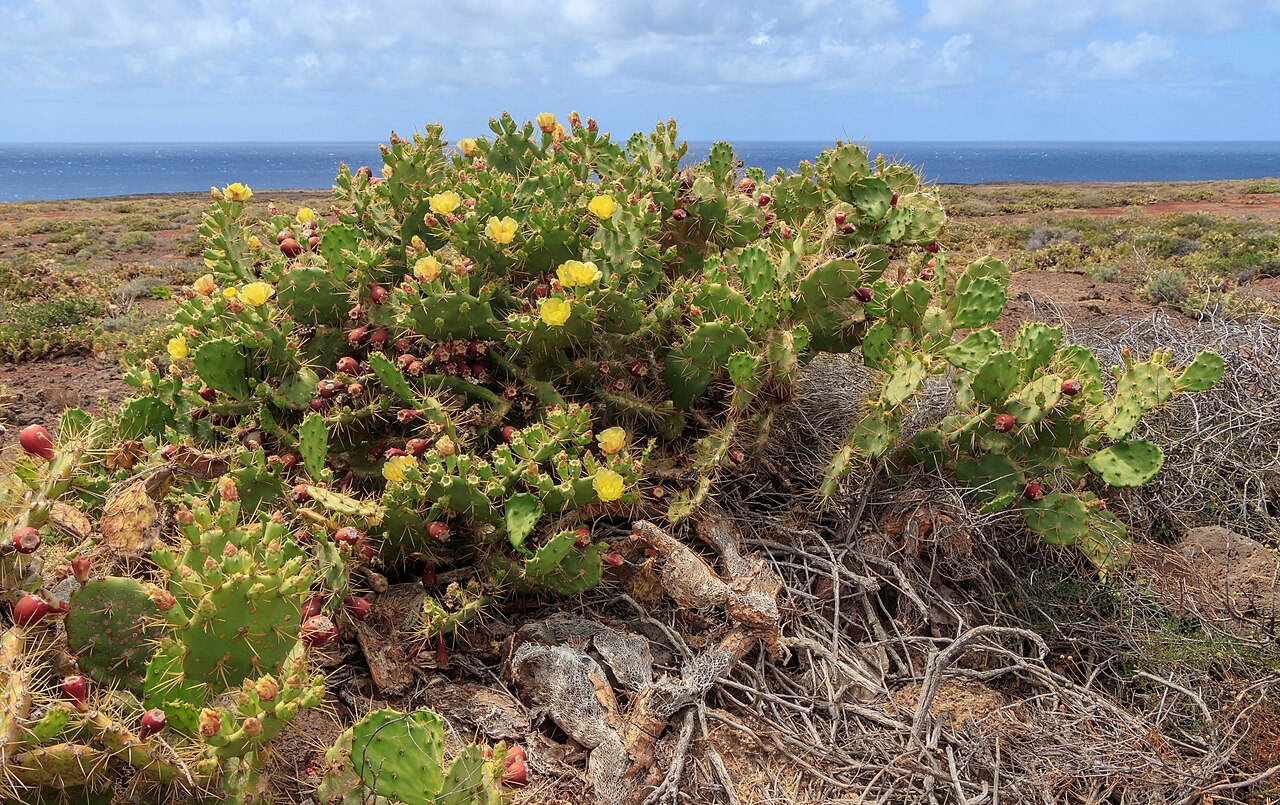
Opuntia stricta, known as Shell Mound Pricklypear, erect pricklypear, coastal prickly pear or Dillen’s prickly pear, is a native cactus of the southeastern coast and the Gulf of Mexico. It forms upright or sprawling clumps of flat, blue-green pads, opens bright lemon-yellow flowers in spring and summer, and bears smooth, wine-red to purple fruits. Many forms have few spines or only short, yellow ones, which makes it one of the friendlier prickly pears to grow.
Its common name comes from one of its favorite habitats: the ancient shell middens (shell mounds) left by Native peoples along the Florida and Gulf coasts, where calcium-rich shell provides the sharp drainage and alkaline soil it loves. It also grows on coastal dunes, barrier islands, coastal hammocks and rocky shores. In Florida it is listed as a state threatened species.
At home it is a modest native, but abroad it is one of the most notorious invasive plants in history. Carried around the world as an ornamental and hedge plant, it overran millions of acres of farmland in Australia in the early 1900s and is still a declared invader in South Africa. This guide covers identification, native range, how to grow it, its wildlife value, and that remarkable story.
Identification
Several prickly pears grow along the southeastern coast, and they hybridize, so identification can be tricky. Shell mound pricklypear is usually taller and more upright than Eastern Prickly Pear, with large, smooth, blue-green pads, few spines and lemon-yellow flowers without a red center.
Growth Form & Pads
Plants are erect to sprawling shrubs usually 1 to 4 feet tall, sometimes taller, made of jointed, flattened stem segments (pads, or cladodes). The pads are obovate to elliptic, about 4 to 10 inches long, thick, smooth and green to blue-green, sometimes with a waxy bloom. Like all opuntias, the pads carry areoles, small raised spots with tufts of tiny barbed bristles called glochids, which detach at a touch and are very irritating.
Spines
Spines vary a lot. The typical variety, var. stricta, is nearly spineless or has a single spine at a few areoles. Var. dillenii has more, stouter yellow spines, often several per areole and up to about 2 inches long. Both forms occur along the U.S. coast, and intermediate plants are common.
Flowers
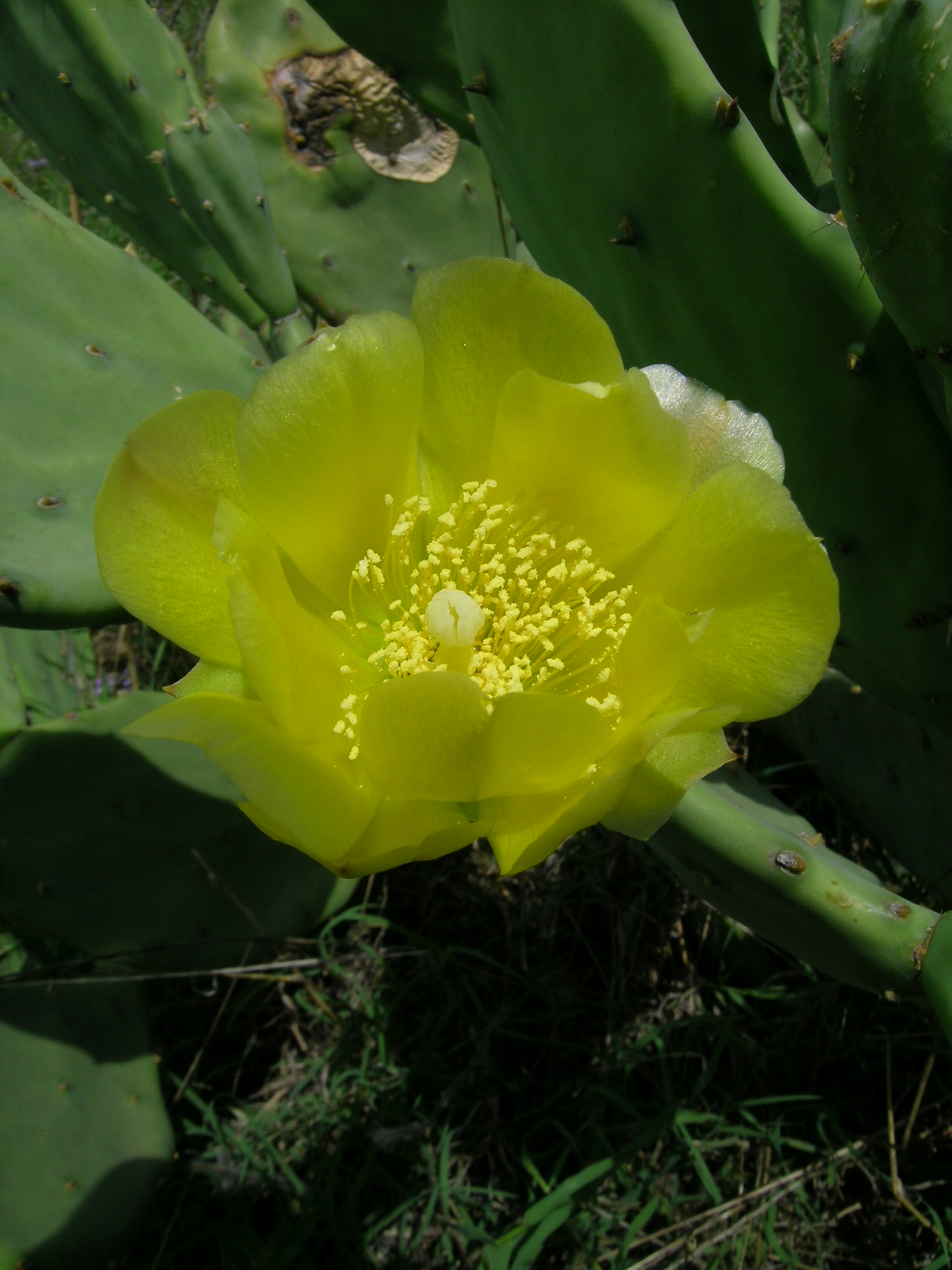
The flowers are borne on the edges of the pads in spring and summer. They are cup-shaped, about 2 to 3 inches across, with clear lemon-yellow petals, many yellow stamens and a green stigma. Unlike several related prickly pears, the flowers lack a red or orange center.
Fruit
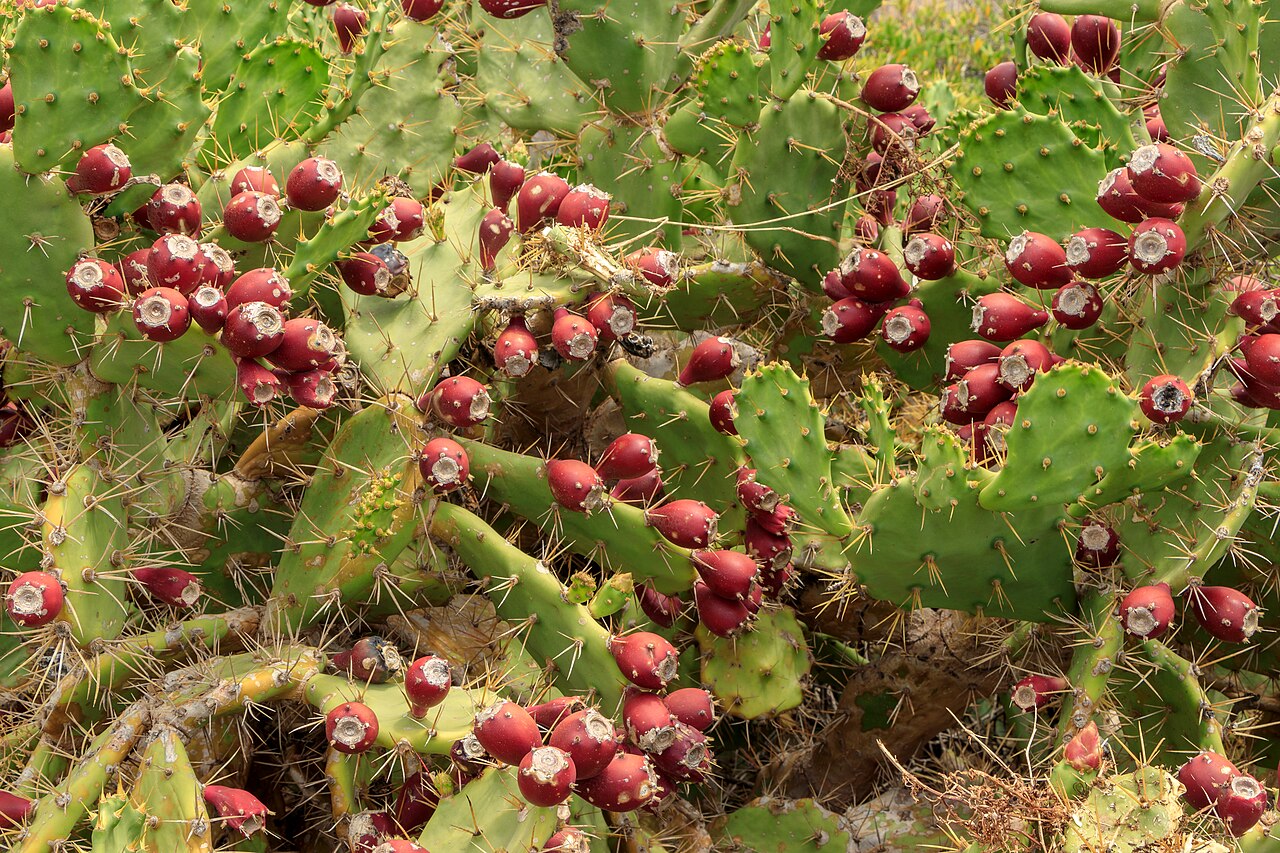
The fruit (a tuna) is pear-shaped, about 1.5 to 2.5 inches long, smooth or with a few small areoles, and ripens to reddish purple or wine red. The pulp is juicy and purplish red, with many hard, pale seeds. The fruits are edible once the glochids are removed, though they are less sweet than those of cultivated prickly pears.
Quick Facts
| Scientific Name | Opuntia stricta (Haw.) Haw.; includes var. dillenii (Ker Gawl.) L.D. Benson |
| Family | Cactaceae (cactus family) |
| Plant Type | Evergreen pad-forming cactus (shrub) |
| Mature Height | 1–4 ft (occasionally to 6 ft) |
| Mature Spread | 3–6 ft or more in clumps |
| Growth Rate | Moderate |
| Sun Exposure | Full sun |
| Water Needs | Very low; drought tolerant |
| Soil Type | Sandy, shelly or rocky soil with excellent drainage; tolerates salt spray |
| Soil pH | About 6.0–8.5 (thrives on alkaline shell soils) |
| Bloom Time | Spring to summer (about April–August) |
| Flower Color | Lemon yellow |
| Fall Color | None; evergreen |
| Fruit | Reddish purple, pear-shaped edible fruit |
| Deer Resistant | Mostly; deer and tortoises eat fruit and some pads |
| USDA Hardiness Zones | 8–11 |
Native Range
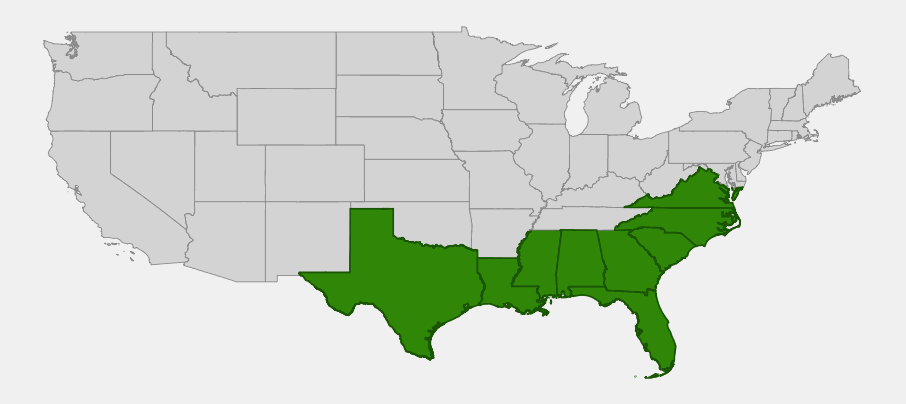
Shell mound pricklypear is native to the coasts of the southeastern United States, the Gulf of Mexico and the Caribbean, south to northern South America. USDA PLANTS lists it as native in Alabama, Florida, Georgia, Louisiana, Mississippi, North Carolina, South Carolina, Texas and Virginia.
In the United States it is mostly a coastal plant. It is most common in Florida, where it grows on dunes, shell mounds, coastal hammocks and rocky shores of both coasts and the Keys, and along the Gulf Coast to Texas. The records from North Carolina and Virginia are outlying ones at the northern edge of its range, and plants there are scarce. Because it is sometimes planted, some inland and northern records may represent old plantings.
Outside the Americas it has been planted and become naturalized in the Mediterranean, the Canary Islands, Africa, the Middle East, India and Australia. It is a declared or listed invasive weed in Australia and South Africa, and it is one of the cacti flagged by global invasive species databases.
📋 Regional plant lists featuring Shell Mound Pricklypear: North & South Florida · Alabama, Georgia & Mississippi · North & South Carolina · Arkansas, Louisiana, Eastern Oklahoma & Eastern Texas · South & West Texas · Maryland, Virginia & West Virginia
Growing & Care Guide
Within its native range, shell mound pricklypear is an excellent, low-maintenance plant for coastal and dry gardens. Plant it only in the Southeast and Gulf Coast where it is native; in other warm, dry parts of the world it can become invasive.
Light
Plant in full sun. In shade, pads become thin, stretched and floppy, and the plant flowers poorly.
Soil & Water
Excellent drainage is essential. It thrives in sand, crushed shell, limestone gravel and rocky soils, including alkaline and salty soils, and tolerates salt spray and seaside wind. Water new plantings lightly every week or two until they root, then leave them to rainfall. In heavy or wet soil, plant on a mound of sand and gravel to prevent rot.
Planting Tips
The easiest way to start a plant is from a pad. Cut a healthy pad at the joint, let the cut end dry and callus for a week or two, then set it upright about one-third deep in dry, sandy soil. It roots within a few weeks in warm weather. Space plants 3 to 6 feet apart and keep them at least a few feet from walkways, play areas and pool decks. Handle pads with tongs, folded newspaper or thick leather gloves: the glochids are much harder to remove than the spines.
Pruning & Maintenance
Remove pads that get in the way by cutting them off at the joint. Dispose of trimmings carefully, because fallen pads root easily. Watch for the invasive cactus moth (Cactoblastis cactorum), whose orange-and-black larvae hollow out pads from the inside; in Florida and along the Gulf Coast, remove and bag infested pads promptly and report sightings to your state extension service.
Propagation
Pads root readily, and plants also grow from seed, which germinates best after the fruit pulp is cleaned off and the seed is given a period of warmth and moisture. Buy plants or pads from a native nursery or a friend’s garden; it is a Florida state-listed species, so never dig plants from the wild.
Landscape Uses
- Coastal and dune gardens: salt-tolerant structure for seaside landscapes in Florida and the Gulf Coast
- Xeriscapes and rock gardens: a native cactus for sunny, sandy, dry sites
- Wildlife gardens: flowers for bees and fruit for birds, mammals and gopher tortoises
- Barrier planting: a living hedge or security planting away from paths
- Edible landscape: fruits for jelly and juice, with careful handling of the glochids
Wildlife & Ecological Value
On coastal dunes and shell mounds, shell mound pricklypear supplies flowers, fruit and safe cover in harsh, sandy places where few other plants grow.
For Pollinators
Bumblebees, native solitary bees (including cactus bees), and honeybees crowd into the large yellow flowers for pollen. Opuntia flowers have touch-sensitive stamens that curl inward when a bee lands, dusting it with pollen.
For Birds
Mockingbirds, thrashers and other birds eat the fruits and spread the seeds. The spiny clumps make protected nesting and roosting sites, and birds perch on them to hunt.
For Mammals
Raccoons, opossums, foxes and rodents eat the fruit. In Florida, gopher tortoises eat both the fruit and the flowers of prickly pears, and box turtles eat fallen fruit.
Ecosystem Role
Its pads store water and its roots bind loose sand, helping to stabilize dunes and shell soils. It is a host for native cactus-feeding insects, including cochineal scales and cactus bugs. In Florida, native prickly pears including this one are threatened by the invasive cactus moth, which arrived from the Caribbean in 1989.
Cultural & Historical Uses
In the 1800s Opuntia stricta was introduced to Australia as a garden and hedge plant. With no natural enemies there, it spread explosively across Queensland and New South Wales. By the mid-1920s invasive prickly pears, mostly this species, covered an estimated 60 million acres and making huge areas unusable for farming. In 1926 scientists released the South American cactus moth, Cactoblastis cactorum, and within about a decade the moth had destroyed most of the infestation, one of the most famous successes of biological control. Farmers in Queensland even built a memorial hall to the moth.
In South Africa it remains a declared invasive plant, spreading in places such as Kruger National Park, where it is managed with a cochineal insect and other control methods. It is also invasive in parts of the Mediterranean, the Middle East and India.
The success of Cactoblastis abroad had an unintended sequel. The moth was later released in the Caribbean, reached the Florida Keys in 1989, and has since spread along the Gulf and Atlantic coasts, where it attacks native prickly pears, including shell mound pricklypear and the rare semaphore cactus. It is a reminder that moving species around can cut both ways.
Frequently Asked Questions
Why is it called shell mound pricklypear?
It often grows on ancient shell middens (shell mounds) left by Native peoples along the Florida and Gulf coasts. The crushed shell makes a well-drained, alkaline soil that suits this cactus.
Is Opuntia stricta native to the United States?
Yes. USDA PLANTS lists it as native along the Southeast and Gulf coasts, from Virginia and the Carolinas to Florida and Texas. It is invasive only outside the Americas, notably in Australia and South Africa.
Is shell mound pricklypear protected in Florida?
Yes. It is listed as a state threatened species in Florida. Grow it from nursery plants or pads, and never dig it from the wild.
Can you eat the fruit of Opuntia stricta?
Yes, the fruits are edible once the tiny glochids are removed, for example by burning or scrubbing them off, then peeling. They are juicy but less sweet than commercial prickly pears and are often made into jelly or juice.
How do I remove prickly pear glochids from my skin?
Use wide tape or a thin layer of white glue: press it on, let it dry, and peel it off. Tweezers help with larger spines. Wear thick gloves when handling the plant to avoid the problem in the first place.

Looking for a nursery that carries Shell Mound Pricklypear?
Browse our native plant nursery directory: Alabama · Florida & Georgia · Louisiana & Mississippi · North Carolina · South Carolina, Texas & Virginia

