
White Grass (Leersia virginica)
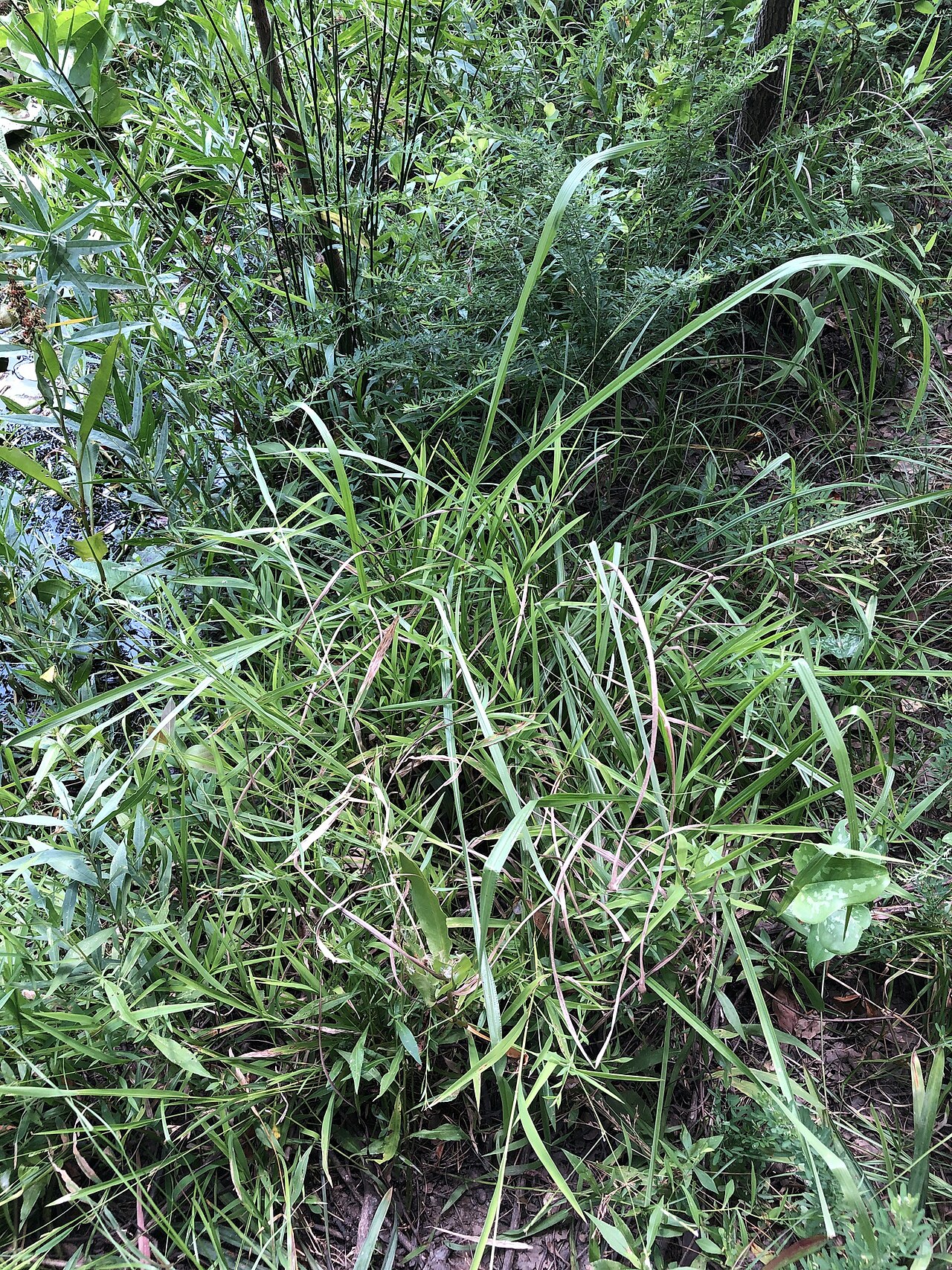
Leersia virginica, known as White Grass or whitegrass, is a native perennial grass of moist, shaded woodlands across the eastern half of North America. It forms loose, sprawling patches of slender stems and soft green leaves on forest floors, floodplains and stream banks, and in late summer it produces delicate, open panicles of tiny, pale, flattened spikelets.
It is one of the few native grasses that thrives in real shade, and it often carpets the ground in bottomland forests where little else grows. Like its relative Rice Cut-grass (L. oryzoides), it belongs to the rice tribe of the grass family (Poaceae), and its flat, one-flowered spikelets look like tiny grains of rice. An older name for it is Homalocenchrus virginicus.
White grass is an excellent, low-key groundcover for shady rain gardens, woodland restorations and streamside plantings. It holds soil on shaded banks, and its foliage feeds the caterpillars of woodland butterflies such as the northern pearly-eye.
Identification
White grass is easy to overlook because it is not showy. Look for a weak-stemmed, sprawling grass in shade, with hairy joints on the stem and a very slender, open panicle of small, flat spikelets pressed tightly to the branches.
Stems and Leaves
The stems are slender and weak, 1½ to 4 feet long, often leaning or sprawling and rooting at the lower joints. They spread from creeping rhizomes to form loose colonies. The joints (nodes) are ringed with short, stiff, downward-pointing hairs. The leaf blades are flat, thin and bright green, about 2 to 7 inches long and ¼ to ½ inch wide, with slightly rough edges.
Flowers
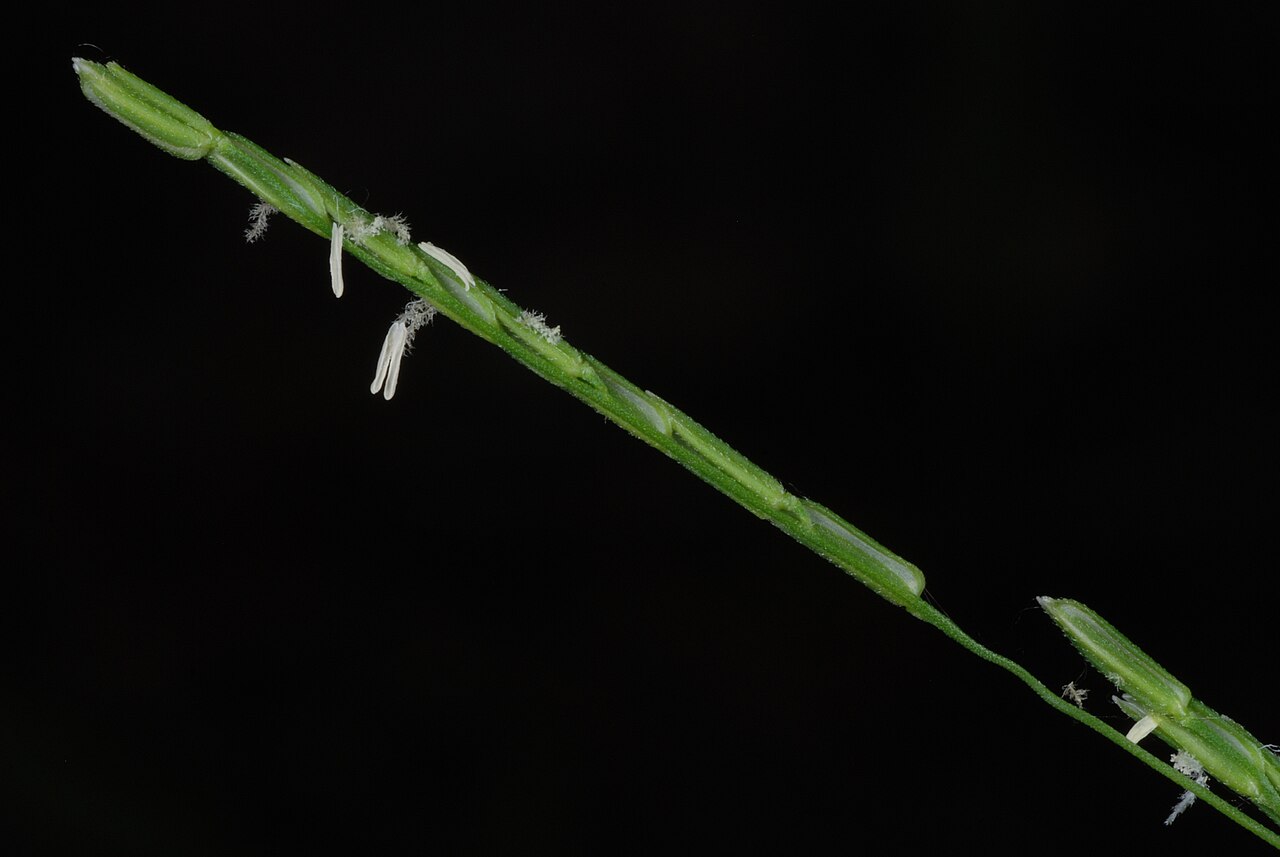
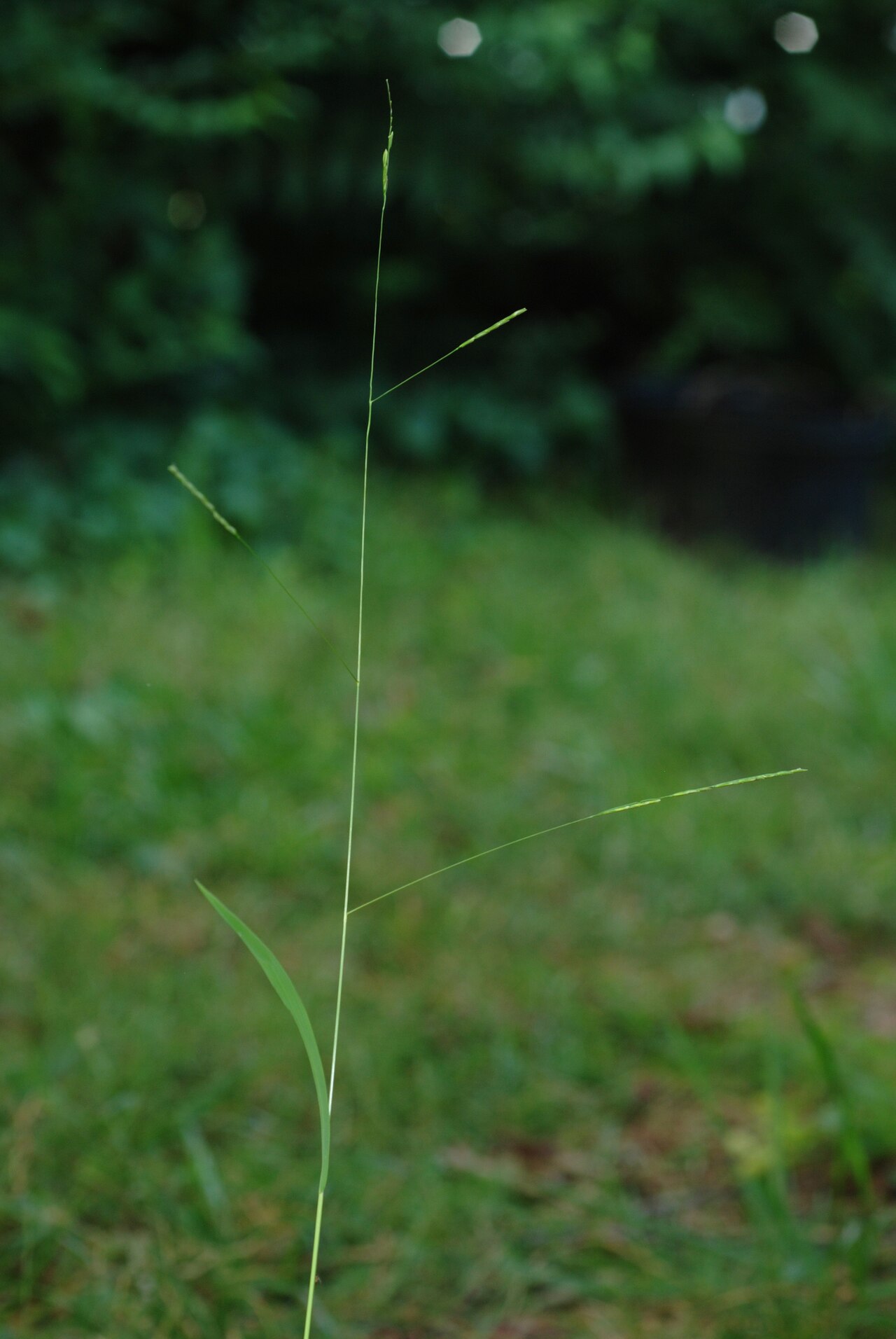
From about July to October, each stem ends in a very open, sparse panicle 2 to 8 inches long with a few long, thread-like, spreading branches. The spikelets are borne only on the outer part of each branch, overlapping and pressed close in a single row.
Spikelets
Each spikelet is a single, strongly flattened flower about ⅛ inch (3 to 4 mm) long, oblong and pale green to whitish, without glumes. The keel of the lemma is fringed with short, stiff bristles.
Similar Species
Rice Cut-grass (L. oryzoides) is a stouter grass of sunny marshes and ditches, with sharply rough leaf edges that can cut skin, and a larger, denser panicle of bigger spikelets (about ¼ inch). White grass is more delicate, grows mostly in shade, and has smaller spikelets on few, very thin branches. Small-flowered panicgrasses and nimblewill can look similar when not in flower, but they lack the flattened, rice-like spikelets.
Quick Facts
| Scientific Name | Leersia virginica Willd. |
| Family | Poaceae (grass family) |
| Plant Type | Rhizomatous perennial grass |
| Mature Height | 1½–4 ft (often sprawling) |
| Mature Spread | Spreads to form loose colonies |
| Growth Rate | Moderate |
| Sun Exposure | Partial to full shade |
| Water Needs | Moderate to high; moist soil |
| Soil Type | Moist loam, silt or clay; tolerates periodic flooding |
| Soil pH | About 5.0–7.5 |
| Bloom Time | July–October |
| Flower Color | Pale green to whitish (inconspicuous) |
| Fall Color | Tan to straw-colored |
| Fruit | Small grain (caryopsis) in a flattened spikelet |
| Deer Resistant | Moderately; lightly browsed |
| USDA Hardiness Zones | 3–9 |
Native Range
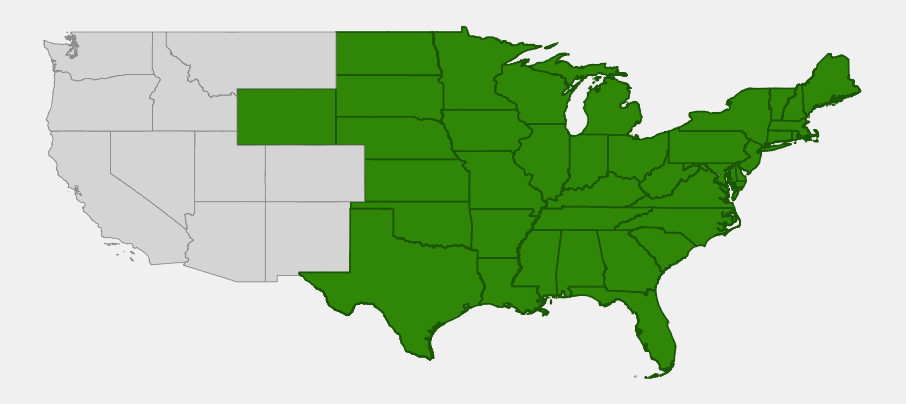
White grass is widespread in eastern and central North America. USDA PLANTS records it as native in 38 states, from Maine, Vermont and the Great Lakes south to Florida and the Gulf Coast, and west to the Dakotas, Nebraska, Kansas, Oklahoma and eastern and central Texas. In Canada it grows in Ontario, Quebec and New Brunswick. USDA also lists a record for Wyoming, far west of its main range; this is an outlying record.
It is most common in the Midwest, the Ohio and Mississippi valleys and the Southeast, and becomes scattered at the northern and western edges of its range, including northern New England and the Dakotas.
Its habitat is moist to wet, shaded ground: floodplain and bottomland forests, wooded stream banks, swamp margins, ravines, moist slopes and shady trails. It tolerates periodic flooding and soil compaction, and it often forms extensive patches in river bottoms beneath silver maple, sycamore and other floodplain trees.
📋 Regional plant lists featuring White Grass: North & South Florida · Alabama, Georgia & Mississippi · North & South Carolina · Maryland, Virginia & West Virginia · Kentucky & Tennessee · Arkansas, Louisiana, Eastern Oklahoma & Eastern Texas · Illinois, Iowa & Missouri · Ohio & Indiana · Nebraska, Kansas & Eastern Colorado · North Dakota, South Dakota & Western Minnesota · Michigan, Wisconsin & Eastern Minnesota · New York, Pennsylvania & Northern New Jersey · Delaware, Southern New Jersey & Long Island · Connecticut, Massachusetts & Rhode Island · New Hampshire, Maine & Vermont · Montana & Wyoming · South & West Texas
Growing & Care Guide
White grass is an easy, adaptable native for shady, moist spots. It is offered by some native plant nurseries and seed companies, mainly for restoration and rain gardens. It is not an ornamental showpiece; grow it as a soft, informal groundcover where turf grass fails.
Light
Partial to full shade is best. It grows under dense tree canopy and on north-facing slopes. It tolerates some sun if the soil stays moist.
Soil & Water
It prefers consistently moist to wet loam, silt or clay, and it handles periodic flooding well. It tolerates short dry spells once established but looks best where the soil does not dry out. It does not need fertilizer.
Planting Tips
Plant plugs about 12 to 18 inches apart in spring or fall. It spreads by rhizomes and seed to fill in gaps, making it good for shaded rain gardens, swales and stream banks. Combine it with ferns, sedges, jewelweed and woodland wildflowers.
Pruning & Maintenance
It needs very little care. Cut or mow old stems in late winter if you want a tidier look. It can spread vigorously in ideal moist shade, so give it room or edge it where it meets more delicate plants.
Propagation
Divide established patches in spring. Seed can be sown in fall outdoors or cold-stratified for about two months before spring sowing. Plants also self-seed in moist, shaded soil.
Landscape Uses
- Shade groundcover: a native alternative to lawn under trees in moist soil
- Rain gardens and swales: tolerates periodic flooding in shade
- Stream bank stabilization: rhizomes hold soil on shaded banks
- Floodplain forest restoration: a common understory grass of bottomland woods
- Butterfly gardens: larval host for woodland butterflies
Wildlife & Ecological Value
White grass is a modest but valuable plant for wildlife in shaded, moist woods.
For Pollinators
Like other grasses, white grass is wind-pollinated and offers little nectar. Its foliage, however, is a larval host for the northern pearly-eye (Enodia anthedon), a woodland butterfly, and it is also listed as a host for Peck’s skipper.
For Birds
Ground-feeding birds and waterfowl in floodplain forests eat the small grains, and the dense patches give cover to ground-nesting birds and wild turkeys.
For Mammals
Deer graze it lightly, and small mammals such as voles and mice use the patches for cover and eat the seeds.
Ecosystem Role
In bottomland forests, white grass forms a living mat that holds silt and soil during floods and slows erosion along streams. It is a characteristic understory species of healthy floodplain woods and an indicator of moist, shaded habitat.
Cultural & Historical Uses
The German botanist Carl Ludwig Willdenow described Leersia virginica in 1797. The genus honors Johann Daniel Leers, an 18th-century German botanist and pharmacist who wrote a flora of the Herborn region.
The common name “white grass” probably refers to the pale, whitish spikelets. The species has also been called Homalocenchrus virginicus, and that name appears in older floras such as Britton and Brown’s Illustrated Flora.
Today white grass is used mostly in ecological restoration of floodplain forests and in shade rain gardens. Botanists value it as one of the common native grasses that tell you you are in a moist, shaded bottomland woodland.
Frequently Asked Questions
How is white grass different from rice cut-grass?
Rice Cut-grass (L. oryzoides) grows in sunny marshes and ditches and has sharply rough leaves that can cut skin, and larger spikelets in a denser panicle. White grass is a slender shade grass of moist woods with smaller spikelets on a few very thin branches.
Will white grass grow in deep shade?
Yes. It is one of the most shade-tolerant native grasses and grows well under dense canopy in moist soil.
Is white grass a good lawn substitute?
It can serve as an informal, unmowed groundcover in moist shade where turf grass fails. It does not tolerate heavy foot traffic or close mowing like a lawn grass.
Does white grass spread aggressively?
It spreads by rhizomes and seed and can form large patches in moist shade, but it is a native plant and not invasive. Give it room in a naturalistic planting.
What wildlife uses white grass?
Its leaves feed caterpillars of the northern pearly-eye butterfly, and ground birds and small mammals eat the seeds and use the patches for cover.

Looking for a nursery that carries White Grass?
Browse our native plant nursery directory: Alabama & Arkansas · Connecticut, Delaware, Florida & Georgia · Illinois, Indiana, Iowa & Kansas · Kentucky, Louisiana, Maine, Maryland, Massachusetts, Michigan, Minnesota, Mississippi & Missouri · Nebraska, New Hampshire, New Jersey, New York, North Carolina, North Dakota, Ohio & Oklahoma · Pennsylvania, Rhode Island, South Carolina, South Dakota, Tennessee, Texas, Vermont & Virginia · West Virginia, Wisconsin & Wyoming

