
Common Water-Crowfoot (Ranunculus aquatilis)
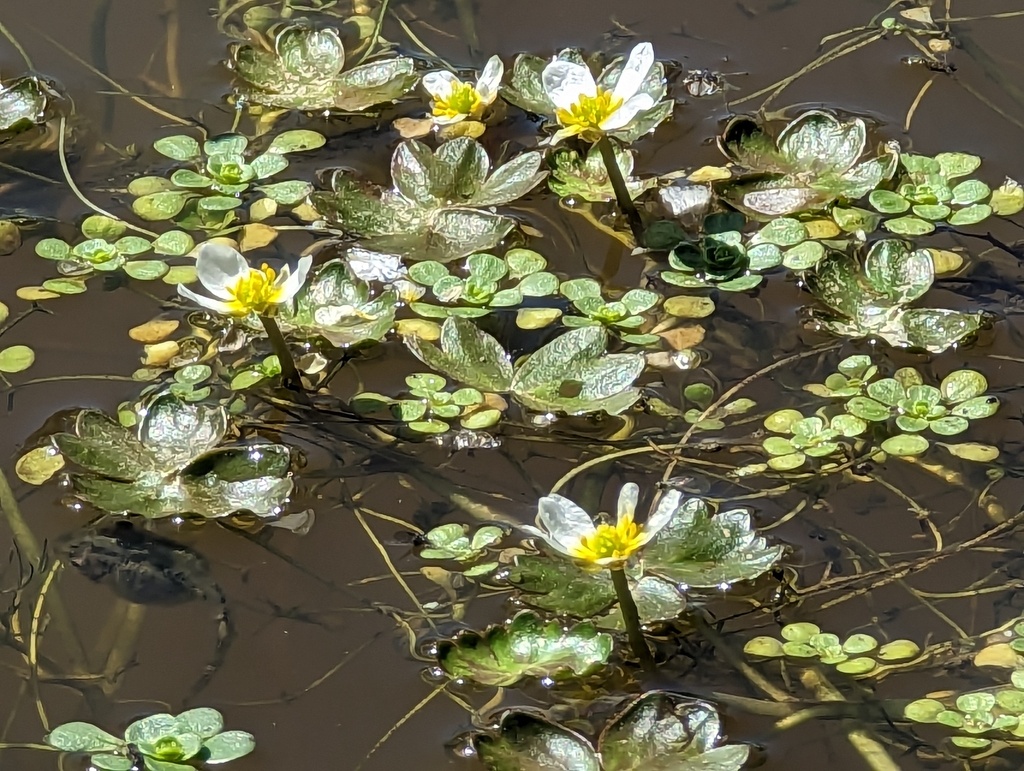
Ranunculus aquatilis, known as Common Water-Crowfoot (also white water crowfoot or water buttercup), is an aquatic buttercup that lives in ponds, ditches, lake margins and slow streams. Its long, flexible stems grow underwater, with feathery, thread-like submerged leaves, and in many plants also round, lobed leaves that float on the surface. In spring and summer it covers the water with small white flowers, each with a yellow center, held just above the surface.
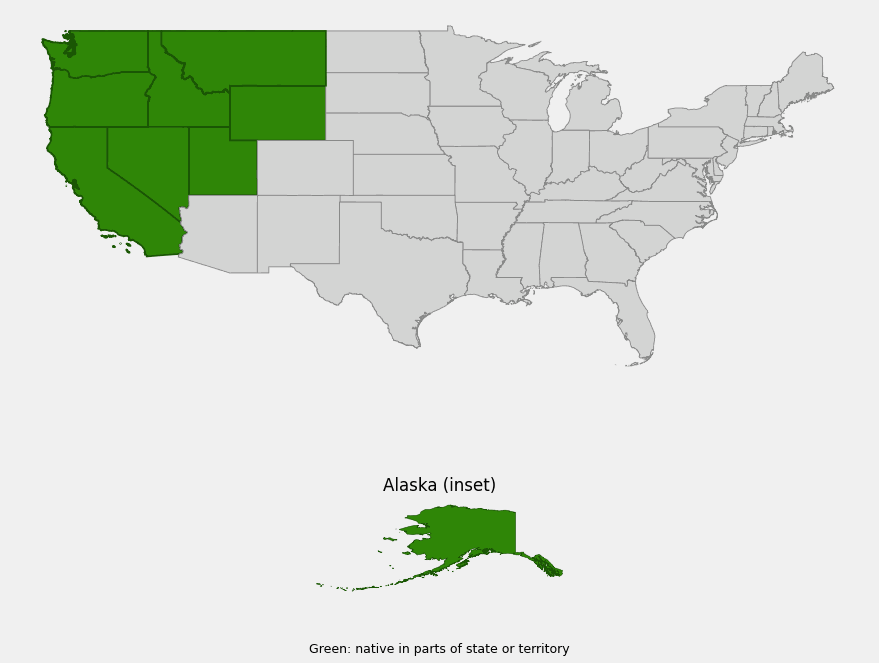
Water-crowfoots are found across the cool and temperate parts of the Northern Hemisphere, and they are among the classic flowers of European chalk streams and ponds. In the United States, USDA PLANTS lists Ranunculus aquatilis as native in Alaska and the western states, from Washington, Oregon and California east to Idaho, Montana, Wyoming, Nevada and Utah. Closely related thread-leaved water-crowfoots grow across much of the rest of the country.
It is a valuable native for wildlife ponds in the West, giving cover to fish, frogs and aquatic insects and food to waterfowl. Like other buttercups it contains irritating, toxic compounds, so it is a plant for the pond, not the plate.
Identification
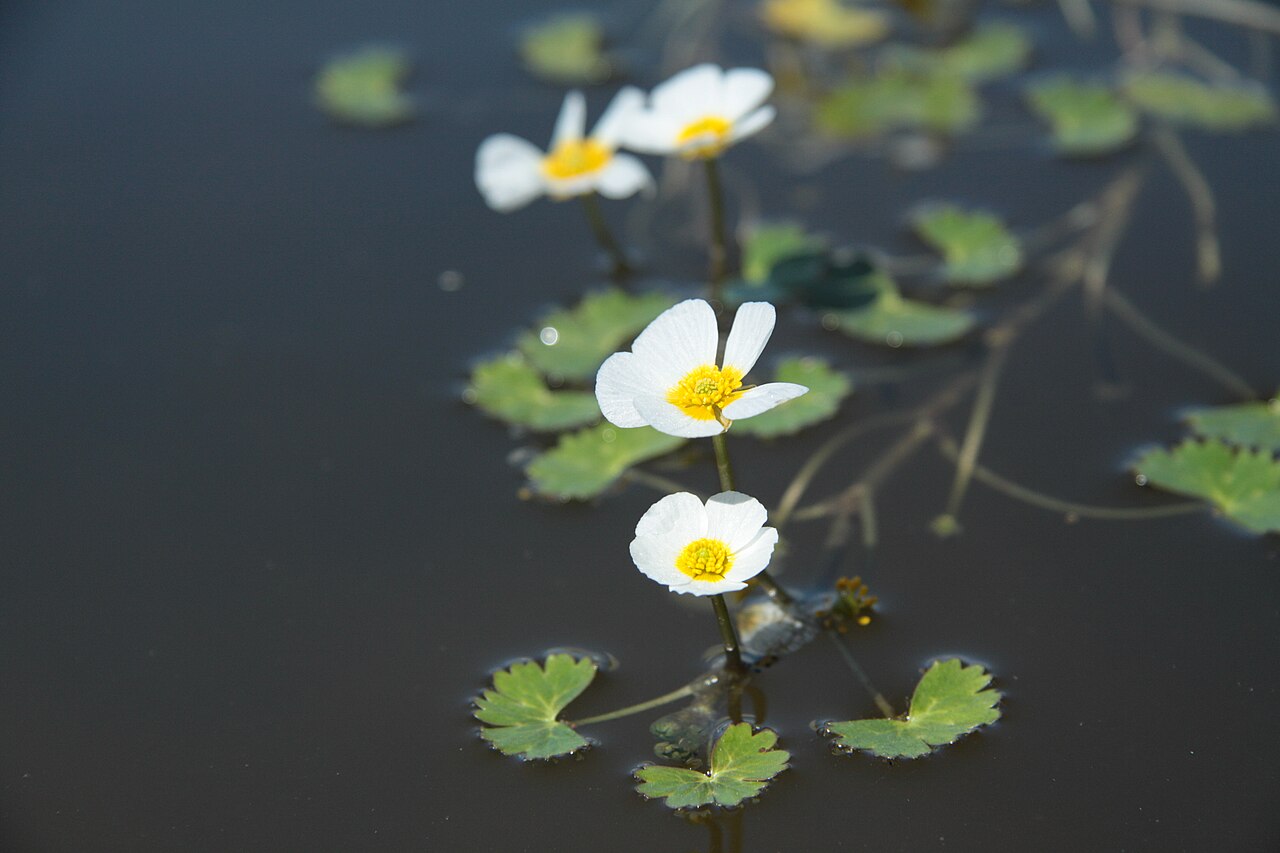
Look for a buttercup growing in water, with masses of feathery, finely divided underwater leaves, often some floating, round to kidney-shaped leaves with three to five lobes, and white, five-petaled flowers with yellow centers about 1/2 to 3/4 inch across.
Growth Habit
Common water-crowfoot is a perennial (sometimes annual) aquatic herb. Its slender, branching stems grow 1 to 6 feet long underwater, rooting at the lower nodes in mud, and can form dense mats in shallow, still or slow-moving water. When water levels drop, it can survive as a small, creeping land form on wet mud.
Leaves
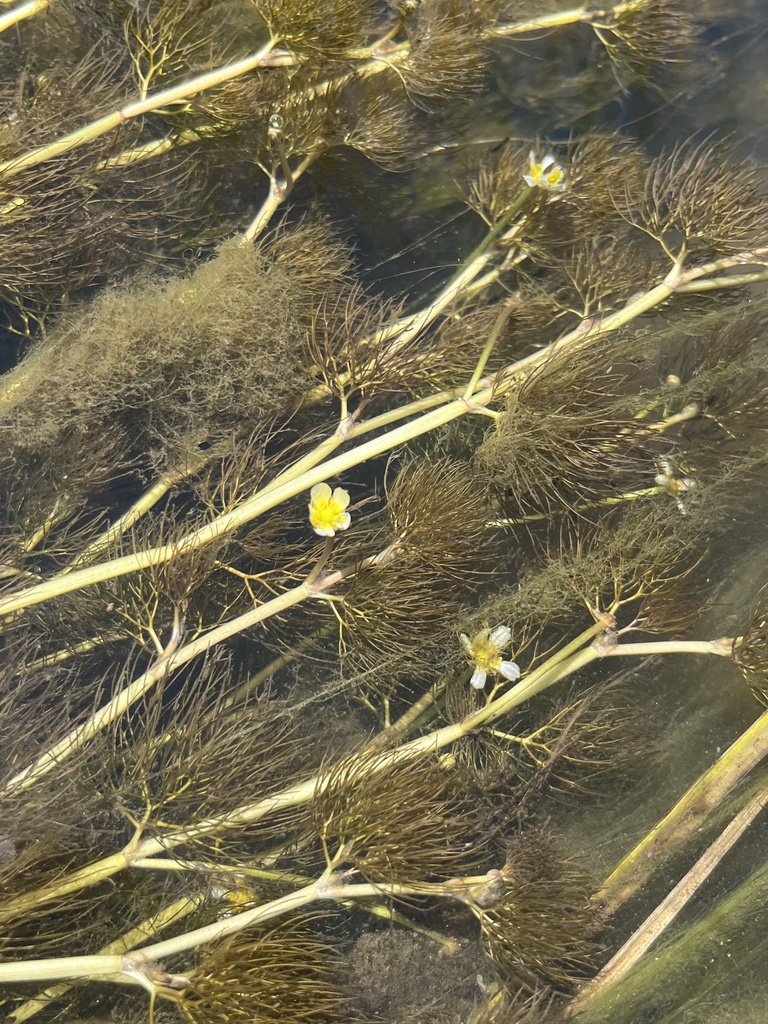
It has two kinds of leaves. The submerged leaves are divided again and again into many fine, thread-like segments that collapse into a limp tassel when lifted out of the water. Many plants also have floating leaves on the surface: these are round to kidney-shaped, about 1/2 to 1 1/4 inches across, and divided into three to five toothed lobes. Plants without floating leaves are often called thread-leaf water-crowfoot.
Flowers
The flowers are borne singly on short stalks from the leaf nodes, opening just above the water. Each is about 1/2 to 3/4 inch across, with five white, rounded petals that are yellow at the base, and many yellow stamens around a small green center of pistils. Flowering is mainly from late spring through summer.
Fruit & Seeds
After flowering the stalk usually curves down and the flower develops into a small, round head of tiny, wrinkled achenes, which sink or are carried away by water and waterfowl.
Look-alikes
Other white-flowered water-crowfoots, such as thread-leaf water-crowfoot (Ranunculus trichophyllus) and longbeak water-crowfoot (R. longirostris), are very similar and are separated by technical details of the leaves and fruit; some botanists lump them with R. aquatilis. Yellow water-crowfoot (R. flabellaris) has yellow flowers. Submerged plants without flowers can be confused with watermilfoils and coontail, which have whorled leaves, or with bladderworts, which have tiny bladders on their leaves.
Quick Facts
| Scientific Name | Ranunculus aquatilis |
| Family | Ranunculaceae (buttercup family) |
| Plant Type | Aquatic perennial herb (submerged and floating leaves) |
| Mature Height | Flowers held about 1 in above the water; stems 1–6 ft long |
| Mature Spread | Forms mats several feet across |
| Growth Rate | Fast |
| Sun Exposure | Full sun to part shade |
| Water Needs | Aquatic; water about 6 in to 3 ft deep |
| Soil Type | Mud, silt, sand or gravel under shallow water |
| Soil pH | Slightly acidic to alkaline (about 6.0–8.5) |
| Bloom Time | May–August |
| Flower Color | White with a yellow center |
| Fall Color | None notable |
| Fruit | Round head of small achenes |
| Deer Resistant | Not applicable (aquatic); toxic to livestock |
| USDA Hardiness Zones | 3–9 |
Native Range
Common water-crowfoot is widespread across Europe, northern Africa and Asia, and in North America. USDA PLANTS lists Ranunculus aquatilis as native in nine states: Alaska, Washington, Oregon, California, Idaho, Nevada, Utah, Montana and Wyoming. In Canada it is listed from British Columbia and the Northwest Territories.
The classification of white water-crowfoots is difficult. Some floras, including the Flora of North America, treat R. aquatilis broadly to include thread-leaved plants (var. diffusus, often called R. trichophyllus), which grow across most of Canada and the northern and western United States. This page follows USDA PLANTS for the map, which shows the narrower species.
It grows in shallow, fresh, cool water: ponds, lake margins, marshes, ditches, irrigation canals, vernal pools and slow streams and springs, from sea level up to mountain lakes. It prefers clear, still or gently flowing water and full sun, and in seasonal pools it may finish its cycle as the water dries.
📋 Regional plant lists featuring Common Water-Crowfoot: Idaho, Eastern Oregon & Eastern Washington · Montana & Wyoming · Utah & Western Colorado · Alaska · Western Oregon & Western Washington · California & Nevada
Growing & Care Guide
Common water-crowfoot is an attractive oxygenating plant for wildlife ponds within its native range. It is easy to grow in cool, clear water and flowers freely in sun. Collect only from your own land or buy from aquatic plant nurseries, and never move it into waters outside its native range.
Light
Full sun for the best flowering; it tolerates part shade.
Soil & Water
Grow it in still or slowly moving fresh water 6 inches to about 3 feet deep, rooted in mud, loam or gravel. It prefers cool, clear, nutrient-moderate water and can die back in warm, stagnant water in midsummer.
Planting Tips
Plant stem cuttings or rooted pieces in spring, either pressed into the mud of the pond bottom or in aquatic baskets of heavy loam topped with gravel, set on a shelf in the pond. A few pieces will spread to cover several square feet in a season.
Pruning & Maintenance
Thin it in summer if it covers too much of a small pond, leaving the removed material on the bank for a day so animals can crawl back into the water. It may die back after flowering and regrow from stem fragments and seed. Wear gloves when handling it.
Propagation
It roots easily from stem cuttings placed in shallow water or wet mud. Seed sown fresh in pans of mud under shallow water also germinates.
Safety: Toxic Plant
Like other buttercups, water-crowfoot contains ranunculin, which breaks down to the irritant protoanemonin when the plant is crushed. The fresh plant can blister skin and the mouth and is toxic if eaten, and it has poisoned livestock. Wear gloves when thinning it, keep pets and children from chewing it, and never eat it. Dried plants are much less toxic.
Landscape Uses
- Wildlife ponds: oxygenating cover for fish, frogs and insects
- Natural swimming ponds: helps keep water clear in cool, sunny ponds
- Rain and stormwater ponds: fills shallow, seasonally wet basins
- Wetland restoration: native cover for western ponds and ditches
Wildlife & Ecological Value
Water-crowfoot is a small but important plant in western ponds and streams, both above and below the water.
For Pollinators
The white flowers are visited by small bees, hover flies and other flies, which land on the flowers floating just above the water.
For Birds
Ducks, geese, swans and coots eat the stems, leaves and seeds, and dabbling ducks also feed on the many insects and snails living among the leaves.
For Mammals
Muskrats and beavers may eat it. Deer and livestock that eat large amounts of fresh plants can be poisoned.
Ecosystem Role
The dense, feathery underwater leaves release oxygen, slow the current, trap sediment and shelter fish fry, tadpoles, aquatic insects and snails. Its mats are an important habitat in cold streams and spring-fed pools.
Cultural & Historical Uses
The genus name Ranunculus means “little frog” in Latin, because many buttercups grow in wet places where frogs live. Aquatilis means “living in water.” The name crowfoot refers to the divided leaves of buttercups, thought to look like a crow’s foot.
Water-crowfoot is a famous example of heterophylly: the same plant makes very different leaves underwater and on the surface. Botanists have long used it to study how water depth, light and temperature control leaf shape.
In England, water-crowfoot beds are a celebrated feature of chalk streams, where they shelter trout and in early summer turn whole stretches of river white with flowers.
Frequently Asked Questions
Is water-crowfoot poisonous?
Yes. Like other buttercups, the fresh plant contains compounds that irritate skin and the mouth and are toxic if eaten. Wear gloves when handling it and never eat it.
Is water-crowfoot good for ponds?
Yes. It oxygenates the water, shelters wildlife and flowers prettily. Use it only within its native range and thin it if it spreads too much.
Why does water-crowfoot have two kinds of leaves?
Underwater it grows fine, thread-like leaves that suit life in the water, and at the surface it grows broader floating leaves. This is called heterophylly.
When does water-crowfoot bloom?
Mainly from May to August, depending on elevation and water temperature.
Where is water-crowfoot native in the United States?
USDA lists it in Alaska and the western states from Washington and California east to Montana, Wyoming and Utah. Related thread-leaved water-crowfoots grow farther east.

Looking for a nursery that carries Common Water-Crowfoot?
Browse our native plant nursery directory: Alaska · California · Idaho · Montana · Nevada · Oregon · Utah · Washington · Wyoming

