
Delta Arrowhead (Sagittaria platyphylla)
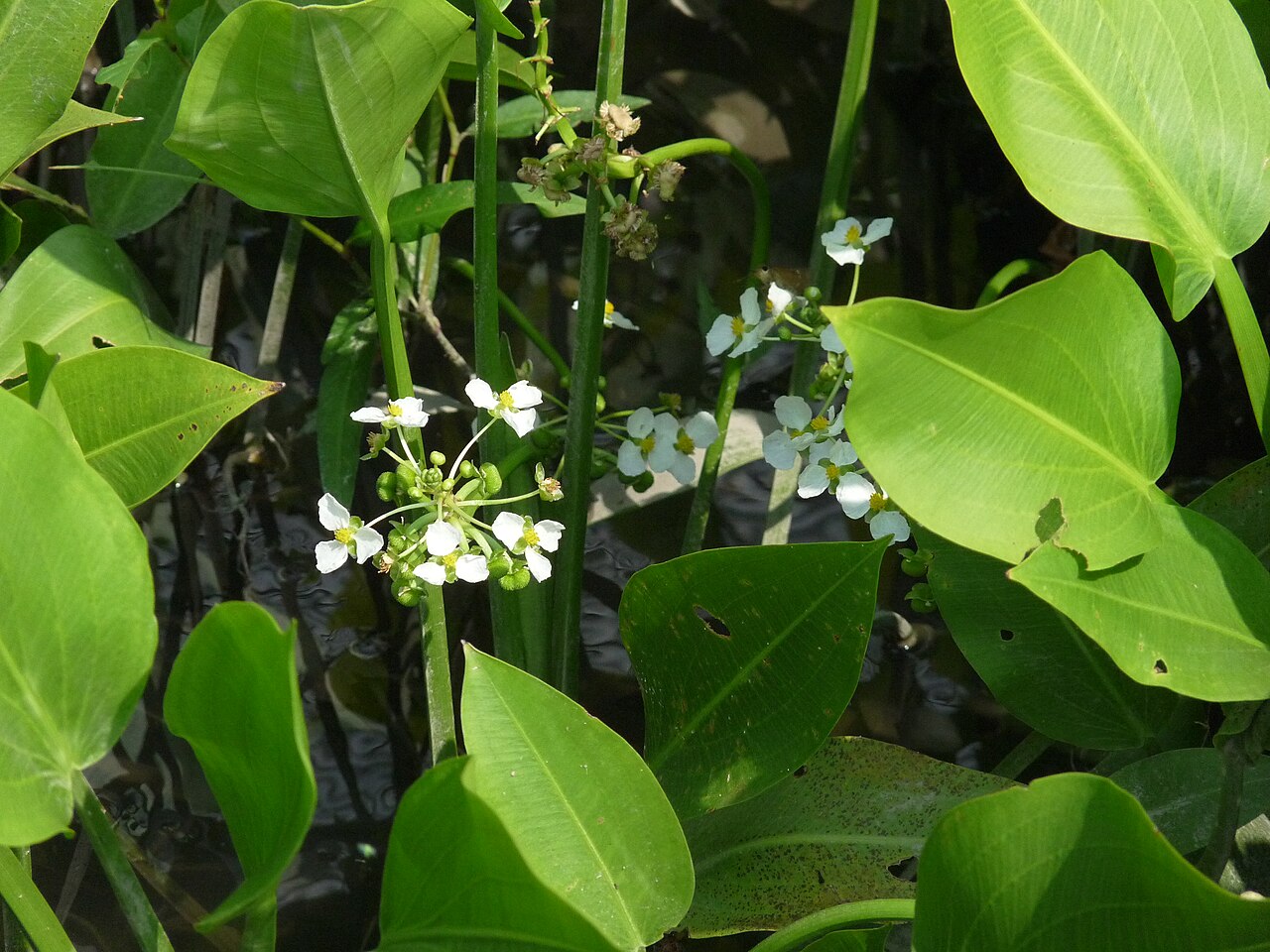
Sagittaria platyphylla, known as Delta Arrowhead, delta duck-potato or broadleaf arrowhead, is an emergent aquatic perennial of ponds, marshes, ditches and slow streams in the southeastern and south-central United States. Despite the name arrowhead, its leaves usually have no basal lobes at all: the emergent leaves are broad, lance-shaped to oval blades on long stalks, standing 1 to 3 feet above the water. From late spring through summer it sends up stalks of crisp white, three-petaled flowers with yellow centers.
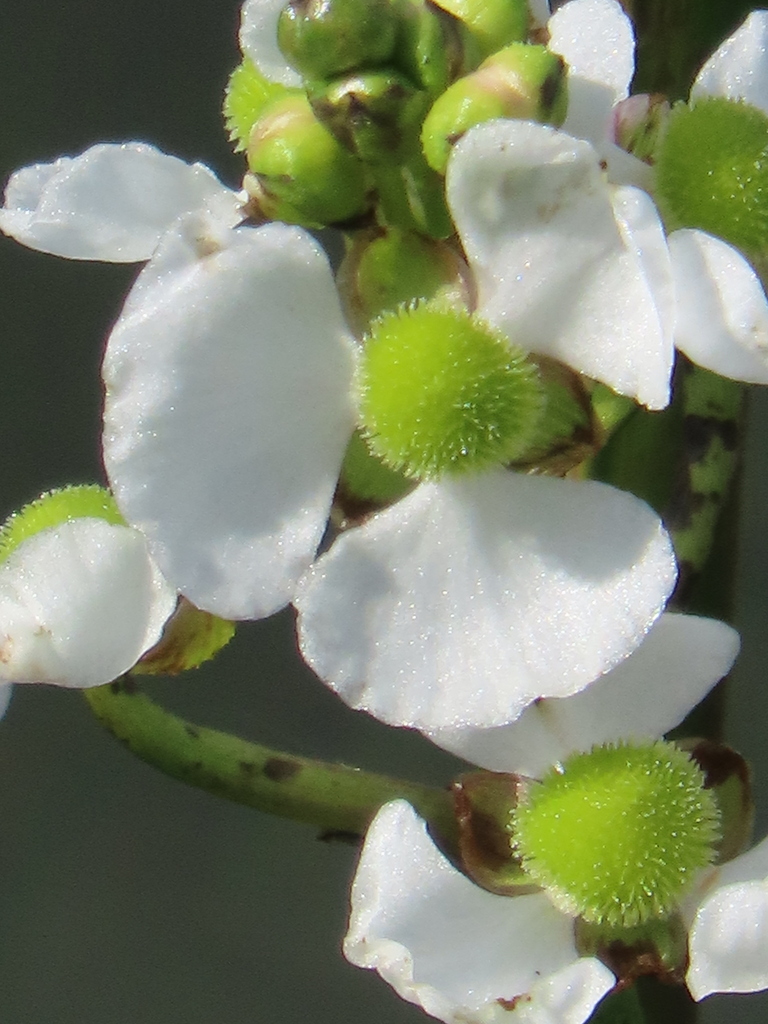
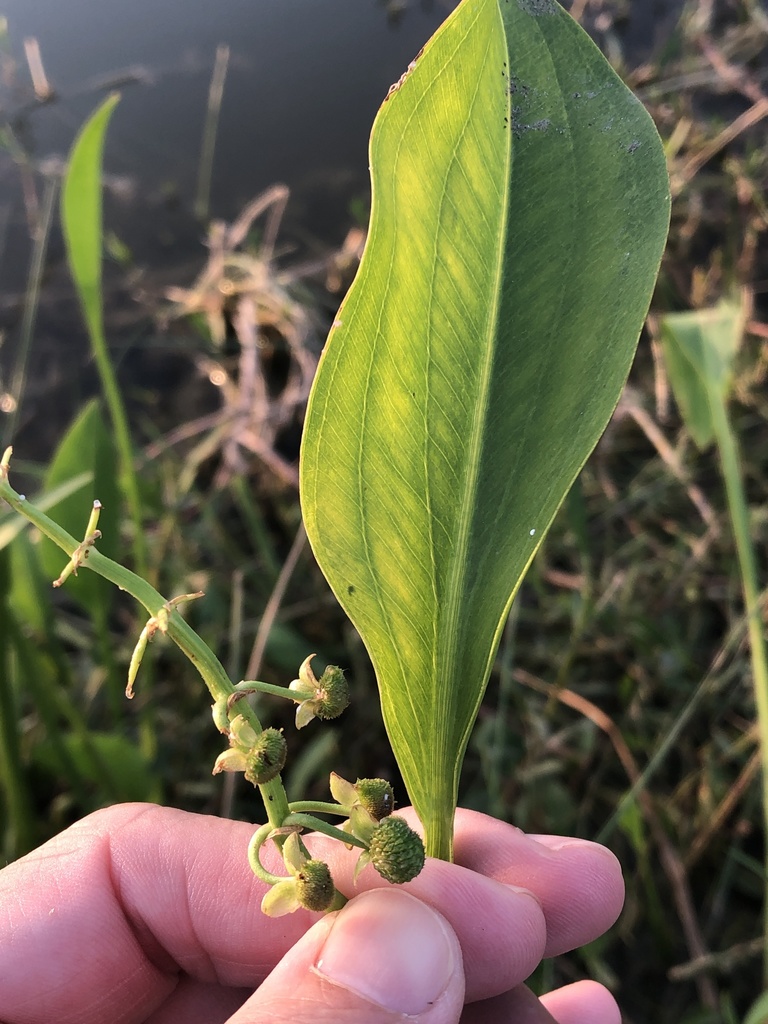
It belongs to the water-plantain family (Alismataceae), with the more familiar duck potato (Sagittaria latifolia). It was once treated as a variety of grassy arrowhead (Sagittaria graminea var. platyphylla), and the old name Sagittaria recurva refers to its most useful identification feature: the fruiting stalks curve sharply downward as the fruit heads ripen. The species name platyphylla means “broad leaf”.
Delta arrowhead spreads by stolons and small underground corms as well as by seed, so it forms colonies along shallow shorelines. It is a good native plant for water gardens, rain gardens and wetland restoration within its range, and it supports pollinators, waterfowl and other wetland wildlife. This guide covers how to identify it, where it grows, how to grow it, and its value to wildlife.
Identification
Delta arrowhead is easiest to identify in summer, when it has flowers and fruit. Look for unlobed, lance-shaped to oval leaves, whorls of white flowers, and fruit heads that hang on downward-curving stalks.
Growth Habit
It is a clump-forming emergent aquatic perennial, usually 1 to 3 feet tall and occasionally up to about 5 feet. Plants grow from underground corms and spread by stolons, forming loose colonies in shallow water and wet mud. In deeper or flowing water it may produce only submerged, strap-like leaves.
Leaves
The emergent leaves have long, spongy stalks and broad blades that are lance-shaped, elliptic or oval, up to about 7 inches long. Unlike duck potato, the blades usually lack the backward-pointing basal lobes that give arrowheads their name. Submerged leaves are reduced to flattened, ribbon-like stalks with no true blade.
Flowers
The flowering stalk carries 3 to 9 whorls of flowers, usually three per whorl. Each flower is up to about 3/4 inch across, with three rounded white petals and a center of yellow stamens or green pistils. Female flowers are in the lower whorls and male flowers above. Bloom time is mainly late spring through summer, and almost year-round in the warmest parts of its range.
Fruit & Seeds
After flowering, the female flowers develop into round, bristly green heads about 1/2 inch across, made of many small, winged achenes. As they develop, the fruiting stalks thicken and bend sharply downward, so the heads hang below the level of the whorl. The heads break apart when ripe and the achenes float away on the water.
Look-alikes
Duck potato (Sagittaria latifolia) has true arrow-shaped leaves with large basal lobes. Lanceleaf arrowhead (Sagittaria lancifolia) has narrower, often taller leaves and fruiting stalks that stay upright or spread. Grassy arrowhead (Sagittaria graminea) is smaller, with narrower leaves and ascending fruiting stalks. Delta arrowhead is identified by its broad, unlobed leaves together with its downward-curving fruiting stalks.
Quick Facts
| Scientific Name | Sagittaria platyphylla (Engelm.) J.G. Sm. |
| Family | Alismataceae (water-plantain family) |
| Plant Type | Emergent aquatic perennial with corms and stolons |
| Mature Height | 1–3 ft (rarely to 5 ft) |
| Mature Spread | 1–2 ft per clump; spreads into colonies |
| Growth Rate | Fast |
| Sun Exposure | Full sun to part shade |
| Water Needs | High; shallow standing water or saturated mud |
| Soil Type | Mucky, silty or sandy mud in shallow water |
| Soil pH | About 6.0–7.5 |
| Bloom Time | May–September (longer in Florida and South Texas) |
| Flower Color | White with a yellow or green center |
| Fall Color | None notable; foliage dies back in cold winters |
| Fruit | Round, bristly heads of small winged achenes on recurved stalks |
| Deer Resistant | Moderately; waterfowl and muskrats eat it more than deer |
| USDA Hardiness Zones | 6–10 |
Native Range
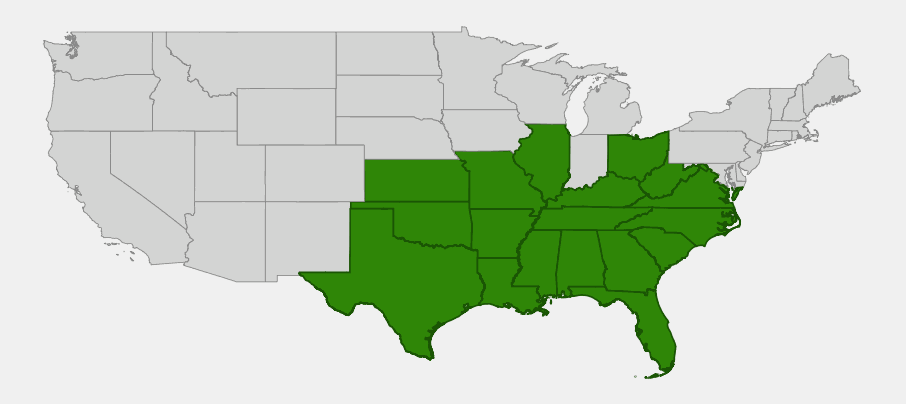
Delta arrowhead is native to the southeastern and south-central United States, and it also grows in Mexico and Central America south to Panama. USDA PLANTS lists it in 18 states: Alabama, Arkansas, Florida, Georgia, Illinois, Kansas, Kentucky, Louisiana, Mississippi, Missouri, North Carolina, Ohio, Oklahoma, South Carolina, Tennessee, Texas, Virginia and West Virginia.
The core of its range runs from central Texas east to the Florida Panhandle and north through the Mississippi Valley to southern Illinois. It is especially common in the Gulf Coastal Plain, in Louisiana, East Texas and the lower Mississippi Delta, which is the source of the name delta arrowhead. It also grows in spring-fed rivers and ponds in central Texas, such as the San Marcos River and around San Antonio. Records from Kansas, Ohio, Kentucky, West Virginia, Virginia, the Carolinas and eastern Georgia are scattered, outlying populations.
It grows in shallow, still or slow-moving water: pond and lake margins, marshes, swamps, sloughs, ditches, canals and the edges of slow streams. It is a lowland plant, found mostly at low elevations on the coastal plain and in river valleys. Outside the Americas it has become a serious weed of irrigation channels and wetlands in Australia and has been found in China, so it should be planted only within its native range.
📋 Regional plant lists featuring Delta Arrowhead: Ohio & Indiana · Kentucky & Tennessee · Nebraska, Kansas & Eastern Colorado · Maryland, Virginia & West Virginia · Illinois, Iowa & Missouri · Alabama, Georgia & Mississippi · North & South Florida · North & South Carolina · Arkansas, Louisiana, Eastern Oklahoma & Eastern Texas · South & West Texas
Growing & Care Guide
Delta arrowhead is an easy, fast-growing plant for the shallow edge of a pond, a water garden container or a constantly wet rain garden. Within its native range it is offered by some native aquatic nurseries, sometimes under the name delta duck-potato. Because it spreads by stolons and floating seed, plant it only where a colony is welcome, and never plant it outside its native range.
Light
It flowers best in full sun but tolerates part shade. In deep shade it produces mostly leaves and few flowers.
Soil & Water
Plant it in mucky or loamy mud in shallow water, from saturated soil to about 6 to 12 inches deep. It tolerates fluctuating water levels and short dry spells as long as the soil stays wet. In containers, use heavy garden soil or aquatic planting media rather than light potting mix, which floats.
Planting Tips
Plant corms or potted plants in spring, setting them a few inches deep in the mud. Space plants about 1 to 2 feet apart; they will fill in within a season or two. It combines well with pickerelweed, lizard’s tail and water willow on the margins of a pond.
Pruning & Maintenance
Remove dead leaves in late winter or early spring. To keep it in bounds, pull or divide clumps once they spread beyond where you want them, and cut off fruiting stalks before the heads break apart if you want to limit seedlings. In small water gardens, growing it in a submerged pot keeps it contained.
Propagation
The easiest method is to divide clumps or replant the small corms and stolon tips in spring. It also grows from seed: sow fresh achenes on the surface of wet mud in warm conditions and keep them constantly moist.
Landscape Uses
- Water gardens and ponds: attractive white flowers for the shallow edge
- Rain gardens and bioswales: tolerates wet soil and fluctuating water
- Wetland restoration: native emergent cover for marshes and shorelines within its range
- Shoreline stabilization: colonies help hold soft mud along still water
- Wildlife ponds: food for waterfowl and shelter for aquatic life
Wildlife & Ecological Value
Like other arrowheads, delta arrowhead is a useful plant for wetland wildlife, from pollinating insects to waterfowl and the animals that live in shallow water.
For Pollinators
The open, bowl-shaped flowers are visited by small bees, flies, wasps and beetles, which collect pollen and nectar. The flowers are easy for short-tongued insects to work.
For Birds
Ducks and other waterfowl eat the seeds, and arrowhead corms are a known food of ducks and geese. Wading birds hunt among the stems for small fish, frogs and invertebrates.
For Mammals
Muskrats and beavers eat the leaves and underground corms of arrowheads. Deer may browse plants at the edge of the water.
Ecosystem Role
Colonies of delta arrowhead provide cover and spawning sites for fish, frogs and aquatic insects, and the stems are perches for dragonflies and damselflies. Like other emergent plants, it slows the water, traps sediment and takes up nutrients along shorelines.
Cultural & Historical Uses
The genus name Sagittaria comes from the Latin sagitta, arrow, after the arrow-shaped leaves of many species. Delta arrowhead is an exception, with broad, mostly unlobed leaves, which is why the species name platyphylla, broad leaf, suits it better. Georg Engelmann first described it as a variety of grassy arrowhead in the nineteenth century, and it was later raised to a species.
Arrowheads, often called duck potatoes or wapato, were an important food for many Native American peoples, who gathered the starchy corms from the mud. Most records of that use are for duck potato, Sagittaria latifolia, rather than delta arrowhead specifically.
In the twentieth century delta arrowhead was sold as an aquarium and pond plant, and it escaped in Australia, where it is now a serious weed of irrigation channels and rivers, and more recently in China. It is a good example of a plant that is valuable in its home wetlands but harmful elsewhere, so gardeners should use it only within its native range.
Frequently Asked Questions
Why is it called delta arrowhead?
It is common in the lower Mississippi Delta and Gulf Coast marshes. Arrowhead is the name for the genus Sagittaria, even though this species usually has unlobed leaves.
How do I tell delta arrowhead from duck potato?
Duck potato has arrow-shaped leaves with large basal lobes. Delta arrowhead has broad, lance-shaped to oval leaves without lobes, and its fruit heads hang on stalks that curve downward.
Where is delta arrowhead native?
It is native from central Texas east to Florida and north to southern Illinois, with scattered populations from Kansas to Ohio, Virginia and the Carolinas, and south through Mexico to Panama.
Is delta arrowhead invasive?
Not within its native range, where it is a normal part of wetland plant communities. It is invasive in Australia and has escaped in China, so plant it only within its native range.
How deep should I plant delta arrowhead?
Plant it in wet mud or shallow water up to about 12 inches deep. It grows and flowers best in a few inches of water in full sun.

Looking for a nursery that carries Delta Arrowhead?
Browse our native plant nursery directory: Alabama & Arkansas · Florida & Georgia · Illinois & Kansas · Kentucky, Louisiana, Mississippi & Missouri · North Carolina, Ohio & Oklahoma · South Carolina, Tennessee, Texas & Virginia · West Virginia

