
Dwarf Live Oak (Quercus minima)
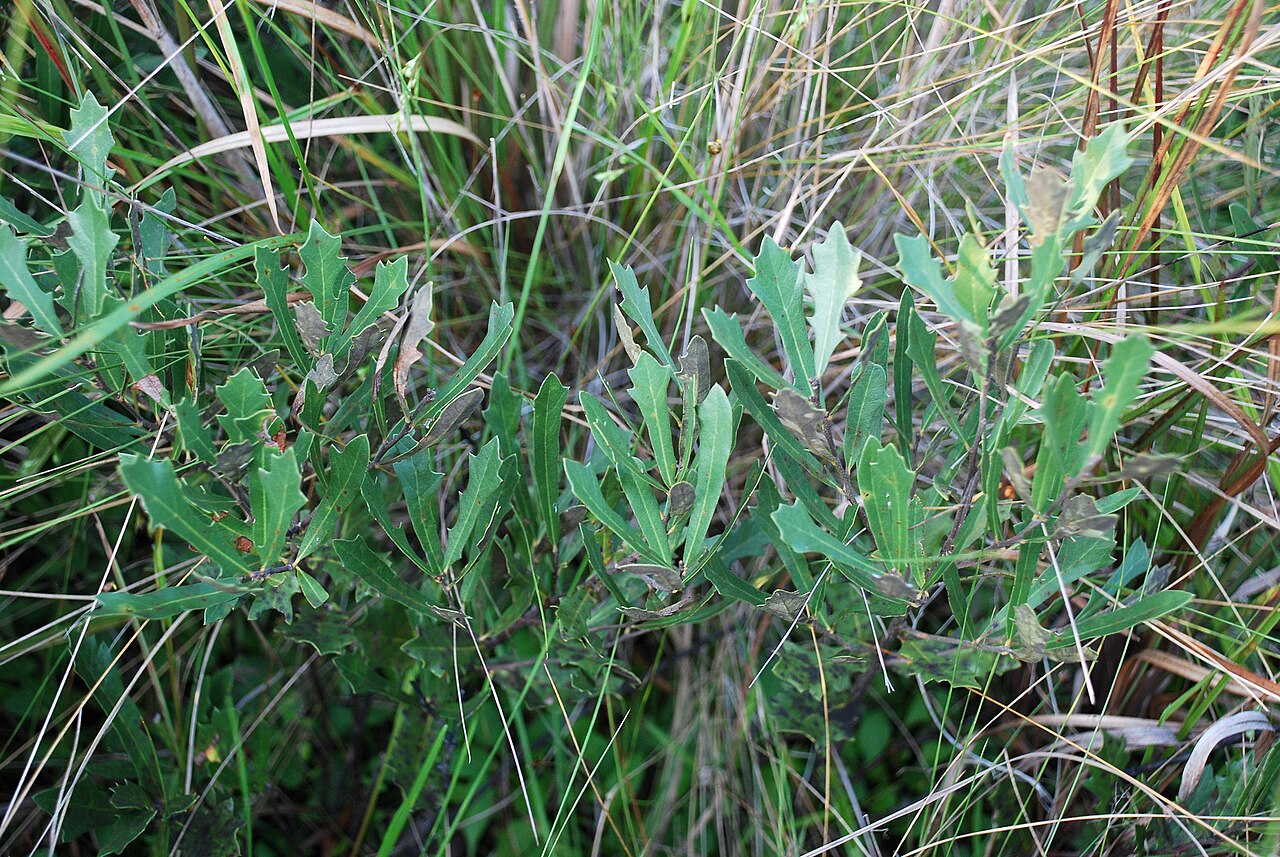
Quercus minima, known as Dwarf Live Oak, is a live oak that rarely grows taller than your knee. Instead of a massive, spreading tree, it forms low colonies of slender, upright stems that spread underground by rhizomes across the sandy pine flatwoods and savannas of the southeastern Coastal Plain, from North Carolina to Florida and west to Louisiana.
It is closely related to the great Live Oak (Quercus virginiana) and Sand Live Oak (Q. geminata), and some botanists treat it as a dwarf variety of live oak, Q. virginiana var. minima. It shares their leathery, mostly evergreen leaves and sweet, early-ripening acorns, but it is adapted to frequent fire: when flames sweep through a pine savanna, it simply resprouts from its underground stems.
This guide covers how to identify dwarf live oak, where it grows, how it fits into fire-maintained longleaf pine ecosystems, and how to use it as a tough, low native groundcover shrub in southeastern gardens.
Identification
Look in sandy pine flatwoods and savannas for colonies of thin, mostly unbranched, upright stems 1 to 3 feet tall, with leathery, glossy leaves that are pale and fuzzy underneath, and small dark acorns in fall.
Habit
Dwarf live oak is a low, colonial shrub, usually 1 to 3 feet tall (rarely to 6 feet), spreading by long underground rhizomes into patches that can cover large areas. The stems are slender and often unbranched or sparingly branched. After fire, a single colony sends up many new shoots at once.
Leaves
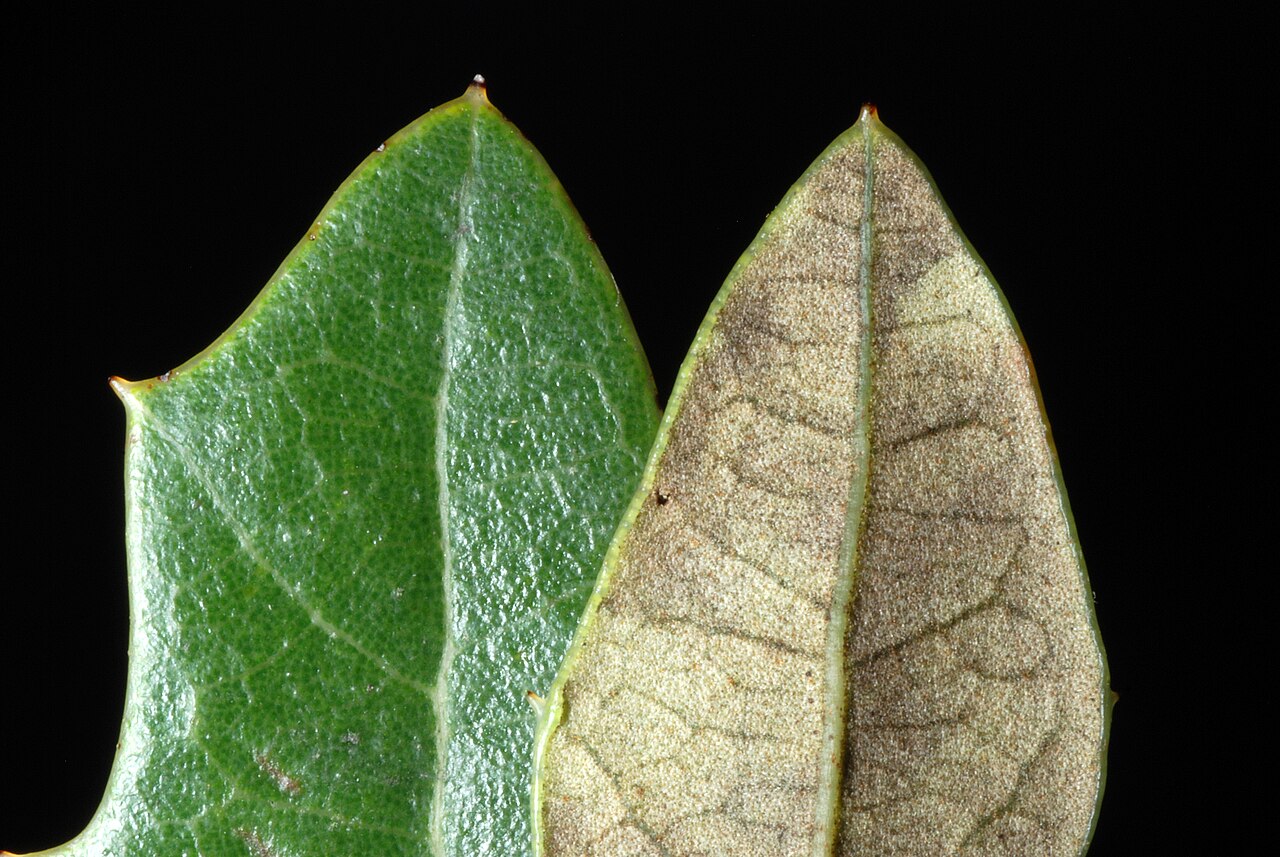
The leaves are leathery and very variable in shape, from narrowly oblong to elliptic or slightly wider toward the tip, usually 1½ to 4 inches long. Many have smooth edges, but leaves on vigorous shoots or sprouts often have a few spine-tipped teeth, a bit like holly. They are glossy dark green above and pale gray-green and finely fuzzy beneath, and the edges are often slightly rolled under. Most leaves stay on the plant through winter and drop in spring as new leaves emerge.
Acorns
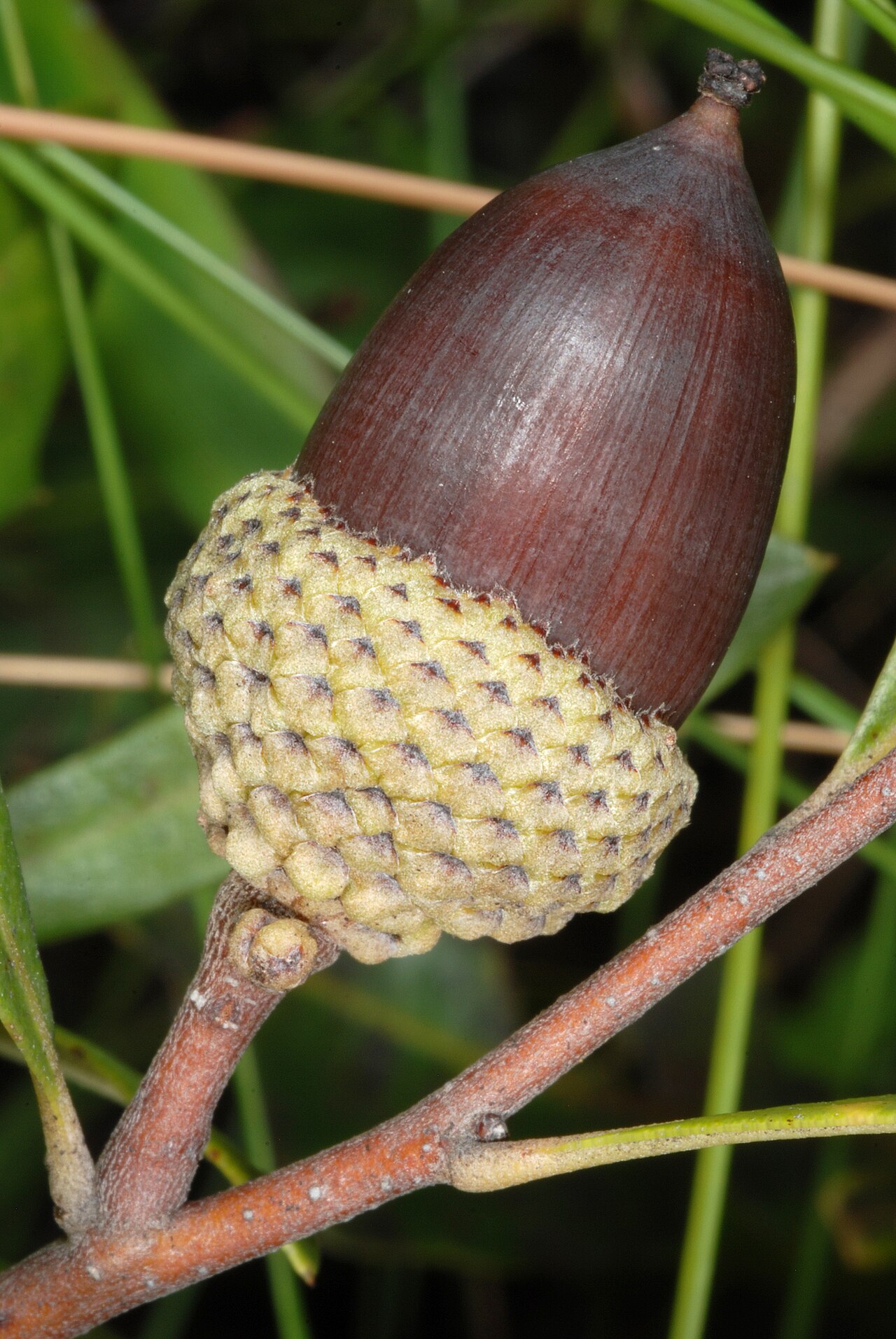
The acorns are about ½ to 1 inch long, dark brown and glossy, held in a deep, bowl-shaped cap with tight scales, often on a long stalk, singly or in small groups. Like other live oaks, they ripen in a single season, in early fall, and they are relatively sweet.
Look-alikes
Sand live oak grows on deep sand and is usually a shrub or small tree with strongly rolled, rough-veined leaves; the two hybridize, as do dwarf and full-sized live oak. Running oak (Q. pumila) is another low, rhizomatous oak of the same habitats, but it is deciduous and belongs to the red oak group, with bristle-tipped leaves and acorns that take two years to mature. Dwarf chinkapin oak has toothed, deciduous leaves and grows farther north.
Quick Facts
| Scientific Name | Quercus minima (Sarg.) Small (syn. Q. virginiana var. minima Sarg.) |
| Family | Fagaceae (beech family) |
| Plant Type | Low, rhizomatous, mostly evergreen shrub |
| Mature Height | 1–3 ft (rarely to 6 ft) |
| Mature Spread | Spreads by rhizomes into colonies several yards across |
| Growth Rate | Moderate; spreads steadily once established |
| Sun Exposure | Full sun to light shade |
| Water Needs | Low to moderate; drought tolerant |
| Soil Type | Sandy, acidic, well-drained to seasonally moist soil |
| Soil pH | About 4.5–6.5 (acidic) |
| Bloom Time | March–April (catkins) |
| Flower Color | Yellowish-green catkins |
| Fall Color | Mostly evergreen; some leaves bronze in winter |
| Fruit | Dark brown acorns, ½–1 in, ripening in one season |
| Deer Resistant | No; deer browse sprouts and eat the acorns |
| USDA Hardiness Zones | 8–10 |
Native Range
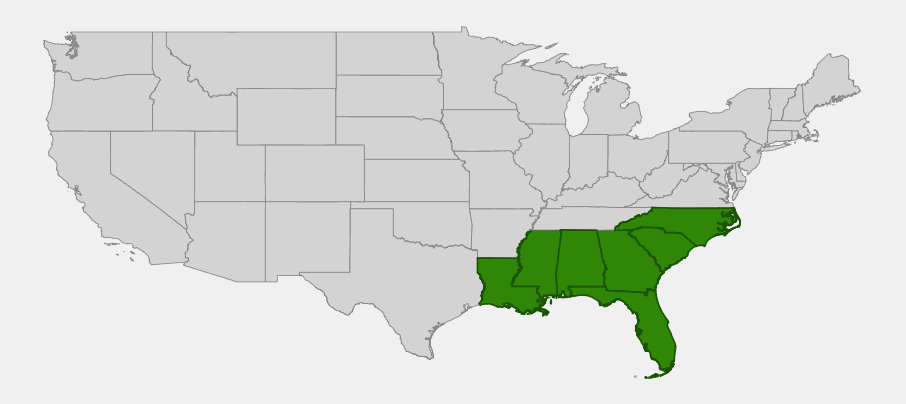
USDA PLANTS lists dwarf live oak as native in Florida, Georgia, South Carolina, North Carolina, Alabama, Mississippi and Louisiana. It is a plant of the southeastern Coastal Plain, from southeastern North Carolina south through peninsular Florida and west along the Gulf Coast to southeastern Louisiana.
It is most common in Florida and southern Georgia, where it is a characteristic shrub of longleaf and slash pine flatwoods and savannas. In Louisiana it is limited to the pinelands of the southeastern parishes, and in North Carolina it reaches its northern limit in the southeastern Coastal Plain.
Its habitats are open, sunny, sandy places maintained by frequent fire: pine flatwoods, wet and dry pine savannas, sandhills, scrubby flatwoods and coastal dunes. Where fire is excluded for many years, the taller shrubs and trees that move in tend to shade it out.
📋 Regional plant lists featuring Dwarf Live Oak: North & South Florida · Alabama, Georgia & Mississippi · North & South Carolina · Arkansas, Louisiana, Eastern Oklahoma & Eastern Texas
Growing & Care Guide
Dwarf live oak is not widely sold, but native plant nurseries in Florida and the Southeast sometimes offer it, and it makes an unusual, durable, low groundcover shrub for sandy, sunny sites. It is a good choice for pine flatwoods restoration, for naturalistic gardens under longleaf or slash pines, and wherever you want a low native evergreen that wildlife can use. Buy nursery-grown plants or grow it from acorns; do not dig colonies from the wild.
Light
Full sun to light shade. In open pine shade it grows well; in deep shade it thins out and stops producing acorns.
Soil & Water
It grows in sandy, acidic, nutrient-poor soil, from dry sandhills to seasonally wet flatwoods. Water regularly until established; after that it is very drought tolerant. Do not fertilize.
Planting Tips
Plant container-grown plants in fall or winter in the Southeast. Give it room to spread, since it slowly forms colonies by rhizomes, and plant it with other flatwoods natives such as wiregrass, saw palmetto, blueberries and gallberry.
Pruning & Maintenance
It needs little care. In naturalistic plantings, occasional mowing or cutting to the ground in late winter (or prescribed fire where it is safe and permitted) mimics natural fire and stimulates vigorous new growth. Remove competing taller shrubs if they begin to shade it.
Propagation
Grow from fresh acorns collected in fall and sown right away, since live oak acorns do not need cold stratification and lose viability if they dry out. Rooted rhizome divisions from nursery plants can also be used.
Landscape Uses
- Native groundcover shrub: a low, mostly evergreen cover for sandy, sunny sites
- Pine flatwoods and savanna restoration: fire-adapted and resprouts after burns
- Wildlife gardens: sweet acorns for turkey, quail, deer and small mammals
- Coastal and xeriscape gardens: tolerant of drought, sand and some salt spray
Wildlife & Ecological Value
Despite its size, dwarf live oak is a valuable food and cover plant in southeastern pinelands, especially because it produces acorns within a year or two after fire.
For Pollinators
Oaks are wind-pollinated, but they are among the most important host plants for moth and butterfly caterpillars in North America, including hairstreaks and duskywings. Those caterpillars in turn feed many birds.
For Birds
Wild turkeys, northern bobwhite quail, blue jays and other birds eat the small, sweet acorns. The low thickets provide nesting and escape cover for quail and ground-nesting birds.
For Mammals
White-tailed deer browse the tender sprouts that follow fire and eat the acorns, as do squirrels, raccoons, black bears and small rodents. The colonies also provide cover for rabbits and small mammals.
Ecosystem Role
Its fire-adapted rhizomes let it survive frequent fires that kill the tops of most shrubs, so it is a lasting part of the ground layer in longleaf pine ecosystems. Wildlife managers value it because its acorn crops come quickly after burns.
Cultural & Historical Uses
Charles Sprague Sargent, the first director of Harvard’s Arnold Arboretum, described the plant as a dwarf variety of live oak, Quercus virginiana var. minima. John Kunkel Small, who studied the flora of Florida and the Southeast, treated it as a separate species, Quercus minima. Botanists still differ, and you will find both names in use.
Like other live oaks, dwarf live oak has relatively sweet, low-tannin acorns. Indigenous peoples of the Southeast used live oak acorns as food and as a source of oil, though there is little specific record for the dwarf form.
Today it is valued mainly by ecologists and land managers. Its ability to resprout and produce acorns soon after fire makes it an important wildlife food in the fire-maintained longleaf pine landscapes that once covered much of the Southeast.
Frequently Asked Questions
Is dwarf live oak a different species from live oak?
Botanists disagree. Many treat it as its own species, Quercus minima, while others consider it a dwarf variety of live oak, Q. virginiana var. minima. Either way, it is a close relative of live oak that stays shrub-sized and spreads by rhizomes.
How tall does dwarf live oak get?
Usually only 1 to 3 feet, occasionally up to about 6 feet. It spreads sideways by underground stems into low colonies rather than growing tall.
Where does dwarf live oak grow?
In sandy pine flatwoods, pine savannas, sandhills and coastal dunes of the southeastern Coastal Plain, from southeastern North Carolina through Florida and west to southeastern Louisiana.
Is dwarf live oak evergreen?
Mostly. The leathery leaves stay on through winter and drop in spring as new leaves appear, so the plant is green nearly all year.
Does dwarf live oak survive fire?
Yes. It is adapted to frequent fire and resprouts quickly from its rhizomes after a burn, often producing acorns again within a year or two.

Looking for a nursery that carries Dwarf Live Oak?
Browse our native plant nursery directory: Alabama · Florida & Georgia · Louisiana & Mississippi · North Carolina · South Carolina

