
Meadow Flax (Linum pratense)
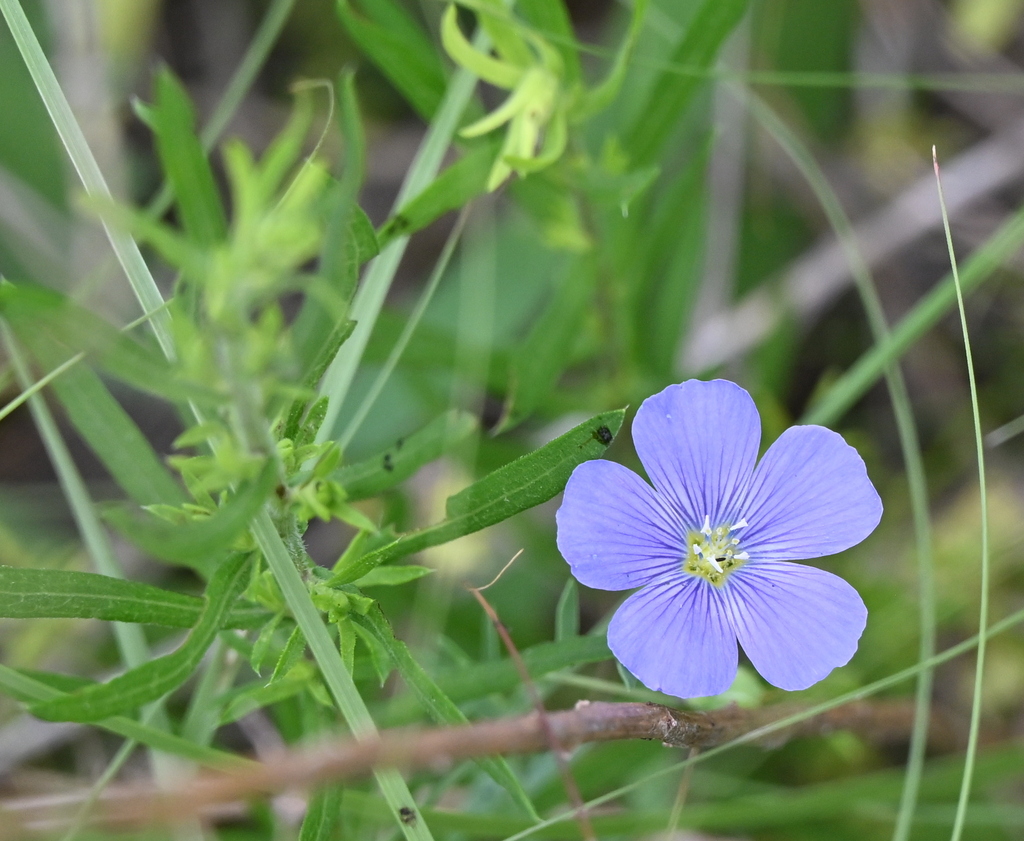
Linum pratense, known as Meadow Flax or Norton’s flax, is a delicate native annual wildflower in the flax family (Linaceae). It grows 4 to 20 inches tall on thin, wiry stems with small, narrow leaves, and in spring it opens pale blue to lavender, five-petaled flowers about 3/4 inch across. Each flower lasts only a single morning, but a plant keeps producing new ones for weeks.
Meadow flax is native to the southern Great Plains and the Southwest, from Kansas and eastern Colorado south through Oklahoma and Texas to New Mexico, Arizona and northern Mexico. It grows in prairies, grassy plains, open woodland, desert grassland and roadsides, and it is especially common in the Blackland Prairie and Cross Timbers around Dallas and Fort Worth. Some botanists treat it as a variety of the perennial blue flax, as Linum lewisii var. pratense, and older works place it in the genus Adenolinum.
Because it is an annual that reseeds itself, meadow flax is easiest to grow by scattering seed in a sunny wildflower meadow or prairie planting. Its soft blue flowers mix beautifully with Indian blanket, paintbrush and other spring wildflowers of the plains.
Identification
Look for a small, slender plant with thread-like stems, short narrow leaves and sky-blue, five-petaled flowers that open in the morning and shed their petals by afternoon.
Growth Habit
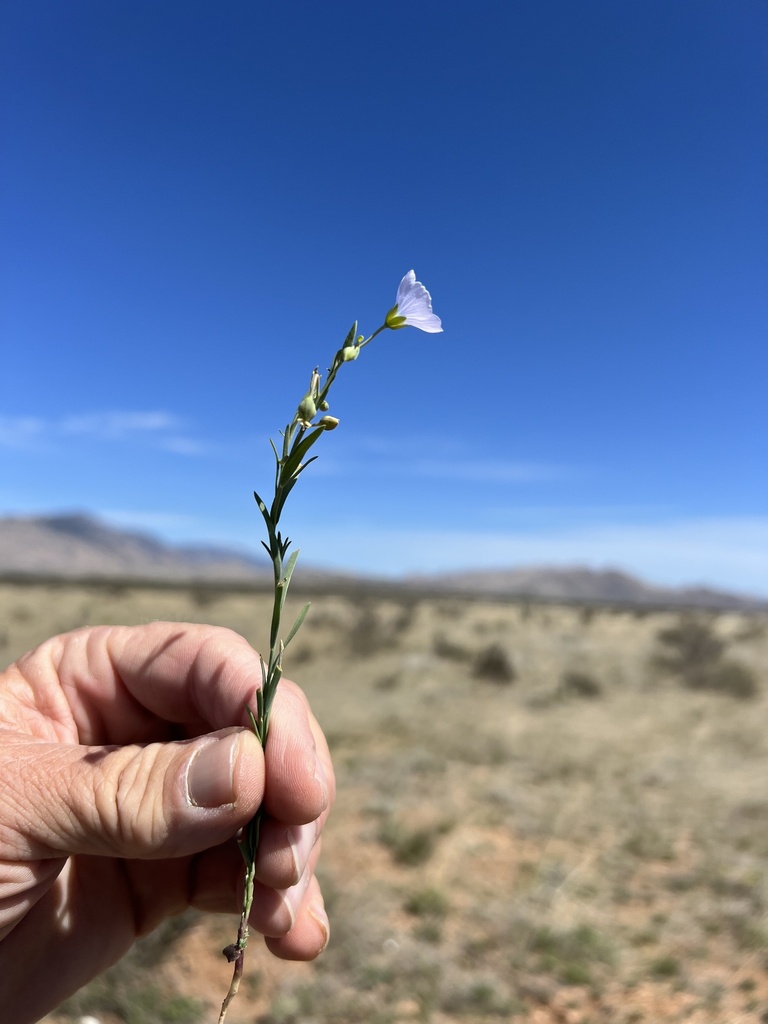
Meadow flax is an annual (occasionally a short-lived biennial) with one to several thin, erect or ascending stems from the base, usually 4 to 20 inches tall and sometimes branched above. The stems are smooth and wiry, and the plant looks airy and fine-textured.
Leaves
The leaves are alternate, linear to narrowly lance-shaped, about 1/2 to 1 inch long and very narrow, stalkless and smooth, with a single vein. They are crowded on the lower stem and more widely spaced above.
Flowers
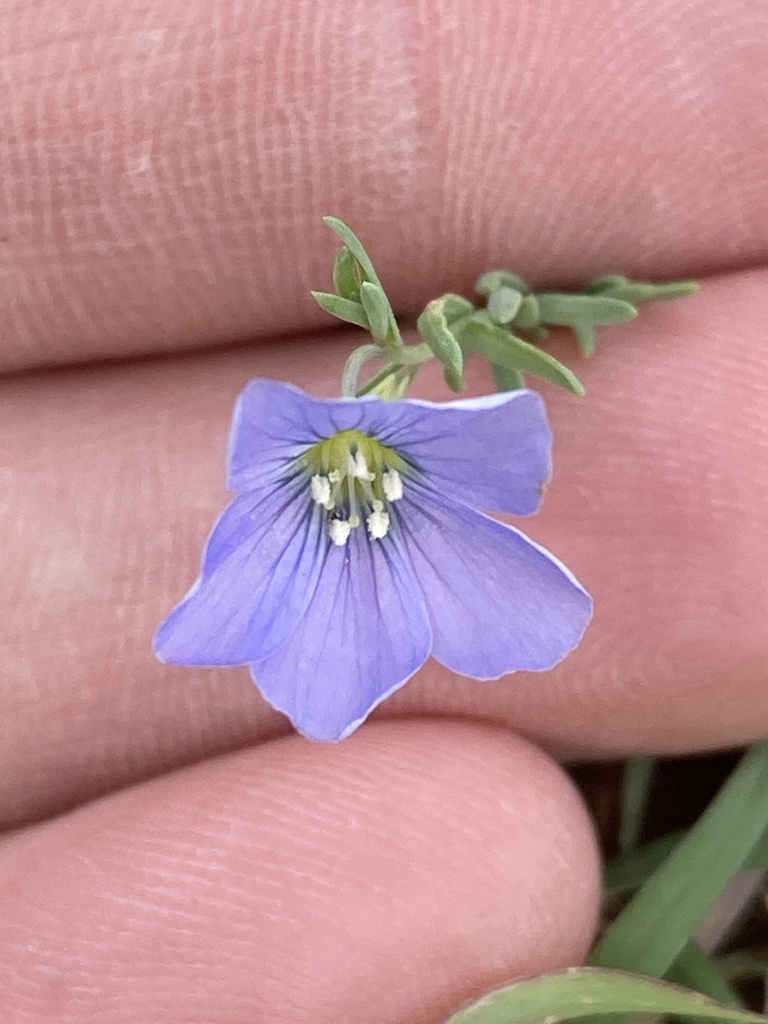
The flowers grow at the tips of the branches in loose, few-flowered clusters. Each is about 1/2 to 1 inch across, with five broad, rounded, pale blue to lavender (occasionally whitish) petals marked with darker veins and a yellowish center. There are five stamens and five styles. The petals fall within a day, often by early afternoon. It blooms mainly from March to June, and sometimes again in fall after rain.
Fruit & Seeds
The fruit is a small, round capsule about 1/8 to 1/4 inch long that splits into ten segments, releasing flat, shiny brown seeds. The fruiting stalks curve slightly outward or downward.
Look-alikes
Blue flax (Linum lewisii) is a long-lived perennial with larger flowers, usually more than 1 inch across, and grows mostly in the West and northern Plains. Stiffstem flax (L. rigidum) and other plains flaxes have yellow to orange flowers. Blue-eyed grass has six blue tepals with a yellow eye and flat, grass-like leaves.
Quick Facts
| Scientific Name | Linum pratense |
| Family | Linaceae (flax family) |
| Plant Type | Annual wildflower |
| Mature Height | 4–20 in |
| Mature Spread | 4–8 in |
| Growth Rate | Fast |
| Sun Exposure | Full sun |
| Water Needs | Low to medium |
| Soil Type | Well-drained loam, clay, sand or rocky limestone soils |
| Soil pH | Neutral to alkaline (about 6.5–8.5) |
| Bloom Time | March–June; occasionally fall |
| Flower Color | Pale blue to lavender, sometimes whitish |
| Fall Color | None (annual) |
| Fruit | Small, round capsule with flat brown seeds |
| Deer Resistant | Moderately |
| USDA Hardiness Zones | Annual; grows in zones 5–9 |
Native Range
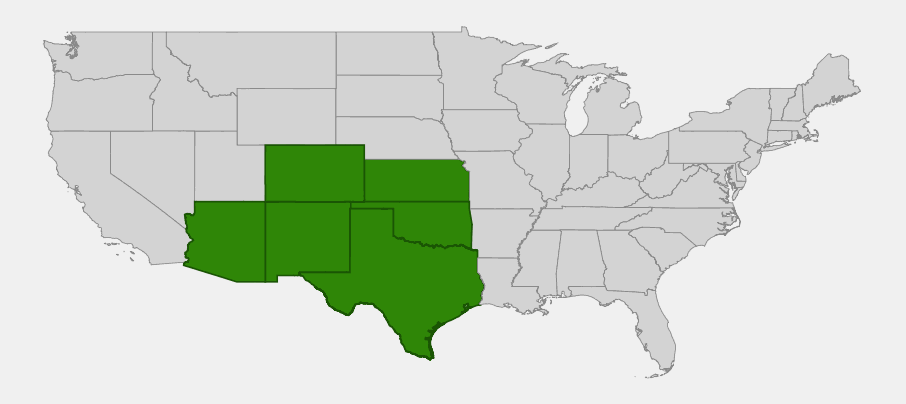
Meadow flax is native to the southern Great Plains and the American Southwest, and it continues into northern Mexico. USDA PLANTS lists it from six states: Kansas, Colorado, Oklahoma, Texas, New Mexico and Arizona. It is not found in Canada.
In Texas it is most common in the Blackland Prairie, Grand Prairie and Cross Timbers of the Dallas-Fort Worth area, and it also grows on the Rolling Plains, in the Panhandle, on the western Edwards Plateau and around San Angelo and Midland in West Texas. It ranges north through western Oklahoma into southern Kansas, where it is rare, and into southeastern Colorado. Farther west it grows in the grasslands and open woodlands of New Mexico and southeastern Arizona.
It grows in open, sunny places: tallgrass and mixed-grass prairies, short-grass plains, desert grassland, juniper and oak savannas, limestone hillsides, and disturbed ground such as roadsides, pastures and vacant lots. It often appears in large numbers after a wet winter.
📋 Regional plant lists featuring Meadow Flax: Nebraska, Kansas & Eastern Colorado · Arizona & New Mexico · South & West Texas · Arkansas, Louisiana, Eastern Oklahoma & Eastern Texas
Growing & Care Guide
Meadow flax is an easy annual for sunny, open ground. Treat it as a self-sowing wildflower rather than a border plant: sow it once, and it will return from seed in years with good winter and spring rain.
Light
Full sun. It tolerates very light shade but becomes thin and floppy and flowers poorly in shade.
Soil & Water
It grows in most well-drained soils, including heavy blackland clay, sandy loam and rocky limestone, and prefers neutral to alkaline conditions. Natural rainfall is usually enough; in dry springs, an occasional watering extends flowering. Avoid rich, fertilized soil, which favors weeds that crowd it out.
Planting Tips
Scatter seed in fall on bare or lightly raked soil and press it in. It works best in wildflower meadows, prairie plantings, open lawns that are not mowed until early summer, and along sunny paths, mixed with other annual wildflowers such as Indian blanket and paintbrush.
Pruning & Maintenance
Do not mow until the plants have dropped their seed in early summer. After that, mow or cut back the dry stems. Leave some bare ground open in fall so seedlings can establish.
Propagation
Grow it from seed. Fall sowing gives the best results in the southern Plains, because the seeds germinate in cool weather and the plants overwinter as small seedlings before blooming in spring. Seeds can also be sown in very early spring.
Landscape Uses
- Wildflower meadows: soft blue flowers among spring annuals
- Prairie plantings: a fine-textured native annual for the southern Plains
- Pollinator gardens: pollen and nectar for small native bees
- Xeriscapes: reseeds in dry, sunny ground
- Roadsides and open lots: a native alternative to weedy annuals
Wildlife & Ecological Value
Although each flower is short-lived, meadow flax produces flowers over several weeks in spring, when many native bees are active.
For Pollinators
The flowers are visited by small native bees, such as sweat bees and mining bees, and by flies and small butterflies that collect pollen and nectar in the morning while the flowers are open.
For Birds
Doves, quail and sparrows eat the small, oily seeds that fall from the capsules in early summer.
For Mammals
Rabbits and deer may nibble the plants, but its small size and short life cycle mean it is seldom heavily browsed.
Ecosystem Role
As a cool-season annual, meadow flax fills gaps between perennial grasses in prairies and plains, helping protect bare soil in spring. It is part of the spring wildflower display that follows wet winters across the southern Great Plains.
Cultural & Historical Uses
The genus name Linum is the Latin name for flax, from which we get the words linen and linseed. The species name pratense means “of meadows,” referring to its grassland habitat.
Meadow flax is a wild relative of cultivated flax (Linum usitatissimum), which has been grown for fiber and oil for thousands of years. Native flaxes have tough stem fibers too, and Native American peoples used the fibers of some wild flaxes to make cordage.
The scientific treatment of meadow flax has varied. It has been described as a species, as a variety of blue flax (Linum lewisii var. pratense) and in the genus Adenolinum. USDA PLANTS currently accepts it as Linum pratense.
Frequently Asked Questions
Is meadow flax an annual or a perennial?
It is an annual, occasionally behaving as a short-lived biennial. It keeps coming back by reseeding.
Why do the flowers drop so quickly?
Each flax flower opens in the morning and sheds its petals the same day, usually by early afternoon. New flowers open each morning for several weeks.
How is meadow flax different from blue flax?
Blue flax (Linum lewisii) is a long-lived perennial with larger flowers. Meadow flax is a small annual with flowers usually under an inch across, and it grows mainly in the southern Plains and Southwest.
When should I sow meadow flax seed?
In fall, so the seedlings can grow through the cool season and bloom in spring.
Where does meadow flax grow in Texas?
It is most common in the Blackland Prairie and Cross Timbers of north-central Texas, and it also grows on the Rolling Plains, in the Panhandle and in parts of West Texas.

Looking for a nursery that carries Meadow Flax?
Browse our native plant nursery directory: Arizona · Colorado · Kansas · New Mexico & Oklahoma · Texas

