
Pretty Jacob’s-ladder (Polemonium pulcherrimum)
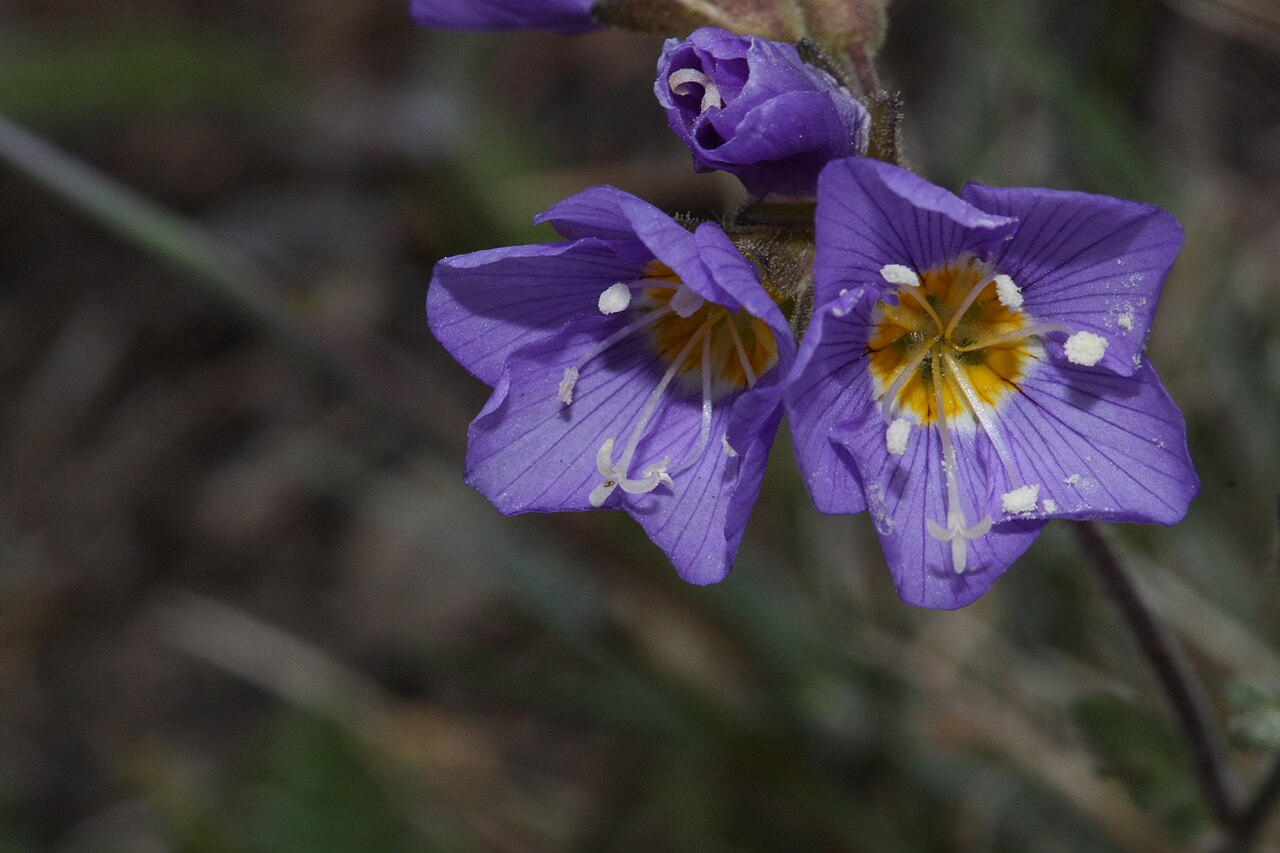
Polemonium pulcherrimum, known as Pretty Jacob’s-ladder, showy Jacob’s-ladder or showy polemonium, is a small, tufted wildflower of western mountains and the far north. From a low rosette of finely divided, ladder-like leaves it sends up short stems with clusters of cup-shaped flowers, sky blue to violet with a bright yellow center, from late spring through summer. The species name pulcherrimum means “very beautiful”, and a clump in full bloom on a rocky slope lives up to it.
It is a widespread and variable plant. In the north it grows from near sea level in Alaska and the Yukon, while farther south it is a plant of subalpine and alpine slopes, rocky ridges and open forests in the Cascades, Sierra Nevada, Great Basin ranges and Rocky Mountains. Botanists recognize several subspecies, including the delicate, open-flowered forms of the southern Rockies (subsp. delicatum). The foliage has a faint musky smell when brushed, which is why some field guides call it skunk-leaved polemonium.
This guide covers how to identify pretty Jacob’s-ladder, where it grows, how to grow it in a rock garden or cool-summer garden, and its value to bees and other pollinators.
Identification
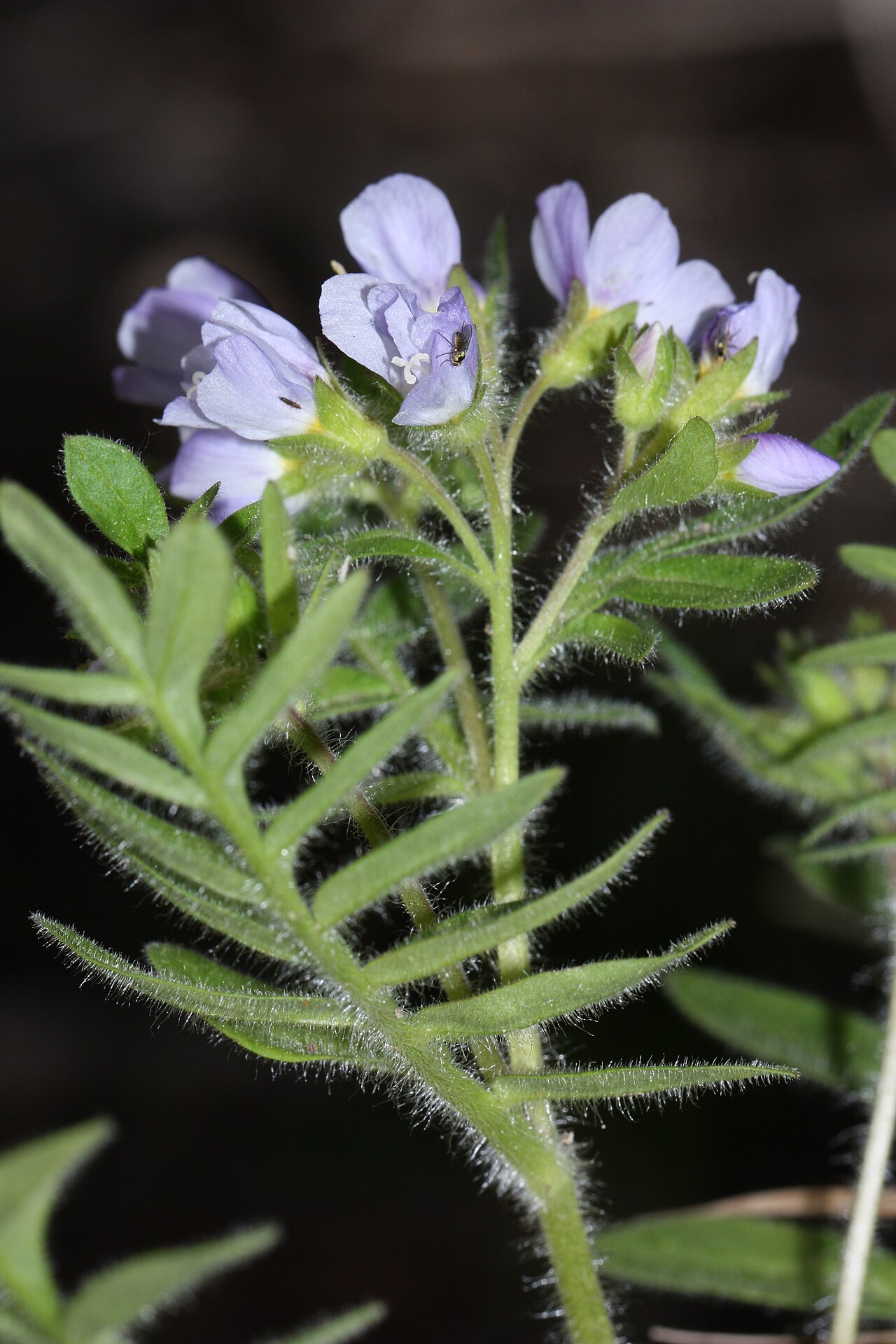
Look for a low clump of ladder-like leaves with many small paired leaflets, and short stems topped by loose clusters of blue to violet, yellow-eyed flowers about 1/2 inch across.
Growth Habit
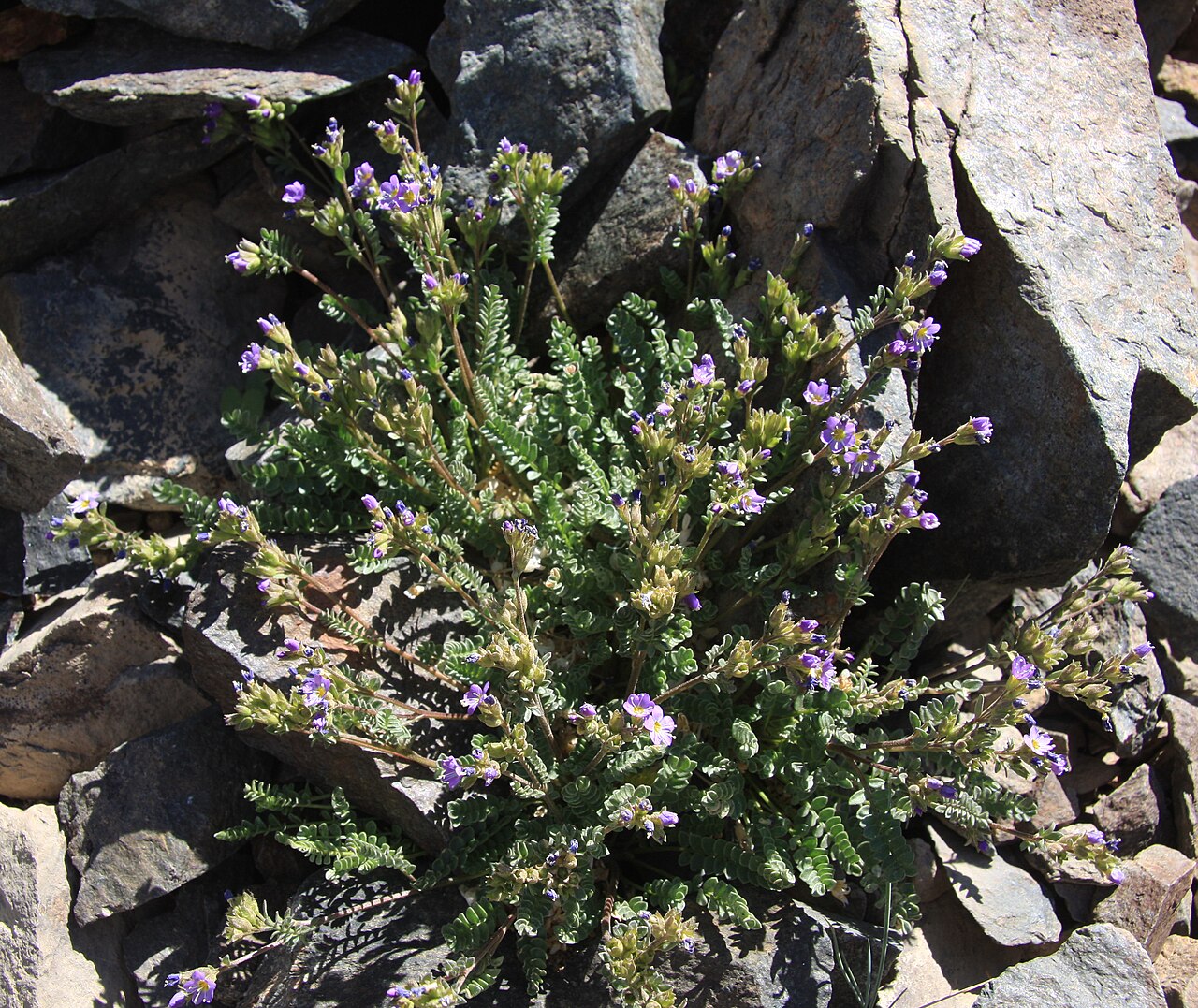
Pretty Jacob’s-ladder is a tufted perennial with a branched base and several stems. It is usually 4 to 12 inches tall, more compact at high elevations and taller and looser in shady forest openings.
Leaves
Most leaves are at the base of the plant. Each is pinnately compound, with roughly 11 to 25 small, oval to round leaflets lined up in pairs along a central stalk like the rungs of a ladder. The leaflets are often slightly hairy or sticky, and the leaves have a mild musky smell when crushed.
Flowers
Flowers are borne in loose, rounded clusters at the tops of the stems. Each is bell- to bowl-shaped, about 1/3 to 1/2 inch across, with five rounded lobes, usually pale to deep blue or violet (occasionally white), and a yellow or yellowish-white throat. The stamens are about as long as the corolla. Bloom time is May to August, depending on elevation and latitude.
Fruit & Seeds
The fruit is a small, three-chambered capsule held inside the persistent calyx. It splits open in late summer to release a few small seeds.
Look-alikes
Sky pilot (Polemonium viscosum) grows in the same alpine areas but has a dense head of larger, funnel-shaped flowers, whorled (not paired) tiny leaflets and a strong skunky smell. Spreading Jacob’s-ladder (P. reptans) is an eastern woodland species. California Jacob’s-ladder (P. californicum) and western Jacob’s-ladder (P. occidentale) are taller plants of moist forests and meadows with larger leaves.
Quick Facts
| Scientific Name | Polemonium pulcherrimum Hook. |
| Family | Polemoniaceae (phlox family) |
| Plant Type | Tufted herbaceous perennial |
| Mature Height | 4–12 in (to about 14 in) |
| Mature Spread | 6–12 in |
| Growth Rate | Moderate |
| Sun Exposure | Full sun to part shade |
| Water Needs | Moderate; moist but well-drained soil |
| Soil Type | Rocky, gravelly or loamy, well-drained soils |
| Soil pH | About 5.5–7.5 |
| Bloom Time | May–August (depending on elevation) |
| Flower Color | Light blue to violet, occasionally white, with a yellow throat |
| Fall Color | None notable; foliage persists until hard frost |
| Fruit | Small three-chambered capsule |
| Deer Resistant | Moderately; the musky foliage is not a favorite |
| USDA Hardiness Zones | 2–7 |
Native Range
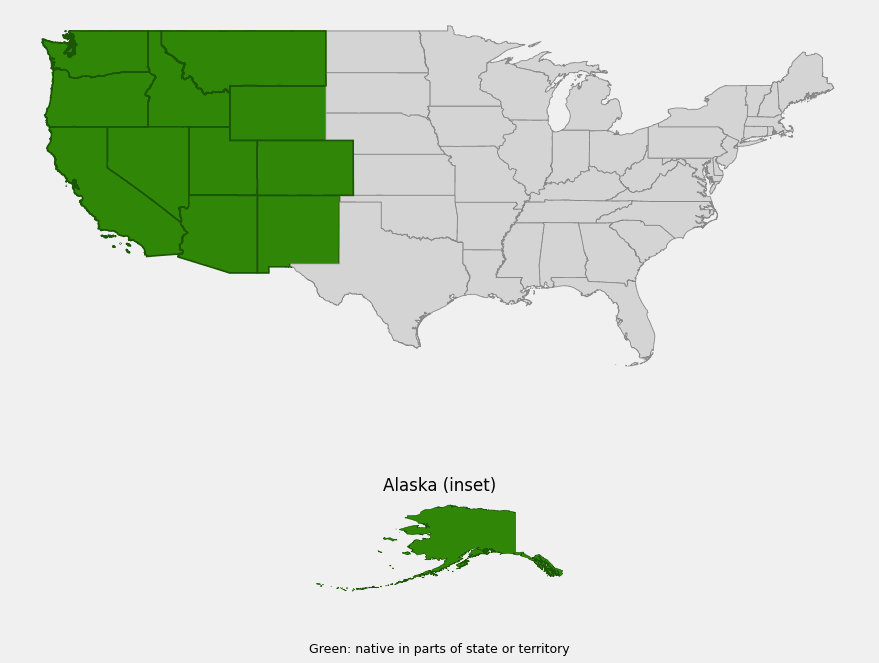
Pretty Jacob’s-ladder has a broad range in western and northern North America. USDA PLANTS lists it in Alaska, Arizona, California, Colorado, Idaho, Montana, Nevada, New Mexico, Oregon, Utah, Washington and Wyoming, and in Alberta, British Columbia, the Northwest Territories and the Yukon in Canada.
In Alaska and northwestern Canada it is common from lowlands to the mountains, on gravel bars, rocky slopes and in open spruce forest. Farther south it is mostly a mountain plant: in the Olympics and Cascades, the Sierra Nevada and the mountains of northern California and Nevada, through the Northern Rockies of Idaho, Montana and Wyoming, and south in the Rockies to Utah, Colorado, northern New Mexico and the high mountains of Arizona.
It grows on rocky slopes, talus, ridges, gravelly meadows and open coniferous forests, most often in the subalpine and alpine zones in the southern part of its range. Elevations range from near sea level in the north to more than 12,000 feet in Colorado.
📋 Regional plant lists featuring Pretty Jacob’s-ladder: Alaska · Western Oregon & Western Washington · Idaho, Eastern Oregon & Eastern Washington · Montana & Wyoming · Utah & Western Colorado · Arizona & New Mexico · California & Nevada
Growing & Care Guide
Pretty Jacob’s-ladder is a lovely small perennial for rock gardens, troughs and cool-summer gardens, especially in the West and North. It is grown by some alpine and native plant nurseries and seed suppliers. Like many mountain plants, it does best where summers are not hot and humid.
Light
Full sun in cool, high-elevation or northern gardens; part shade, especially in the afternoon, in warmer areas.
Soil & Water
Give it gritty, well-drained soil that stays evenly moist during the growing season, such as a scree bed, rock garden pocket or raised bed with added gravel. Avoid heavy, soggy soil, especially in winter. Water during dry spells in summer; it tolerates short dry periods once established but not prolonged drought.
Planting Tips
Plant in spring or early fall. Tuck plants between rocks, along the front of a border or in a trough with other small alpines such as penstemons, phlox and buckwheats. Its fine foliage looks good even when it is not in bloom.
Pruning & Maintenance
Shear off spent flower stems after the main bloom to keep the clump tidy and sometimes encourage a few more flowers; leave some to set seed if you want seedlings. Clumps may be short-lived in hot gardens, so let a few self-sow.
Propagation
Sow seed outdoors in fall or give it about 4 to 8 weeks of cold-moist stratification before spring sowing. Plants can also be divided carefully in early spring. Collect seed only in small amounts and only where permitted; never dig plants from the wild.
Landscape Uses
- Rock gardens and troughs: a compact clump of ladder-like leaves and sky-blue flowers
- Alpine and mountain gardens: suited to cool, high-elevation and northern gardens
- Pollinator gardens: its open, nectar-rich flowers attract bees, flies and butterflies
- Woodland edges: tolerates light shade in open forest settings
- Restoration of subalpine slopes: a native perennial for rocky, disturbed mountain sites
Wildlife & Ecological Value
Pretty Jacob’s-ladder offers early to midsummer nectar and pollen on mountain slopes where the flowering season is short.
For Pollinators
The open, bowl-shaped flowers are visited by bumble bees, solitary bees, syrphid flies and butterflies. The yellow eye acts as a nectar guide pointing insects to the center of the flower.
For Birds
Ground-feeding birds such as sparrows and juncos forage around the plants in mountain meadows and may take some of the small seeds.
For Mammals
The musky-smelling foliage is not a preferred food, but it is grazed occasionally by deer, elk, mountain goats and small mammals such as pikas, which gather a wide range of alpine plants for winter hay piles.
Ecosystem Role
As a low, long-blooming perennial of rocky and gravelly ground, it helps stabilize talus and slopes and supports the pollinator community of the subalpine and alpine zones.
Cultural & Historical Uses
The genus name Polemonium goes back to ancient Greek writers, who used it for a medicinal plant possibly named after Polemon, a king or philosopher. The name Jacob’s-ladder refers to the ladder-like leaves and to the biblical story of Jacob’s dream of a ladder reaching to heaven.
The species was described by the botanist William Jackson Hooker in the nineteenth century from specimens collected in northwestern North America. Its wide range and variable form have led to many named varieties and subspecies, and botanists still differ on how to divide them.
Some Indigenous peoples of the North used Jacob’s-ladders in traditional medicine, but it is not a food plant and should not be eaten or used as a home remedy. It is valued today mainly as a wildflower of mountain trails and as a choice rock-garden plant.
Frequently Asked Questions
Why is it called Jacob’s-ladder?
The leaves are divided into many small leaflets in neat pairs along the stalk, like the rungs of a ladder. The name refers to the ladder in the biblical story of Jacob’s dream.
Where does pretty Jacob’s-ladder grow?
It grows in Alaska and western Canada and in the mountains of the western United States, from Washington and Montana south to California, Arizona and New Mexico, on rocky slopes, ridges, gravelly meadows and open forests.
Can I grow pretty Jacob’s-ladder in my garden?
Yes, in a cool-summer garden with gritty, well-drained soil that stays evenly moist, such as a rock garden or trough. It tends to be short-lived in hot, humid climates.
How is it different from sky pilot?
Sky pilot has a dense head of larger, funnel-shaped flowers, tiny leaflets in whorls and a strong skunky smell. Pretty Jacob’s-ladder has smaller, open bowl-shaped flowers in loose clusters and paired leaflets.
When does pretty Jacob’s-ladder bloom?
From about May at lower elevations and in the north to August high in the mountains, often soon after the snow melts.

Looking for a nursery that carries Pretty Jacob’s-ladder?
Browse our native plant nursery directory: Alaska & Arizona · California · Colorado · Idaho · Montana · Nevada & New Mexico · Oregon · Utah · Washington · Wyoming

