
Round-Leaved Dogwood (Cornus rugosa)
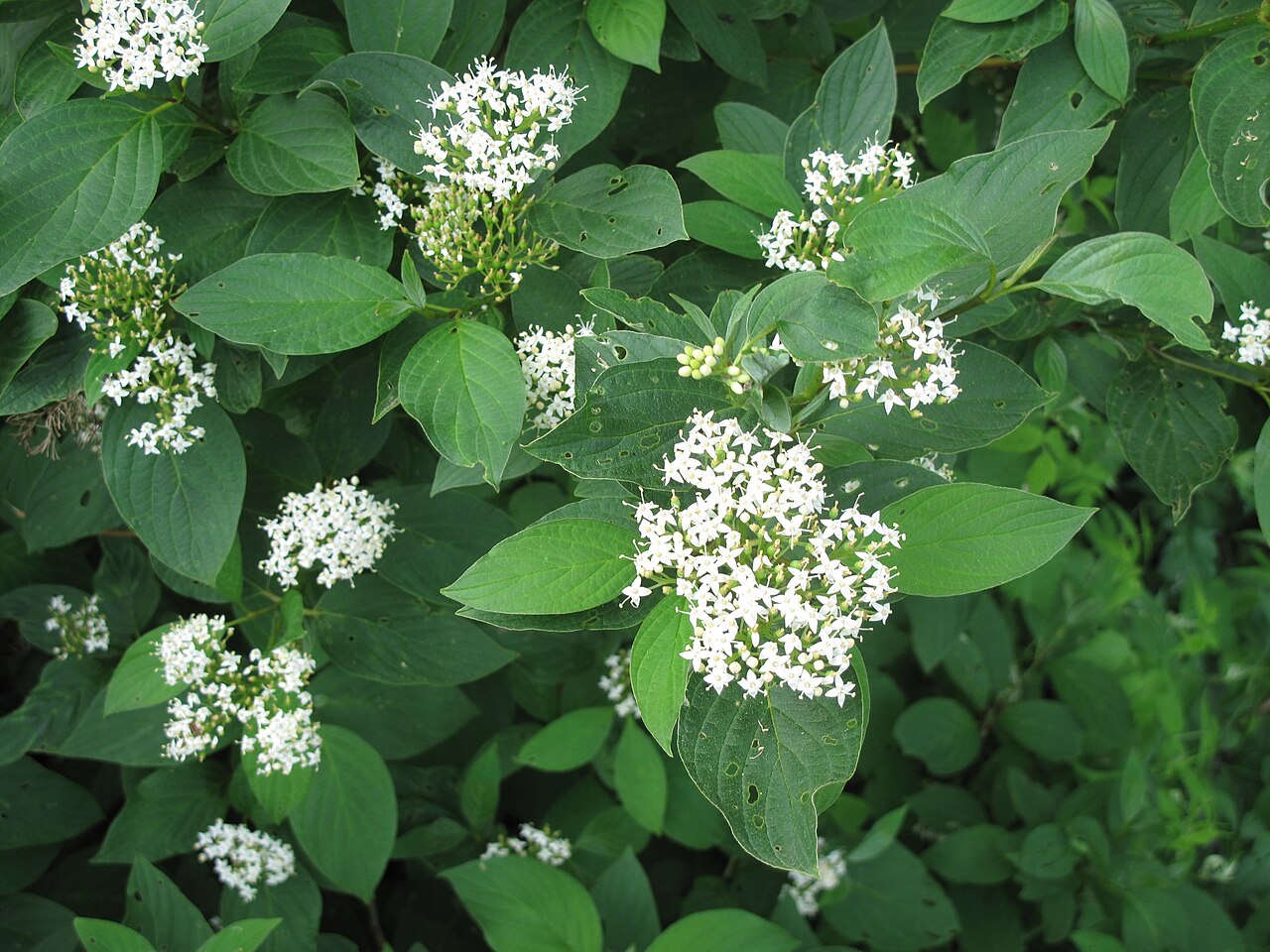
Cornus rugosa, known as Round-Leaved Dogwood or roundleaf dogwood, is a deciduous shrub of the dogwood family (Cornaceae) native to the northeastern and north-central United States and southeastern Canada. It usually grows 3 to 10 feet tall, with loose, spreading branches, greenish twigs streaked or blotched with purple, and broad, nearly round leaves that set it apart from every other shrubby dogwood in its range.
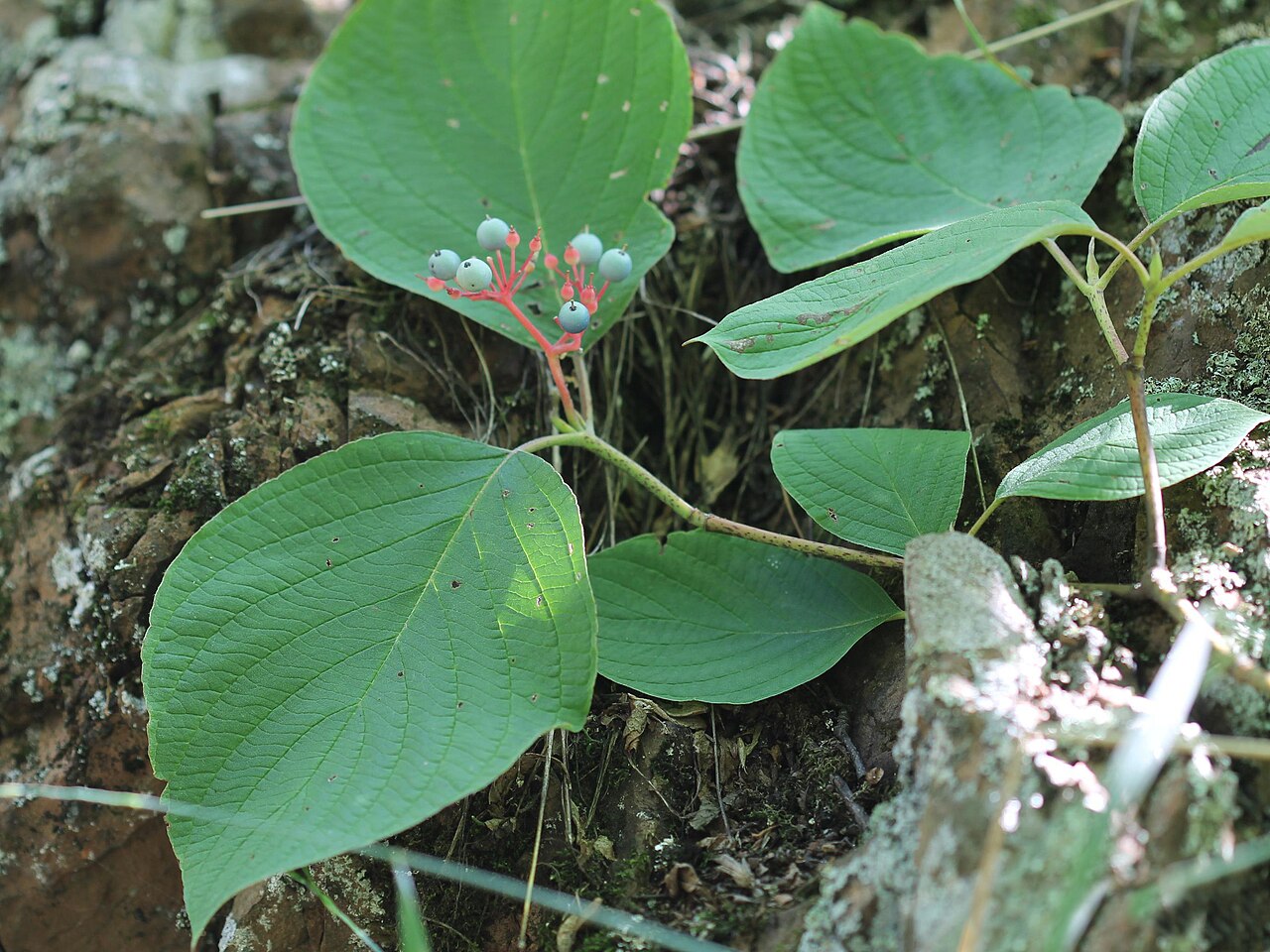
In late spring and early summer it carries flat-topped clusters of small, creamy-white, four-petaled flowers. By late summer these become clusters of pale blue to bluish-white berries held on bright red stalks, a striking combination that birds strip quickly. The species name rugosa means “wrinkled” and refers to the leaves, whose deeply impressed, curving veins give the surface a slightly puckered look.
Round-leaved dogwood is a plant of rocky woods, wooded slopes, ledges, talus and thin-soiled woodland edges, often over limestone or other base-rich rock, though it also grows on sandy soils. It is common in parts of New England, New York and the upper Great Lakes, and becomes scarce toward the southern and western edges of its range. This guide covers how to identify it, where it grows, how to grow it in a shady native garden, and what it offers wildlife.
Identification
Several shrubby dogwoods share the same woods and thickets in the Northeast and Great Lakes. Round-leaved dogwood is the easiest to recognize: look for its unusually wide, rounded leaves, the soft hairs on their undersides, and its pale blue fruit on red stalks.
Growth Habit & Twigs
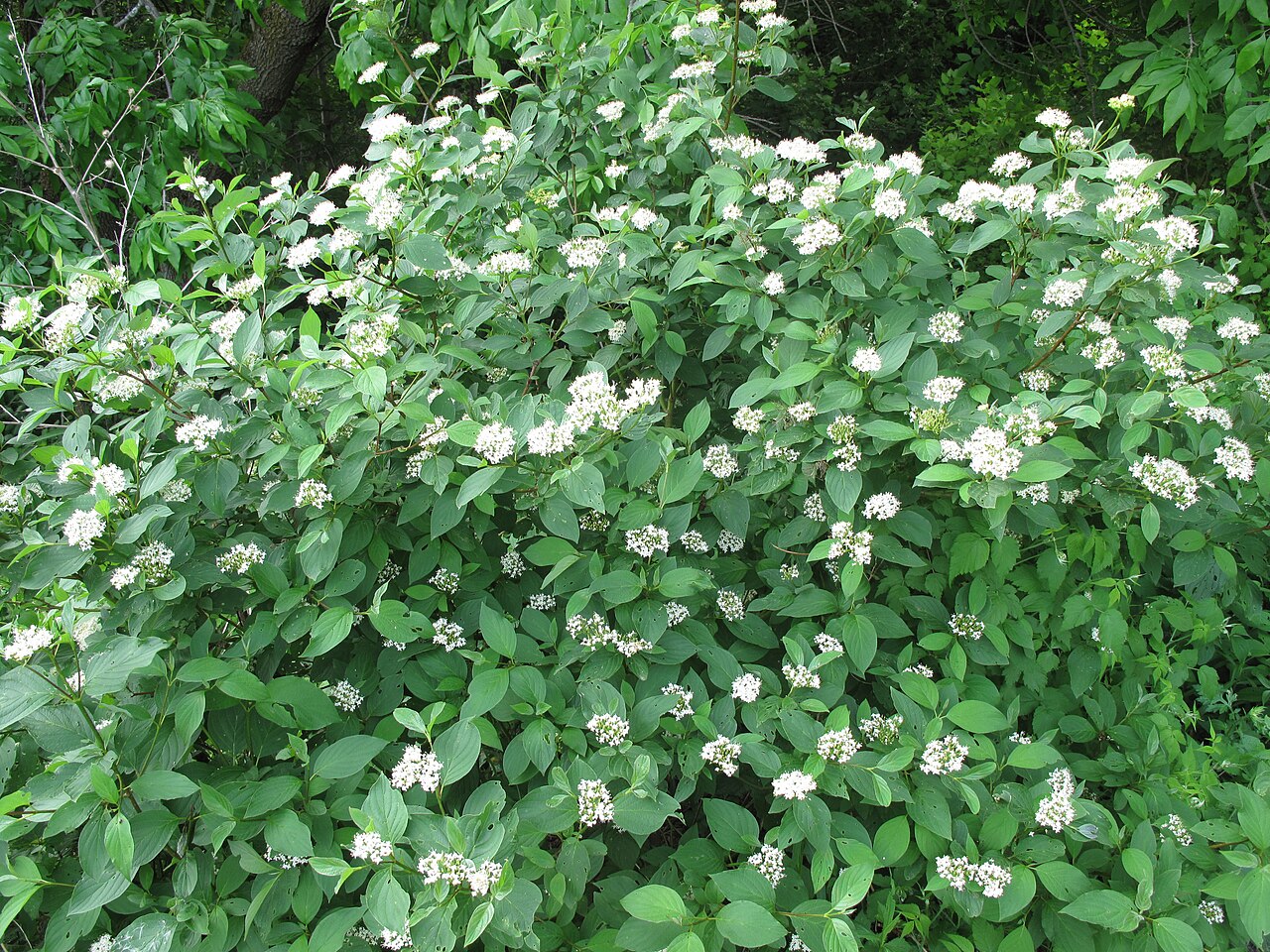
It is a multi-stemmed, open, loosely branched shrub, usually 3 to 10 feet tall and occasionally taller. Young twigs are green to yellowish-green and often streaked or blotched with purple, becoming reddish-purple or brownish with age. Older stems have smooth gray-brown bark. The pith of the twigs is white. Unlike red-osier dogwood, it does not form dense colonies of bright red stems.
Leaves
The leaves are opposite, as in almost all dogwoods, and are the best field mark. They are broadly oval to nearly round, about 2 to 5 inches long and almost as wide, with a short, abrupt point at the tip and smooth margins. The upper surface is dull green, and the lower surface is pale and densely covered in soft, woolly hairs. Each leaf has about six to nine pairs of prominent veins that curve toward the tip, the classic dogwood vein pattern. If you tear a leaf gently, the veins stretch into fine, elastic threads, another dogwood trait.
Flowers
From late May into July, depending on latitude, it bears flat-topped or slightly domed clusters (cymes) about 2 to 3 inches across at the ends of the branches. Each cluster contains many small, creamy-white flowers with four petals and four protruding stamens. Unlike flowering dogwood and bunchberry, it has no large, petal-like bracts.
Fruit
The fruits are small, round drupes about 1/4 inch across, ripening in late summer to a pale blue, light grayish-blue or bluish-white, held on stalks that turn bright red or coral. Each contains a single hard stone. The fruits rarely stay on the shrub for long because birds eat them as soon as they ripen.
Look-alikes
Gray dogwood (Cornus racemosa) and silky dogwood (Cornus amomum) also have flat clusters of white flowers and pale or bluish fruit, but their leaves are narrower and more elongated. Gray dogwood has white fruit on red stalks and gray, smooth twigs; silky dogwood has blue fruit, reddish-purple twigs with brown pith and silky rather than woolly hairs. Pagoda dogwood (Cornus alternifolia) has alternate, crowded leaves and blue-black fruit. Round-leaved dogwood’s broad, almost circular leaves with woolly undersides are distinctive.
Quick Facts
| Scientific Name | Cornus rugosa Lam. |
| Family | Cornaceae (dogwood family) |
| Plant Type | Deciduous, multi-stemmed shrub |
| Mature Height | 3–10 ft (occasionally taller) |
| Mature Spread | 3–8 ft |
| Growth Rate | Moderate |
| Sun Exposure | Part shade to full sun; tolerates fairly deep shade |
| Water Needs | Low to moderate; dry to moist, well-drained soil |
| Soil Type | Rocky, gravelly or sandy well-drained soils; often over limestone |
| Soil pH | About 5.5–8.0 |
| Bloom Time | May–July |
| Flower Color | Creamy white |
| Fall Color | Reddish to purplish in some years |
| Fruit | Pale blue to bluish-white drupes on red stalks, late summer |
| Deer Resistant | No; deer browse dogwoods |
| USDA Hardiness Zones | 3–7 |
Native Range
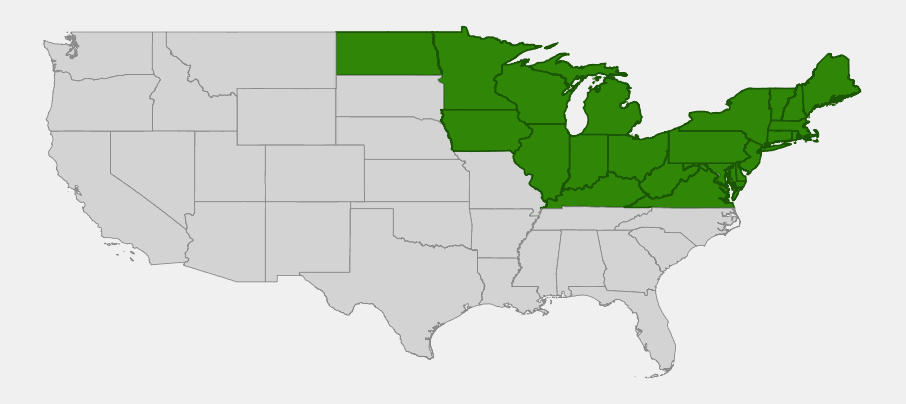
Round-leaved dogwood is a northern shrub. USDA PLANTS lists it as native to 22 states, from Maine south to Virginia, Maryland and Delaware and west through the Great Lakes states to Minnesota, Iowa and North Dakota. In Canada it grows from the Maritime provinces and Quebec west across Ontario to Manitoba.
It is most frequent in New England, New York, northern Pennsylvania and the upper Great Lakes region, especially in rocky, hilly country and on limestone and dolomite outcrops such as those of the Niagara Escarpment, Manitoulin Island and northern Michigan and Wisconsin. Toward the south and west (Kentucky, Virginia, West Virginia, Maryland, Delaware, Iowa and North Dakota) it becomes scattered or rare. Kentucky lies at the extreme southern edge, with only scattered records.
Typical habitats are dry to moist rocky woods, wooded slopes and ravines, cliffs, ledges and talus, open woodland edges, thickets and sandy or gravelly banks. It is often found in mixed hardwood and conifer forests with sugar maple, oaks, white cedar, birches and hophornbeam, and it tolerates more shade and drier soil than most shrubby dogwoods.
📋 Regional plant lists featuring Round-Leaved Dogwood: New York, Pennsylvania & Northern New Jersey · Ohio & Indiana · Michigan, Wisconsin & Eastern Minnesota · Kentucky & Tennessee · Connecticut, Massachusetts & Rhode Island · New Hampshire, Maine & Vermont · Maryland, Virginia & West Virginia · Delaware, Southern New Jersey & Long Island · Illinois, Iowa & Missouri · North Dakota, South Dakota & Western Minnesota
Growing & Care Guide
Round-leaved dogwood is an easy, adaptable shrub for naturalistic plantings in the North, though it is less often sold than red-osier, gray or silky dogwood. Look for it at native plant nurseries in the Northeast and Great Lakes. Its main assets are shade tolerance, drought tolerance once established, and fruit that birds love.
Light
It grows in light to fairly deep shade under trees, at woodland edges and in full sun. It flowers and fruits most heavily with a few hours of sun, but it is one of the better dogwoods for a shady, dry spot where other shrubs struggle.
Soil & Water
Give it well-drained soil: rocky, gravelly, sandy or loamy. It is at home on thin soils over limestone but also grows in mildly acidic soil. Unlike red-osier and silky dogwood, it does not want wet ground. Water regularly during its first season; established plants handle summer dry spells well.
Planting Tips
Plant container-grown shrubs in spring or fall, spacing them about 4 to 6 feet apart for a loose hedge or woodland-edge thicket. It looks best in informal groups at the edge of woods, on a shady slope, or mixed with other native shrubs such as witch hazel, American hazelnut and mapleleaf viburnum.
Pruning & Maintenance
Little pruning is needed. If the shrub gets leggy, remove a few of the oldest stems at the base in late winter to encourage vigorous new growth. Leaf spots and twig cankers that affect other dogwoods can occur but are rarely serious in a healthy planting.
Propagation
Grow it from seed or cuttings. Clean the pulp from ripe fruits in late summer and sow the stones outdoors in fall; like most dogwood seeds they need a warm period followed by cold stratification, so some may not germinate until the second spring. Softwood cuttings taken in early summer root fairly readily with rooting hormone. Never dig plants from the wild, especially in states where the species is rare.
Landscape Uses
- Woodland gardens: one of the few shrubby dogwoods that tolerates dry shade
- Bird gardens: pale blue summer fruits eaten by many songbirds
- Rocky slopes and limestone sites: thrives on thin, well-drained soils
- Woodland-edge and hedgerow plantings: loose, informal habit that blends with other native shrubs
- Pollinator plantings: early-summer flowers visited by bees, flies, beetles and butterflies
Wildlife & Ecological Value
Like other dogwoods, round-leaved dogwood is a valuable wildlife shrub: its flowers feed insects in early summer and its fat-rich fruits feed birds in late summer.
For Pollinators
The open, flat-topped flower clusters are easy for many insects to use, including small native bees, flies, beetles and butterflies. Dogwoods are larval hosts of the spring azure butterfly (Celastrina species), whose caterpillars feed on the flower buds and flowers, and the Lady Bird Johnson Wildflower Center lists round-leaved dogwood as a host. Dogwood foliage also feeds the caterpillars of a variety of native moths.
For Birds
The fruits ripen in late summer, when many songbirds are fattening up for migration. Thrushes, vireos, catbirds, woodpeckers, cardinals and other songbirds eat dogwood fruits, and grouse eat them too. The bright red fruit stalks and pale berries make the clusters easy for birds to find.
For Mammals
White-tailed deer, moose and snowshoe hares browse the twigs and leaves, and small mammals eat fallen fruit. In heavily browsed areas, young plants may need protection.
Ecosystem Role
Round-leaved dogwood is part of the shrub layer of rocky northern forests and woodland edges, where it helps hold thin soils on slopes and ledges. Its fruits spread its seeds through the woods in the droppings of birds, and its leaves add easily decomposed litter to the forest floor.
Cultural & Historical Uses
The genus name Cornus comes from the Latin cornu, a horn, a reference to the very hard wood of dogwoods. The species name rugosa, wrinkled, describes the leaves with their deeply impressed veins. The species was described by the French naturalist Jean-Baptiste Lamarck in the 1780s.
Round-leaved dogwood has sometimes been called “green osier” for its green, purple-mottled twigs, in contrast to the red twigs of red-osier dogwood. Like several other dogwoods, its inner bark has been reported among materials used by Native peoples of the Great Lakes region in smoking mixtures, and the shrub has a history in traditional medicine. These uses are mentioned for their cultural interest only; dogwood bark is not a safe home remedy.
Because it is common in some parts of its range and rare in others, round-leaved dogwood is a good example of why local sourcing matters. Where it is scarce, plant nursery-grown stock of regional origin and leave wild plants undisturbed.
Frequently Asked Questions
How can I tell round-leaved dogwood from other shrubby dogwoods?
Look at the leaves. Round-leaved dogwood has broad, nearly round leaves with soft, woolly undersides. Gray, silky and red-osier dogwoods have narrower, more pointed leaves. Its pale blue fruits on red stalks are another good clue.
Does round-leaved dogwood grow in shade?
Yes. It grows in light to fairly deep shade and in dry, rocky woods, which makes it one of the more shade- and drought-tolerant shrubby dogwoods.
Does it need wet soil like red-osier dogwood?
No. It prefers well-drained, rocky, gravelly or sandy soil and does not do well in waterlogged ground.
Are the berries edible?
They are eaten by birds, not people. Dogwood fruits are generally considered inedible for humans, so plant it for wildlife rather than for food.
Where does round-leaved dogwood grow?
It is native from Maine and the Maritime provinces west through New York, Pennsylvania and the Great Lakes states to Minnesota, Iowa, North Dakota and Manitoba, and south to Virginia, with scattered records in Kentucky.

Looking for a nursery that carries Round-Leaved Dogwood?
Browse our native plant nursery directory: Connecticut & Delaware · Illinois, Indiana & Iowa · Kentucky, Maine, Maryland, Massachusetts, Michigan & Minnesota · New Hampshire, New Jersey, New York, North Dakota & Ohio · Pennsylvania, Rhode Island, Vermont & Virginia · West Virginia & Wisconsin

