
Strawberry Groundcherry (Physalis grisea)
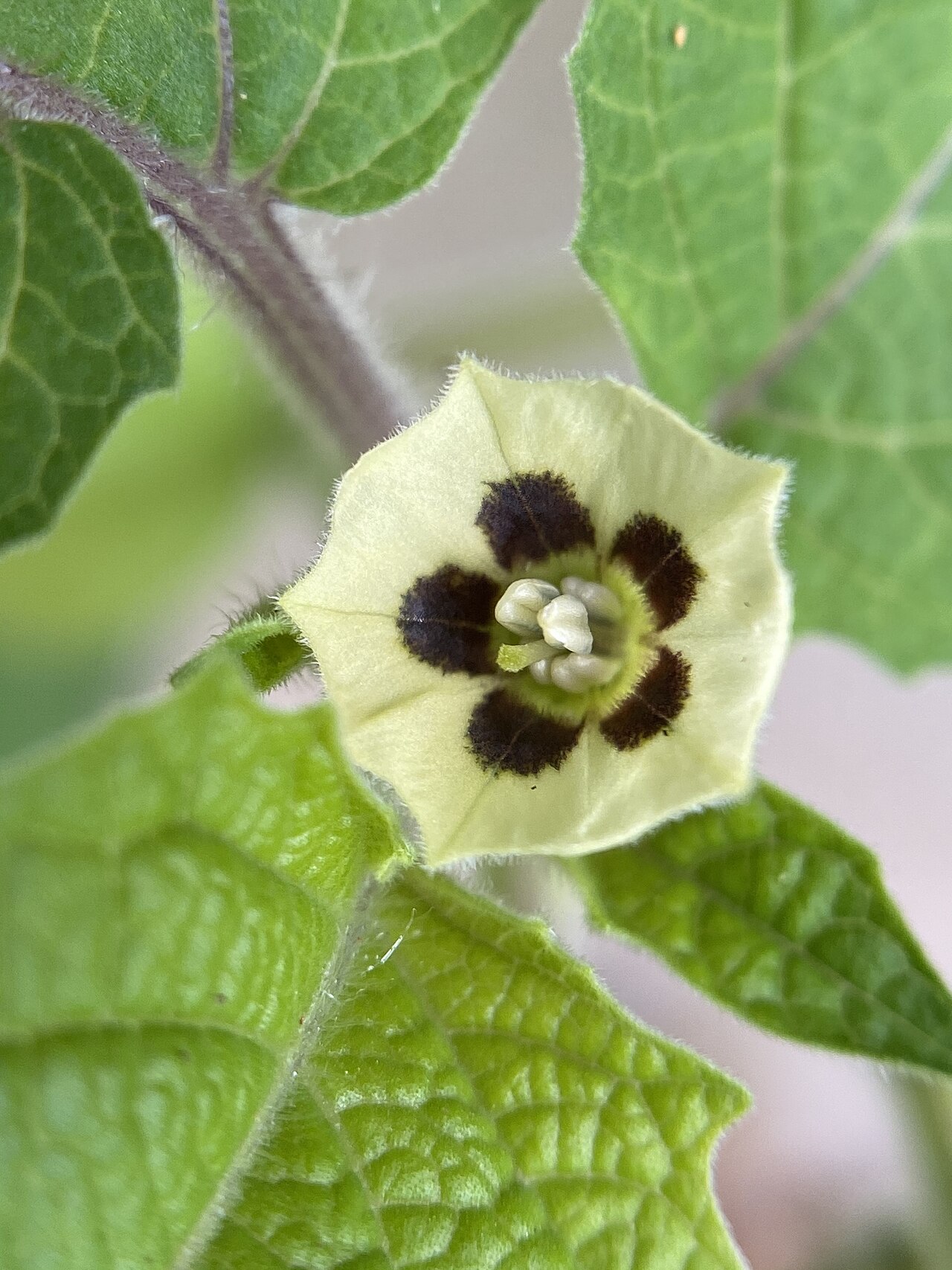
Physalis grisea, Strawberry Groundcherry, also called downy groundcherry or strawberry-tomato, is a native annual of the nightshade family (Solanaceae) and the wild ancestor of the “ground cherries” that gardeners grow for their sweet, pineapple-and-strawberry flavored fruit. It is a low, bushy plant with broad, softly hairy, gray-green leaves, nodding pale yellow bell-shaped flowers with five dark spots in the throat, and small golden berries wrapped in papery husks that fall to the ground when ripe.
It is native to the eastern and central United States and southeastern Canada, where it grows in sandy fields, open woods, riverbanks, gardens and other disturbed ground. Much of what is sold in seed catalogs as Physalis pruinosa, including popular heirloom ground cherries such as ‘Aunt Molly’s’, is in fact this species. The name P. pruinosa was misapplied to it for many years, and it has also been confused with P. pubescens.
Safety note: like tomatoes and potatoes, groundcherries contain toxic glycoalkaloids. The leaves, stems, husks and unripe green fruit are poisonous and should never be eaten, and they are toxic to pets and livestock. Only fully ripe fruit, golden-orange inside a dry, tan husk, is safe to eat. This guide covers identification, native range, growing it in a vegetable or native garden, and its value to wildlife.
Identification
Groundcherries are a large and confusing genus. Strawberry groundcherry is best recognized by its annual habit, the soft gray-green hairs that cover the whole plant, its broad, coarsely toothed leaves, and its relatively small flowers with dark spots and bluish anthers.
Growth Habit
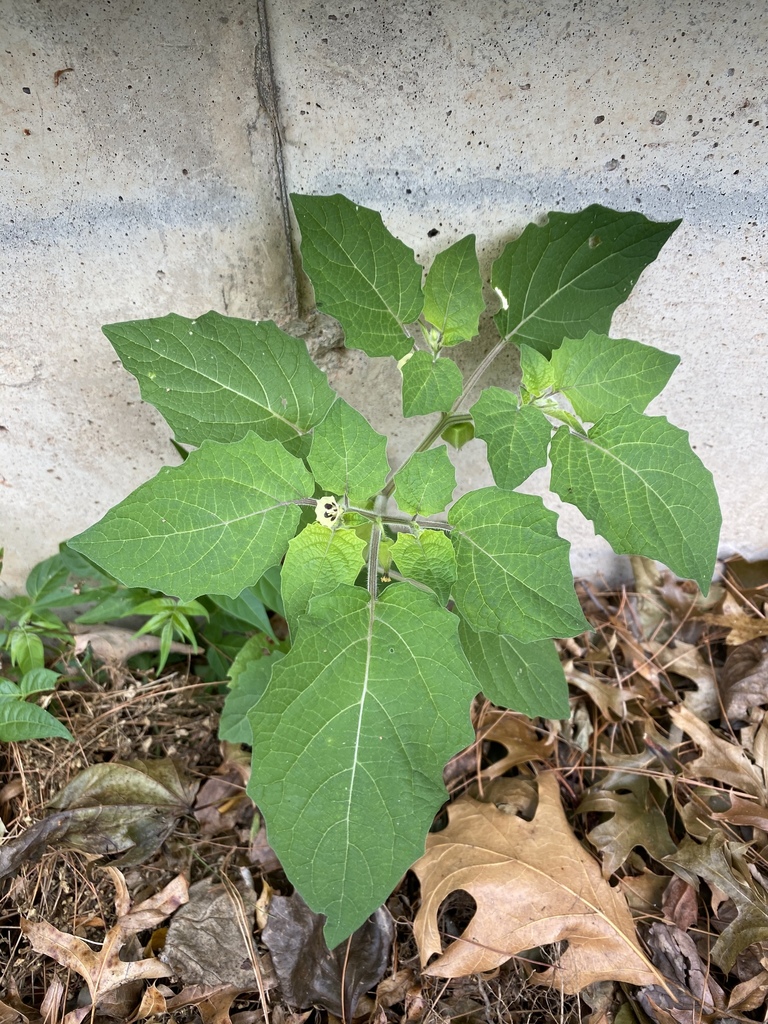
An annual from a taproot, it grows 6 to 18 inches tall and branches widely, often sprawling 1 to 3 feet across. Stems are densely covered with soft, sticky-glandular hairs, which give the plant its downy, grayish look (grisea means gray).
Leaves
Leaves are alternate, broadly heart-shaped to ovate, 2 to 4 inches long, with coarse, irregular teeth along the margins and a net of conspicuous veins. Both surfaces are softly hairy. A helpful field mark: the leaves dry orange rather than brown or black.
Flowers
From early summer to fall, single nodding flowers hang from the leaf axils. The bell-shaped corolla is pale yellow, about ¼ to ⅜ inch long, with five dark purple-brown spots in the throat. The anthers are blue to purple. Clammy groundcherry (P. heterophylla) has larger flowers with yellow anthers and is a rhizomatous perennial.
Fruit
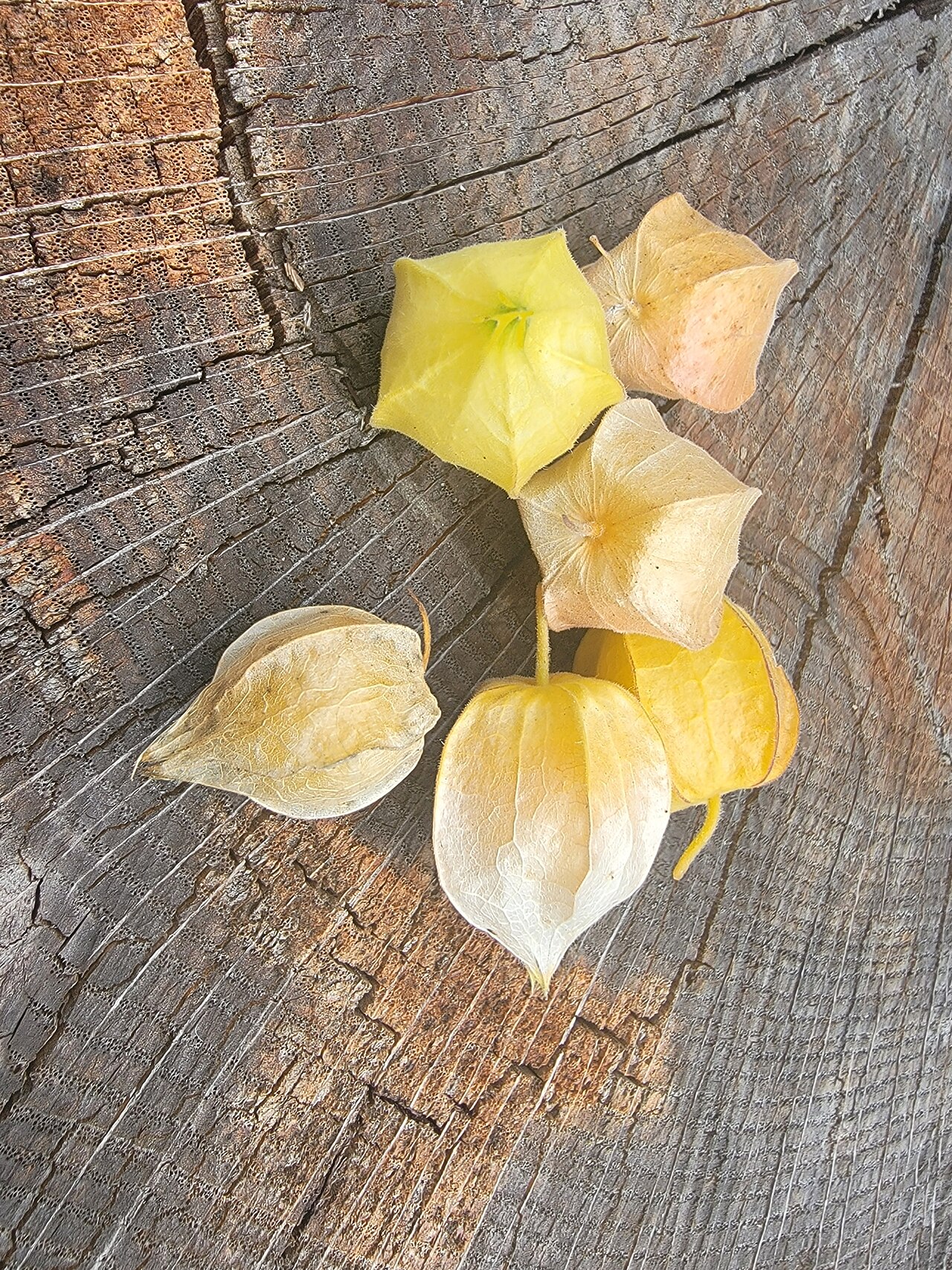
After flowering, the five sepals enlarge into a papery, five-angled, lantern-like husk about ¾ to 1¼ inch long that encloses a round berry about ½ inch across. When ripe, the berry turns orange-yellow, the husk turns tan and dry, and the whole fruit drops to the ground, which is where the name “ground cherry” comes from. Each berry contains many small, flat seeds.
Quick Facts
| Scientific Name | Physalis grisea (syn. P. pubescens var. grisea; often sold as P. pruinosa) |
| Family | Solanaceae (nightshade family) |
| Plant Type | Annual herb |
| Mature Height | 6–18 in |
| Mature Spread | 1–3 ft |
| Growth Rate | Fast |
| Sun Exposure | Full sun to part shade |
| Water Needs | Medium; tolerates short dry spells |
| Soil Type | Sandy or loamy, well-drained soil |
| Soil pH | About 6.0–7.5 |
| Bloom Time | June–September |
| Flower Color | Pale yellow with five dark purple-brown spots |
| Fall Color | None; killed by frost |
| Fruit | Orange-yellow berry in a papery husk (edible only when fully ripe) |
| Deer Resistant | Mostly; foliage is toxic and seldom browsed |
| USDA Hardiness Zones | Annual; grows in zones 3–10 |
Native Range
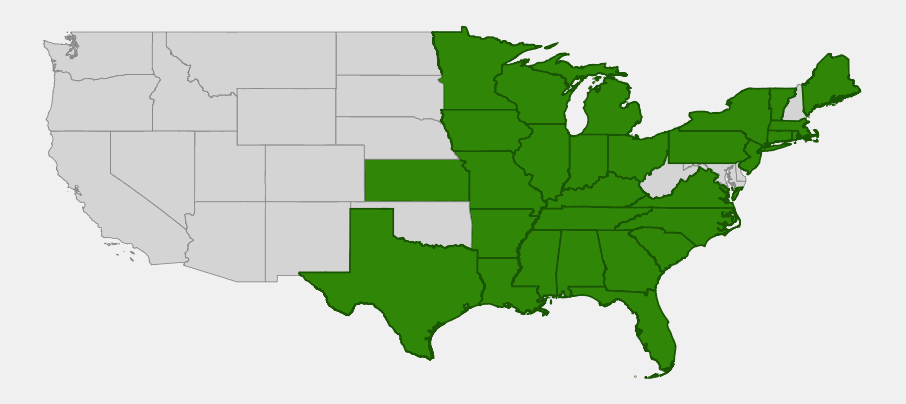
Strawberry groundcherry is native to eastern North America. USDA PLANTS records it across the eastern and central United States, from Maine, Vermont and the Great Lakes states south to Florida and west to Minnesota, Iowa, Missouri, Kansas, Arkansas, Louisiana and Texas. In Canada it grows in southern Ontario and Quebec. Because it is so often grown in vegetable gardens, it is hard to separate wild populations from escapes, and in parts of New England some populations are probably introduced.
USDA also lists records from California, Oregon, Washington and Utah. These are far outside the species’ natural range and are best treated as garden escapes, so they are not included on the map here. It has likewise escaped from cultivation in Europe and Australia.
In the wild it favors open, sunny, often sandy ground: old fields, prairie and savanna openings, sandy riverbanks, open woods, railroad embankments, field edges and gardens. It is an opportunist that comes up where soil has been disturbed and fades as perennial vegetation closes in.
📋 Regional plant lists featuring Strawberry Groundcherry: North & South Florida · Alabama, Georgia & Mississippi · North & South Carolina · Maryland, Virginia & West Virginia · Kentucky & Tennessee · Arkansas, Louisiana, Eastern Oklahoma & Eastern Texas · Illinois, Iowa & Missouri · Ohio & Indiana · Nebraska, Kansas & Eastern Colorado · Michigan, Wisconsin & Eastern Minnesota · New York, Pennsylvania & Northern New Jersey · Delaware, Southern New Jersey & Long Island · Connecticut, Massachusetts & Rhode Island · New Hampshire, Maine & Vermont
Growing & Care Guide
Strawberry groundcherry is one of the easiest native food plants to grow. Grow it like a small, sprawling tomato: start seed in warmth, plant out after frost, and harvest the fruit as it drops in late summer. Once grown, it usually reseeds itself in the same bed for years.
Light
Full sun gives the most fruit. It tolerates part shade but produces fewer flowers and berries.
Soil & Water
Any well-drained garden soil works, and it does especially well in sandy loam. Water regularly while plants establish and during long dry spells. Avoid heavy fertilizing, which produces leafy plants with less fruit.
Planting Tips
Start seed indoors 6 to 8 weeks before the last frost, about ¼ inch deep in warm (70–80°F) soil, or sow directly once the soil has warmed. Set plants 18 to 24 inches apart. A mulch of straw or clean leaves under the plants keeps fallen fruit clean and easy to find.
Pruning & Maintenance
No pruning is needed. Gather fruit from the ground every few days in late summer and fall. Rotate plantings away from beds where tomatoes, peppers or potatoes grew the previous year, since groundcherries share some of their pests and diseases, including flea beetles and Colorado potato beetles.
Propagation
By seed. Squeeze seeds from a few fully ripe berries, rinse and dry them, and store them cool and dry. Fallen fruit left in the bed will usually produce volunteer seedlings the next spring.
Landscape Uses
- Edible and kitchen gardens: a compact native fruit for fresh eating, pies, jams and salsas (ripe fruit only)
- Native food forests and permaculture: a self-sowing groundcover-sized annual for sunny openings
- Children’s gardens: fun “lantern” husks, but supervise children closely because unripe fruit and leaves are toxic
- Wildlife and pollinator gardens: an easy source of summer bloom for native bees and fruit for ground-feeding birds
Wildlife & Ecological Value
As a widespread annual of open and disturbed ground, strawberry groundcherry supports a surprisingly wide community of insects and animals.
For Pollinators
The nodding flowers are visited by native bees, including sweat bees and small solitary bees. In eastern North America, groundcherries are visited by a specialist bee, Colletes latitarsis, which collects pollen mainly from Physalis flowers. Groundcherries are also larval hosts for several moths, including the groundcherry-feeding Heliothis (Chloridea) subflexa, whose caterpillars bore into the fruit.
For Birds
Fallen ripe fruit is eaten by ground-feeding birds such as wild turkeys, quail and some sparrows, which help disperse the seeds.
For Mammals
Small mammals such as mice, chipmunks and raccoons eat ripe fruit from the ground. The foliage contains toxic alkaloids and is rarely eaten by deer or rabbits, and it should be kept away from livestock and pets.
Ecosystem Role
Strawberry groundcherry is a pioneer species. It quickly covers bare soil after disturbance, produces abundant seed that persists in the soil, and gives way to perennial vegetation over a few seasons. Its husked fruits and leaves also support a variety of specialized beetles and caterpillars.
Cultural & Historical Uses
Indigenous peoples of eastern North America gathered and ate ripe groundcherries fresh, dried or cooked into sauces, and several nations also used them medicinally. Settlers adopted them as a garden fruit, and by the 1800s American and European seed catalogs offered “strawberry tomatoes” and “husk tomatoes.” Family and heritage gardens kept them in cultivation, which is how heirloom varieties such as ‘Aunt Molly’s’ came down to the present.
The botanical name has a tangled history. For a long time the strawberry groundcherry was called Physalis pruinosa, but that name actually belongs to another species, and the gardeners’ plant was also confused with P. pubescens. The botanist U. T. Waterfall described the plant as P. pubescens var. grisea, and in 1993 the Mexican botanist Mahinda Martínez raised it to species rank as Physalis grisea.
Today ground cherries are enjoying a revival among home gardeners, chefs and small farms, and researchers have begun using modern genetics to improve groundcherries as a crop. Strawberry groundcherry remains the most common one in North American gardens, a native plant hiding in plain sight in many vegetable beds.
Frequently Asked Questions
Are strawberry groundcherries poisonous?
The ripe fruit is edible, but the leaves, stems, husks and unripe green fruit contain toxic glycoalkaloids, like those in green potatoes and tomato leaves. Eat only berries that are fully golden-orange inside a dry, tan husk, remove the husk first, and keep pets and livestock away from the plants. If anyone eats unripe fruit or foliage and feels unwell, contact Poison Control (1-800-222-1222 in the U.S.).
Is Physalis pruinosa the same as Physalis grisea?
In gardening, usually yes. Most ground cherries sold as P. pruinosa, including ‘Aunt Molly’s’, are P. grisea. The true P. pruinosa of Linnaeus is a different plant, and the name was misapplied for many years.
How do I know when ground cherries are ripe?
Ripe fruits drop from the plant on their own. The husk turns from green to tan and papery, and the berry inside is golden-orange and sweet. Green or pale yellow berries are unripe and should not be eaten; you can leave fallen fruit in its husk for a few days to finish ripening.
Is strawberry groundcherry native?
Yes. It is native to the eastern and central United States and southeastern Canada. Populations in the western United States, Europe and Australia are garden escapes.
Will it come back every year?
It is an annual, so each plant dies at frost, but fallen fruit usually produces volunteer seedlings the next spring. In a garden it often behaves like a perennial patch.

Looking for a nursery that carries Strawberry Groundcherry?
Browse our native plant nursery directory: Alabama & Arkansas · Connecticut, Florida & Georgia · Illinois, Indiana, Iowa & Kansas · Kentucky, Louisiana, Maine, Massachusetts, Michigan, Minnesota, Mississippi & Missouri · New Jersey, New York, North Carolina & Ohio · Pennsylvania, Rhode Island, South Carolina, Tennessee, Texas, Vermont & Virginia · Wisconsin

