
Violet Bush Clover (Lespedeza violacea)
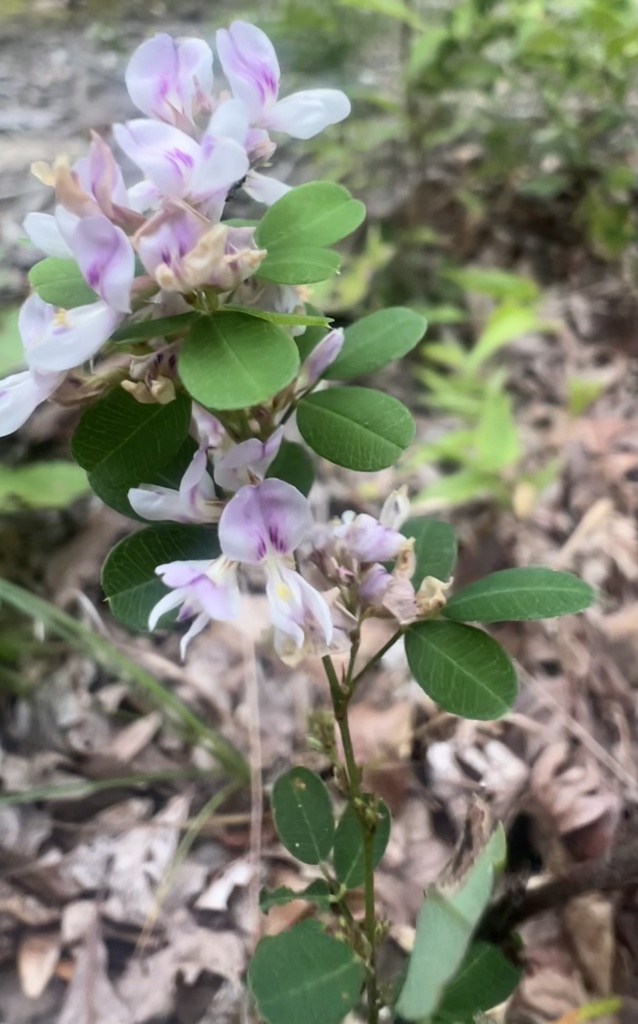
Lespedeza violacea, known as Violet Bush Clover or violet lespedeza (the USDA name), is a native perennial legume of dry open woods, woodland edges and rocky or sandy clearings across the eastern United States. A member of the pea family (Fabaceae), it forms a loose, bushy plant 1 to 2 feet tall with leaves divided into three oval leaflets, and from mid to late summer it bears small, rosy-violet pea flowers in airy clusters.
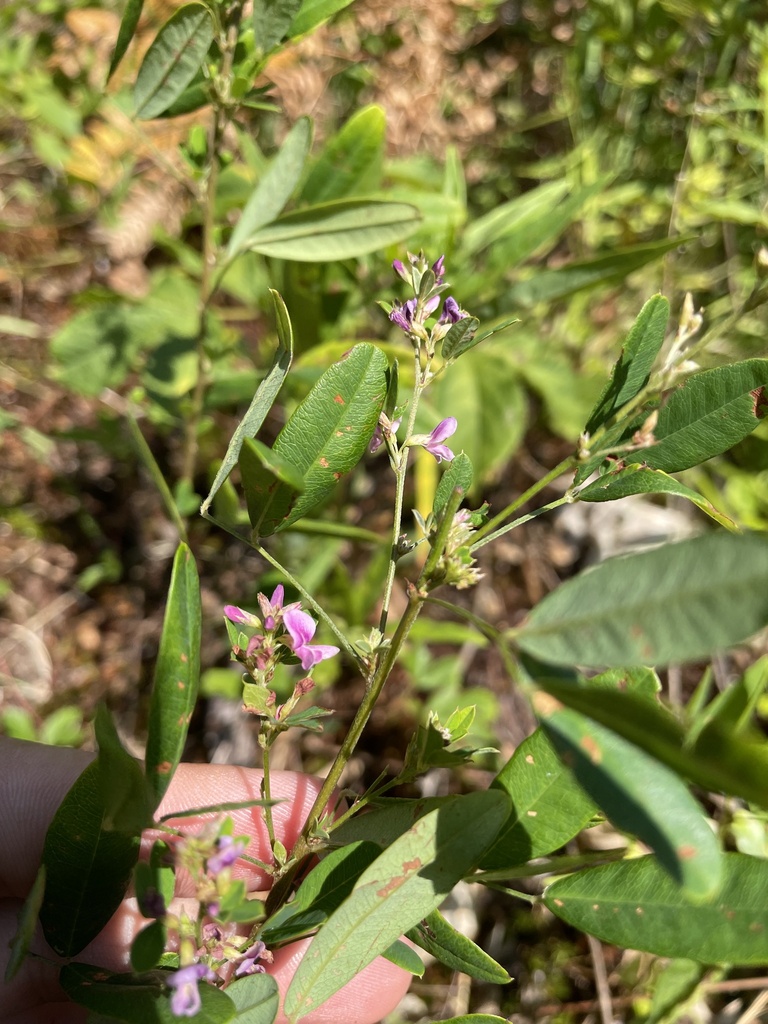
Unlike the dense, wand-like flower spikes of several other bush clovers, violet bush clover carries its flowers in loose, few-flowered clusters on slender stalks that often extend beyond the leaves. Like other lespedezas, it also produces tiny, closed, self-pollinating flowers in the leaf axils that set seed without opening.
It is an easy, drought-tolerant plant for dry shade gardens, woodland edges and meadow plantings, and like other legumes it enriches the soil by fixing nitrogen. It is a native relative of the invasive Asian lespedezas, such as sericea lespedeza (L. cuneata) and shrubby bicolor lespedeza (L. bicolor), and makes a good native substitute for them.
Identification
Look for a delicate, branching legume with three oval leaflets per leaf and small, violet to rose-purple pea flowers in loose clusters on long, slender stalks, growing in dry, open woods in late summer.
Growth Habit
A perennial from a woody crown, with several slender, upright to spreading or arching stems 1 to 2 1/2 feet long. The stems branch freely and are smooth or lightly hairy, giving the plant a loose, bushy, sometimes sprawling look.
Leaves
Leaves are alternate and divided into three leaflets on a short stalk. The leaflets are thin, elliptic to oval, about 1/2 to 2 inches long, with rounded tips, green and smooth to sparsely hairy above and finely hairy beneath.
Flowers
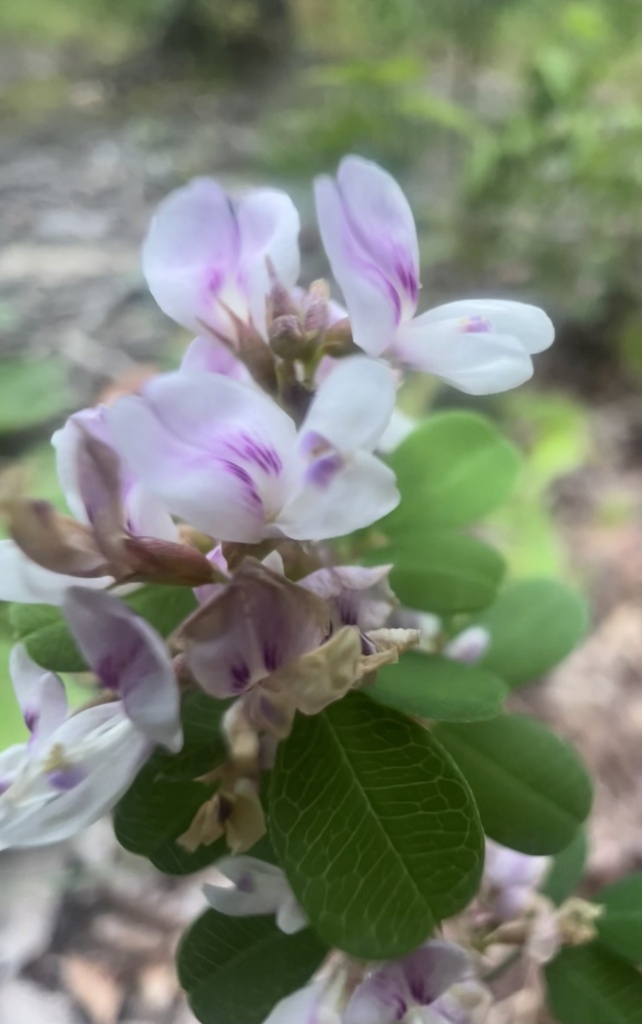
From July to September, small pea-shaped flowers about 1/4 to 3/8 inch long appear in loose clusters of a few flowers on slender stalks from the leaf axils, often held beyond the leaves. They are violet to rose-purple, with a darker patch on the upper petal. Tiny, petal-less flowers that never open (cleistogamous flowers) are also produced in the leaf axils.
Fruit & Seeds
The fruit is a small, flat, oval pod, about 1/4 inch long, that holds a single seed and does not split open. Pods ripen in late summer and fall.
Look-alikes
Slender bush clover (L. virginica) has narrow leaflets and flowers crowded along upright stems. Trailing lespedeza (L. procumbens) has hairy, trailing stems. Hairy lespedeza and round-headed bush clover have creamy white flowers. Wand bush clover (L. intermedia) and shrubby bush clover (L. frutescens) are very similar and were long confused with violet bush clover; they have denser flower clusters on shorter stalks. Lespedezas hybridize, so some plants are hard to name.
Quick Facts
| Scientific Name | Lespedeza violacea |
| Family | Fabaceae (pea family) |
| Plant Type | Herbaceous perennial legume |
| Mature Height | 1–2 ft |
| Mature Spread | 1–2 ft |
| Growth Rate | Moderate |
| Sun Exposure | Full sun to part shade |
| Water Needs | Low; dry to medium soil |
| Soil Type | Sandy, rocky or loamy, well-drained soil |
| Soil pH | Acidic to neutral (about 5.0–7.0) |
| Bloom Time | July–September |
| Flower Color | Violet to rose-purple |
| Fall Color | Leaves may yellow |
| Fruit | Small one-seeded pod |
| Deer Resistant | No; deer and rabbits browse it |
| USDA Hardiness Zones | 4–9 |
Native Range
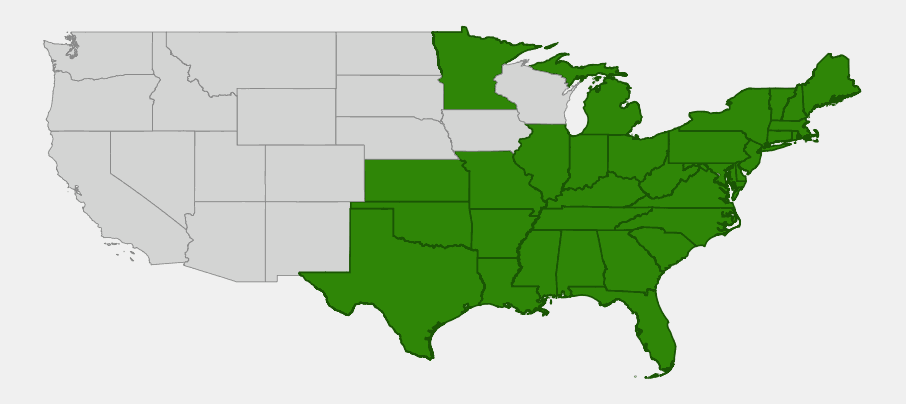
Violet bush clover is native to the eastern and central United States and southern Ontario. USDA PLANTS records it in 32 states, from Maine, Vermont and New Hampshire south to northern Florida, and west to Michigan, Minnesota, Missouri, Kansas, Oklahoma, eastern Texas and Louisiana.
It is most common in the Appalachian and Ozark regions, the Ohio Valley and the Piedmont. It becomes uncommon at the northern edge of its range in northern New England, Michigan and Minnesota, and is scattered on the Coastal Plain. In Texas it grows only in the eastern part of the state, and in Minnesota in the southeast.
Typical habitats are dry, open oak and oak-pine woods, woodland edges and clearings, rocky or wooded slopes, glades, sandy plains, old fields and roadsides. It prefers well-drained, acidic to neutral soils and light shade or partial sun, and is often found where fire or other disturbance keeps the woods open.
📋 Regional plant lists featuring Violet Bush Clover: New York, Pennsylvania & Northern New Jersey · Ohio & Indiana · Michigan, Wisconsin & Eastern Minnesota · Kentucky & Tennessee · Nebraska, Kansas & Eastern Colorado · Connecticut, Massachusetts & Rhode Island · New Hampshire, Maine & Vermont · Maryland, Virginia & West Virginia · Delaware, Southern New Jersey & Long Island · Illinois, Iowa & Missouri · Alabama, Georgia & Mississippi · North & South Florida · North & South Carolina · Arkansas, Louisiana, Eastern Oklahoma & Eastern Texas · South & West Texas
Growing & Care Guide
Violet bush clover is a tough, low-maintenance native for dry, lean soils in sun or light shade. It is rarely sold by nurseries, but specialist native seed and plant suppliers sometimes offer it.
Light
Full sun to part shade. It flowers best with a few hours of direct sun but grows well in the dappled light of open oak woods.
Soil & Water
Plant in well-drained sandy, rocky or loamy soil that is acidic to neutral. Rich or wet soil is not needed and may cause weak, floppy growth. Once established it tolerates drought well and needs no extra water except in long dry spells.
Planting Tips
Plant in spring or fall about 12 to 18 inches apart. It looks best in groups or mixed with native grasses such as little bluestem, which help hold up its slender stems. It needs no fertilizer, because it fixes its own nitrogen.
Pruning & Maintenance
Leave stems standing through winter for the seeds and cut them back in early spring. In meadow plantings, a spring burn or mowing every few years helps keep competing woody plants in check.
Propagation
Grow it from seed. The hard seed coat should be scarified (lightly nicked or sanded) before sowing, and inoculating seed with the right rhizobium bacteria helps young plants. Sow seed outdoors in fall or in spring after scarification.
Landscape Uses
- Dry shade gardens: summer flowers under open oaks and pines
- Meadows and prairies: a delicate legume among native grasses
- Woodland edges: soft texture along trails and forest margins
- Pollinator and butterfly gardens: nectar for bees and a host plant for butterflies
- Native alternative: a native substitute for invasive Asian lespedezas
Wildlife & Ecological Value
Like other native bush clovers, violet bush clover is valuable to wildlife, supporting bees, butterfly caterpillars and seed-eating birds.
For Pollinators
Bumblebees and other bees visit the flowers for nectar and pollen. Native lespedezas are host plants for the caterpillars of several butterflies and skippers, including the eastern tailed-blue, silver-spotted skipper, hoary edge and cloudywings.
For Birds
The seeds of native lespedezas are eaten by northern bobwhite, wild turkey and songbirds, especially in fall and winter.
For Mammals
White-tailed deer and rabbits browse the leaves and stems, which are high in protein.
Ecosystem Role
As a legume, it hosts nitrogen-fixing bacteria in root nodules and adds nitrogen to poor, dry soils. It is a characteristic plant of open, fire-maintained oak woodlands and declines when these woods become dense and shady.
Cultural & Historical Uses
The genus Lespedeza was named for Vicente Manuel de Céspedes, a Spanish governor of East Florida in the late eighteenth century; a printing error turned “Cespedes” into “Lespedeza.” The species name violacea means “violet-colored,” for the flowers.
Several Asian bush clovers were widely planted in the United States for erosion control, forage and wildlife food, and some, especially sericea lespedeza, became invasive. Native species such as violet bush clover are increasingly recommended in their place for restoration and wildlife plantings.
Violet bush clover was originally described by Linnaeus as a species of Hedysarum. Its close resemblance to other bush clovers and their tendency to hybridize have made the group a long-standing puzzle for botanists.
Frequently Asked Questions
Is violet bush clover invasive?
No. It is a native perennial that does not spread aggressively. The invasive lespedezas are Asian species such as sericea lespedeza and bicolor lespedeza.
Does violet bush clover grow in shade?
Yes. It grows well in part shade, such as open oak woods and woodland edges, although it flowers more in brighter light.
When does violet bush clover bloom?
From July to September, depending on location.
Is violet bush clover good for wildlife?
Yes. It feeds bees, hosts butterfly caterpillars, and its seeds are eaten by bobwhite, turkeys and songbirds.
How is violet bush clover different from slender bush clover?
Violet bush clover has oval leaflets and loose flower clusters on long stalks. Slender bush clover has narrow leaflets and flowers crowded along stiff, upright stems.

Looking for a nursery that carries Violet Bush Clover?
Browse our native plant nursery directory: Alabama & Arkansas · Connecticut, Delaware, Florida & Georgia · Illinois, Indiana & Kansas · Kentucky, Louisiana, Maine, Maryland, Massachusetts, Michigan, Minnesota, Mississippi & Missouri · New Hampshire, New Jersey, New York, North Carolina, Ohio & Oklahoma · Pennsylvania, Rhode Island, South Carolina, Tennessee, Texas, Vermont & Virginia · West Virginia

