
Water Pygmyweed (Crassula aquatica)
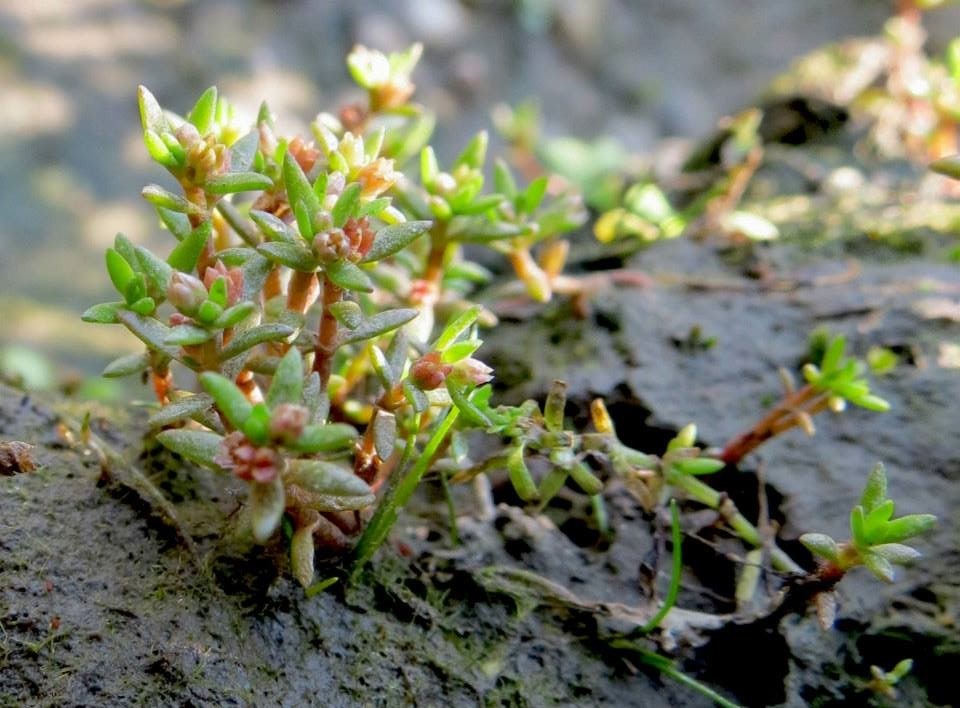
Crassula aquatica, the Water Pygmyweed (also called aquatic pygmyweed or water crassula), is one of the smallest flowering plants you are likely to find in North America. It is a tiny, succulent annual, usually only ½ to 2 inches tall, that grows on wet mud and in shallow water at the edges of ponds, lakes, vernal pools and freshwater tidal flats.
It is a member of the stonecrop family, a relative of jade plants and sedums, but adapted to life in water. Its paired, narrow, fleshy leaves and minute white flowers are easy to overlook, so it is often found only by botanists searching exposed mudflats on hands and knees. It grows across the cooler parts of the Northern Hemisphere, and in the United States from Alaska and the Pacific Northwest to New England, with scattered populations in the Southwest and the South.
Water pygmyweed is not a garden plant and is not sold by nurseries. This guide is an identification and appreciation page: how to recognize it, where it grows, and why these small mudflat specialists matter. In several states it is rare and tracked by natural heritage programs, so leave wild plants and their habitat undisturbed.
Identification
Water pygmyweed is a tiny, hairless, often reddish annual that forms small tufts or carpets on wet mud. Look for paired, narrow, fleshy leaves joined at their bases around the stem, and single minute white flowers tucked in the leaf axils.
Stems & Leaves
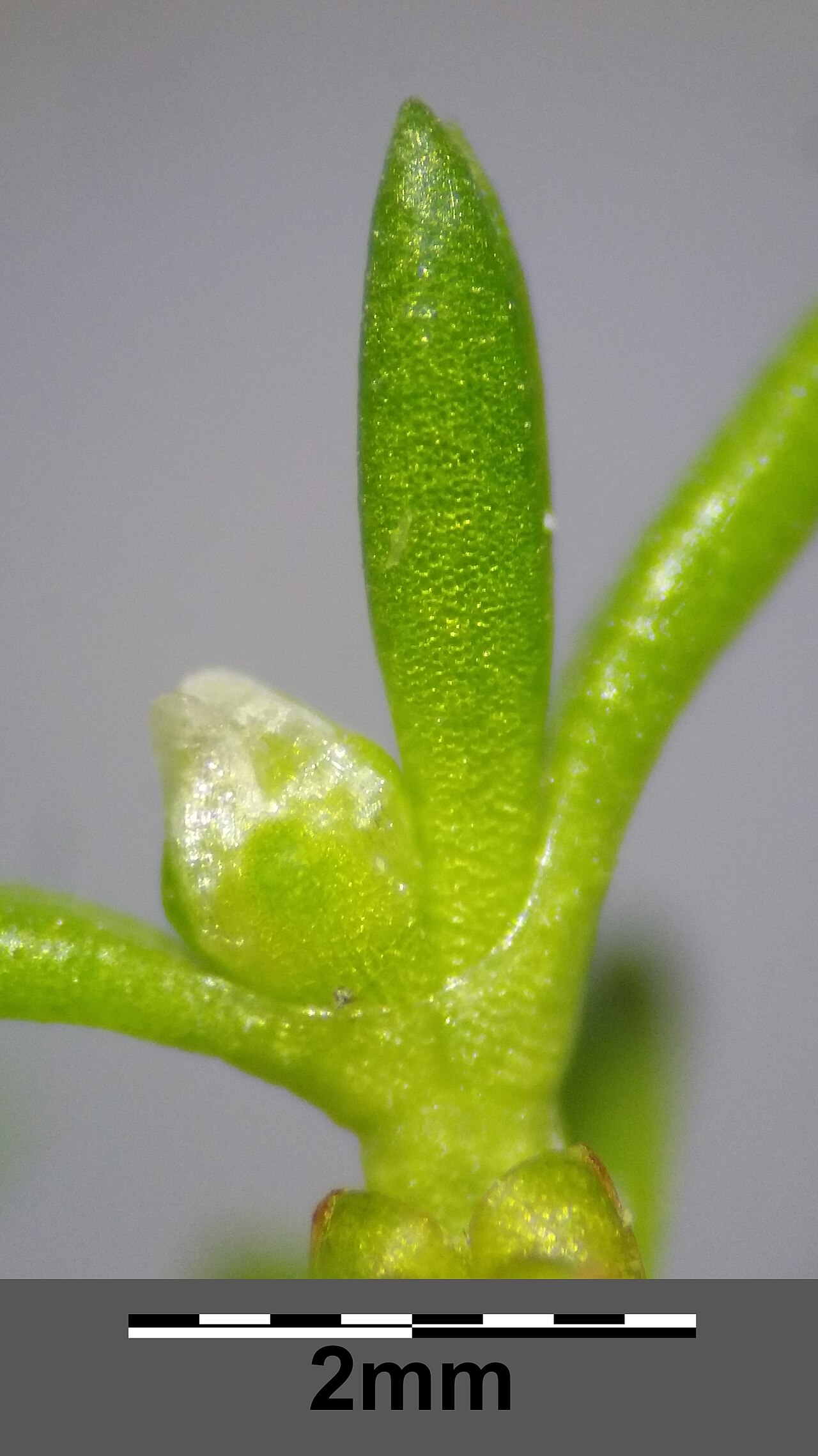
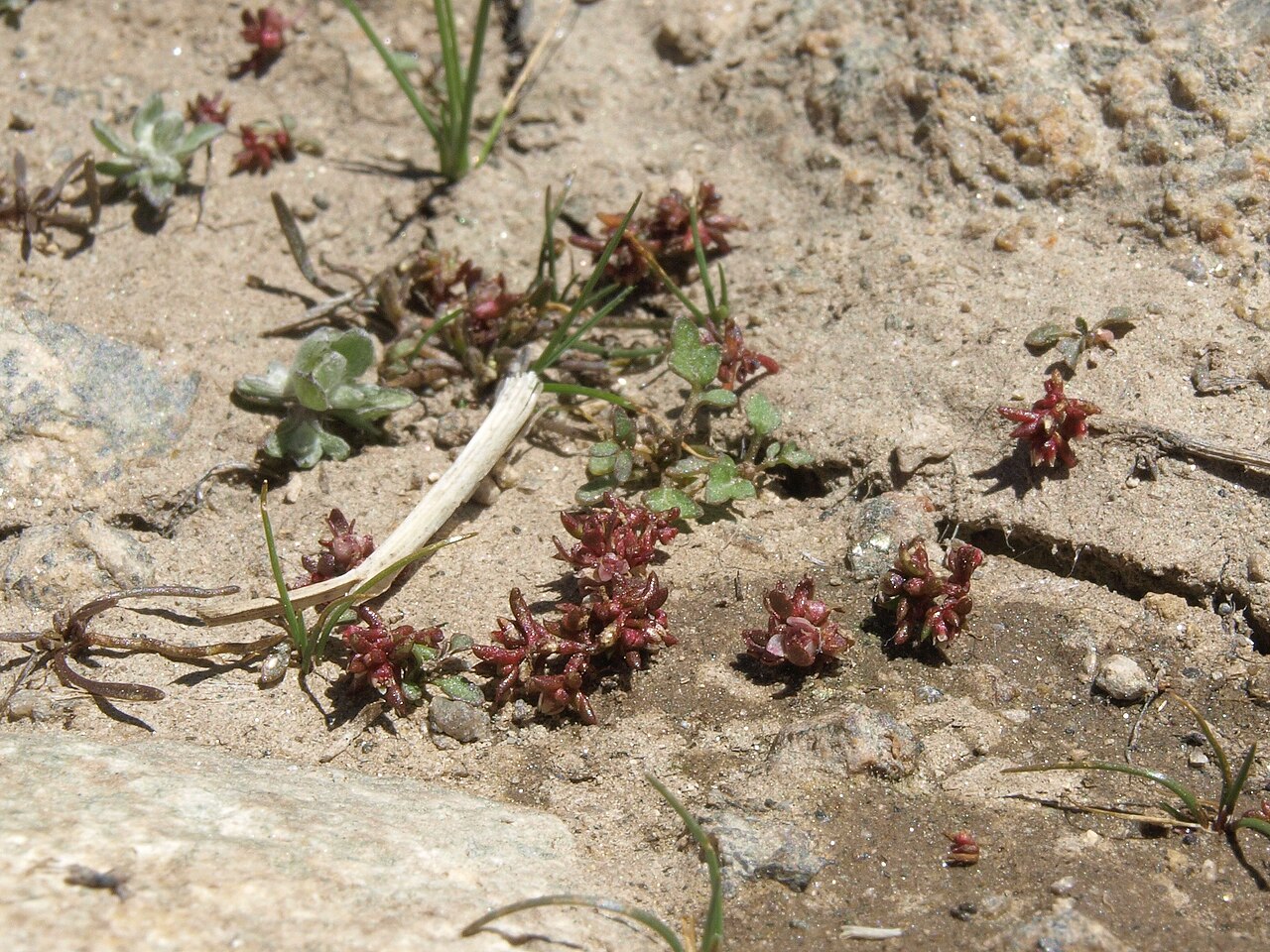
The plants are usually ½ to 2 inches tall, rarely to 4 inches, with slender, branching stems that may lie on the mud and root at the nodes. The leaves are opposite, linear to narrowly lance-shaped, about ⅛ to ¼ inch long, fleshy and slightly flattened, and their bases are joined around the stem. Plants are bright green when growing in water and often turn red to reddish brown as the mud dries.
Flowers
The flowers are solitary in the leaf axils, nearly stalkless and only about 1/16 inch across. Each flower has four tiny sepals and four whitish petals, with four stamens. Flowering happens in summer and early fall, usually as water levels drop and the plants are exposed on mud, though plants can also flower underwater.
Fruit & Seeds
Each flower produces four tiny pod-like follicles that split along one side to release several minute seeds. Seeds are long-lived in the mud, so plants may appear in large numbers in years when water levels are low and then seem to vanish for years.
Look-alikes
Sand pygmyweed (Crassula connata) of the West grows in drier sandy or rocky ground, is usually reddish throughout, and has more crowded, pointed leaves. Waterworts (Elatine) also form tiny mats on mud but have thin, non-succulent leaves and pinkish flowers. Mudwort (Limosella) has leaves in basal tufts with long stalks. Very young Needle Spikerush can form similar green carpets but has hair-like stems with no paired leaves. Australian swamp stonecrop (Crassula helmsii), an invasive relative in Europe, is larger and perennial.
Quick Facts
| Scientific Name | Crassula aquatica (L.) Schönland (syn. Tillaea aquatica L.) |
| Family | Crassulaceae (stonecrop family) |
| Plant Type | Tiny succulent annual of wet mud and shallow water |
| Mature Height | ½–2 in (rarely to 4 in) |
| Mature Spread | 1–3 in per plant; forms small carpets |
| Growth Rate | Fast (completes its life cycle in one season) |
| Sun Exposure | Full sun |
| Water Needs | Wet; shallow water or saturated mud |
| Soil Type | Mud, silt, wet sand and gravel |
| Soil pH | Slightly acidic to neutral |
| Bloom Time | June–September |
| Flower Color | White to pinkish, minute |
| Fall Color | Often turns red as the mud dries |
| Fruit | Four tiny follicles with minute seeds |
| Deer Resistant | Not relevant; rarely noticed by grazers |
| USDA Hardiness Zones | 2–9 (annual) |
Native Range
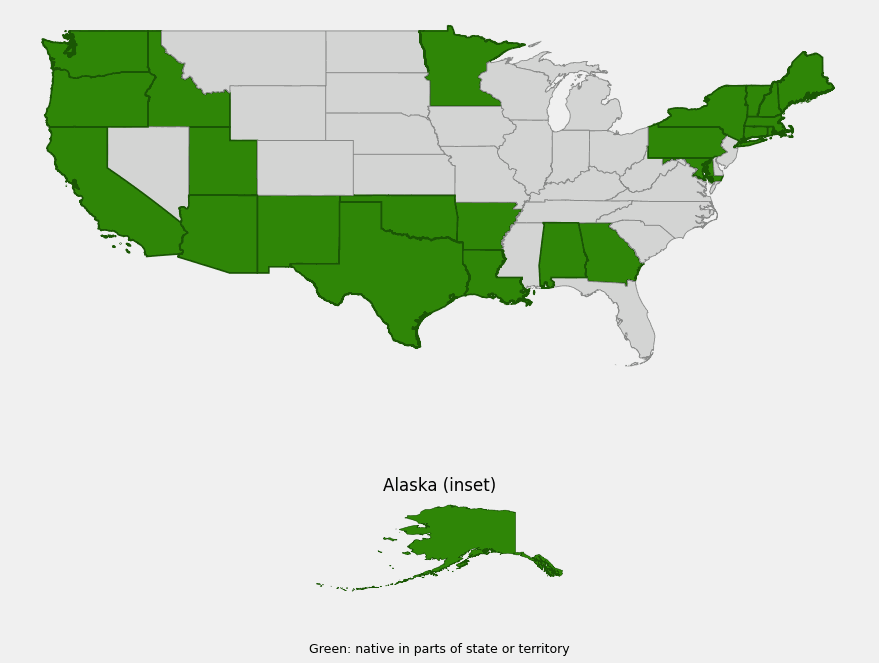
Water pygmyweed grows around much of the cooler Northern Hemisphere, in Europe, northern Asia and North America. USDA PLANTS lists it as native in Alaska and in Alabama, Arizona, Arkansas, California, Connecticut, Georgia, Idaho, Louisiana, Maine, Maryland, Massachusetts, Minnesota, New Hampshire, New Mexico, New York, Oklahoma, Oregon, Pennsylvania, Rhode Island, Texas, Utah, Vermont and Washington, and across Canada from British Columbia and the Yukon to Newfoundland and Nova Scotia. It is also known from Saint Pierre and Miquelon.
Its range is patchy. In the Northeast it is best known from freshwater tidal shores of large rivers such as the Hudson and from pond and lake shores in New England and the Maritimes. In the West it grows in vernal pools, mountain meadows and the drawdown zones of reservoirs and ponds. In the South and Southwest it is scattered, with outlying records in states such as Alabama, Georgia, Louisiana and Arizona. Because it is so small and appears only in certain years, it is probably underrecorded in many areas.
Its habitat is any place where shallow fresh water recedes and leaves open mud or wet sand: lakeshores and pond margins, vernal pools, tidal freshwater mudflats, river bars, ditches and the edges of reservoirs. It does best where competition from taller plants is kept down by fluctuating water levels or tides.
📋 Regional plant lists featuring Water Pygmyweed: Alaska · Alabama, Georgia & Mississippi · Arkansas, Louisiana, Eastern Oklahoma & Eastern Texas · Arizona & New Mexico · Utah & Western Colorado · Idaho, Eastern Oregon & Eastern Washington · Western Oregon & Western Washington · California & Nevada · Michigan, Wisconsin & Eastern Minnesota · New York, Pennsylvania & Northern New Jersey · Delaware, Southern New Jersey & Long Island · Connecticut, Massachusetts & Rhode Island · New Hampshire, Maine & Vermont · Maryland, Virginia & West Virginia · South & West Texas
Growing & Care Guide
Water pygmyweed is not cultivated and is not sold by nurseries; it is a wild plant of natural shorelines. In several states it is rare. Do not dig plants or collect seed from wild populations. The best way to “grow” it is to protect natural shorelines with seasonal water-level changes and open mud.
Light
In the wild it needs full sun on open mud. Shading by taller shoreline plants is one reason it disappears where water levels stop fluctuating.
Soil & Water
It grows on saturated mud, silt or wet sand, and in water a few inches deep. Most plants germinate in shallow water and flower as the water recedes in summer.
Planting Tips
It is not planted in gardens. It sometimes appears on its own along the muddy edges of natural ponds where it already occurs nearby. Wildlife ponds with gently sloping, unmulched mud edges and seasonal drawdowns offer the right kind of habitat.
Pruning & Maintenance
No maintenance applies. On public lands, keeping vehicles and heavy foot traffic off exposed mudflats, controlling invasive plants such as purple loosestrife and reed canary grass, and allowing natural water-level changes help it persist.
Propagation
It reproduces only by seed in the wild. Its tiny seeds remain in the mud for years and germinate when water levels and temperatures are right, so a population can appear suddenly after a dry summer exposes a lakeshore.
Landscape Uses
- Shoreline and wetland conservation: an indicator of natural, fluctuating shorelines
- Botanical exploration: a rewarding find for plant lovers searching mudflats
- Citizen science: photograph and report sightings to state heritage programs or iNaturalist
- Environmental education: shows how tiny annuals use short windows of exposed mud
Wildlife & Ecological Value
Water pygmyweed is a small player in shoreline ecosystems, but it is part of a specialized community of tiny annuals that cover exposed mud when water levels drop.
For Pollinators
Its minute flowers are probably mostly self-pollinated, and many flowers set seed without insect visits. Tiny flies and other small insects of mudflats may occasionally visit them.
For Birds
Shorebirds and dabbling ducks feed on mudflats where it grows, and small seeds of mudflat annuals are part of the mix of food they find there.
For Mammals
It is too small to matter much as food for mammals.
Ecosystem Role
Along with spikerushes, waterworts, mudwort and other tiny annuals, it helps cover and stabilize bare mud after water levels drop, and its long-lived seed bank lets the community return year after year. Its presence often indicates healthy shoreline habitat with natural water-level changes.
Cultural & Historical Uses
Carl Linnaeus described this plant in 1753 as Tillaea aquatica, and many European books still use that name. It was later moved into Crassula, the large genus that includes the popular jade plant (Crassula ovata). The name Crassula means “little thick one,” for the fleshy leaves, and aquatica refers to its watery habitat.
It is one of very few members of the stonecrop family adapted to water. Like many succulents, it can use a special form of photosynthesis (crassulacean acid metabolism, named after this family) that saves water; studies of submerged Crassula species suggest this also helps them gather carbon dioxide underwater.
Because of its small size and irregular appearance, water pygmyweed is a favorite “find” among field botanists. It is listed as rare or of conservation concern by natural heritage programs in several states and provinces, where its shoreline habitat has been lost to development, dams and invasive plants.
Frequently Asked Questions
Is water pygmyweed a succulent?
Yes. It belongs to the stonecrop family (Crassulaceae), the same family as jade plants and sedums, and has small, fleshy leaves. Unlike most succulents, it grows in shallow water and wet mud.
How big is water pygmyweed?
Tiny. Most plants are ½ to 2 inches tall, with leaves about ⅛ to ¼ inch long and flowers about 1/16 inch across.
Where can I find water pygmyweed?
Search exposed mud along pond and lake shores, vernal pools, river bars and freshwater tidal flats in late summer, especially in the Northeast, the Pacific Northwest and western mountain meadows. It appears more often in years with low water.
Can I grow water pygmyweed in my pond?
It is not sold by nurseries and should not be collected from the wild, since it is rare in several states. Natural ponds with gently sloping muddy edges and seasonal water-level changes may support it if it already grows nearby.
Is it invasive?
No. It is native to North America. A different species, Australian swamp stonecrop (Crassula helmsii), is a serious invasive in Europe, and should not be confused with native water pygmyweed.

Looking for a nursery that carries Water Pygmyweed?
Browse our native plant nursery directory: Alabama, Alaska, Arizona & Arkansas · California · Connecticut & Georgia · Idaho · Louisiana, Maine, Maryland, Massachusetts & Minnesota · New Hampshire, New Mexico, New York & Oklahoma · Oregon · Pennsylvania, Rhode Island, Texas, Utah & Vermont · Washington

