
Starry False Lily (Maianthemum stellatum)
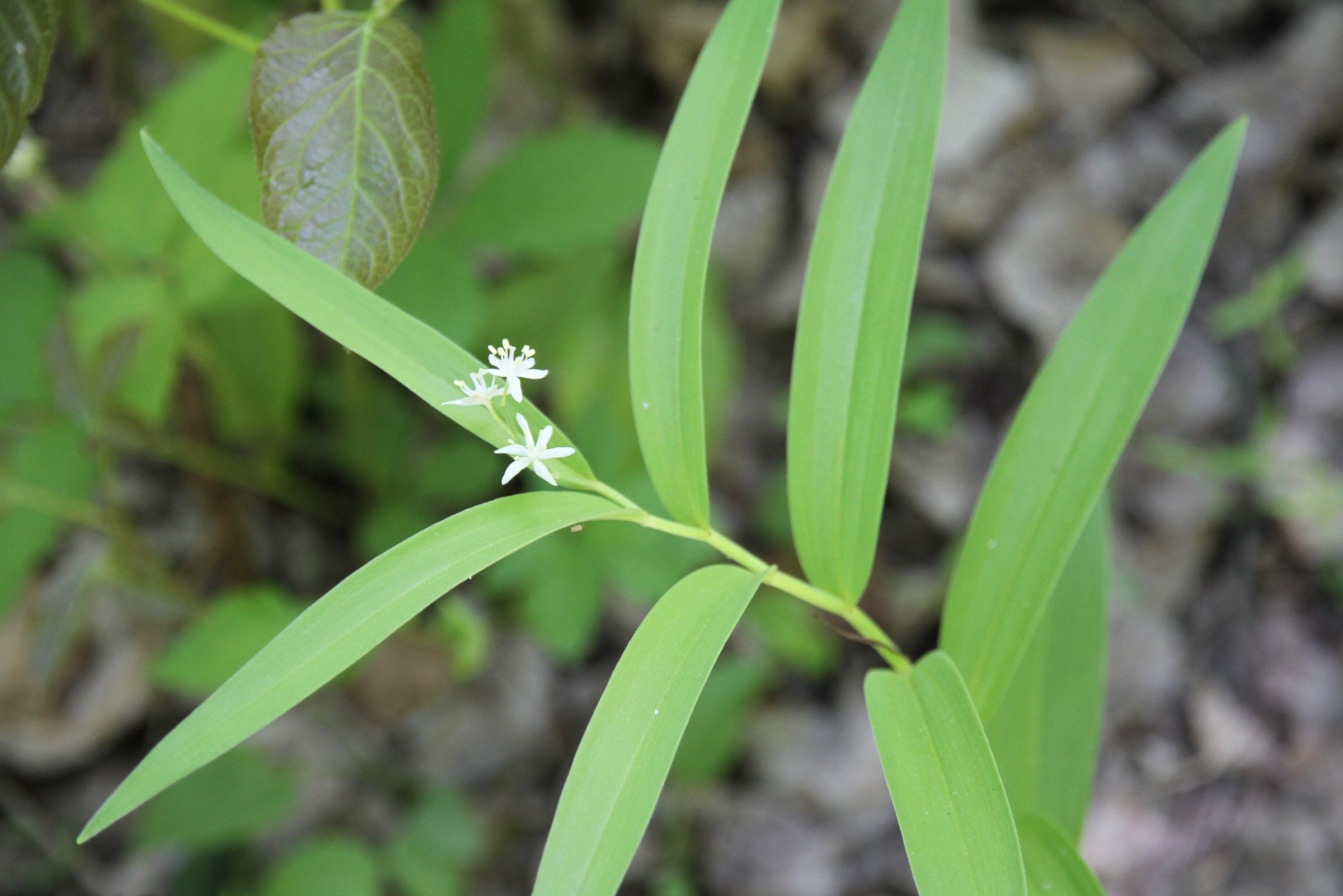
Maianthemum stellatum (syn. Smilacina stellata), widely known as Starry False Lily of the Valley, Starry False Solomon’s Seal, or Star-flowered Solomon’s Seal, is one of the most widely distributed native woodland and streamside wildflowers in North America. A member of the asparagus family (Asparagaceae), it is found from Alaska to Newfoundland and south through most of the northern two-thirds of the continental United States, reaching the mountains of New Mexico and Arizona in the Southwest and the hardwood forests of the Appalachians in the East. Its single, gently arching stem, two ranks of pleated, parallel-veined leaves, and small spray of star-shaped white flowers make it an easy and rewarding plant to recognize once you know what to look for.
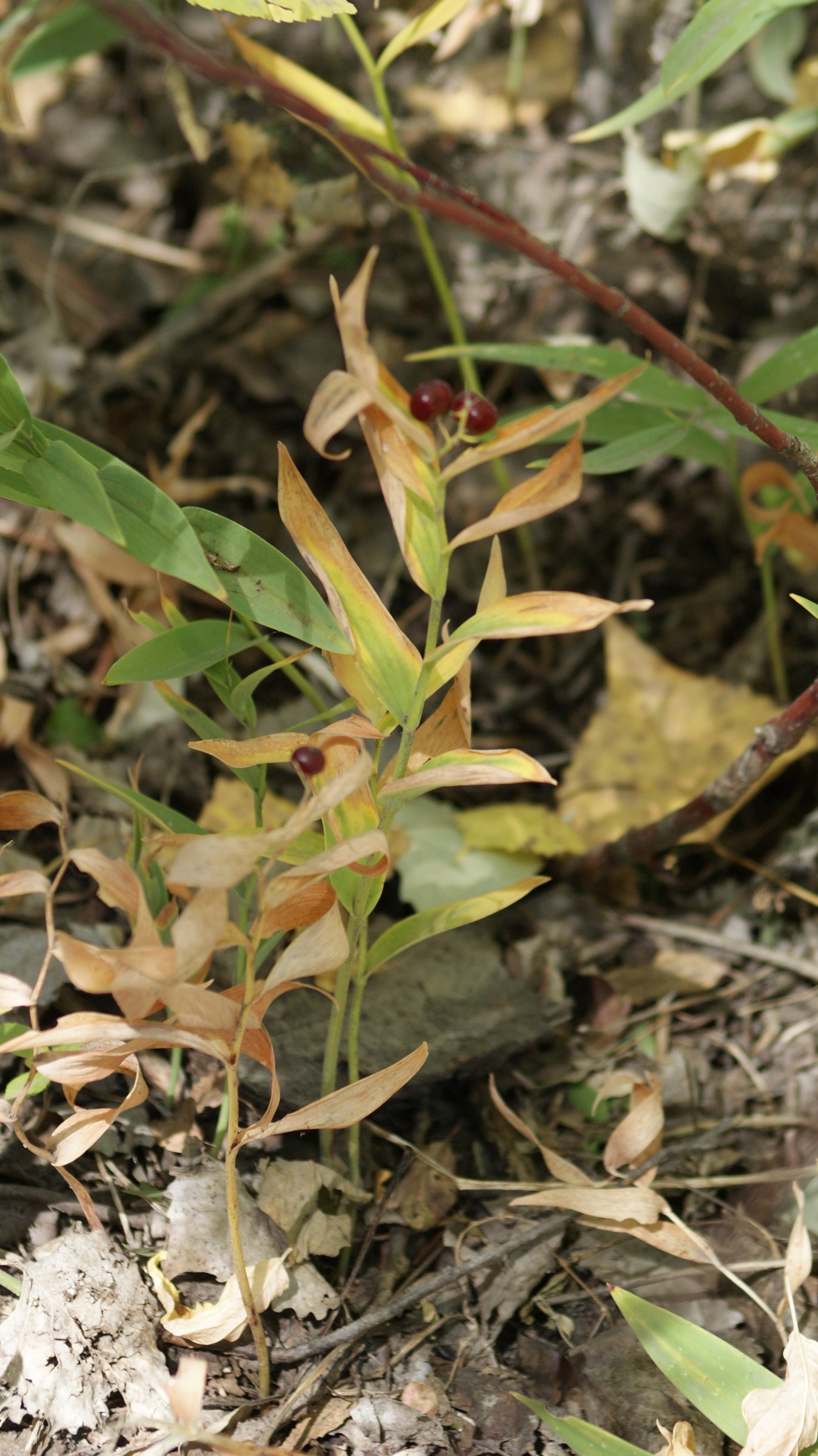
True to its common name, each flower has six narrow, pointed white tepals that spread into a distinct six-pointed star, clustered loosely at the tip of the stem rather than in a dense spike. The flowers bloom from spring into early summer and are followed by small berries that start out green with dark maroon stripes, gradually ripening through late summer and fall to deep red or nearly black — a striking color show that persists on the plant long after the flowers are gone.
Starry False Lily spreads by slender underground rhizomes and, given moist, humusy soil in part shade, forms loose, spreading colonies that knit together the forest floor, streambank, or shaded border planting. It asks for very little once established, tolerates a wide range of soils, and rewards patience with a long season of visual interest: fresh green shoots in spring, starry flowers in late spring, and jewel-toned berries through fall.
Identification
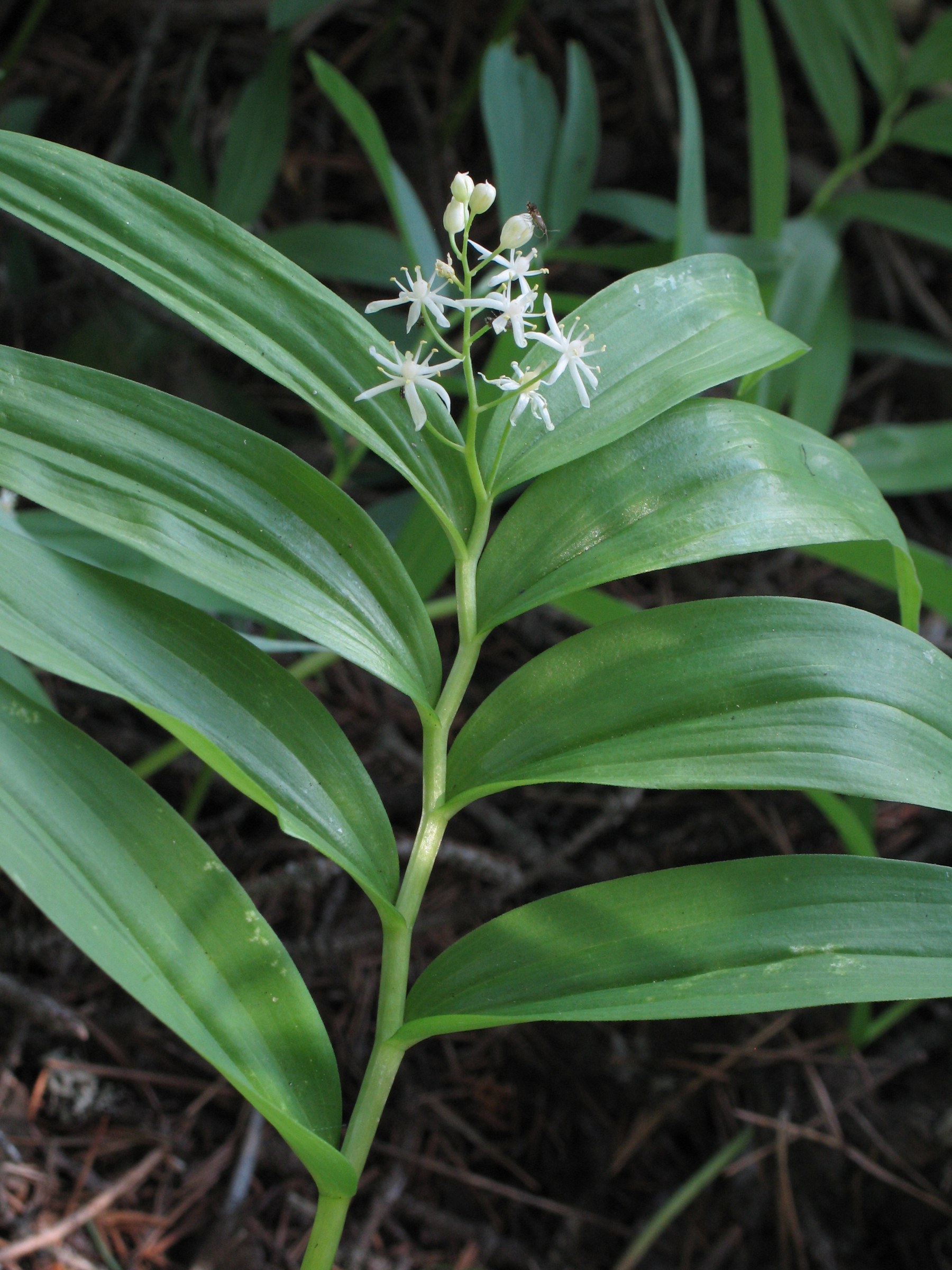
Starry False Lily is a rhizomatous herbaceous perennial reaching 8 to 18 inches tall (occasionally to 20 inches), with a single, unbranched stem that arches gently rather than standing fully upright. The whole plant dies back to the ground each winter and resprouts from its spreading rhizome system the following spring, often forming loose patches over time rather than staying as an isolated clump.
Leaves
The leaves are simple, lance-shaped to elliptic, 2 to 6 inches long, arranged alternately in two flattened ranks along the stem so that the whole plant has a distinctive pleated, zig-zag look when viewed from above. Each leaf is strongly parallel-veined, light to medium green, and clasps the stem slightly at its base. The foliage is often mistaken for a true lily-of-the-valley or Solomon’s seal at a glance, which is the source of the plant’s common names.
Flowers
From roughly May into July, depending on latitude and elevation, a loose, few-flowered cluster of small white flowers opens at the tip of the stem. Each flower has six narrow, spreading tepals that form a clean, six-pointed star about ¼ inch across — noticeably more open and star-shaped than the crowded, plume-like flower clusters of true Solomon’s plume (Maianthemum racemosum), its larger relative. The flowers have a light, pleasant fragrance and are visited by small native bees and flies.
Fruit & Seeds
The flowers give way to small round berries that begin pale green with dark maroon stripes, then ripen over the course of the summer and fall to a deep red or near-black. These berries are not a human food source — unlike some other native fruits, they should not be eaten; leave them for the birds and small mammals that rely on them. Each berry holds a few small seeds that are dispersed when wildlife feed on the fruit.
Quick Facts
| Scientific Name | Maianthemum stellatum (syn. Smilacina stellata) |
| Family | Asparagaceae (Asparagus family) |
| Plant Type | Herbaceous Perennial (rhizomatous) |
| Mature Height | 8–18 in (occasionally to 20 in) |
| Mature Spread | Slowly spreading colonies via rhizomes |
| Growth Rate | Moderate; spreads readily once established |
| Sun Exposure | Part Shade to Full Shade |
| Water Needs | Moderate; tolerates dry shade once established |
| Soil Type | Moist, humusy woodland soil; sandy to loamy |
| Soil pH | Slightly acidic to neutral |
| Bloom Time | May – July |
| Flower Color | White |
| Fall Color | Foliage yellows before dying back; berries ripen to deep red/black |
| Fruit | Green-and-maroon striped berries ripening to red or black; not edible for people |
| Deer Resistant | Moderate (occasionally browsed, not a preferred food) |
| USDA Hardiness Zones | 3–8 |
Native Range
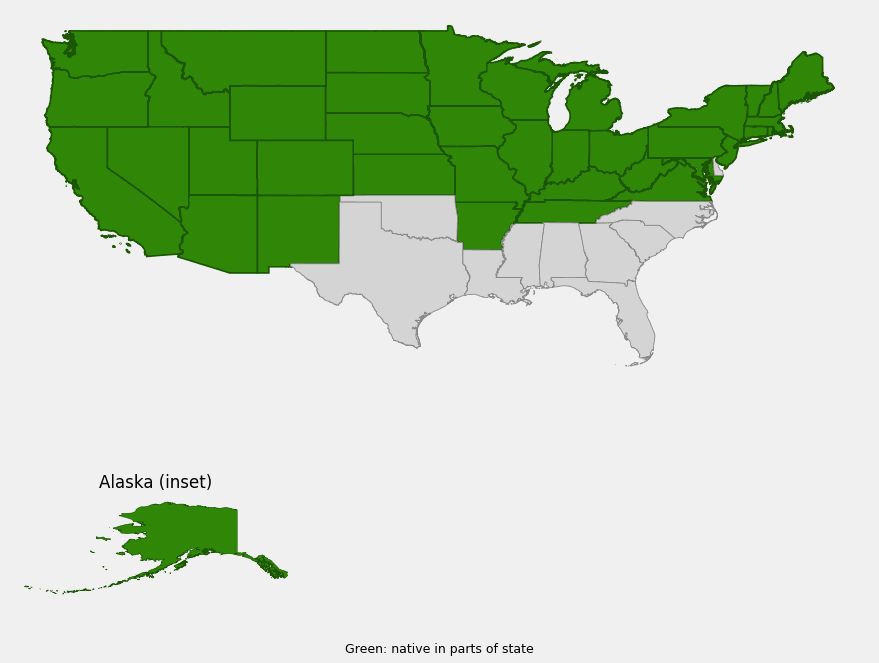
Starry False Lily has one of the broadest native ranges of any North American woodland wildflower, stretching from Alaska across almost all of Canada to Newfoundland and Labrador, and south through most of the northern two-thirds of the Lower 48 — from the Pacific Northwest and California through the Rocky Mountain states, the upper Midwest and Great Plains, the Great Lakes region, New England, and south in the Appalachians to Virginia. Isolated populations also reach the mountains of New Mexico and Arizona.
Despite how widely it is listed as present at the state level, county-level mapping shows Starry False Lily is genuinely native only in the northern two-thirds of the continent and is essentially absent as a wild plant from the Gulf Coast and Deep South. It is not native to Texas, Oklahoma, Louisiana, Mississippi, Alabama, Georgia, Florida, South Carolina, or Delaware, and within Virginia it occurs only in cooler, higher-elevation sites rather than across the whole state. Gardeners in the Deep South and Gulf Coast should not treat it as a local native.
Within its true range, look for Starry False Lily in moist deciduous and mixed woods, along gravelly or alluvial stream and lake shores, in thickets, wet meadows, and open savannas. It tolerates both consistently moist, humus-rich soils and surprisingly dry, sandy sites once its rhizomes are established, which is part of why it has become so widespread.
📋 Regional plant lists featuring Starry False Lily: Alaska · Arizona & New Mexico · Arkansas, Louisiana, Eastern Oklahoma & Eastern Texas · North Dakota, South Dakota & Western Minnesota · Delaware, Southern New Jersey & Long Island · Illinois, Iowa & Missouri · Idaho, Eastern Oregon & Eastern Washington · Ohio & Indiana · Kentucky & Tennessee · Maryland, Virginia & West Virginia · Michigan, Wisconsin & Eastern Minnesota · Montana & Wyoming · Nebraska, Kansas & Eastern Colorado · New Hampshire, Maine & Vermont · Connecticut, Massachusetts & Rhode Island · New York, Pennsylvania & Northern New Jersey · Western Oregon & Western Washington · Utah & Western Colorado
Growing & Care Guide
Starry False Lily is an easygoing, low-drama groundcover for shaded and partly shaded gardens across most of the northern and western United States. Once its rhizomes settle in, it needs little attention and reliably returns each spring, slowly widening into an attractive patch.
Light
Part shade to full shade suits it best, mimicking its native woodland-edge and streambank habitat. It tolerates a bit more sun in consistently moist soil, especially in the cooler northern parts of its range, but foliage can scorch in hot, dry, full-sun sites farther south.
Soil & Water
Moist, humus-rich woodland soil produces the lushest growth, but Starry False Lily is notably adaptable and will also grow in drier, sandy soils once established, thanks to its drought-tolerant rhizomes. Good drainage is helpful, though it also tolerates periodically damp sites such as stream edges and low meadows.
Planting Tips
Plant divisions or container stock in spring or fall, spacing plants 10 to 12 inches apart to let the rhizomes fill in naturally over a season or two. Starry False Lily combines well at the front of a shaded native bed or as an underplanting beneath deciduous trees and shrubs, where its arching habit and starry flowers stand out against taller companions.
Pruning & Maintenance
Essentially no pruning is required. Cut back the foliage after it yellows in fall if a tidier winter bed is wanted, or leave it in place to break down naturally and feed the soil. Established colonies can be divided in fall every few years if you want to control spread or share plants.
Propagation
The easiest method is rhizome division in fall, lifting and separating sections of an established clump. Seed can also be used but requires a cold-warm-cold stratification sequence to germinate reliably, so division is the faster, more predictable route for most home gardeners.
Landscape Uses
Starry False Lily fills several useful roles in a native shade garden:
- Woodland groundcover beneath deciduous trees and large shrubs
- Streambank and pond-edge plantings in consistently moist soil
- Naturalized shade gardens paired with ferns and other spring wildflowers
- Erosion control on shaded slopes, thanks to its spreading rhizome mat
- Four-season interest — spring flowers, summer foliage, and fall berry color
Wildlife & Ecological Value
Starry False Lily supports woodland wildlife at nearly every stage of its growing season, from spring flowers to fall fruit.
For Pollinators
The small, fragrant white flowers attract native bees and flies in late spring, offering a nectar source in the shaded woodland layer at a time when many sun-loving wildflowers are not yet blooming.
For Birds
Ruffed grouse, various thrushes, and other woodland birds feed on the ripe berries in late summer and fall, helping disperse the seeds to new patches of forest floor.
For Mammals
Small mammals, including chipmunks and mice, eat the fallen berries, and deer will occasionally browse the foliage, though it is not considered a preferred forage plant.
Ecosystem Role
As a rhizomatous groundcover of the forest floor, Starry False Lily helps stabilize soil on shaded slopes and stream edges, fills in the herbaceous layer beneath the tree canopy, and contributes to the structural diversity that woodland wildlife depend on for food and cover throughout the growing season.
Cultural & Historical Uses
Indigenous peoples across the plant’s wide range historically made use of its rhizomes rather than its berries. Several accounts describe the fleshy roots being used, somewhat like onions, to flavor other foods, and medicinally the roots were reportedly chewed raw or prepared into syrups and teas to help relieve coughs, and applied as poultices to burns and skin swellings. These are historical ethnobotanical uses, not guidance for modern self-treatment, and the plant’s berries in particular were not used as food.
Because of its wide range and reliable spread, Starry False Lily has also long been noted by botanists and foragers as one of the easier-to-recognize members of the Solomon’s seal and Solomon’s plume group, distinguished from its relatives by its smaller size, more open star-shaped flowers, and the striped pattern of its developing berries.
Frequently Asked Questions
Can I eat Starry False Lily berries?
No. The berries are not a food source for people and should be left for birds and wildlife. If you want an edible native berry for the garden, choose a different species — don’t rely on this one.
How is Starry False Lily different from Solomon’s Plume (Maianthemum racemosum)?
Starry False Lily is smaller overall, with a looser, more open cluster of star-shaped flowers at the stem tip. Solomon’s Plume is larger, with a denser, plume-like cluster of many small flowers rather than a handful of distinct stars.
Will Starry False Lily spread aggressively in my garden?
It spreads by rhizomes and will form a slowly expanding colony in good conditions, but it is not considered an aggressive or weedy native. In a shaded bed it typically fills in gracefully over a few seasons rather than overrunning neighboring plants.
Does Starry False Lily grow in Texas or the Deep South?
No. Despite sometimes appearing on broad, state-level native plant lists, detailed county mapping shows it is not genuinely native to Texas, Oklahoma, Louisiana, Mississippi, Alabama, Georgia, Florida, South Carolina, or Delaware. Its true range is the northern two-thirds of the continent plus scattered mountain populations in the Southwest.
What growing conditions does it need?
Part shade to full shade and moist, humus-rich soil give the best results, though established plants tolerate drier, sandy soils as well. It is a forgiving, low-maintenance choice for a native shade garden once its rhizomes take hold.

Looking for a nursery that carries Starry False Lily?
Browse our native plant nursery directory: Alaska, Arizona & Arkansas · California · Colorado & Connecticut · Idaho, Illinois, Indiana, Iowa & Kansas · Kentucky, Maine, Maryland, Massachusetts, Michigan, Minnesota, Missouri & Montana · Nebraska, Nevada, New Hampshire, New Jersey, New Mexico, New York, North Carolina, North Dakota & Ohio · Oregon · Pennsylvania, Rhode Island, South Dakota, Tennessee, Utah, Vermont & Virginia · Washington · West Virginia, Wisconsin & Wyoming