
Thicket Creeper (Parthenocissus vitacea)
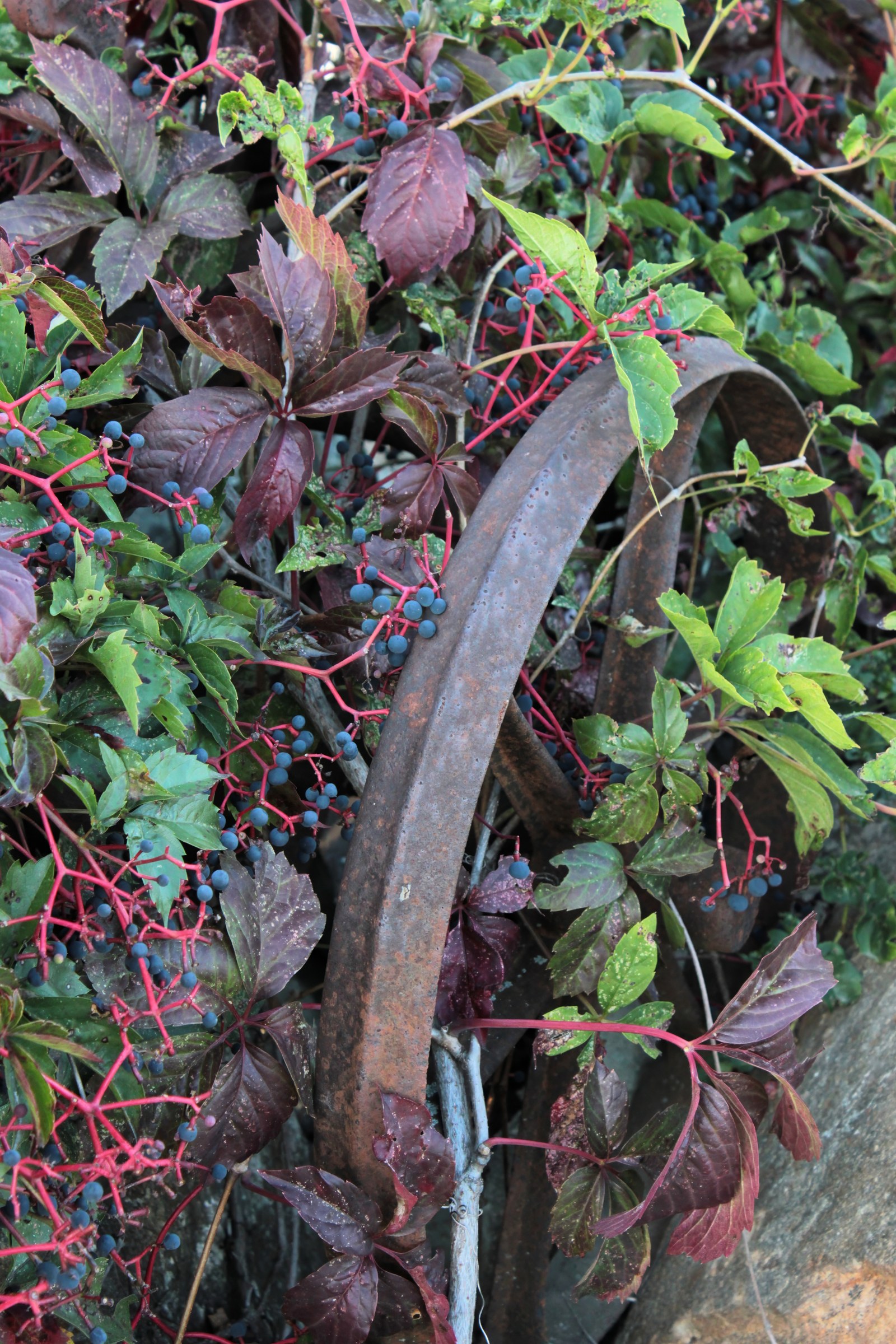
Parthenocissus vitacea, commonly called Thicket Creeper or Woodbine, is a vigorous, deciduous climbing vine native across much of the northern and central United States and southern Canada. It belongs to the grape family (Vitaceae) and is one of two look-alike native vines gardeners regularly confuse with each other — the other being Virginia Creeper (Parthenocissus quinquefolia). Thicket Creeper scrambles rather than clings, using twining tendril tips instead of the adhesive discs that let Virginia Creeper climb bare walls, so in the landscape it behaves more like a sprawling groundcover or a vine that weaves through shrubs, fences, and brush piles.
In the wild, Thicket Creeper is a plant of forest edges, thickets, riverbanks, and disturbed ground — the kind of rough, sunny-to-partly-shaded margin habitat its common name describes. Its palmate leaves of five leaflets turn shades of red, orange, and purple in fall, and its small greenish flowers mature into grape-like clusters of blue-black berries that are an important food source for birds. Those berries, like the rest of the plant, are toxic to people and pets and should never be eaten.
Because it spreads readily by both seed and rooting stems, Thicket Creeper is best used in naturalistic settings — along fence lines, over brush piles, scrambling through a hedgerow, or as erosion-holding cover on a rough slope — rather than in tidy, small garden beds where its rambling habit needs frequent editing.
Identification
Thicket Creeper is a woody, deciduous vine that can reach 20 to 35 feet or more where it has structure to climb, though without support it often forms a tangled, waist-high groundcover mat. Stems are reddish when young, aging to gray-brown and slightly shaggy with loose bark on older growth.
Leaves & Tendrils
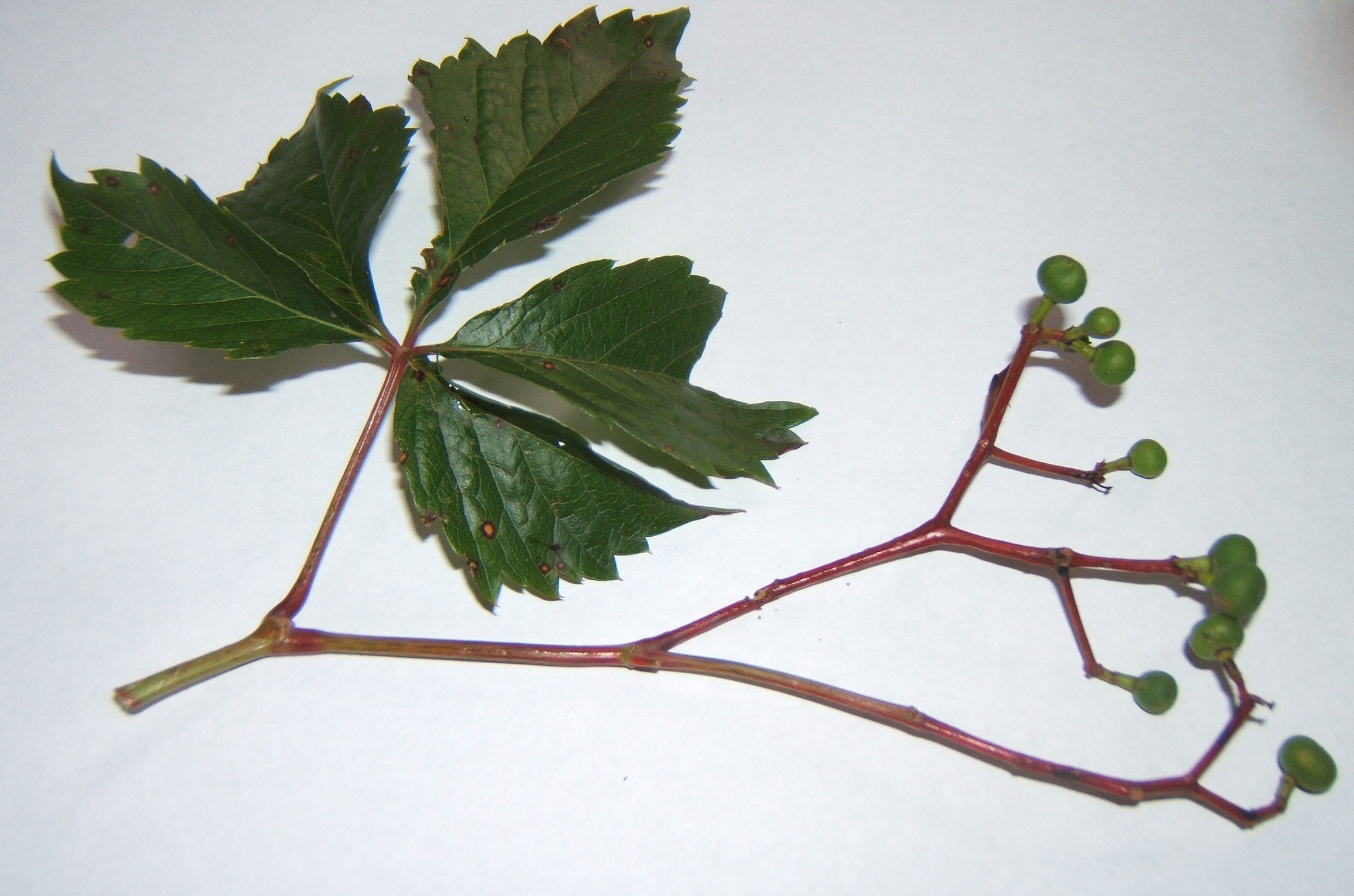
Leaves are palmately compound with five coarsely toothed leaflets radiating from a central point, each leaflet 2 to 5 inches long. New leaflets are glossy on top; the whole leaf turns brilliant red, orange, or burgundy in autumn. Tendrils branch into a handful of short, curling tips that wrap around twigs, wire, or rough bark — they do not produce the flattened adhesive discs seen in Virginia Creeper, so Thicket Creeper cannot climb a smooth wall or tree trunk on its own.
Flowers & Fruit
Small, greenish, five-parted flowers appear in branched clusters in late spring to early summer, largely hidden among the foliage. They mature by late summer into round berries 3/8 to 1/2 inch across, green at first and ripening to a deep blue-black with a waxy bloom, carried on bright pink-red stalks that stay showy after the leaves color up.
⚠️ Toxicity warning: The berries, leaves, and sap of Thicket Creeper contain calcium oxalate crystals and are toxic if eaten, causing mouth and throat irritation, vomiting, and digestive upset in people and pets. Handling the foliage can also irritate skin in sensitive individuals. Do not eat any part of this plant, and site it where small children and pets won’t be tempted by the berries.
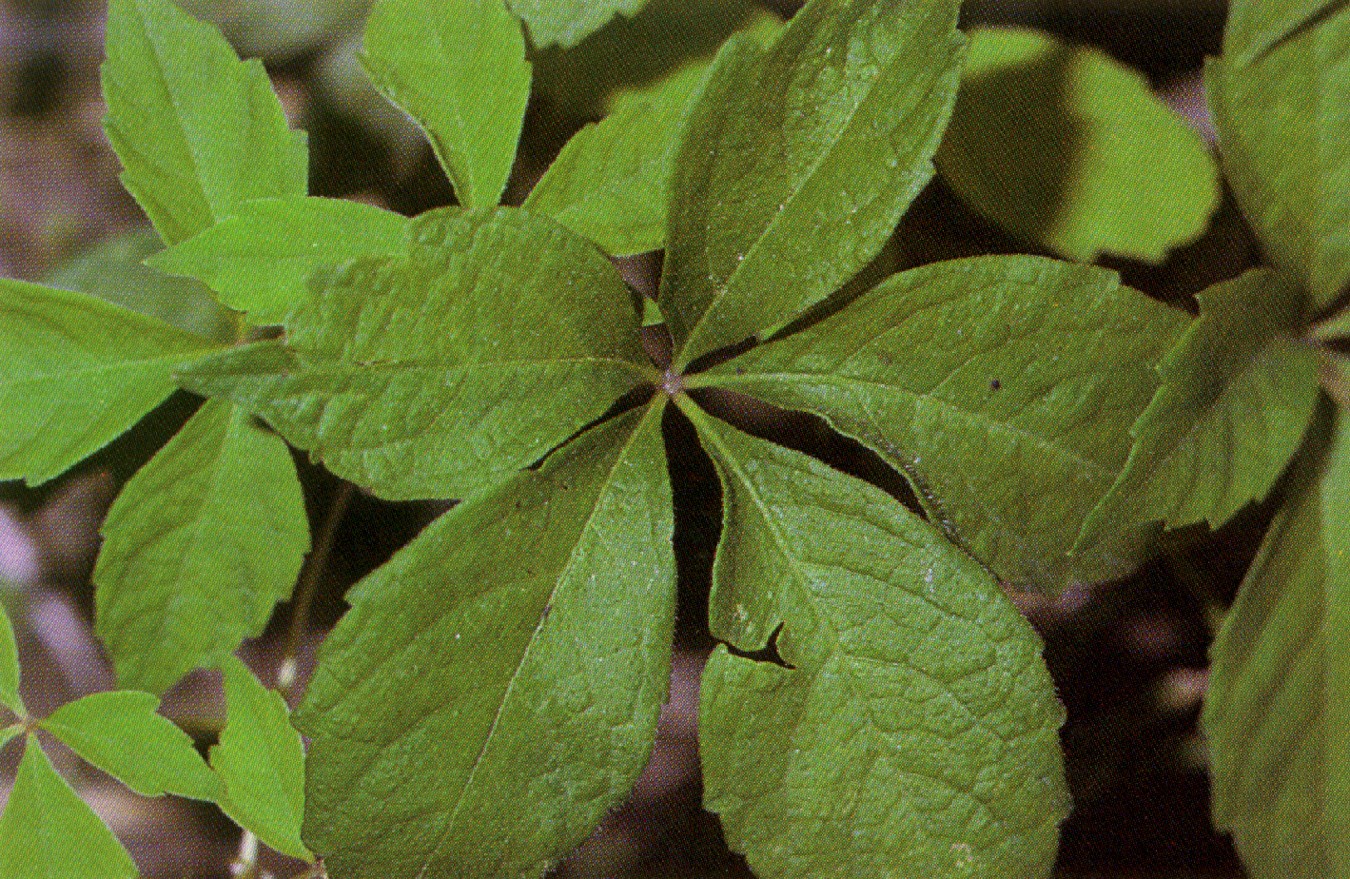
Thicket Creeper vs. Virginia Creeper
These two native vines are so often confused that many nurseries and even some plant lists mislabel one as the other. A few quick checks settle it:
- Tendril tips: Thicket Creeper has slender, curling tendrils with no adhesive pads; Virginia Creeper’s tendrils end in round, sticky discs that let it climb smooth surfaces like brick and siding.
- Berry size: Thicket Creeper berries run about 3/8–1/2 inch across; Virginia Creeper’s are smaller, roughly 1/4–3/8 inch.
- Leaf stalks: The individual leaflet stalks (petiolules) on Thicket Creeper are clearly stalked and up to an inch long; on Virginia Creeper they are much shorter or nearly stalkless.
- Flower cluster shape: Thicket Creeper’s flower clusters branch evenly in twos and threes; Virginia Creeper’s branch unevenly around one main stalk.
Both vines are native, both turn brilliant red in fall, and both produce toxic berries that birds eat safely — the distinction matters mainly for gardeners who want a vine that clings to masonry (Virginia Creeper) versus one that scrambles through brush and fencing without climbing smooth walls (Thicket Creeper).
Quick Facts
| Scientific Name | Parthenocissus vitacea |
| Family | Vitaceae (Grape) |
| Plant Type | Deciduous woody vine |
| Mature Length | 20–35+ ft climbing, or a sprawling 1–2 ft groundcover mat without support |
| Growth Rate | Fast |
| Sun Exposure | Full sun to part shade |
| Water Needs | Low to moderate once established |
| Soil Type | Adaptable; sand to clay, average to dry |
| Bloom Time | Late spring – early summer |
| Flower Color | Greenish-white (inconspicuous) |
| Fall Color | Red, orange, burgundy |
| Fruit | Blue-black berries, toxic if eaten |
| Climbing Method | Twining tendrils (no adhesive discs) |
| USDA Hardiness Zones | 3–9 |
Native Range
Thicket Creeper is native across a broad swath of the northern and central United States, from New England west through the Upper Midwest and Great Plains to the Rocky Mountain states, and south through the Southwest to Texas and Arizona, with a range that also extends into southeastern Canada west to Manitoba. It is largely absent from the true Southeast — the Gulf Coast states, the Carolinas, Georgia, and most of the lower Mississippi Valley fall outside its native range. It is present in California but is considered likely introduced there rather than a native population.
Habitat is varied but consistently disturbed or open: riverbanks and floodplain thickets, fence lines, forest edges, rocky slopes, and recently disturbed ground. It tolerates both consistently moist bottomland soils and drier upland sites, which helps explain its wide geographic spread.
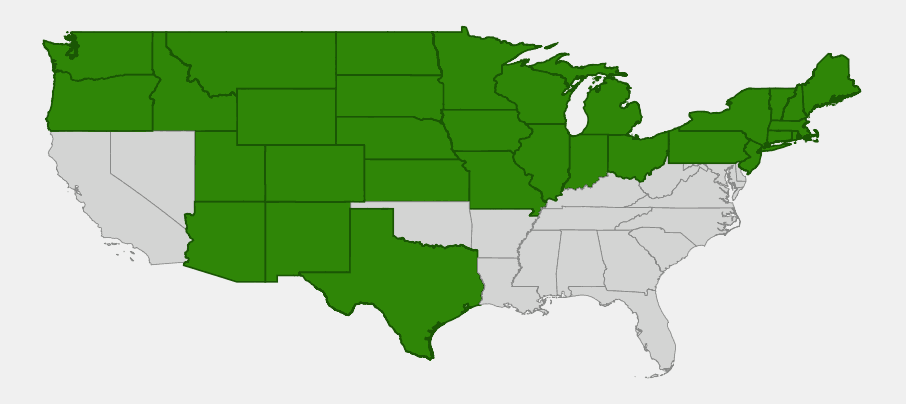
📋 Regional plant lists featuring Thicket Creeper: New Hampshire, Maine & Vermont · Connecticut, Massachusetts & Rhode Island · New York, Pennsylvania & Northern New Jersey · Ohio & Indiana · Illinois, Iowa & Missouri · Michigan, Wisconsin & Eastern Minnesota · North Dakota, South Dakota & Western Minnesota · Nebraska, Kansas & Eastern Colorado · Utah & Western Colorado · Montana & Wyoming · Idaho, Eastern Oregon & Eastern Washington · Western Oregon & Western Washington · Arizona & New Mexico · Arkansas, Louisiana, Eastern Oklahoma & Eastern Texas
Growing & Care Guide
Thicket Creeper is about as low-maintenance as native vines get — the main challenge is containing its enthusiasm, not coaxing it along.
Light
It grows and fruits best in full sun to light shade. In deeper shade it survives but climbs and flowers less vigorously, spreading instead as a loose groundcover searching for brighter light.
Soil & Water
Thicket Creeper is highly adaptable, tolerating sandy, loamy, or clay soils and a wide pH range. Established plants handle drought well and need no supplemental irrigation outside of extended dry spells in their first year. It also tolerates occasional flooding, which suits its natural riverbank habitat.
Planting Tips
Give it something substantial to climb — a fence, arbor, dead tree, or brush pile — since without an adhesive grip it needs branches or wire to twine around rather than a bare wall. Allow generous space, 10 feet or more, since vigorous plants will spread both by seed and by rooting wherever a stem touches soil. It is an excellent, fast choice for covering an unsightly chain-link fence or stabilizing a rough slope.
Pruning & Maintenance
Prune hard in late winter or early spring to keep growth in bounds; Thicket Creeper responds well to even severe cutback. Watch for rooted layers at ground level and remove any you don’t want, since a single plant can colonize a surprising amount of ground over a few seasons. It has no significant pest or disease problems.
Landscape Uses
- Fence and trellis cover for chain-link, split-rail, or wire fencing
- Slope stabilization on rough, erosion-prone banks
- Wildlife hedgerows woven through shrubs for cover and berries
- Brush pile camouflage in naturalistic or restoration plantings
- Fall color accent where its red-and-blue autumn display can be appreciated at a distance from paths and play areas
Wildlife & Ecological Value
For Birds
The blue-black berries are an important late-season food source for many songbirds, including robins, thrushes, catbirds, and woodpeckers, which strip the clusters through fall and into winter and spread the seeds widely in their droppings. The dense tangle of foliage also provides nesting cover and protection from predators and weather.
For Pollinators
The small, nectar-rich flowers are visited by a range of native bees, including sweat bees, as well as small beetles and other insects, during a period in late spring when fewer other blooms are available in disturbed, brushy habitats.
Ecosystem Role
As a fast-colonizing vine of disturbed edges, Thicket Creeper helps stabilize soil on slopes and riverbanks and knits together brushy cover that shelters small mammals and ground-nesting birds. Its toxicity to mammalian browsers means deer generally leave it alone, which can make it a useful, reliable groundcover where deer pressure limits other native plant choices.
A Note on Naming & History
Taxonomists have long debated whether this plant and Virginia Creeper are different enough to warrant separate species status, and some modern treatments favor the name Parthenocissus inserta for this plant on priority grounds. USDA PLANTS continues to recognize Parthenocissus vitacea as the accepted name used on this page, and the two names refer to the same plant. Regardless of the label on a given label or list, remember that the common name “Woodbine” is shared with Virginia Creeper on many regional plant lists — always check the scientific name before assuming which vine you’re getting.
Historically, Indigenous peoples across the plant’s range used parts of various Parthenocissus species in traditional practices, though detailed, well-documented ethnobotanical records specific to Thicket Creeper are sparse compared to its more widely studied relative. Given its toxicity, this page does not describe any food or medicinal use — admire it for its fall color and wildlife value instead.
Frequently Asked Questions
Is Thicket Creeper the same as Virginia Creeper?
No, though they are closely related and often confused — even sharing the common name “Woodbine” in some regions. Thicket Creeper (Parthenocissus vitacea) climbs by twining tendrils with no adhesive discs, so it cannot grip bare walls the way Virginia Creeper can. See the comparison above for more identification details.
Are Thicket Creeper berries poisonous?
Yes. The berries, leaves, and sap contain calcium oxalate crystals that are toxic to people and pets if eaten, and can cause skin irritation on contact for some individuals. Birds eat the berries safely and help disperse the seeds, but they are not safe for human or pet consumption.
Will Thicket Creeper take over my yard?
It can spread aggressively by seed and by rooting wherever a stem touches soil, so it’s best suited to naturalistic plantings, fences, and slopes where vigorous growth is welcome rather than small, tidy beds. Annual pruning keeps it in check.
Does Thicket Creeper need a trellis?
It benefits from something to twine around — fencing, branches, or wire — since it lacks the adhesive tendrils that let Virginia Creeper climb smooth surfaces unaided. Without support, it sprawls as a groundcover instead of climbing.
Is Thicket Creeper native to California?
It is present in California, but botanists consider it likely introduced there rather than part of the state’s native flora, so it is not included in the native-range list above for California gardens.

Looking for a nursery that carries Thicket Creeper?
Browse our native plant nursery directory: ME/MA/MI/MN/MO/MT region · NH/NJ/NY/ND/OH region · PA/RI/SD/TX/UT/VT region · CO/CT region · ID/IL/IN/IA/KS region · WI/WY region · AZ region · Oregon · Washington