
Seaside Heliotrope (Heliotropium curassavicum)
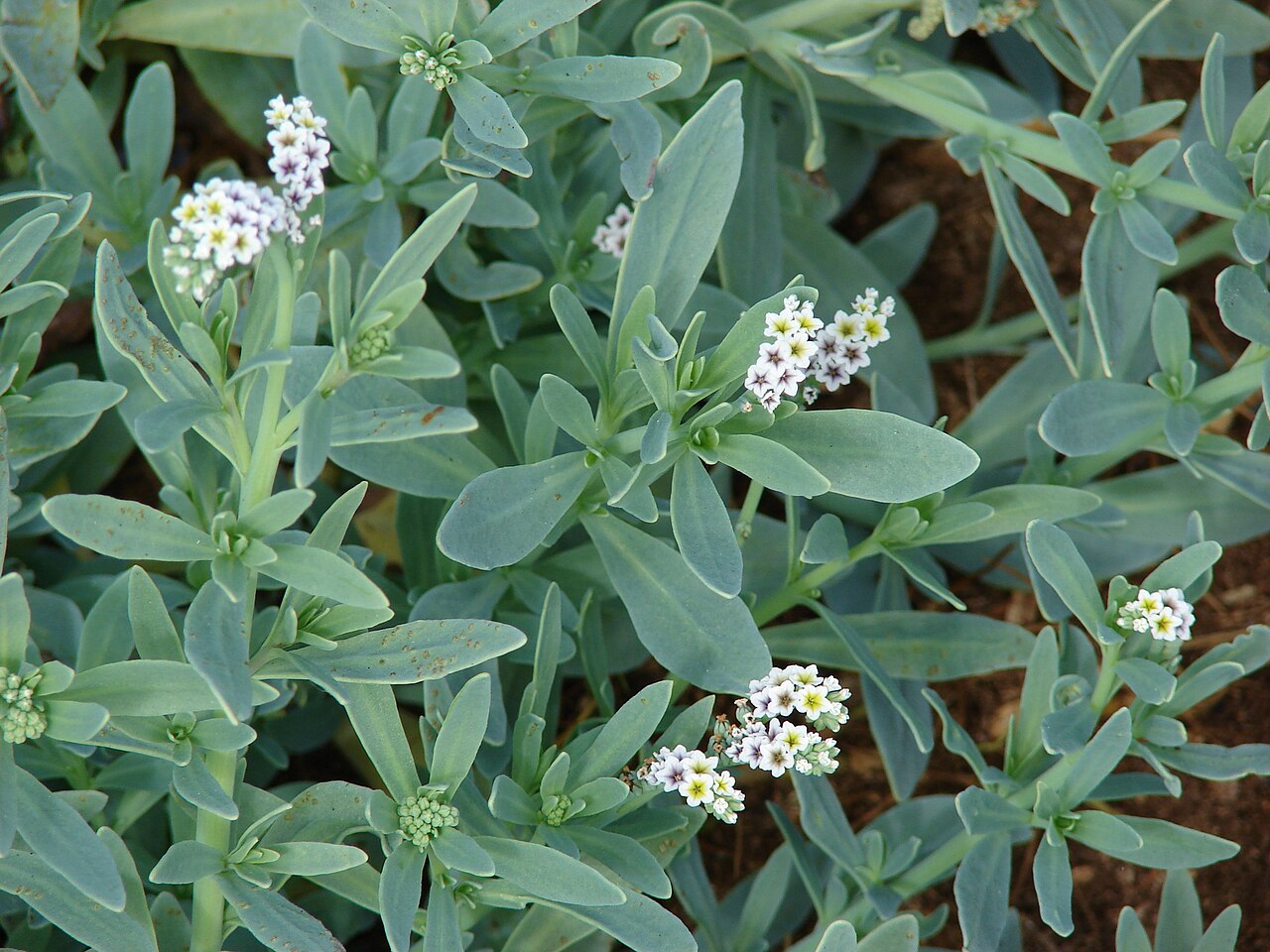
Heliotropium curassavicum, Seaside Heliotrope, is a low, fleshy, blue-green wildflower of beaches, salt marshes, alkaline flats and desert playas. USDA PLANTS calls it salt heliotrope, and in parts of the West it is known as quail plant, while the Spanish name cola de mico, “monkey tail,” describes its curled flower stalks. It belongs to the borage family (Boraginaceae), along with forget-me-nots and the garden heliotrope.
The plant is smooth and somewhat succulent, with narrow, waxy leaves and stems that usually sprawl along the ground and turn up at the tips. Its tiny white flowers open along paired, coiled stalks that slowly unroll like a scorpion’s tail as new flowers open. Each flower has a yellow center that turns purple as it ages, so a single cluster often shows both colors. Few native wildflowers tolerate as much salt: it thrives in soils too salty or alkaline for most other plants.
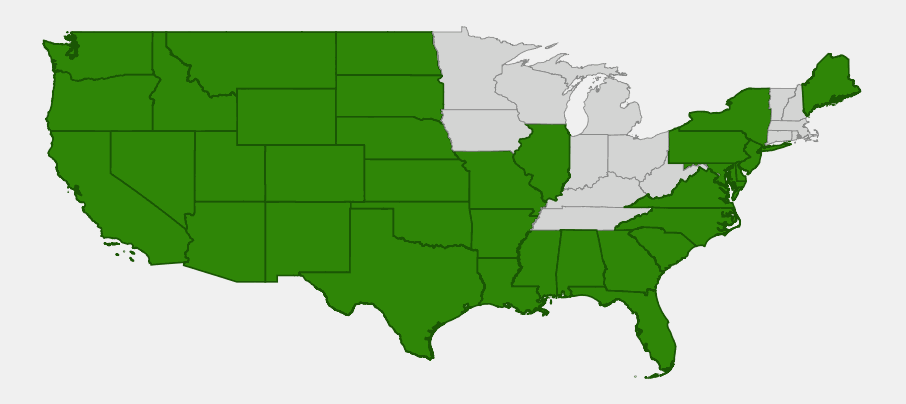
Seaside heliotrope has one of the broadest ranges of any native wildflower in the Americas. USDA PLANTS lists it as native in the lower 48 states, Hawaii, Puerto Rico, the U.S. Virgin Islands and Canada, and it extends south through Mexico and Central America to Argentina. In Florida it grows along the coast, from beaches and dunes to the edges of salt marshes and mangroves. This guide covers how to identify it, where it grows, and how to use it in salty or alkaline gardens.
Identification
Seaside heliotrope is easy to recognize: it is the only common native plant in most of its range that combines smooth, fleshy, blue-green leaves with coiled clusters of tiny white flowers.
Stems & Roots
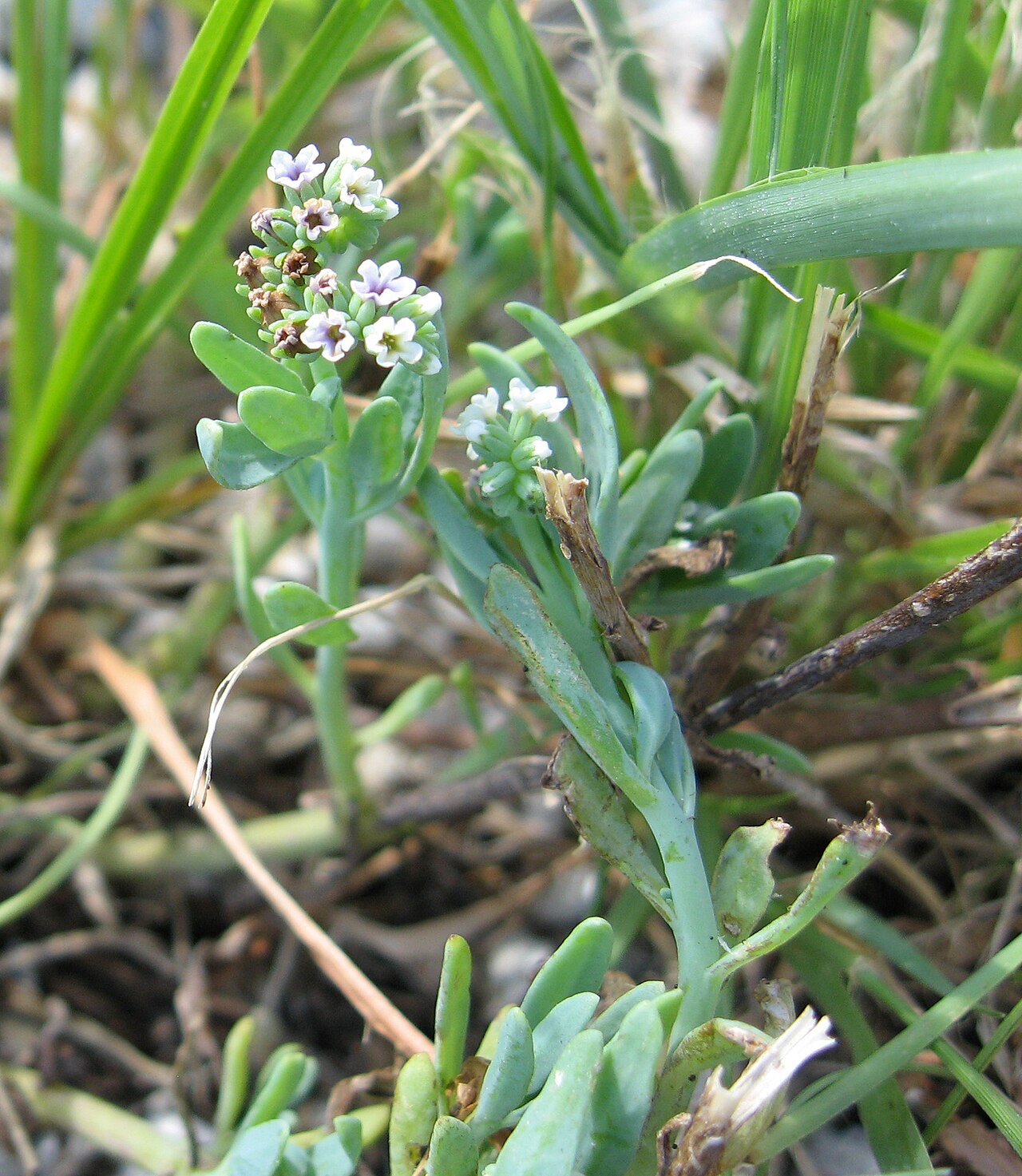
It is an annual or perennial herb, sometimes woody at the base. The stems are smooth, fleshy and pale blue-green with a whitish bloom, usually 4 to 24 inches long, and they lie on the ground or rise at the tips, forming loose mats. Perennial plants have a deep taproot and often spread by creeping underground stems, which helps them form colonies on open sand and mud.
Leaves
Leaves are alternate, stalkless or nearly so, narrow (linear to spoon-shaped), about ¾ to 2½ inches long, thick and fleshy, smooth, and blue-green to gray-green with a waxy surface. The lack of hairs separates it from most other native heliotropes.
Flowers
The flowers are borne in coiled, one-sided spikes (scorpioid cymes), usually in pairs at the ends of short stalks. They open from the base of each coil outward, so the spike gradually straightens. Each flower is small, about ⅛ to ¼ inch across, funnel-shaped with five spreading lobes, white with a yellow throat that turns purple or bluish with age. In Florida and other warm climates it can bloom in any month; farther north it flowers from late spring to fall.
Fruit
Each flower produces a small, rounded fruit that separates into four nutlets when ripe.
Quick Facts
| Scientific Name | Heliotropium curassavicum |
| Family | Boraginaceae (borage family) |
| Plant Type | Annual or perennial succulent herb or subshrub; low, spreading |
| Mature Height | 4–18 in |
| Mature Spread | 1–3 ft |
| Growth Rate | Fast |
| Sun Exposure | Full sun |
| Water Needs | Low to moderate; tolerates both drought and periodic flooding |
| Soil Type | Sand, gravel, silt or clay; tolerates saline and alkaline soils |
| Soil pH | Neutral to strongly alkaline (about 6.5–9.0) |
| Bloom Time | Spring–fall; nearly year-round in Florida and Hawaii |
| Flower Color | White with a yellow center that turns purple |
| Fall Color | None |
| Fruit | Small dry fruit splitting into four nutlets |
| Deer Resistant | Yes; contains toxic alkaloids and is seldom browsed |
| USDA Hardiness Zones | 5–11 |
Native Range
USDA PLANTS records seaside heliotrope as native in 34 of the lower 48 states plus Hawaii, Puerto Rico, the U.S. Virgin Islands and Canada. It is found throughout the West, from Washington, Oregon and California east across the Great Basin, the Southwest and the Rocky Mountain states to the Great Plains, and along the Gulf and Atlantic coasts from Texas to Florida and north to New York and Maine, with scattered inland records in Missouri, Illinois and Arkansas. In Canada it reaches the alkaline prairies. Beyond North America it ranges through Mexico, Central America and the Caribbean to South America, and it has been introduced to parts of the Old World.
Across this huge range it occupies one kind of niche: open, sunny ground with salty, alkaline or periodically wet soil. On the coasts it grows on beaches, dunes, shell ridges, salt marsh edges and the margins of mangroves and tidal flats. Inland it grows on alkali flats, around saline lakes and playas, along desert washes, streams and irrigation ditches, and in disturbed, salty farm fields.
In Florida, the Atlas of Florida Plants records it as native, mainly in coastal counties around the peninsula and the Keys. In Hawaii, USDA lists it as native, and it is a common plant of the islands’ beaches and salt flats.
📋 Regional plant lists featuring Seaside Heliotrope: North & South Florida · Alabama, Georgia & Mississippi · North & South Carolina · Maryland, Virginia & West Virginia · Arkansas, Louisiana, Eastern Oklahoma & Eastern Texas · South & West Texas · Illinois, Iowa & Missouri · Nebraska, Kansas & Eastern Colorado · North Dakota, South Dakota & Western Minnesota · New York, Pennsylvania & Northern New Jersey · Delaware, Southern New Jersey & Long Island · New Hampshire, Maine & Vermont · Idaho, Eastern Oregon & Eastern Washington · California & Nevada · Arizona & New Mexico · Utah & Western Colorado · Montana & Wyoming · Hawaii
Growing & Care Guide
Seaside heliotrope is rarely sold, but it is easy to grow from seed and is a useful plant for difficult sites: salty coastal soils, alkaline desert gardens, and the edges of brackish ponds and swales. Native seed suppliers and a few coastal native nurseries offer it. In good conditions it can spread quickly by seed and creeping roots.
Light
Plant it in full sun. It does not grow well in shade.
Soil & Water
Almost any open soil works, including sand, gravel and heavy clay, and it is especially valuable where salt or alkali limit other plants. It tolerates long dry periods and also brief flooding, though it does best where water does not stand for weeks. Do not fertilize.
Planting Tips
Sow seed directly on bare, moist ground in spring, or in fall in mild climates, and keep the soil damp until seedlings appear. Space plants about 12 to 18 inches apart for a groundcover. It works well as a low edging along walkways, in rock and gravel gardens, and on coastal banks.
Pruning & Maintenance
Little care is needed. Cut back sprawling stems if it overgrows paths, and pull unwanted seedlings. In irrigated, rich garden beds it can become weedy, so it is best kept to lean, dry or salty sites. Because all parts contain toxic alkaloids, keep it away from areas where livestock graze.
Propagation
Grow it from seed, or divide rooted sections of creeping stems. Stem cuttings root readily in sandy soil.
Landscape Uses
- Coastal gardens: for beaches, dunes and salt-sprayed banks
- Desert and xeric gardens: in alkaline soils of the Southwest and Great Basin
- Saline and brackish sites: edges of salt marshes, brackish ponds, ditches and swales
- Gravel and rock gardens: a low, blue-green mat with long-blooming flowers
- Restoration of salty soils: within its native range, on disturbed alkali and coastal sites
Wildlife & Ecological Value
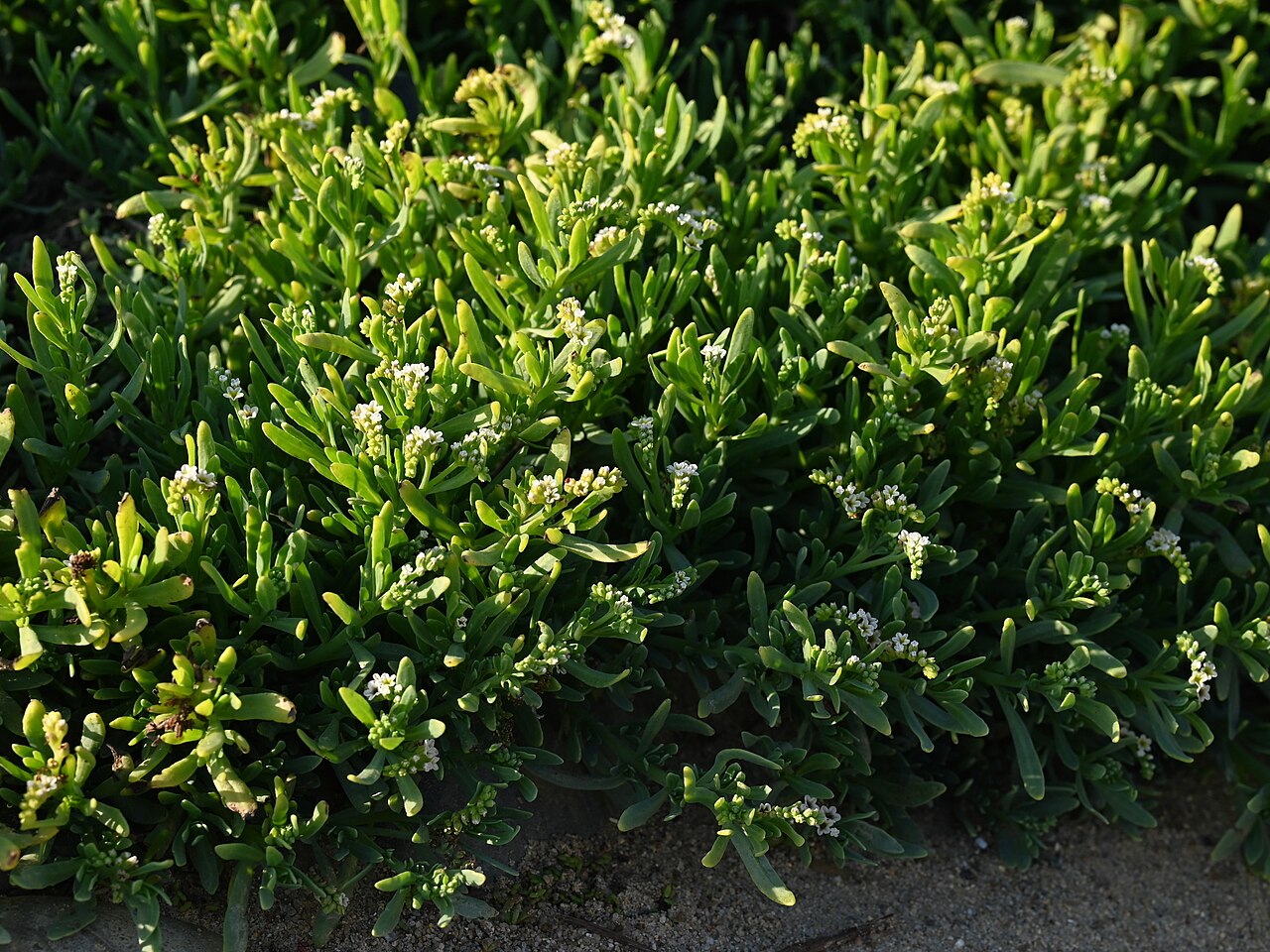
Although its flowers are tiny, seaside heliotrope blooms over a long season in habitats where few other flowers grow, which makes it a reliable food source for small insects.
For Pollinators
The flowers are visited by small native bees, wasps, flies and small butterflies such as blues and skippers. Heliotropes are also known to attract male danaine butterflies, such as queens, which gather alkaloids from heliotrope plants for use in courtship.
For Birds
In the West the plant is called quail plant because quail eat its seeds and fruits, according to the Lady Bird Johnson Wildflower Center. Other seed-eating birds also take the nutlets.
For Mammals
Mammals rarely eat it. The plant contains pyrrolizidine alkaloids, which are toxic to livestock and can damage the liver if eaten in quantity.
Ecosystem Role
On beaches, salt flats and alkali soils it is often one of the first plants to colonize bare ground, and its mats help stabilize loose sand and silt. Its tolerance of salt, drought and flooding makes it an indicator of saline and alkaline habitats across much of the continent.
Cultural & Historical Uses
Linnaeus described Heliotropium curassavicum in 1753 in Species Plantarum. The species name refers to Curaçao in the Dutch Caribbean, one of the places from which early specimens came. The genus name comes from the Greek helios (sun) and trope (turning), an old belief that heliotrope flowers turn to follow the sun.
Native peoples in the western United States and Mexico used seaside heliotrope in traditional medicine, and ethnobotanical records describe uses as a poultice, wash and tea. Because the plant contains pyrrolizidine alkaloids that can damage the liver, it should not be used as a home remedy or eaten.
Its many local names, from salt heliotrope and quail plant in the United States to cola de mico in Latin America, reflect how widespread and familiar it is in salty and alkaline places throughout the Americas.
Frequently Asked Questions
Is seaside heliotrope the same as salt heliotrope?
Yes. USDA PLANTS uses the common name salt heliotrope for Heliotropium curassavicum. Seaside heliotrope and quail plant are other names for the same native plant.
Is seaside heliotrope poisonous?
Yes. Like many heliotropes, it contains pyrrolizidine alkaloids that are toxic to livestock and people if eaten. Do not plant it where animals graze, and do not use it as food or medicine.
Can seaside heliotrope grow in salty soil?
Yes. It is one of the most salt-tolerant native wildflowers, growing on beaches, salt marsh edges and alkaline desert flats where most plants fail.
Is it native to Hawaii?
USDA PLANTS lists seaside heliotrope as native in Hawaii, as well as in the lower 48 states, Puerto Rico, the U.S. Virgin Islands and Canada.
Will it spread in my garden?
It can. It spreads by seed and creeping roots and can become weedy in rich, irrigated beds. In lean, dry or salty sites it stays in bounds and makes a useful low groundcover.

Looking for a nursery that carries Seaside Heliotrope?
Browse our native plant nursery directory: Alabama, Arizona & Arkansas · California · Colorado, Delaware, Florida & Georgia · Idaho, Illinois & Kansas · Louisiana, Maine, Maryland, Mississippi, Missouri & Montana · Nebraska, Nevada, New Jersey, New Mexico, New York, North Carolina, North Dakota & Oklahoma · Oregon · Pennsylvania, South Carolina, South Dakota, Texas, Utah & Virginia · Washington · Wyoming