
Carolina Springbeauty (Claytonia caroliniana)
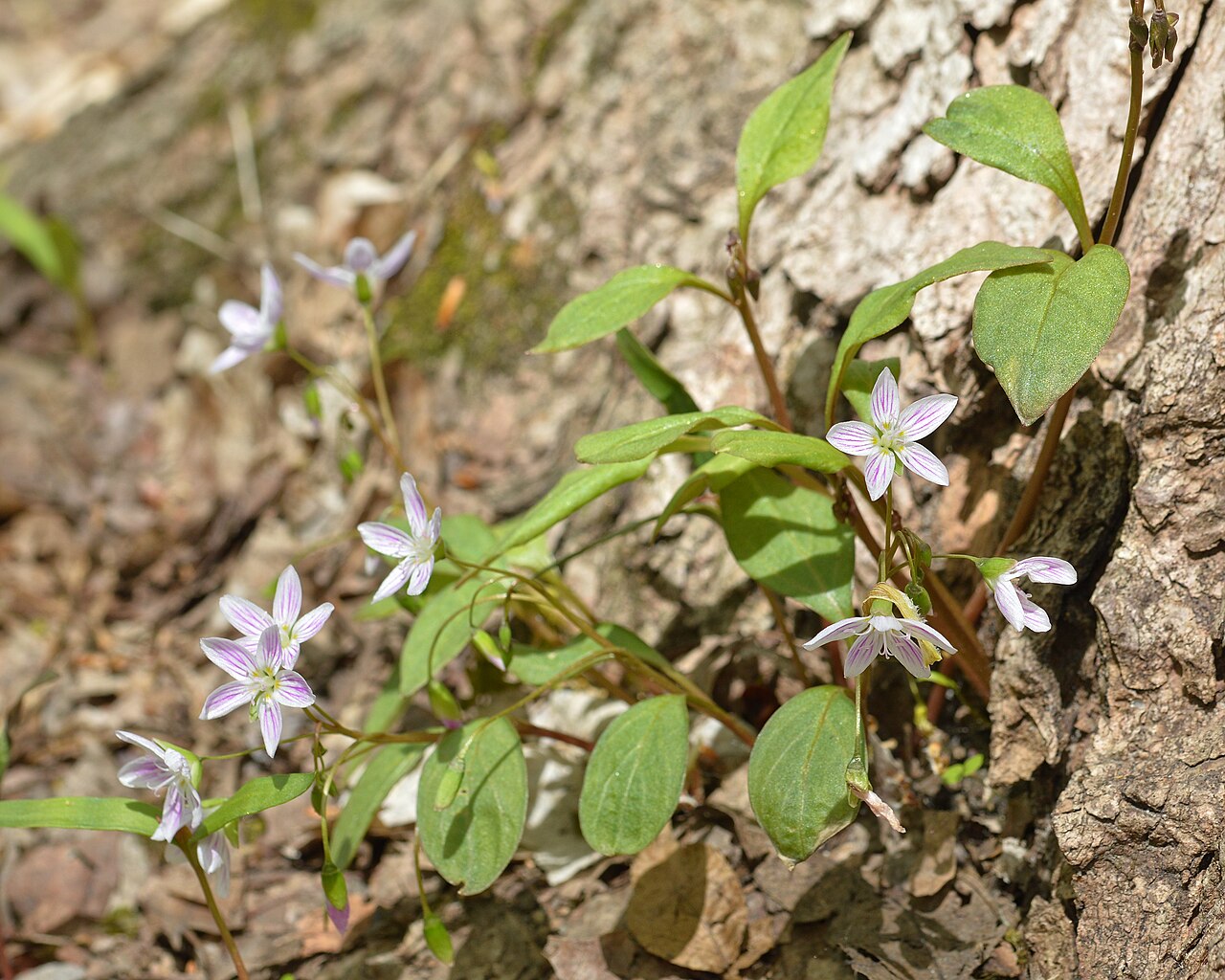
Claytonia caroliniana, known as Carolina Springbeauty, is one of the first wildflowers to bloom in the rich hardwood forests of northeastern North America and the Appalachian Mountains. In early spring, often just after the snow melts, each small plant sends up a slender stem with a single pair of broad green leaves and a loose cluster of white to pale pink flowers striped with darker pink veins.
It is a true spring ephemeral. The plant grows from a small, round underground tuber, flowers and sets seed in the few weeks of sunlight before the tree canopy closes, and then withers away, leaving no trace above ground until the following spring. It belongs to the miner’s lettuce family (Montiaceae), which was formerly part of the purslane family (Portulacaceae).
Carolina springbeauty is the northern and mountain counterpart of the more familiar spring beauty (Claytonia virginica). The two look alike in flower, but Carolina springbeauty has much broader leaves. This guide covers how to identify it, where it grows, and how to welcome it into a shady woodland garden.
Identification
Carolina springbeauty is a small plant, usually 3 to 10 inches tall, and it is visible above ground only from about March to early June. The leaves are the best way to identify it, especially where it grows near spring beauty.
Leaves
Each flowering stem carries one pair of opposite leaves about halfway up. They are smooth, untoothed and elliptic to spoon-shaped, up to about 3 inches long and ½ to ¾ inch wide, with a distinct leaf stalk and a prominent midvein. A few broad basal leaves may also appear from the tuber.
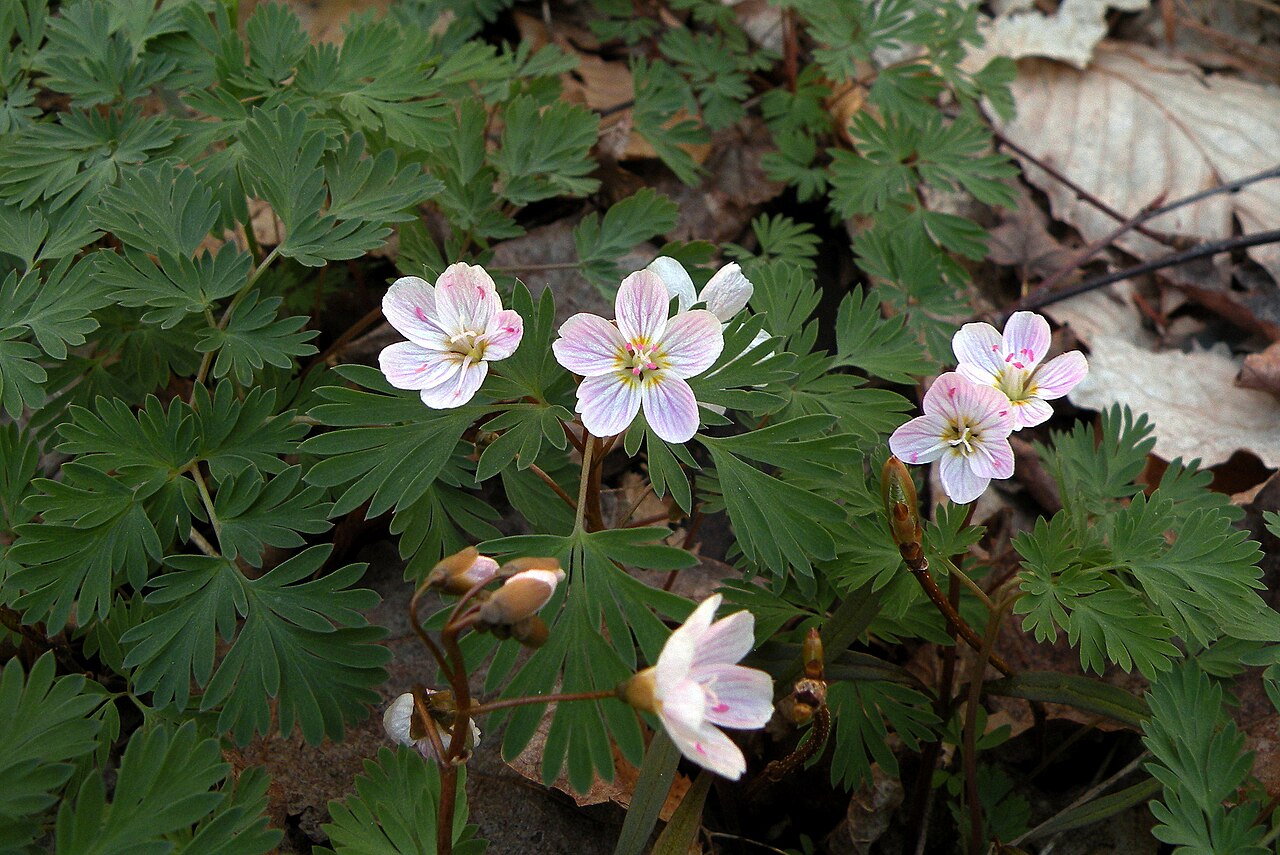
In spring beauty (C. virginica), the leaves are long, narrow and almost grass-like, without a clear stalk. Where the two grow together, intermediate plants occur, since natural hybrids have been documented.
Flowers
The flowers are held in a loose, one-sided cluster at the top of the stem, opening a few at a time. Each is about ½ inch across, with two green sepals and five white to pale pink petals marked with darker pink veins. The five stamens have pink anthers. The flowers open in sunshine and close at night and in cloudy weather.
Stems & Tuber
The weak, fleshy stems rise from a small, round, dark underground tuber (often called a corm) buried a few inches deep in the humus. Several stems may come from one tuber, and older plants form small clumps.
Fruit & Seeds
After flowering, each flower forms a small capsule enclosed by the persistent sepals. When ripe it splits into three parts and flings out a few shiny black seeds. By late spring or early summer the leaves yellow and the whole plant disappears.
Quick Facts
| Scientific Name | Claytonia caroliniana |
| Family | Montiaceae (miner’s lettuce family) |
| Plant Type | Perennial spring ephemeral wildflower from a tuber |
| Mature Height | 3–10 in |
| Mature Spread | 3–6 in per plant; slowly forms colonies |
| Growth Rate | Slow |
| Sun Exposure | Part shade (full sun in spring under deciduous trees) |
| Water Needs | Moderate; moist in spring |
| Soil Type | Rich, moist, humus-rich woodland soil |
| Soil pH | About 5.0–7.0 |
| Bloom Time | March–June, depending on latitude and elevation |
| Flower Color | White to pale pink with darker pink veins |
| Fall Color | None (dormant by early summer) |
| Fruit | Small three-parted capsule with shiny black seeds |
| Deer Resistant | Moderately; rarely a deer target |
| USDA Hardiness Zones | 3–7 |
Native Range
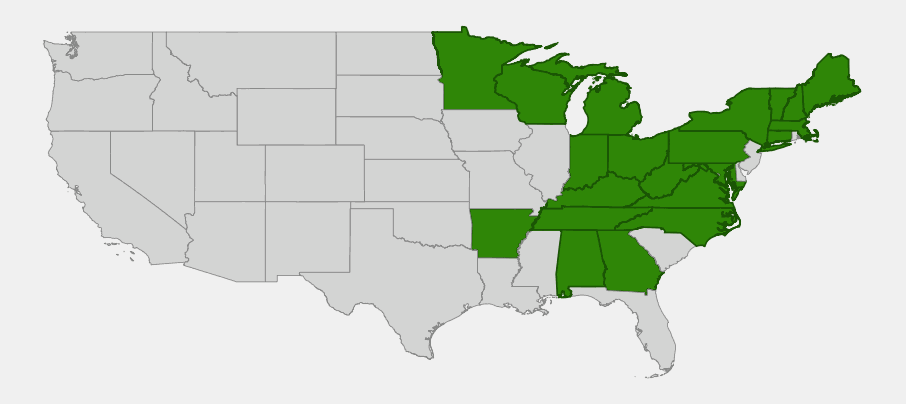
Carolina springbeauty is native to eastern and central North America. In Canada it ranges from Ontario and Quebec east to the Maritime Provinces, with a northern limit in Newfoundland. In the United States, USDA PLANTS records it in 21 states, from Maine and Minnesota south through New England, New York, Pennsylvania and the Great Lakes states, and along the Appalachian Mountains to North Carolina, Tennessee, Georgia and Alabama. Outlying populations grow in the Ozarks of Arkansas.
In the north it is a widespread plant of hardwood and mixed forests at low elevations. Farther south it is mainly a mountain plant, growing at higher elevations in the Appalachians, where the cool, moist climate resembles that of its northern range. The Lady Bird Johnson Wildflower Center summarizes its range as Nova Scotia to Ontario, south to New England, northern Michigan and northeastern Minnesota, and in the mountains to Georgia, Alabama and Arkansas.
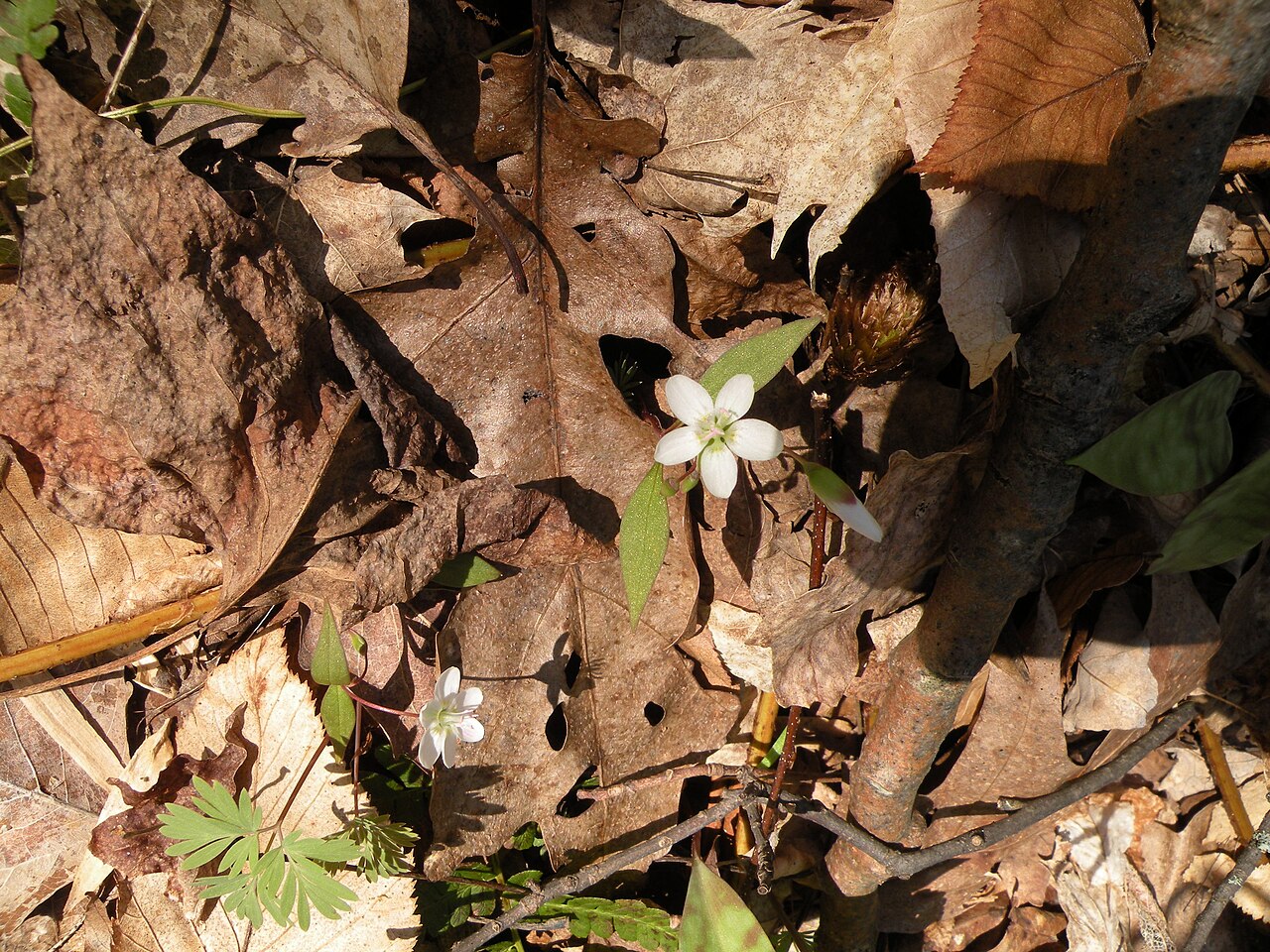
It grows in rich, moist deciduous woods, especially northern hardwood forests of sugar maple, beech and birch, as well as cove forests, wooded slopes and streambanks. It is often found with other spring ephemerals in deep leaf litter and humus.
📋 Regional plant lists featuring Carolina Springbeauty: New York, Pennsylvania & Northern New Jersey · Ohio & Indiana · Michigan, Wisconsin & Eastern Minnesota · Kentucky & Tennessee · Connecticut, Massachusetts & Rhode Island · New Hampshire, Maine & Vermont · Maryland, Virginia & West Virginia · Delaware, Southern New Jersey & Long Island · Alabama, Georgia & Mississippi · North & South Carolina · Arkansas, Louisiana, Eastern Oklahoma & Eastern Texas
Growing & Care Guide
Carolina springbeauty is a gentle, low-maintenance plant for a shady woodland garden within its native range. It is occasionally sold by native plant nurseries as tubers or potted plants. Buy nursery-propagated stock, and never dig plants from the wild.
Light
Plant it under deciduous trees or shrubs, where it gets bright sun in early spring before the leaves come out and shade for the rest of the year. Because the plant is dormant by summer, summer shade does not harm it.
Soil & Water
It needs rich, moist, well-drained soil with plenty of humus, like a forest floor. Keep the soil moist in spring while the plant is growing. In summer, when it is dormant, the soil can dry somewhat, but it should not bake. A layer of fallen leaves left in place each autumn is the best mulch.
Planting Tips
Plant tubers in fall, about 2 to 3 inches deep, in groups of five or more for a good display. Potted plants can go in during spring. Mark the spot, because the plants vanish in early summer and are easy to dig up by mistake. Combine them with later perennials and ferns that fill the space after the springbeauties go dormant.
Pruning & Maintenance
No pruning is needed. Let the foliage yellow and die back naturally so the tuber can store energy for the next year. Avoid raking out leaf litter or disturbing the soil in the planting area, and don’t use the area for summer bulbs or annuals that need digging.
Propagation
It spreads slowly by seed, and colonies thicken over the years. Fresh seed sown in fall on the soil surface under a light leaf cover will germinate the following spring, but seedlings take two or more years to reach flowering size. Larger clumps can be divided carefully when dormant.
Landscape Uses
- Woodland gardens: an early, delicate flower under deciduous trees
- Spring ephemeral plantings: with trout lily, hepatica and Dutchman’s breeches
- Shady lawns and naturalized areas: flowers and goes dormant before the first mowing
- Pollinator support: one of the first nectar and pollen sources of spring
- Native plant restoration: understory of restored hardwood forests
Wildlife & Ecological Value
Although it is small and short-lived above ground, Carolina springbeauty blooms at a time when very few other flowers are open, which makes it important for early pollinators.
For Pollinators
The flowers are visited by early native bees, bee flies, hover flies and small butterflies on sunny spring days. The pink veins act as nectar guides. The spring beauty mining bee (Andrena erigeniae) is a specialist that collects pollen almost entirely from springbeauties, and it times its short adult life to their bloom.
For Birds
Its contribution to birds is mostly indirect, through the early insects it supports. Ground-feeding birds may also pick up some of the small seeds.
For Mammals
Chipmunks, mice and other small mammals dig up and eat the starchy tubers, and deer occasionally nibble the foliage.
Ecosystem Role
As a spring ephemeral, Carolina springbeauty takes up nutrients from the forest floor in early spring, when little else is growing, and returns them to the soil when its leaves decay. Together with other ephemerals, it helps keep nutrients from washing out of the forest before the trees leaf out.
Cultural & Historical Uses
The French botanist André Michaux described the species in 1803 in his flora of North America, naming it for the Carolinas, where he collected plants in the southern Appalachians. The genus Claytonia honors John Clayton (1694–1773), a colonial Virginia botanist whose specimens formed the basis of the early Flora Virginica.
The small tubers are edible, and the Lady Bird Johnson Wildflower Center notes that they can reportedly be eaten like potatoes. Spring beauty tubers are sometimes called fairy spuds. However, each plant has just one small tuber, and harvesting them destroys the plant, so wild populations should be left alone.
In the north, Carolina springbeauty is one of the classic signs of spring in maple–beech forests, where it may carpet the ground alongside trout lily and Dutchman’s breeches during the brief window between snowmelt and leaf-out.
Frequently Asked Questions
How do I tell Carolina springbeauty from spring beauty?
Look at the leaves. Carolina springbeauty has one pair of broad, elliptic to spoon-shaped leaves, ½ to ¾ inch wide, with distinct stalks. Spring beauty (Claytonia virginica) has long, narrow, grass-like leaves.
Why does Carolina springbeauty disappear in summer?
It is a spring ephemeral. It grows, flowers and sets seed before the tree canopy closes, then dies back to its underground tuber, which stays dormant until the next spring.
Can I grow Carolina springbeauty in my garden?
Yes, in a shady woodland garden with rich, moist, humus-rich soil within its native range. Plant nursery-propagated tubers in fall, and leave the leaf litter in place.
When does Carolina springbeauty bloom?
From March to June, depending on location. It blooms earliest at low elevations in the south and latest in the far north and at high elevations, often right after the snow melts.
Is Carolina springbeauty good for pollinators?
Yes. It is one of the first flowers of spring, and it feeds early native bees, flies and butterflies, including the spring beauty mining bee, which depends on springbeauties for pollen.

Looking for a nursery that carries Carolina Springbeauty?
Browse our native plant nursery directory: Alabama & Arkansas · Connecticut & Georgia · Indiana · Kentucky, Maine, Maryland, Massachusetts, Michigan & Minnesota · New Hampshire, New York, North Carolina & Ohio · Pennsylvania, Tennessee, Vermont & Virginia · West Virginia & Wisconsin