
Spoonleaf Sundew (Drosera intermedia)
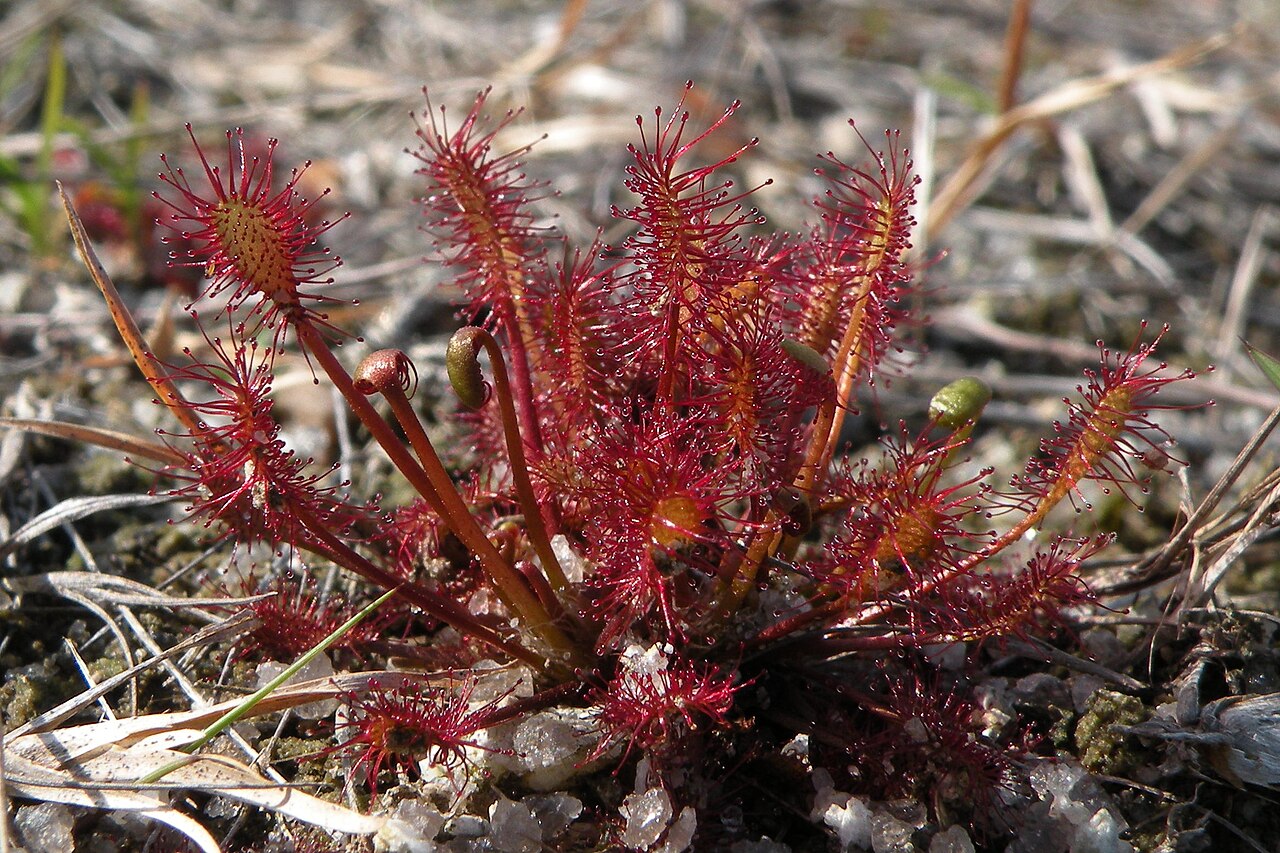
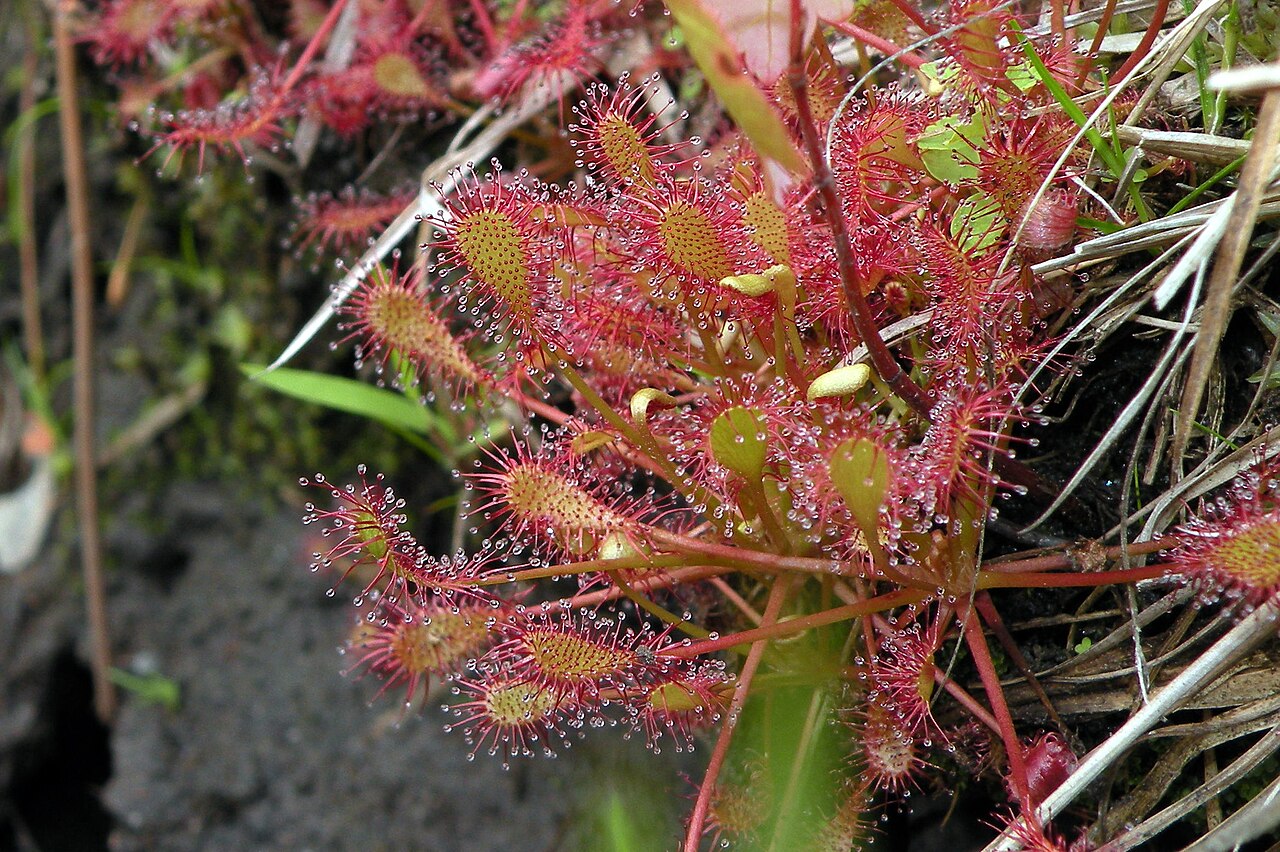
Drosera intermedia, known as Spoonleaf Sundew (also spoon-leaved or oblong-leaved sundew), is a small carnivorous perennial of bogs, wet sandy shores and pond margins in eastern North America and Europe. It belongs to the sundew family (Droseraceae). Each plant is a small rosette of reddish, spoon-shaped leaves held upward on long stalks, usually 2 to 4 inches across. The leaf blades are covered with red, hair-like tentacles tipped with drops of sticky mucilage that sparkle like dew.
Like other sundews, it catches small insects on its sticky leaves. Gnats, midges, mosquitoes, small flies and even small damselflies get stuck, and the tentacles slowly bend over the prey while digestive enzymes release nitrogen and phosphorus. This lets spoonleaf sundew thrive in wet, acidic, nutrient-poor sand and peat. In summer it sends up slender stalks with small white flowers. It often grows in wetter places than its close relative, round-leaved sundew, including shallow water at the edges of ponds and bog pools.
Spoonleaf sundew is widespread on the Atlantic and Gulf Coastal Plains and in the glaciated Northeast and Great Lakes region, but its wetland habitats are fragile and it is rare in some states. Never dig sundews from the wild. Buy nursery-propagated plants only, and grow them in a properly built bog garden or container.
Identification
Spoonleaf sundew is best recognized by its spoon-shaped leaf blades, which are clearly longer than wide, on long stalks that angle upward rather than lying flat. It often grows in sand or peat that is wet to the surface, or in standing water.
Rosette & Stem
The plant forms a semi-erect rosette 1 to 4 inches across. In wet sites, especially in shallow water, older plants often develop a short upright stem with old dead leaves below and a new rosette on top, so they can look like tiny shrubs. Roots are short and weak.
Leaves
The leaf blades are spoon-shaped to oblong, about 1/4 to 3/8 inch wide and 1/3 to 3/4 inch long, narrowing gradually into a long, hairless stalk 1/2 to 2 inches long. The upper surface and edges are covered with reddish, gland-tipped tentacles. Plants in full sun are bright red; those in shade are greener. Leaves stand upright or angle outward instead of lying flat on the ground.
Flowers
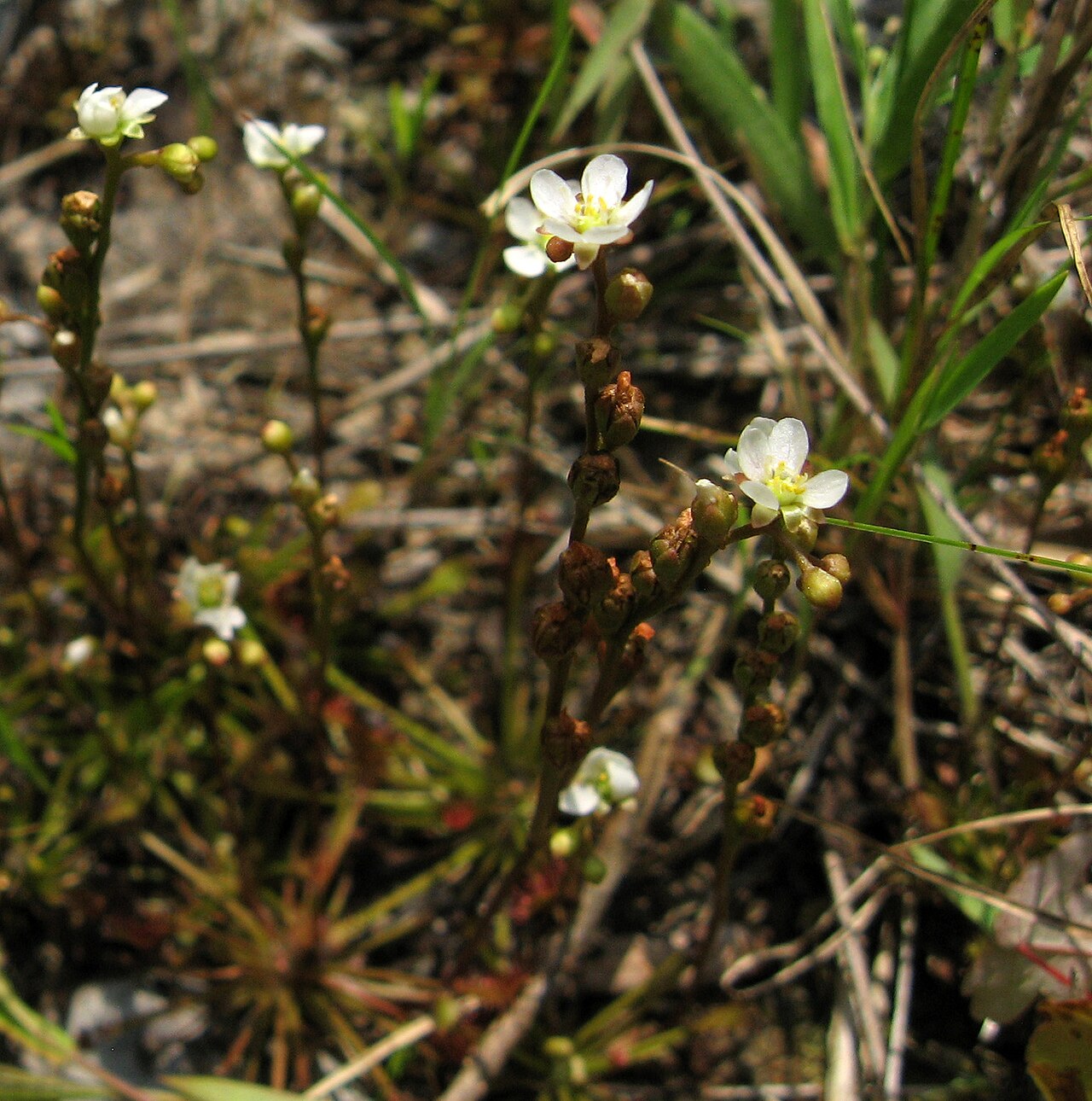
From June to August, each plant produces one or more leafless flower stalks, up to about 10 inches tall. A distinctive feature is that the stalks arise from below the rosette and curve upward. The flowers are about 1/4 to 3/8 inch across, with five white (occasionally pinkish) petals, arranged on one side of the stalk. Each opens for a few hours on sunny mornings, and the flowers frequently self-pollinate.
Fruit & Seeds
The flowers produce small capsules full of tiny, rough-coated seeds that are scattered by wind and water. In the North, plants die back in autumn to a tight winter bud (hibernaculum) and survive under ice and snow. Plants in the warm Southeast often stay in growth year-round.
Look-alikes
Round-leaved sundew (Drosera rotundifolia) has round blades wider than long, on hairy stalks, in a flatter rosette; its flower stalks rise from the center. Pink sundew (D. capillaris) of the Southeast has a flat rosette, shorter stalks and pink flowers. Thread-leaved sundew (D. filiformis) has long, thread-like leaves. Spoonleaf sundew hybridizes with round-leaved sundew where they meet; the hybrid, D. × beleziana, is sterile.
Safety & Conservation
Sundews are harmless to people and pets; their traps catch only tiny insects. Spoonleaf sundew is listed as rare or protected in some states at the edges of its range, and its bogs, pond shores and seeps are easily damaged by trampling, drainage and off-road vehicles. Never collect plants from the wild; buy only nursery-propagated sundews from reputable carnivorous plant growers.
Quick Facts
| Scientific Name | Drosera intermedia |
| Family | Droseraceae (sundew family) |
| Plant Type | Carnivorous herbaceous perennial |
| Mature Height | Rosette 1–3 in tall; flower stalks up to about 10 in |
| Mature Spread | 1–4 in per rosette |
| Growth Rate | Slow |
| Sun Exposure | Full sun to light shade |
| Water Needs | Very high; saturated soil or shallow standing water |
| Soil Type | Wet sand, peat, sphagnum moss |
| Soil pH | About 4.0–6.0 (strongly acidic) |
| Bloom Time | June–August |
| Flower Color | White, sometimes tinged pink |
| Fall Color | Leaves redden; northern plants die back to a winter bud |
| Fruit | Small capsule with many tiny seeds |
| Deer Resistant | Yes; too small and sticky to be browsed |
| USDA Hardiness Zones | 3–9 |
Native Range
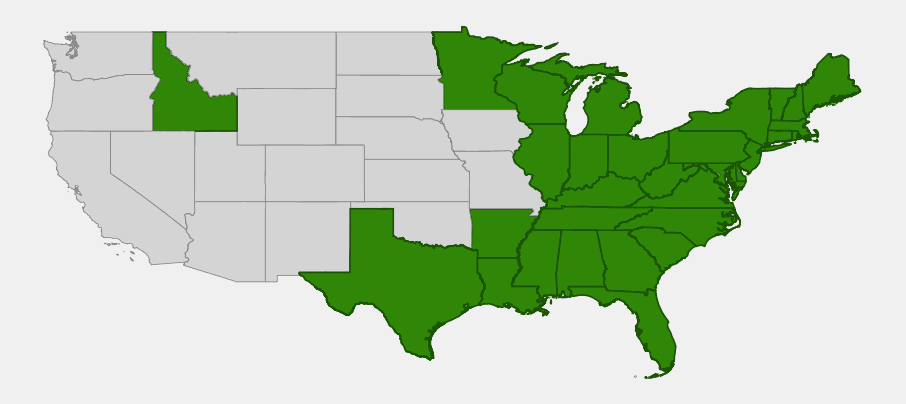
Spoonleaf sundew grows in eastern North America and Europe, with scattered populations in the Caribbean and South America. In North America, USDA PLANTS lists it as native in the lower 48 states, Canada and Saint Pierre and Miquelon, and records it from 31 states. Its main range runs from Newfoundland and Nova Scotia west through Quebec and Ontario to Minnesota, and south along the Atlantic and Gulf Coastal Plains to Florida and eastern Texas, with scattered inland sites in the Appalachians, Ohio Valley and Ozarks.
The record from Idaho is an outlying one, far west of the main range. Spoonleaf sundew is most common in the glaciated Northeast and Great Lakes region, the New Jersey Pine Barrens and the southeastern Coastal Plain. It is local and uncommon farther inland, for example in Kentucky, Tennessee, West Virginia, Ohio, Indiana and Illinois. In Texas it grows in seepage bogs of the eastern Pineywoods rather than in the south and west.
Typical habitats are open, acidic and constantly wet: sphagnum bogs and poor fens, wet sandy and peaty pond shores, the margins of bog pools, seepage slopes, wet savannas and pitcher-plant bogs, and wet sand in ditches and old borrow pits. It tolerates shallow flooding better than most sundews and often grows right at the waterline. Like other sundews, it disappears when taller plants shade it out.
📋 Regional plant lists featuring Spoonleaf Sundew: New York, Pennsylvania & Northern New Jersey · Idaho, Eastern Oregon & Eastern Washington · Ohio & Indiana · Michigan, Wisconsin & Eastern Minnesota · Kentucky & Tennessee · Connecticut, Massachusetts & Rhode Island · New Hampshire, Maine & Vermont · Maryland, Virginia & West Virginia · Delaware, Southern New Jersey & Long Island · Illinois, Iowa & Missouri · Alabama, Georgia & Mississippi · North & South Florida · North & South Carolina · Arkansas, Louisiana, Eastern Oklahoma & Eastern Texas
Growing & Care Guide
Spoonleaf sundew is one of the easier native sundews to grow in a bog garden or a container kept in a tray of water, but it will not survive in ordinary garden soil. Buy nursery-propagated plants from a carnivorous plant specialist. Never take plants from the wild.
Light
Give it full sun or very bright light for strong red color and abundant dew. In too much shade the leaves become green and weak.
Soil & Water
Use long-fiber sphagnum moss or a mix of about one part sphagnum peat to one part lime-free sand or perlite. Keep the medium wet at all times; this species tolerates having its pot stand in 1/2 to 1 inch of water, or even brief submergence. Use only rainwater, distilled water or reverse-osmosis water, never hard tap water, and never fertilize the soil.
Planting Tips
Plant in spring in a lined bog garden, a mini-bog tub without drainage holes, or a pot standing in a tray of water. Place it at the wettest, lowest edge of a bog garden or along a shallow pool margin. Combine with pitcher plants and small sedges, keeping taller plants from shading it.
Pruning & Maintenance
Northern plants need a cold winter dormancy: leave outdoor bogs alone in winter, and protect container plants from drying out and repeated freeze-thaw cycles. Plants from southern sources may stay green all year. Remove dead leaves and weeds, and pull out tree seedlings and grasses that shade the rosettes.
Propagation
Seed sown on the surface of moist sphagnum peat germinates readily, often without stratification, and flowering plants can appear in a year or two. Leaf cuttings laid on wet sphagnum produce plantlets. Mature plants often produce volunteer seedlings in a bog garden.
Landscape Uses
- Bog gardens: the wettest edges, beside pitcher plants and round-leaved sundew
- Container mini-bogs: tubs or trays of sphagnum kept wet with rainwater
- Pond margins: wet sand or peat at the edge of an acidic pool
- Nature education: an easy way to show carnivorous plants and insect trapping
- Wetland conservation: an indicator of intact, nutrient-poor, acidic shores and bogs
Wildlife & Ecological Value
Spoonleaf sundew is a small predator in nutrient-poor wetlands and part of the specialized plant and insect community of bogs and sandy pond shores.
For Pollinators
The small white flowers are visited by small bees, flies and other insects, but the plant often self-pollinates. The tall, curving flower stalks hold the blooms above the sticky leaves, which helps keep pollinators from being trapped.
For Birds
Sundews have little direct food value for birds, but they grow in bogs, shores and wet savannas used by many wetland birds.
For Mammals
Mammals rarely eat sundews. The plants are vulnerable mainly to trampling by people, vehicles and animals.
Ecosystem Role
Spoonleaf sundew captures gnats, midges, mosquitoes, small flies and even small damselflies, recycling nutrients in acidic, nutrient-poor wetlands. A few insects, such as certain plume moth caterpillars, can feed on sundew leaves. Spoonleaf sundew declines where wetlands are drained, polluted with fertilizer runoff or overgrown by taller vegetation.
Cultural & Historical Uses
Spoonleaf sundew was described by the German botanist Friedrich Gottlob Hayne in 1798. The species name intermedia refers to its leaves, which are intermediate in shape between the round leaves of Drosera rotundifolia and the long, narrow leaves of English sundew (D. anglica).
Along with round-leaved sundew, spoonleaf sundew has been gathered in Europe for herbal cough remedies sold under the name “drosera.” Wild collection contributed to declines there. Sundews contain plumbagin and related compounds that can irritate the skin and digestive tract, so they should not be used as a home remedy.
Charles Darwin experimented with several sundews for his book Insectivorous Plants (1875), which helped establish that some plants truly capture and digest animals. Today spoonleaf sundew is a popular, easy carnivorous plant for beginners and a favorite subject of wetland nature walks.
Frequently Asked Questions
How is spoonleaf sundew different from round-leaved sundew?
Spoonleaf sundew has spoon-shaped leaf blades longer than wide on upright, hairless stalks, and its flower stalks curve up from below the rosette. Round-leaved sundew has round blades on hairy stalks in a flatter rosette.
Can I dig spoonleaf sundew from a pond shore?
No. Wild plants rarely survive transplanting, wetland habitats are easily damaged and the species is rare or protected in some states. Buy nursery-propagated plants from a reputable grower.
Can spoonleaf sundew grow in standing water?
Yes. It tolerates shallow water better than most sundews and often grows right at the waterline or partly submerged. In containers, a pot standing in a tray of water works well.
Does spoonleaf sundew need winter dormancy?
Northern plants form a winter bud and need a cold dormancy. Plants from the warm Southeast may grow all year. Ask your grower where the plants came from.
Is spoonleaf sundew dangerous to pets?
No. It is harmless to touch and catches only tiny insects. Do not eat it or use it as a remedy, since sundews contain compounds that can irritate the digestive tract.

Looking for a nursery that carries Spoonleaf Sundew?
Browse our native plant nursery directory: Alabama & Arkansas · Connecticut, Delaware, Florida & Georgia · Idaho, Illinois & Indiana · Kentucky, Louisiana, Maine, Maryland, Massachusetts, Michigan, Minnesota & Mississippi · New Hampshire, New Jersey, New York, North Carolina & Ohio · Pennsylvania, Rhode Island, South Carolina, Tennessee, Texas, Vermont & Virginia · West Virginia & Wisconsin