
Bigbract Verbena (Verbena bracteata)
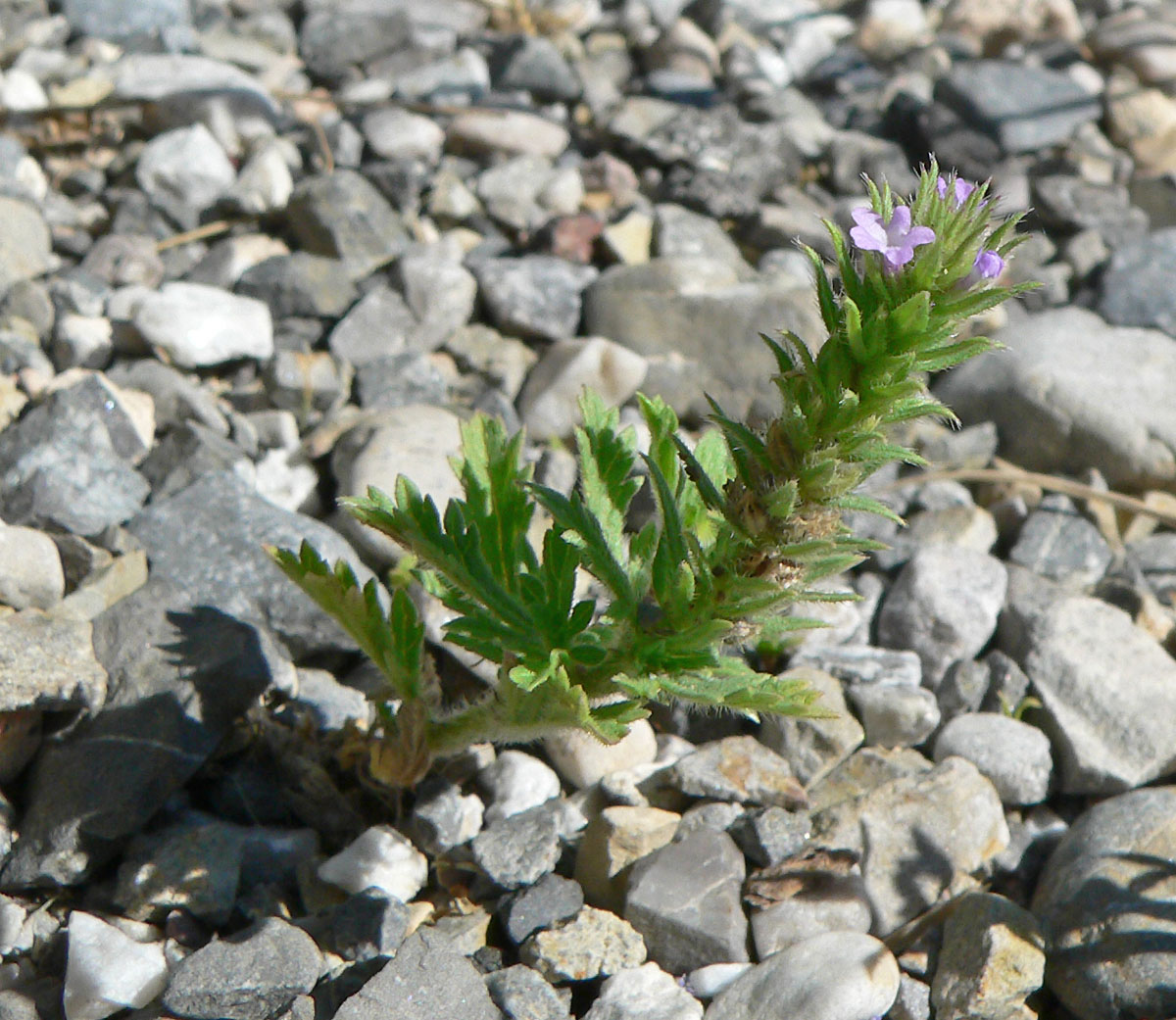
Verbena bracteata, known as Bigbract Verbena, is a low, sprawling native vervain also called prostrate vervain, bracted vervain and carpet vervain. It belongs to the verbena family (Verbenaceae). Its hairy, square stems spread flat from a central root to form a rough mat up to about 1 1/2 feet across. At the stem tips are dense, bristly spikes of tiny lavender to pale blue flowers, each tucked among long, narrow bracts that stick out beyond the flowers. Those bracts give the plant its common and scientific names.
It is an annual, biennial or short-lived perennial that blooms from late spring until fall. It is one of the most widespread vervains in North America, native from British Columbia and the northern Plains south through the West and Midwest to the Gulf Coast and Florida, and into Mexico. It is a plant of open, often disturbed ground: roadsides, trails, overgrazed pastures, prairie dog towns, dry fields, sandy flats and gravelly slopes.
Bigbract verbena is not a showy garden flower, but it is a tough, low-growing native that covers bare, compacted soil where little else will grow and offers small flowers for bees over a long season. It is most useful in naturalistic plantings, dry meadows and restoration of disturbed sites, and it is worth knowing so it is not mistaken for a weedy exotic.
Identification
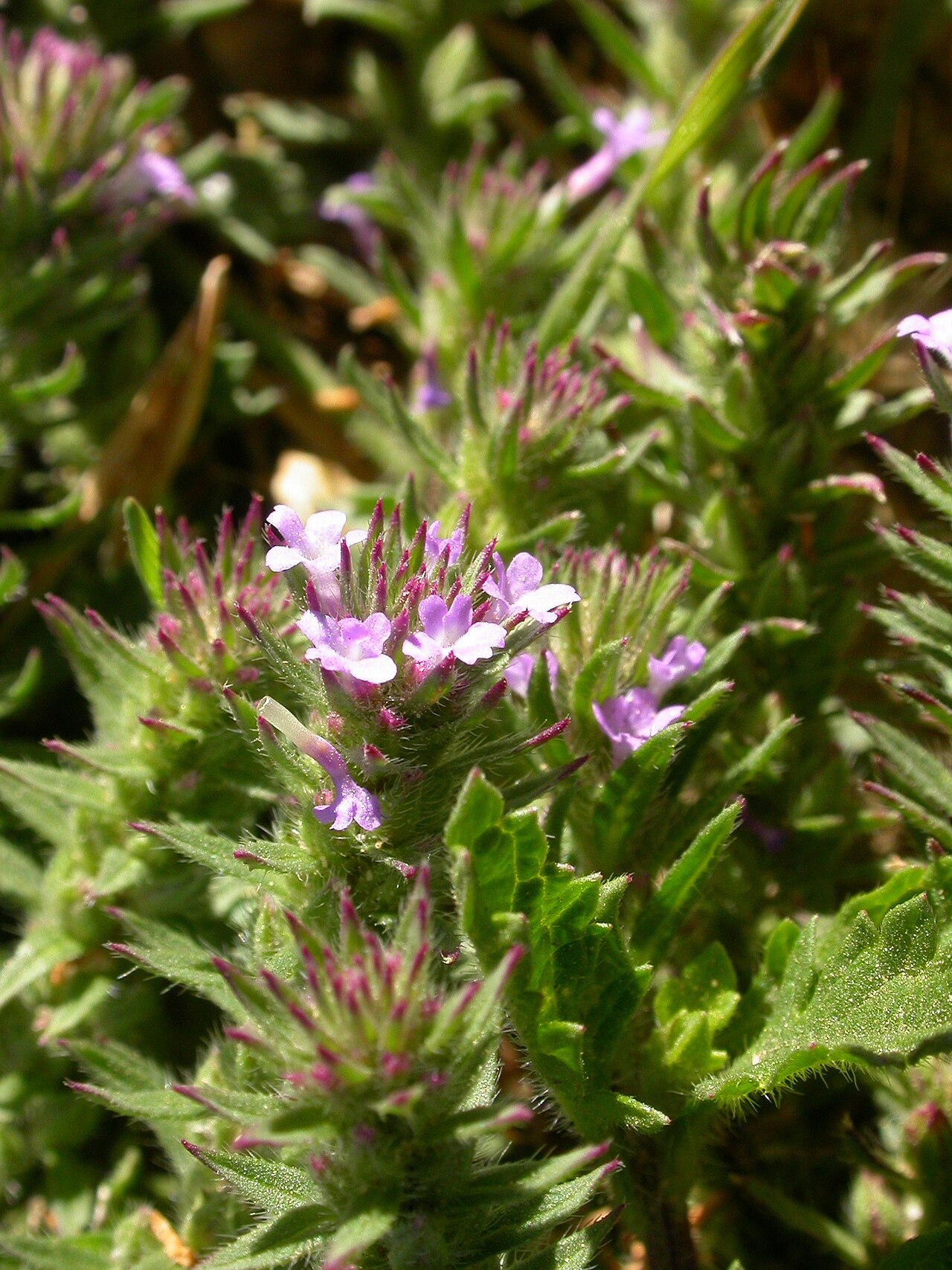
Bigbract verbena is easy to identify once you know it. Look for a flat, hairy mat of four-angled stems with deeply lobed leaves, ending in thick, bristly spikes where the bracts are longer than the small purple flowers.
Stems & Growth Habit
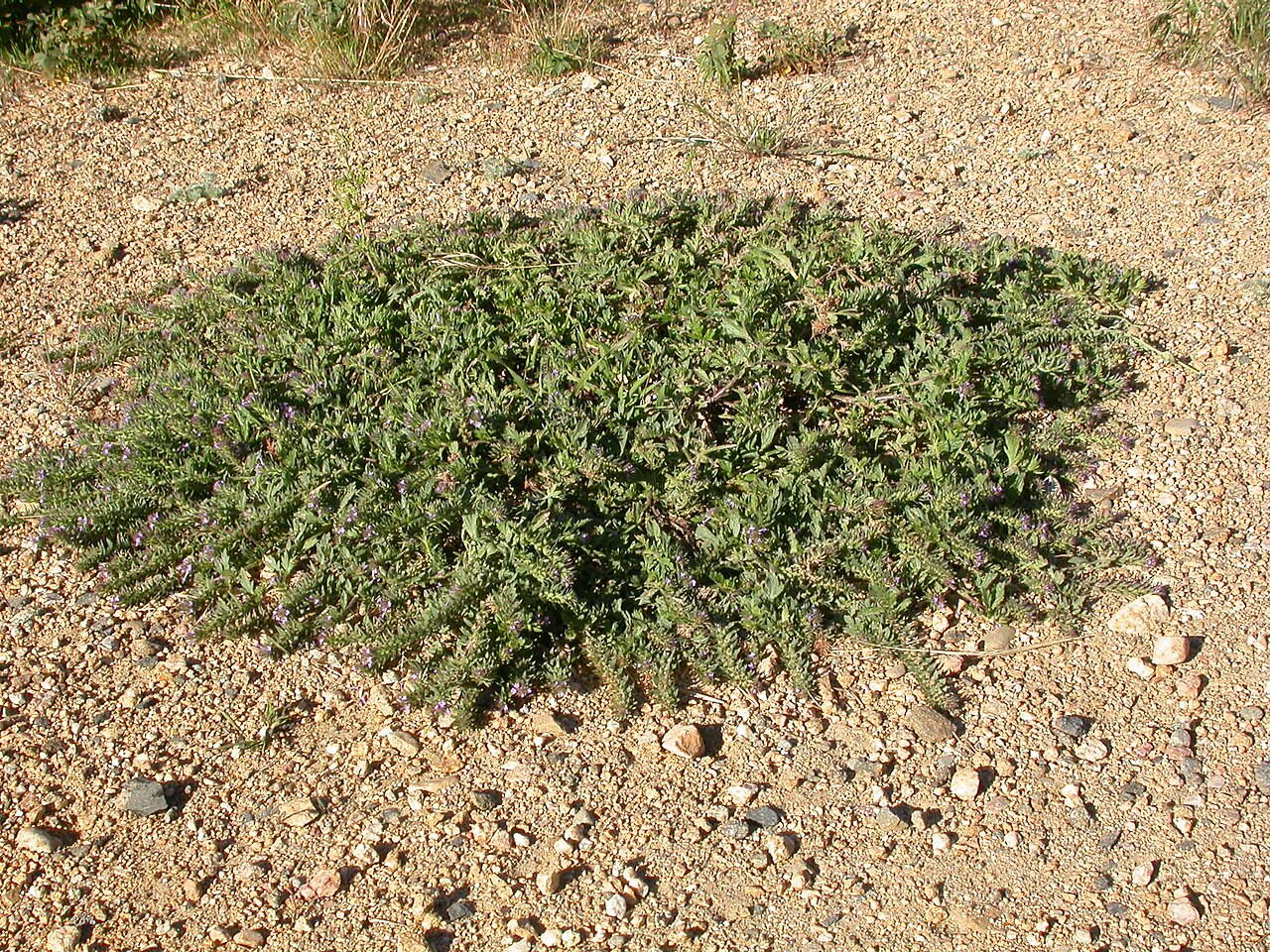
The stems are square in cross-section, as in most of the verbena family, and covered with stiff, spreading hairs. They branch from the base and spread flat along the ground or curve upward at the tips, usually 4 to 20 inches long. A single plant forms a rough circle or mat around its taproot.
Leaves
The leaves are opposite, about 1 to 2 1/2 inches long, hairy, and deeply cut into three main lobes, which are further toothed or lobed. The leaf bases narrow into a short, winged stalk. Leaves are medium to grayish green.
Flowers
The flowers are borne in dense, stiff spikes at the ends of the stems. Each spike is crowded with narrow, hairy, leaf-like bracts about 1/4 to 1/2 inch long, longer than the flowers. The flowers are tiny, about 1/8 inch across, with five pale blue, lavender or purple lobes, and open a few at a time in a ring that moves up the spike. Blooming runs from about May to October.
Fruit & Seeds
Each flower produces four small, narrow nutlets that remain enclosed in the calyx among the bracts. As the spike lengthens, the lower part fills with ripening fruits, and the spikes become rough and bristly. Seeds fall near the parent plant or are carried away on boots, tires and animal fur.
Look-alikes
Dakota mock vervain (Glandularia bipinnatifida) has similar divided leaves but showy, flat-topped clusters of larger pink to purple flowers. Hoary vervain (Verbena stricta) is upright, with long, slender spikes of larger purple flowers and undivided leaves. Hybrids between bigbract verbena and other vervains are sometimes found where they grow together. The long, conspicuous bracts and flat growth habit are the best clues for bigbract verbena.
Safety
Bigbract verbena is not known as a poisonous plant to people or pets. Livestock generally do not eat it, which is one reason it becomes common in overgrazed pastures.
Quick Facts
| Scientific Name | Verbena bracteata (syn. V. bracteosa) |
| Family | Verbenaceae (verbena family) |
| Plant Type | Prostrate annual, biennial or short-lived perennial |
| Mature Height | 2–6 in |
| Mature Spread | 6–20 in |
| Growth Rate | Fast |
| Sun Exposure | Full sun |
| Water Needs | Low; drought tolerant |
| Soil Type | Sandy, gravelly, loamy or clay; tolerates compacted soil |
| Soil pH | Slightly acidic to alkaline |
| Bloom Time | May–October |
| Flower Color | Lavender, pale blue or purple |
| Fall Color | None |
| Fruit | Four small nutlets enclosed in the calyx |
| Deer Resistant | Yes; seldom browsed |
| USDA Hardiness Zones | 3–10 |
Native Range
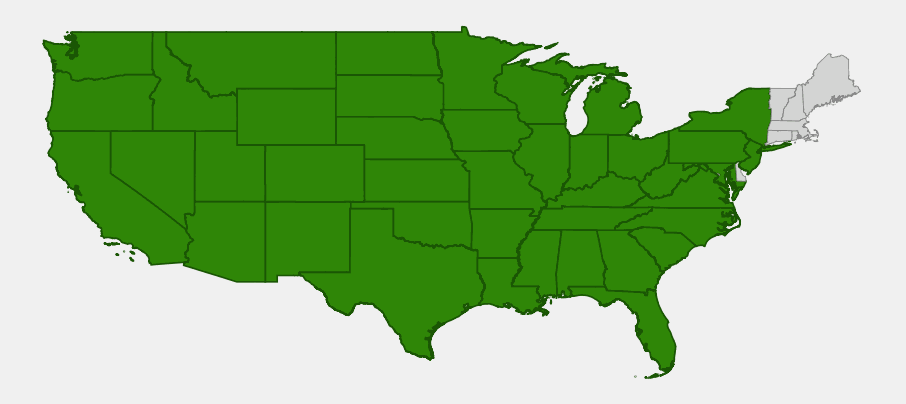
Bigbract verbena is native across much of North America. USDA PLANTS lists it as native in the lower 48 states and Canada, and the Lady Bird Johnson Wildflower Center describes its native distribution as Florida to Texas, California and Mexico, north to southeastern Virginia, Wisconsin and British Columbia. In Canada USDA records it in British Columbia, Alberta, Saskatchewan, Manitoba and Ontario.
USDA PLANTS records it in 45 states. In New England it is introduced: the Lady Bird Johnson Wildflower Center describes it as adventive to New England, and Go Botany says it is native to North America but introduced into New England, where it grows in waste areas. The New England states (Connecticut, Maine, Massachusetts and Vermont) are therefore left off the range map. Records in some northeastern states such as New York and Pennsylvania may also partly reflect spread along roads and railroads.
It is a plant of open, sunny, often disturbed ground. It grows in prairies and plains, dry fields, overgrazed pastures, prairie dog towns, roadsides, trails, sandy and gravelly flats, stream banks, open woodlands and mountain meadows, from near sea level to around 8,000 feet in the West.
📋 Regional plant lists featuring Bigbract Verbena: New York, Pennsylvania & Northern New Jersey · Idaho, Eastern Oregon & Eastern Washington · Ohio & Indiana · Montana & Wyoming · Michigan, Wisconsin & Eastern Minnesota · Kentucky & Tennessee · Nebraska, Kansas & Eastern Colorado · Utah & Western Colorado · Maryland, Virginia & West Virginia · Delaware, Southern New Jersey & Long Island · Arizona & New Mexico · Illinois, Iowa & Missouri · Alabama, Georgia & Mississippi · North & South Florida · North & South Carolina · Arkansas, Louisiana, Eastern Oklahoma & Eastern Texas · South & West Texas · North Dakota, South Dakota & Western Minnesota · California & Nevada
Growing & Care Guide
Bigbract verbena is rarely sold, but it is very easy to grow from seed and often appears on its own in open ground. It suits informal, dry, sunny spots, naturalistic plantings and restoration of bare or compacted ground, rather than formal flower beds.
Light
Full sun. It does poorly in shade and is quickly overgrown by taller plants in rich, moist soil.
Soil & Water
It grows in almost any well-drained soil, including sand, gravel, rocky soil and compacted clay. It needs no fertilizer and little water once established; rainfall is usually enough throughout its range. Avoid wet, poorly drained sites.
Planting Tips
Scatter seed on bare soil in fall or early spring and press it in lightly. It is useful along paths, driveways, gravel areas and between stepping stones, where its flat mats tolerate light foot traffic and summer heat. In meadow plantings, place it at the front edge or in open patches where taller plants will not shade it.
Pruning & Maintenance
No pruning is needed. Plants reseed in open ground; pull unwanted seedlings while they are small. Because it thrives on disturbance, it tends to fade as perennial grasses and wildflowers fill in, which is part of its natural role.
Propagation
Grow it from seed. Collect the bristly spikes when they turn brown in late summer or fall, dry them, and rub out the small nutlets. A period of cold, moist conditions over winter improves germination, so fall sowing works best.
Landscape Uses
- Restoration of bare ground: covers compacted, disturbed or eroding soil
- Gravel and path edges: a low, heat-tolerant native mat
- Dry meadows and prairie plantings: long-season flowers at ground level
- Pollinator plantings: small flowers for native bees from spring to fall
- Wildlife gardens: seeds for ground-feeding birds
Wildlife & Ecological Value
Bigbract verbena is a modest plant, but its long bloom season and its ability to grow on bare ground make it useful for small wildlife.
For Pollinators
The tiny flowers provide nectar and pollen for small native bees, flies and small butterflies from late spring to fall. Vervains are also larval host plants for a few moths and for the common buckeye butterfly, whose caterpillars feed on plants in the verbena and plantain families.
For Birds
Seed-eating birds such as sparrows, juncos and doves eat vervain seeds, and the low mats offer cover for insects that ground-feeding birds hunt.
For Mammals
Deer and livestock rarely eat it, since the stems and leaves are rough and hairy. This is one reason it increases in heavily grazed pastures and on prairie dog towns, where it is part of the typical plant community.
Ecosystem Role
Bigbract verbena is an early colonizer of disturbed ground. It helps hold bare soil after drought, overgrazing, burrowing by prairie dogs, flooding or construction, and it is gradually replaced by longer-lived grasses and wildflowers as the site recovers.
Cultural & Historical Uses
The scientific name bracteata and the common name bigbract both refer to the long, conspicuous bracts in the flower spikes. The older name Verbena bracteosa, used by André Michaux, appears in many early American floras.
Vervains have a long history in folk medicine in Europe and North America, and some Native American peoples used native vervains medicinally. Records of uses specific to bigbract verbena are limited, so it should not be used as a home remedy.
Because it grows so well on trampled and grazed ground, ranchers and range managers have long used the abundance of bigbract verbena as one sign of overgrazing or heavy disturbance. For gardeners, it is a reminder that some native plants are specialists of disturbance, filling the role that weedy exotics often take over in modern landscapes.
Frequently Asked Questions
Is bigbract verbena native?
Yes. It is native across most of the United States, southern Canada and Mexico. It is considered introduced in New England, where it grows mainly in waste places.
Is bigbract verbena a weed?
It often grows on roadsides, trails and overgrazed land, so it can look weedy, but it is a native plant that covers bare soil and feeds small pollinators. It tends to fade as taller vegetation returns.
Is bigbract verbena an annual or a perennial?
It can be an annual, a biennial or a short-lived perennial, depending on growing conditions. In most places individual plants live only one or two years, but they reseed readily.
How do I tell bigbract verbena from other vervains?
Look for its flat, spreading mats of hairy, square stems, deeply lobed leaves and dense spikes where the narrow bracts are longer than the tiny lavender flowers.
Will bigbract verbena attract butterflies?
Its tiny flowers mainly attract small bees and flies, along with some small butterflies. Vervains are also larval host plants for the common buckeye butterfly.

Looking for a nursery that carries Bigbract Verbena?
Browse our native plant nursery directory: Alabama, Arizona & Arkansas · California · Colorado, Florida & Georgia · Idaho, Illinois, Indiana, Iowa & Kansas · Kentucky, Louisiana, Maryland, Michigan, Minnesota, Mississippi, Missouri & Montana · Nebraska, Nevada, New Jersey, New Mexico, New York, North Carolina, North Dakota, Ohio & Oklahoma · Oregon · Pennsylvania, South Carolina, South Dakota, Tennessee, Texas, Utah & Virginia · Washington · West Virginia, Wisconsin & Wyoming