
Pale-spiked Lobelia (Lobelia spicata)
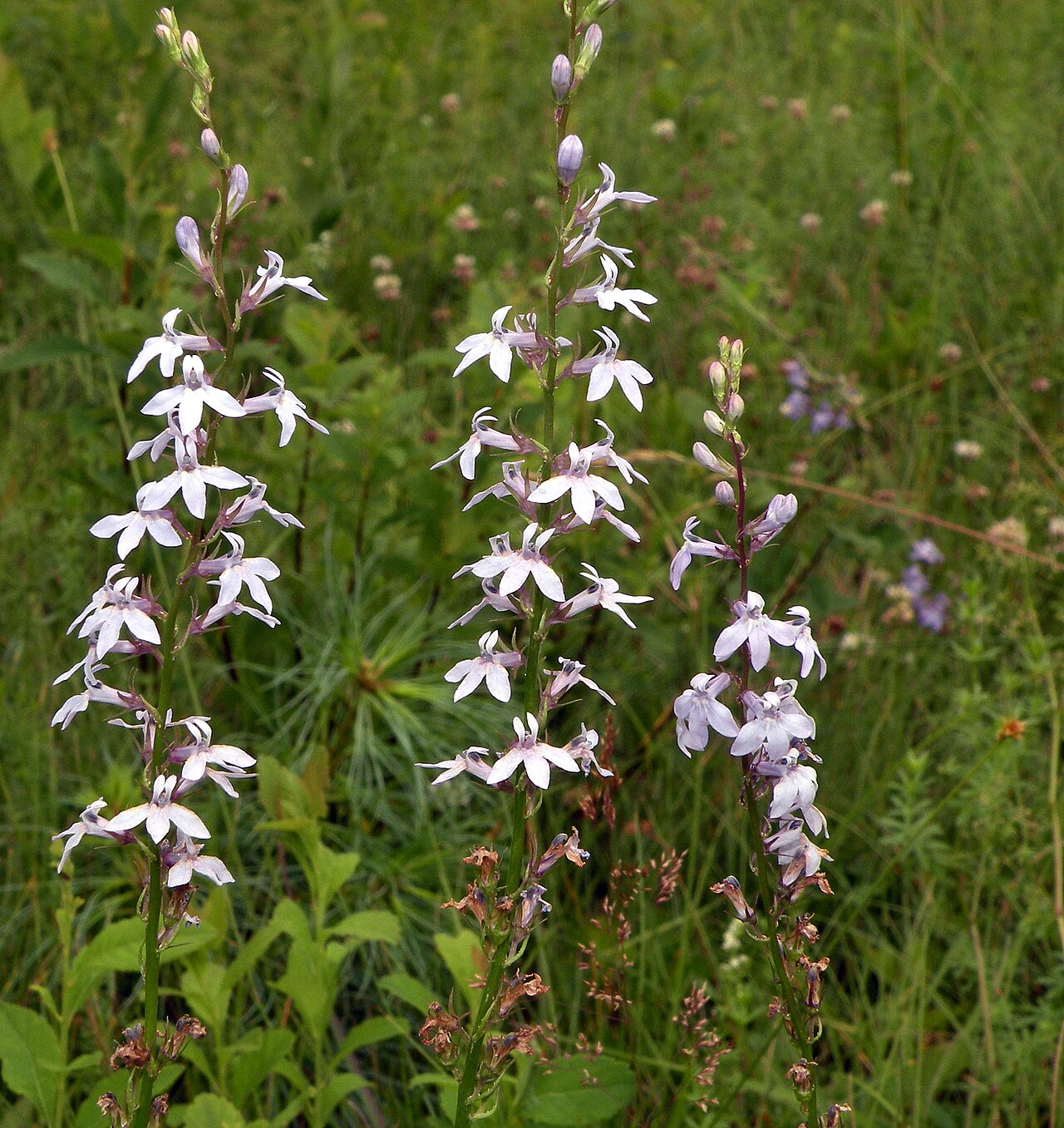
Lobelia spicata, known as Pale-spiked Lobelia, palespike lobelia (its USDA name) or spiked lobelia, is a slender native wildflower of prairies, meadows, glades and open woods across much of eastern and central North America. From a small rosette of leaves it sends up a single, wand-like stem 1 to 3 feet tall, lined for much of its length with small, pale blue to white two-lipped flowers in early to midsummer.
It is a short-lived perennial in the bellflower family (Campanulaceae) and a relative of the much showier cardinal flower and great blue lobelia. It is easy to overlook, because it often blooms beneath taller grasses and wildflowers, but its delicate spires add a fine, airy texture to prairie plantings and dry meadows, and it tolerates poorer, drier soils than most lobelias.
Like other lobelias, it contains toxic alkaloids, so this guide includes a safety note for people, pets and livestock along with identification, range, growing tips and its value to wildlife.
Identification
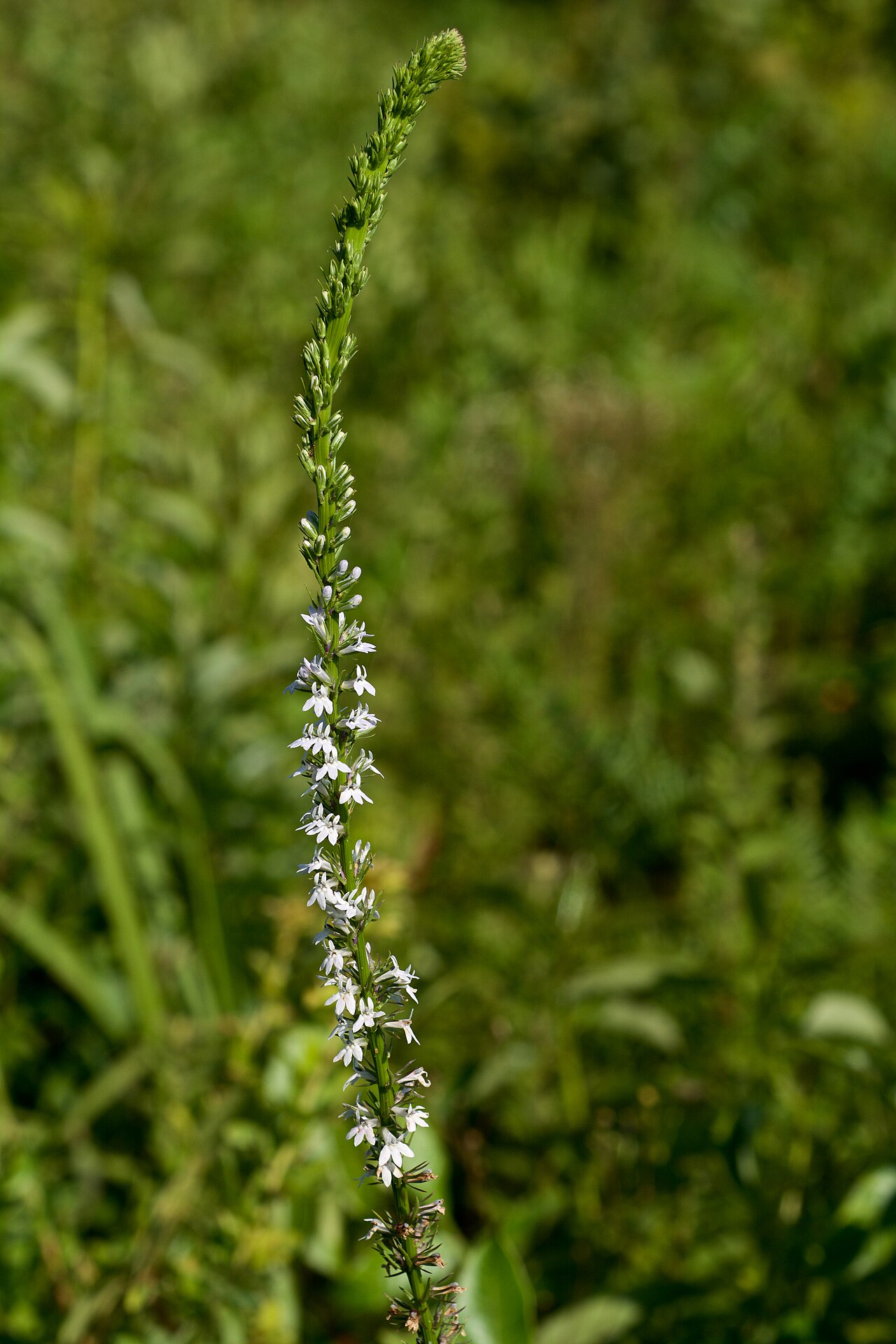
Pale-spiked lobelia is identified by its single, unbranched stem with a long, narrow spike of small pale flowers, and by its modest size compared with other eastern lobelias.
Leaves & Stem
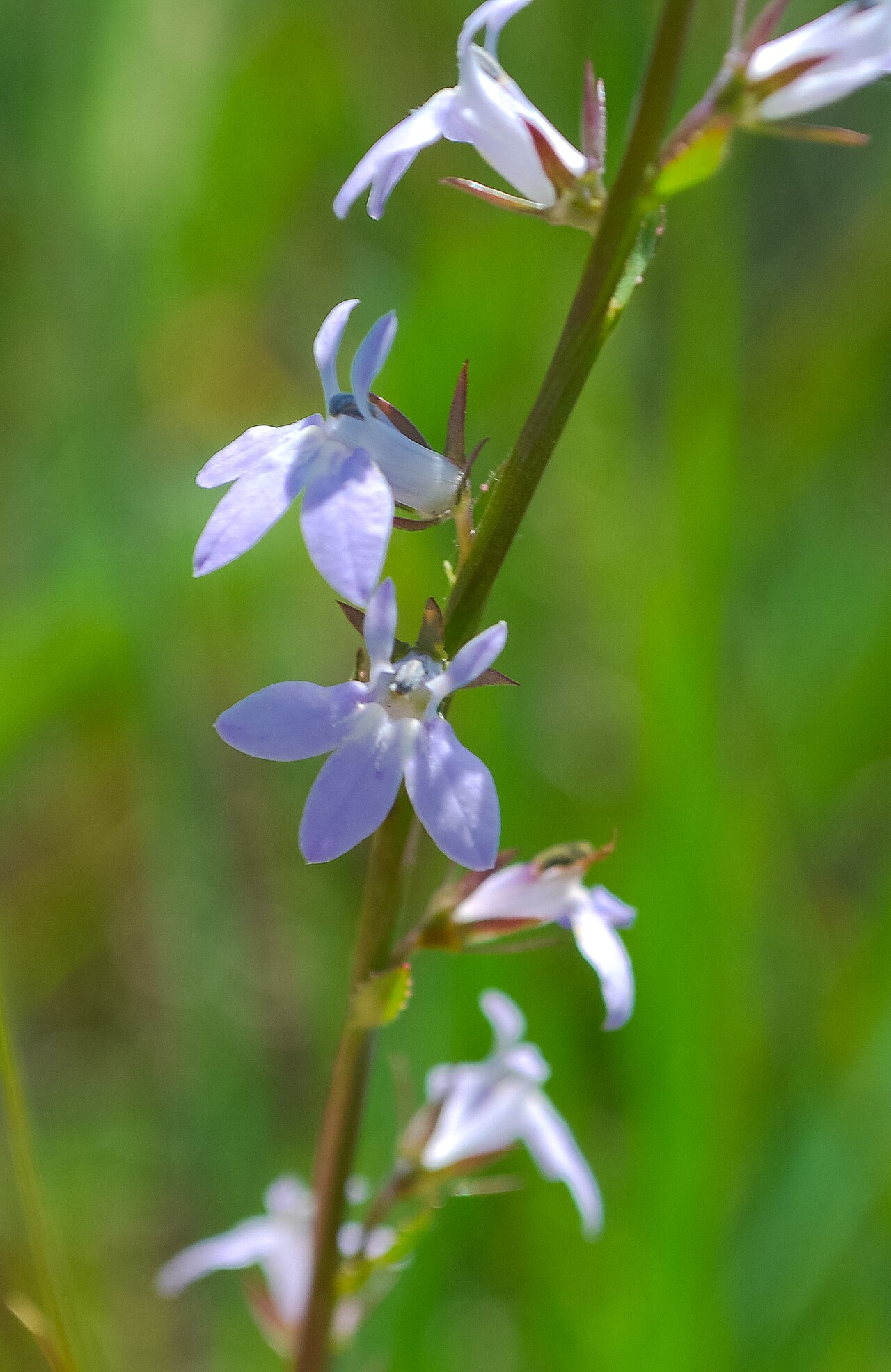
Plants begin as a small basal rosette of oval to spoon-shaped leaves 1 to 3½ inches long. The flowering stem is usually unbranched, 1 to 3 feet tall, often reddish and finely hairy near the base and smooth above, with alternate, narrow, stalkless leaves that become smaller toward the top. Broken stems exude a milky sap.
Flowers
The flowers are arranged in a long, slender spike-like raceme at the top of the stem, opening from the bottom up over several weeks from late May to August. Each flower is about ⅓ to ½ inch long, pale blue, lavender or nearly white, with the typical lobelia shape: two narrow upper lobes and a broader lower lip divided into three lobes.
Fruit & Seeds
The fruits are small, rounded capsules held close to the stem, each containing many tiny, dust-like seeds that spill out when the capsule opens in late summer and fall.
Similar Species
Indian tobacco (Lobelia inflata) is a branched annual with tiny flowers and inflated, balloon-like seed pods. Great blue lobelia (Lobelia siphilitica) is stouter, with larger, deep blue flowers, and grows in wet places. Downy lobelia (Lobelia puberula) of the Southeast has larger, deeper blue flowers and hairy foliage and blooms later in the season.
Quick Facts
| Scientific Name | Lobelia spicata |
| Family | Campanulaceae (bellflower family) |
| Plant Type | Herbaceous short-lived perennial |
| Mature Height | 1–3 ft |
| Mature Spread | 6–12 in |
| Growth Rate | Moderate |
| Sun Exposure | Full sun to part shade |
| Water Needs | Low to moderate; dry to moist soil |
| Soil Type | Average loam, sandy, rocky or clay soils; tolerates thin soils |
| Soil pH | About 5.5–7.5 |
| Bloom Time | Late May–August |
| Flower Color | Pale blue, lavender or white |
| Fall Color | None notable |
| Fruit | Small capsules with many tiny seeds |
| Deer Resistant | Yes; toxic foliage is seldom eaten |
| USDA Hardiness Zones | 3–8 |
Native Range
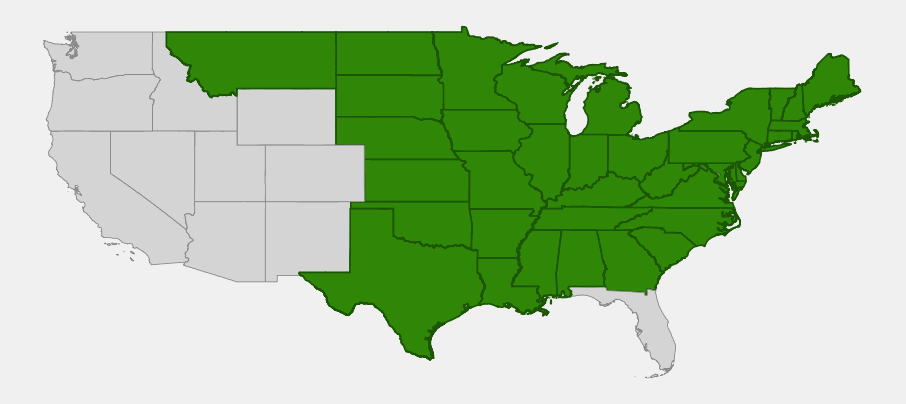
Pale-spiked lobelia is one of the most widespread lobelias in North America. USDA PLANTS records it in 37 states, from Maine to Georgia, west across the Great Lakes and Midwest to the Dakotas, Nebraska, Kansas and Oklahoma, and south to Louisiana and eastern Texas. Montana records are outlying, at the far northwestern edge of the range in the eastern part of the state. In Canada it ranges from the Maritime provinces west to Saskatchewan and Alberta.
In Texas it is restricted to the eastern part of the state, and it is absent from most of peninsular Florida. It is most common in the prairie and woodland regions of the Midwest and the Ohio Valley.
It grows in dry to moist prairies, meadows and old fields, savannas and open woods, rocky glades and barrens (including limestone and serpentine barrens), and along roadsides, usually in sun or light shade where competition is not too dense.
📋 Regional plant lists featuring Pale-spiked Lobelia: New York, Pennsylvania & Northern New Jersey · Ohio & Indiana · Montana & Wyoming · Michigan, Wisconsin & Eastern Minnesota · Kentucky & Tennessee · Nebraska, Kansas & Eastern Colorado · Connecticut, Massachusetts & Rhode Island · New Hampshire, Maine & Vermont · Maryland, Virginia & West Virginia · Delaware, Southern New Jersey & Long Island · Illinois, Iowa & Missouri · Alabama, Georgia & Mississippi · North & South Carolina · Arkansas, Louisiana, Eastern Oklahoma & Eastern Texas · North Dakota, South Dakota & Western Minnesota
Growing & Care Guide
Pale-spiked lobelia is an easy, adaptable plant for sunny, naturalistic gardens. It is short-lived, so it is best treated as a self-sowing component of a meadow or prairie planting rather than a long-lived specimen.
Light
Full sun to part shade. It flowers best in sun but tolerates the light shade of open woods and savanna edges.
Soil & Water
It grows in average, sandy, rocky or clay soils, from dry to moist, and tolerates poorer, thinner soils than most lobelias. Water during dry spells in the first season; afterward it rarely needs watering. Avoid rich, heavily fertilized soil, where taller plants crowd it out.
Planting Tips
Plant it in groups of five or more, in front of or among short grasses such as little bluestem so the slender spikes are visible. Good companions include black-eyed Susan, lanceleaf coreopsis and spiderwort.
Pruning & Maintenance
No pruning is needed. Leave the spent stems standing until the capsules release their seed, so plants can reseed. Avoid smothering the small basal rosettes with heavy mulch or leaf litter in winter. Wear gloves if you are sensitive to plant sap.
Propagation
Grow it from seed. The seed is dust-fine: surface-sow it in fall or after about 60 days of cold, moist stratification in spring, and do not cover it, because it needs light to germinate. Plants usually bloom in their second year. Established plants also form small offset rosettes that can be separated in spring.
Landscape Uses
- Prairie and meadow plantings: adds slender, airy spires among grasses
- Dry and rocky gardens: tolerates thin, poor and rocky soils
- Pollinator gardens: visited by small bees and other insects
- Savanna and open woodland edges: grows in sun or light shade
- Restoration plantings: a widespread, adaptable native forb for seed mixes
Wildlife & Ecological Value
Pale-spiked lobelia is a modest but useful part of prairie and meadow plant communities, blooming over a long summer season.
For Pollinators
The small flowers are visited mainly by bees, especially small and medium-sized bees, and occasionally by small butterflies and other insects. Like other lobelias, its flowers release pollen before the stigma is receptive, which favors cross-pollination by visiting insects.
For Birds
The tiny seeds are of little value to birds, but the plant is part of the grassland flora that supports insect-eating birds in prairies and meadows.
For Mammals
Mammals rarely eat it because its foliage contains bitter, toxic alkaloids. Deer and rabbits usually leave it alone.
Ecosystem Role
As a widespread prairie and glade wildflower it adds diversity to grassland plant communities, and its long blooming season provides a steady trickle of nectar and pollen through summer.
Cultural & Historical Uses
The genus Lobelia honors the Flemish botanist Matthias de l’Obel (Lobelius), and spicata means “spiked,” for the long flower spike. The species was described by the French naturalist Jean-Baptiste Lamarck. Botanists recognize several varieties across its wide range, though they are hard to separate.
Safety note: Pale-spiked lobelia, like other lobelias, contains lobeline and related alkaloids. Eating the leaves, roots or seeds can cause nausea, vomiting, sweating, rapid heartbeat and, in larger amounts, serious poisoning, and plants in this genus have caused deaths in people and livestock. Do not use it as an herbal remedy, keep children and pets from chewing on it, and avoid planting it where livestock graze. Contact a doctor, veterinarian or poison control center if any part is eaten.
Its relative Indian tobacco (Lobelia inflata) has a long history in folk medicine, and lobelias in general were used by Indigenous peoples and later herbalists, but the narrow line between an effective and a toxic dose makes these plants unsafe for home use.
Frequently Asked Questions
Is pale-spiked lobelia poisonous?
Yes. Like all lobelias it contains toxic alkaloids such as lobeline. Do not eat any part of it, and keep children, pets and livestock from eating it.
How tall does pale-spiked lobelia grow?
Usually 1 to 3 feet, as a single slender flowering stem rising from a small basal rosette.
Will it grow in dry soil?
Yes. Unlike cardinal flower and great blue lobelia, which need moist to wet soil, pale-spiked lobelia grows in dry to moist prairies, glades and open woods.
Why did my pale-spiked lobelia disappear?
It is a short-lived perennial that often lives only a few years. Let it set seed and keep the soil surface open so seedlings can replace older plants.
What is the difference between pale-spiked lobelia and Indian tobacco?
Indian tobacco is a branched annual with very small flowers and inflated, balloon-like pods. Pale-spiked lobelia is a perennial with a single, mostly unbranched spike of larger pale blue to white flowers.

Looking for a nursery that carries Pale-spiked Lobelia?
Browse our native plant nursery directory: Alabama & Arkansas · Connecticut, Delaware & Georgia · Illinois, Indiana, Iowa & Kansas · Kentucky, Louisiana, Maine, Maryland, Massachusetts, Michigan, Minnesota, Mississippi, Missouri & Montana · Nebraska, New Hampshire, New Jersey, New York, North Carolina, North Dakota, Ohio & Oklahoma · Pennsylvania, Rhode Island, South Carolina, South Dakota, Tennessee, Texas, Vermont & Virginia · West Virginia & Wisconsin