
Cutleaf Grapefern (Botrychium dissectum)
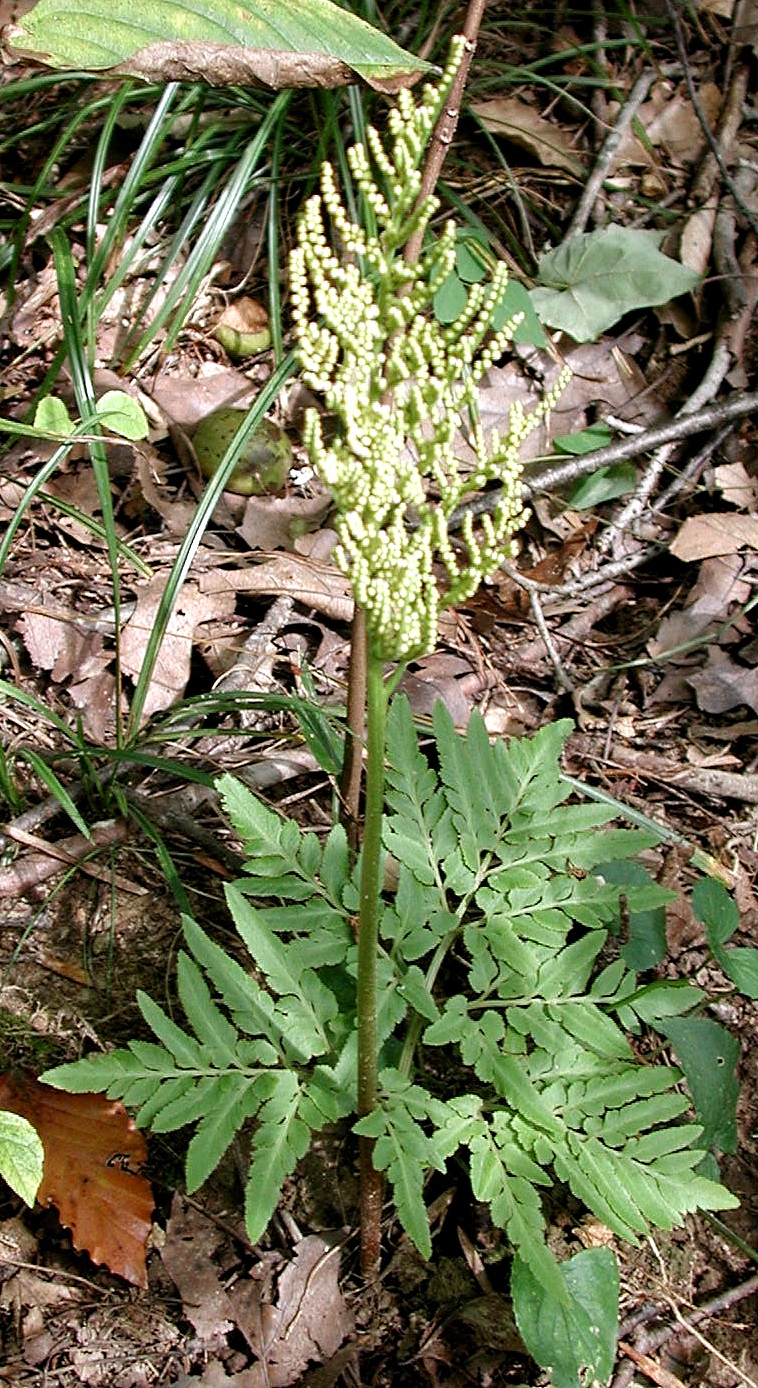
Botrychium dissectum, known as Cutleaf Grapefern, cut-leaved grapefern, bronze fern or common grapefern, is a small, low fern of eastern woods, old fields and thickets. Each year it produces a single leaf that is split into two parts: a spreading, leathery, triangular blade held close to the ground, and an upright stalk topped with clusters of round, bead-like spore cases that look like tiny bunches of grapes. The leaf appears in summer, stays green through winter, and in cold weather often turns a rich bronze or purplish color.
It belongs to the adder’s-tongue family (Ophioglossaceae), an ancient group of ferns that differ in many ways from the familiar woodland ferns. Many botanists now place it, along with the other evergreen grapeferns, in the genus Sceptridium as Sceptridium dissectum, and you will see both names in field guides and on iNaturalist. The species is famous for its variable leaf: in some plants the blade is finely cut and lacy, while in others it is only toothed. The less-divided plants were once called a separate species, Botrychium obliquum, but they are now treated as a form (forma obliquum) of the same species.
Cutleaf grapefern depends on soil fungi throughout its life and is not available as nursery stock. It almost never survives digging, so this page is mainly an identification and appreciation guide. If it already grows in your woods or an unmown corner of your yard, the best thing you can do is leave it alone.
Identification
Grapeferns are small and easily overlooked, but once you learn the pattern of a low, spreading blade with an upright spore stalk, they are easy to spot, especially in fall and winter when most other low plants have died back.
Plant Structure
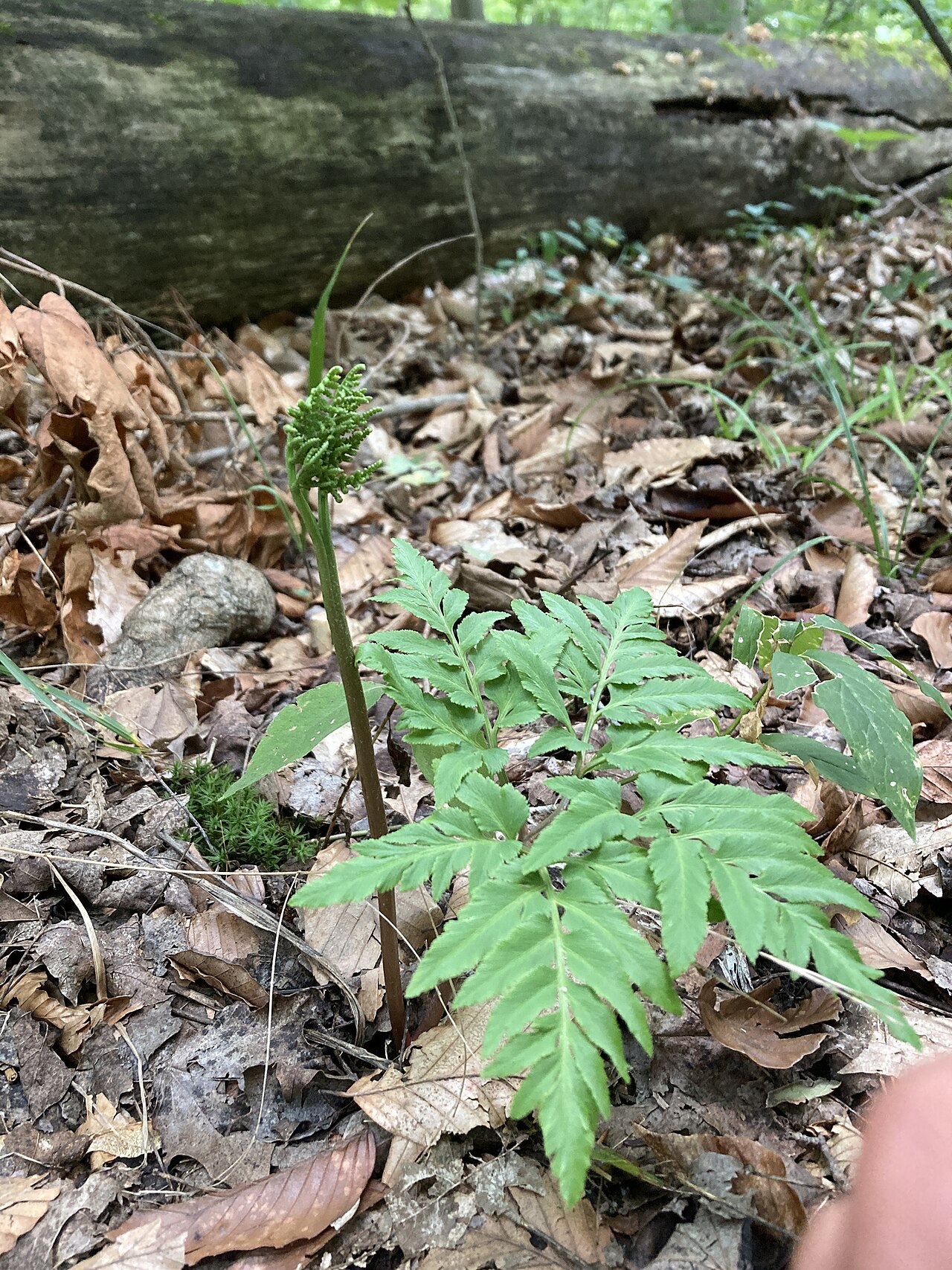
Each plant produces just one leaf per year from a short, fleshy, underground stem with thick, unbranched roots. The leaf divides near the ground into two branches. The sterile part (trophophore) spreads horizontally on a short stalk and is broadly triangular, about 2 to 7 inches wide. The fertile part (sporophore) rises on a long stalk, usually 4 to 12 inches tall, and branches near the top into clusters of round, yellow to brown spore cases.
Leaf Blade
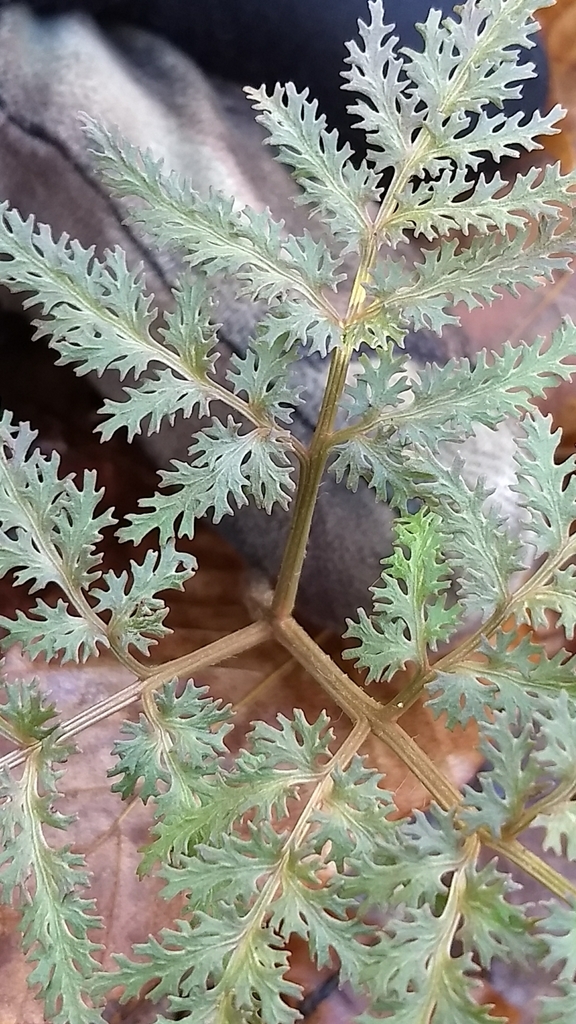
The sterile blade is two to three times divided into leaflets. It is thick and somewhat leathery, smooth, and green in summer and fall. In the typical form (forma dissectum) the leaflets are cut into many narrow, toothed lobes, giving the blade a lacy look. In forma obliquum, the leaflets are lance-shaped with finely toothed edges and are not deeply cut. Intermediate plants are common, and both forms can grow in the same population. In winter, leaves exposed to cold and sun usually turn bronze, coppery or purplish, and many survive under snow until new growth appears the next summer.
Spore Stalk
The fertile stalk appears in late summer and releases its dust-like yellow spores in fall, usually from September to November. After shedding spores, it withers and turns brown, while the sterile blade stays green or bronze through the winter.
Similar Species
Rattlesnake fern (Botrychium virginianum, also called Botrypus virginianus) is larger, with a thin, lacy, deciduous blade that appears in spring and attaches high on the stem, with the spore stalk rising from its base. Southern grapefern (B. biternatum) has smaller, less divided leaflets with rounded teeth, and leathery grapefern (B. multifidum) has thicker, fleshier, more rounded leaflets. Grapeferns can be hard to separate, and hybrids and intermediate plants occur, so use several features together.
Quick Facts
| Scientific Name | Botrychium dissectum Spreng. (syn. Sceptridium dissectum, B. obliquum) |
| Family | Ophioglossaceae (adder’s-tongue family) |
| Plant Type | Evergreen perennial fern; depends on mycorrhizal fungi |
| Mature Height | 2–6 in sterile blade; fertile stalk 4–12 in |
| Mature Spread | 2–7 in; single leaf per plant |
| Growth Rate | Very slow |
| Sun Exposure | Partial shade; tolerates sun in old fields |
| Water Needs | Moderate; dry to moist soils |
| Soil Type | Undisturbed loam or sandy soil with intact fungal network |
| Soil pH | Acidic to neutral (about 5.0–7.0) |
| Bloom Time | Does not flower; spores shed September–November |
| Flower Color | None; spore clusters yellow to brown |
| Fall Color | Sterile blade turns bronze to purplish in winter |
| Fruit | None; spores borne in round, grape-like clusters |
| Deer Resistant | Variable; occasionally browsed |
| USDA Hardiness Zones | 3–9 |
Native Range
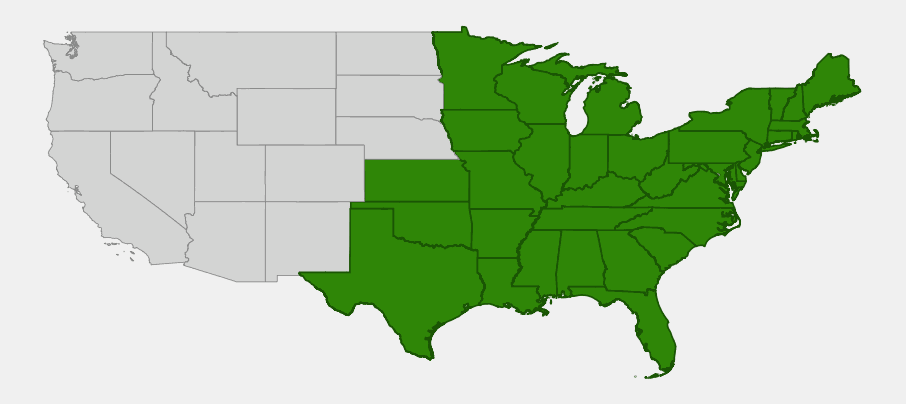
Cutleaf grapefern is one of the most widespread grapeferns in eastern North America. USDA PLANTS lists it as native in 34 states, from Maine, Vermont and New Hampshire south through New England, New York, Pennsylvania and the Mid-Atlantic to Florida, west through the Great Lakes states to Minnesota, Wisconsin and Iowa, and south through Missouri, Kansas, Oklahoma and Arkansas to Louisiana and eastern Texas. In Canada it grows in southern Ontario, southern Quebec, New Brunswick, Nova Scotia and Prince Edward Island.
It is most common in the Appalachian and Ohio Valley states and the Northeast. In Texas it is limited to the eastern Piney Woods, in Oklahoma and Kansas to the eastern edge, and in Minnesota mainly to the east and southeast. In Florida it is mostly in the northern part of the state.
It grows in moist to fairly dry woods, second-growth forests, old fields growing up to trees, thickets, wooded stream terraces, and even shady lawns, cemeteries and orchards that are seldom mown. Many populations are in places that were once farmed or cleared and have since grown back, as long as the soil has been left undisturbed for some years.
📋 Regional plant lists featuring Cutleaf Grapefern: New York, Pennsylvania & Northern New Jersey · Ohio & Indiana · Michigan, Wisconsin & Eastern Minnesota · Kentucky & Tennessee · Nebraska, Kansas & Eastern Colorado · Connecticut, Massachusetts & Rhode Island · New Hampshire, Maine & Vermont · Maryland, Virginia & West Virginia · Delaware, Southern New Jersey & Long Island · Illinois, Iowa & Missouri · Alabama, Georgia & Mississippi · North & South Florida · North & South Carolina · Arkansas, Louisiana, Eastern Oklahoma & Eastern Texas
Can You Grow It?
Not in the usual sense. Cutleaf grapefern is not sold as nursery stock, cannot be reliably transplanted, and should never be dug from the wild. Its whole life is tied to fungi in the soil. What you can do is recognize it and protect the places where it already grows.
Light
In the wild it grows in light to moderate shade under deciduous or mixed trees, and in partly open old fields and thickets. It tolerates more sun than many woodland ferns, but it does not thrive in hot, open, regularly disturbed ground.
Soil & Water
It grows in a range of soils, from moist loam to fairly dry, sandy or rocky ground, as long as the soil has been left undisturbed long enough for the right fungi to be present. Tilling, heavy compaction and repeated fertilizing destroy the conditions it needs.
Planting Tips
Do not try to transplant it. Grapeferns have fleshy roots that are fully dependent on mycorrhizal fungi, and dug plants nearly always decline and die. If you find it in your yard or woods, mark the spot, avoid trampling and digging, and keep invasive groundcovers away. In a lawn, simply raise the mower or leave a small unmown patch from late summer through winter, when the leaf is up.
Pruning & Maintenance
None. Let the leaf and spore stalk die back on their own. Leave fallen leaves in place: grapeferns often grow up through leaf litter and are protected by it. Avoid herbicides and fertilizers in the area.
Propagation
Propagation is not practical. The spores germinate underground in darkness and grow into tiny, colorless gametophytes that live for years entirely on sugars supplied by fungi. Only after fertilization does a young plant form, and it may spend several more years underground before sending up its first green leaf. This slow, fungus-dependent life cycle is why grapeferns cannot be produced like ordinary nursery ferns.
Where to See It
- Eastern woods in fall and winter: look for bronze or green blades in leaf litter after other plants have died back
- Old fields and second-growth forest: common where farmland has grown back to trees
- Shady lawns and cemeteries: often found in seldom-mown, older lawns under trees
- Fern walks and nature study: a good example of the ancient adder’s-tongue family
- Citizen science: photograph both the sterile blade and the spore stalk for iNaturalist records
Wildlife & Ecological Value
Cutleaf grapefern is a small and inconspicuous member of the forest-floor community, but it is part of the network of plants and fungi that keeps woodland soils alive.
For Pollinators
As a fern, it does not flower and offers no nectar or pollen. Its spores are spread by wind.
For Birds
It provides little direct food for birds, but its evergreen leaves add a bit of winter cover on the forest floor where thrushes, towhees and juncos forage among the leaves.
For Mammals
Deer and rabbits occasionally browse the leaves, especially in winter when little else is green. Browsing usually removes the leaf for one year, and healthy plants send up a new one the next summer.
Ecosystem Role
Grapeferns depend on arbuscular mycorrhizal fungi at every stage of life, and their underground gametophytes live for years with no green tissue at all, fed entirely by fungi. The adult plants still rely heavily on the same fungal partners. Because the fungi need undisturbed soil, the presence of grapeferns is often a sign that a site has been free of plowing or heavy disturbance for many years. Their evergreen leaves also photosynthesize through mild periods in fall and winter when the tree canopy is bare.
Cultural & Historical Uses
The genus name Botrychium comes from the Greek botrys, a bunch of grapes, a reference to the clustered spore cases. Sceptridium, the genus name many botanists now use for the evergreen grapeferns, means “little scepter,” after the upright fertile stalk. The species was named dissectum, “cut apart,” for its deeply divided leaflets.
Nineteenth-century fern enthusiasts were puzzled by how much the leaves vary, and they described several species and varieties that are now considered forms of cutleaf grapefern. Studies have since shown that finely cut and less-divided plants can grow from the same population, and researchers still discuss how genetics and environment shape the leaf form.
The adder’s-tongue family is one of the oldest lineages of living ferns, with close relatives in the whisk ferns. Grapeferns are a reminder that ferns come in many forms beyond the familiar feathery fronds, and that much of a plant’s life can happen out of sight underground.
Frequently Asked Questions
Can I buy or transplant cutleaf grapefern?
No. It is not available as nursery stock, and dug plants almost always die because they depend on soil fungi. Never dig it from the wild. If it grows on your property, protect the spot.
Is it Botrychium dissectum or Sceptridium dissectum?
Both names are in use for the same plant. USDA PLANTS uses Botrychium dissectum; many recent fern treatments place the evergreen grapeferns in Sceptridium.
Why do the leaves look so different from plant to plant?
Cutleaf grapefern is known for its variable leaves. Some plants have lacy, deeply cut leaflets (forma dissectum), while others have toothed, lance-shaped leaflets (forma obliquum), with many in between. They are all the same species.
Why does it turn bronze in winter?
Leaves exposed to cold and light produce reddish pigments that give them a bronze or purplish color. The leaf stays alive through winter and may turn green again in spring before it withers.
When is the best time to find it?
Late summer through early spring. The leaf appears in summer, the spore stalk ripens in fall, and the bronze winter blades stand out against brown leaf litter.

Looking for a nursery that carries Cutleaf Grapefern?
Browse our native plant nursery directory: Alabama & Arkansas · Connecticut, Delaware, Florida & Georgia · Illinois, Indiana, Iowa & Kansas · Kentucky, Louisiana, Maine, Maryland, Massachusetts, Michigan, Minnesota, Mississippi & Missouri · New Hampshire, New Jersey, New York, North Carolina, Ohio & Oklahoma · Pennsylvania, Rhode Island, South Carolina, Tennessee, Texas, Vermont & Virginia · West Virginia & Wisconsin