
Floating Primrose-Willow (Ludwigia peploides)
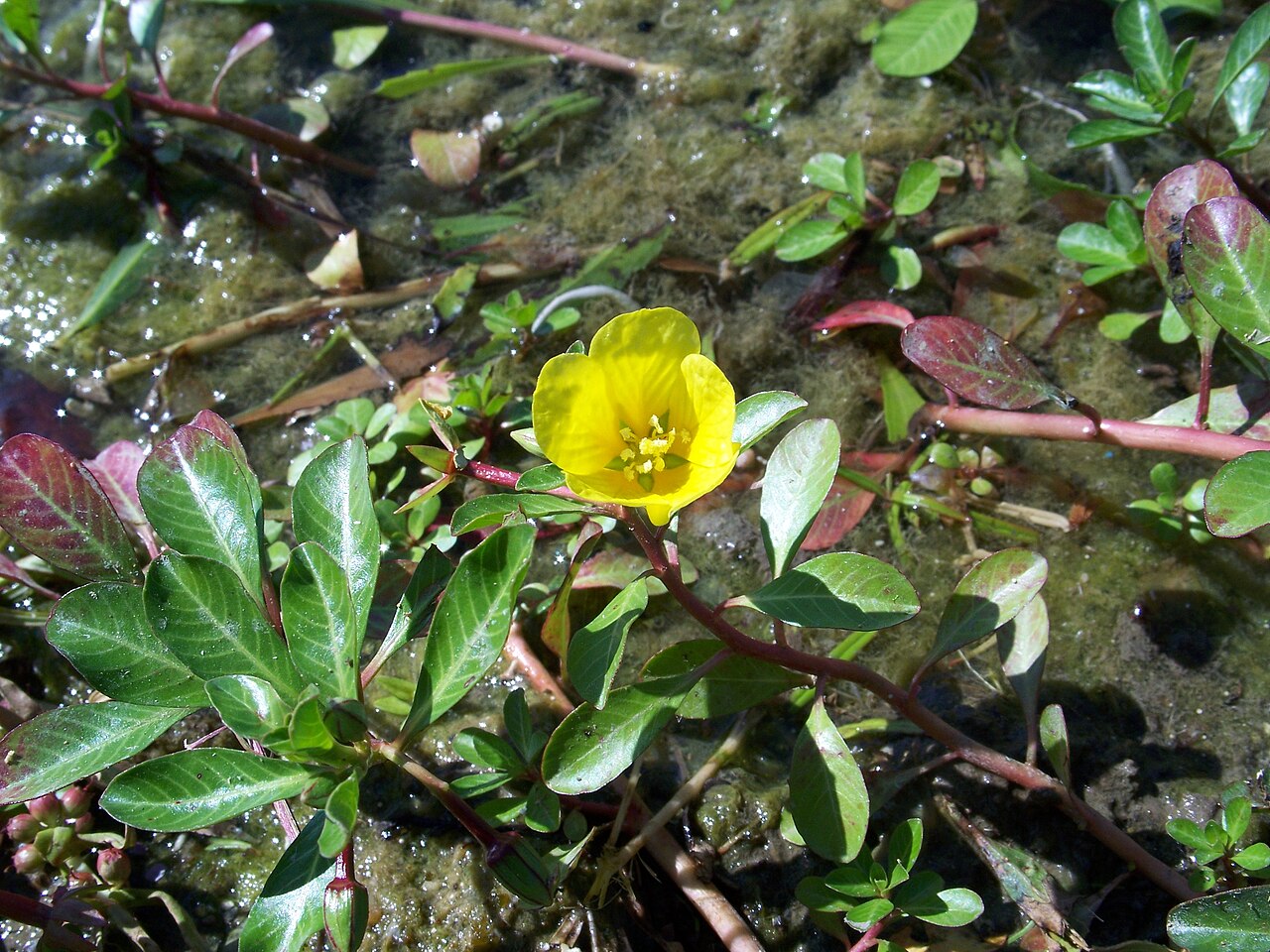
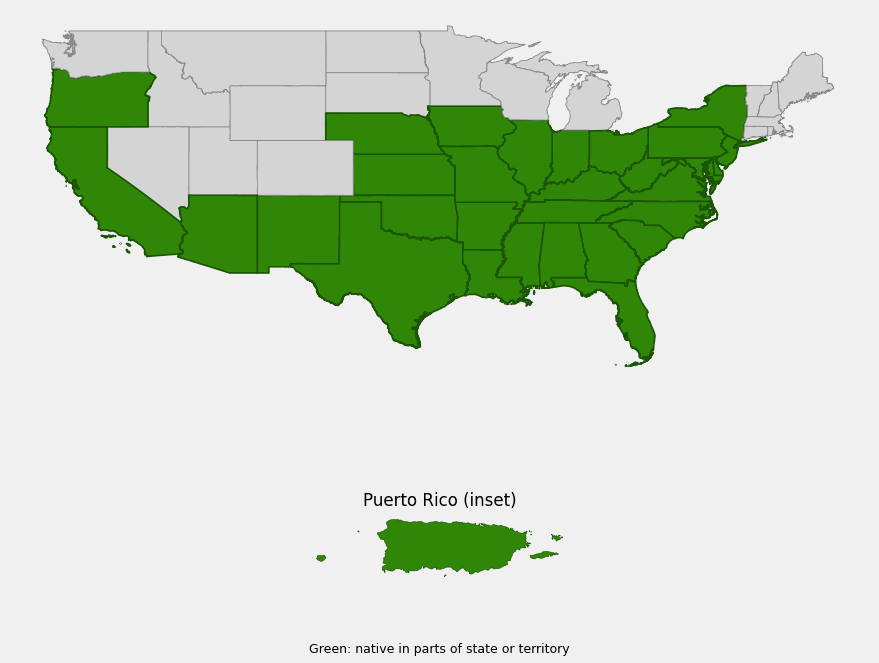
Ludwigia peploides, known as Floating Primrose-Willow, and also called creeping water primrose, is a sprawling aquatic perennial of the evening primrose family (Onagraceae). It is native to much of the Americas and to Australia. In the United States, USDA PLANTS lists it as native in 30 states, from the Southeast and Gulf Coast north through the Mississippi and Ohio valleys to Iowa, Nebraska and New York, west through Texas to Arizona, California and Oregon, and in Puerto Rico.
Its reddish stems creep across mud or float on shallow water, rooting at the nodes and forming dense mats. Glossy, oval to spoon-shaped leaves line the stems, and from late spring to fall bright yellow, five-petaled flowers about an inch across open on short stalks in the leaf axils. In warm climates it can bloom nearly all year.
It grows on muddy shores, in ponds, ditches, sloughs, marshes and the slow backwaters of rivers. In its native range it provides cover for fish and aquatic insects and nectar for bees. But it spreads aggressively from stem fragments, and it is a serious invasive weed in Europe and other places where it has been introduced. Plant it only within its native region, keep it contained, and never release it into waterways.
Identification
Floating primrose-willow is recognized by its bright yellow, five-petaled flowers held just above mats of glossy, alternate leaves on reddish stems that creep across mud or float on water.
Growth Form
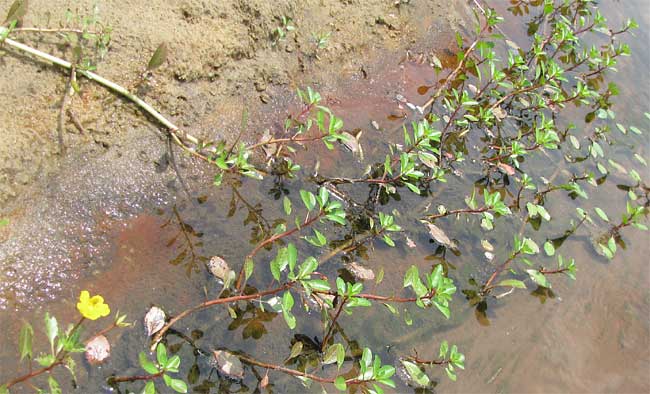
A perennial herb with long, branching stems that creep across wet mud or float on the water, often 2 to 6 feet long or more, with the tips turning upward. The stems are often reddish, smooth or hairy depending on the subspecies, and root at the nodes. Floating stems may produce white, spongy air roots that help them stay buoyant. Plants can form dense mats that cover small ponds and ditches.
Leaves
The leaves are alternate, simple and untoothed, oblong, oval or spoon-shaped, about 1 to 4 inches long, with a narrow base tapering into a short stalk. They are glossy green, often with reddish midribs. Leaves of young floating shoots are often small and rounded, forming rosettes on the water surface.
Flowers
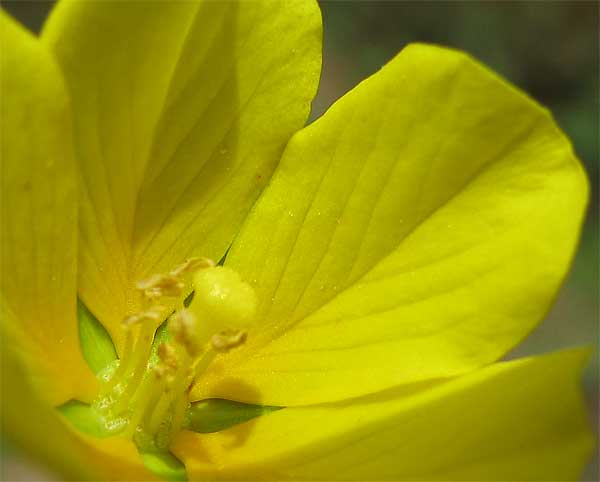
From about May to October, and year-round in Florida and Puerto Rico, single flowers rise on stalks from the leaf axils. Each has five (sometimes six) bright yellow, rounded petals, usually 3/8 to 1 inch long, five narrow green sepals, ten short stamens and a round stigma. The flowers open in the morning and close later in the day.
Fruit
The fruit is a hard, cylindrical capsule about 1/2 to 1 1/2 inches long, often slightly curved, with the persistent sepals at its tip. It contains many small seeds embedded in corky tissue, which helps them float.
Look-alikes
Large-flower primrose-willow (Ludwigia grandiflora) and water primrose (L. hexapetala) are larger, usually hairier plants with flowers up to 2 inches across and are invasive in many U.S. states. Mexican Primrose-Willow (L. octovalvis) is an upright, bushy plant with four petals. Creeping primrose-willow (L. repens) has small, opposite leaves and flowers with four petals.
Safety
Floating primrose-willow is not known to be toxic to people or pets. The greater concern is ecological: it spreads easily from fragments, so never dump plants or pond water into streams, lakes or storm drains.
Quick Facts
| Scientific Name | Ludwigia peploides |
| Family | Onagraceae (evening primrose family) |
| Plant Type | Aquatic perennial; creeping or floating emergent herb |
| Mature Height | 4–24 in above the water |
| Mature Spread | 3–6 ft or more; spreads by rooting stems |
| Growth Rate | Fast; can be aggressive |
| Sun Exposure | Full sun to part shade |
| Water Needs | Very high; wet mud to water up to about 3 ft deep |
| Soil Type | Mud, silt, sand or muck; shallow fresh water |
| Soil pH | About 6.0–8.0 |
| Bloom Time | May–October; year-round in warm climates |
| Flower Color | Bright yellow |
| Fall Color | Leaves may redden; dies back after frost in the North |
| Fruit | Cylindrical capsule with many small, floating seeds |
| Deer Resistant | Yes; rarely browsed |
| USDA Hardiness Zones | 5–11 |
Native Range
Floating primrose-willow has one of the widest ranges of any American aquatic plant, from the United States through Mexico, Central America and the Caribbean to South America, with native populations also in Australia and New Zealand. USDA PLANTS lists it as native in the lower 48 states and Puerto Rico. In the East and Midwest it is most common in the Mississippi and Ohio River valleys and on the southern Coastal Plain, reaching north to Iowa, Illinois, Ohio, Pennsylvania, New Jersey and New York. In the West it grows in Texas, New Mexico, Arizona and California and reaches Oregon.
Botanists recognize several subspecies. Subspecies glabrescens, with mostly smooth stems, is the common form in the central and eastern United States. Subspecies peploides is native along the West Coast, and subspecies montevidensis, from South America, is the form that has become a major invader in western Europe. In parts of the Northeast and the Pacific Northwest, some botanists consider local populations to be recent arrivals, and aggressive water primroses are controlled as weeds in parts of California and Oregon.
It grows in shallow, still or slow-moving fresh water and on wet mud: pond and lake margins, river backwaters and oxbows, ditches, canals, sloughs, marshes, swamps and rice fields. It tolerates fluctuating water levels, surviving on exposed mud when water drops and floating when it rises.
📋 Regional plant lists featuring Floating Primrose-Willow: New York, Pennsylvania & Northern New Jersey · Ohio & Indiana · Kentucky & Tennessee · Nebraska, Kansas & Eastern Colorado · Maryland, Virginia & West Virginia · Delaware, Southern New Jersey & Long Island · Arizona & New Mexico · Illinois, Iowa & Missouri · Alabama, Georgia & Mississippi · North & South Florida · Puerto Rico · North & South Carolina · Arkansas, Louisiana, Eastern Oklahoma & Eastern Texas · South & West Texas · Western Oregon & Western Washington · California & Nevada
Growing & Care Guide
Floating primrose-willow is easy to grow in shallow water, so easy that it must be managed carefully. It is best suited to contained water gardens and restoration sites within its native region, not to natural ponds or streams where it could spread.
Light
It flowers best in full sun and tolerates part shade. In shade it grows more loosely and blooms less.
Soil & Water
Grow it in wet mud or shallow water, from saturated soil to about 1 foot deep for best results. It tolerates fluctuating water levels and short periods of drying. Rich, mucky soil makes it grow faster; it needs no fertilizer and is best kept lean to slow its spread.
Planting Tips
Plant it in a submerged pot or a lined container rather than directly in the soil of a pond, so its stems cannot root everywhere. Place the pot at the edge of a water garden with the rim just below the surface. Within its native range it can be used in constructed wetlands and stormwater ponds where its spread is acceptable.
Pruning & Maintenance
Trim back stems that escape the pot during the growing season, and remove all cut pieces from the water, since fragments can root and start new plants. Compost or bag trimmings away from any waterway. In cold climates the stems die back in winter and regrow from the roots and surviving stems in spring.
Propagation
It roots very easily from stem cuttings placed in mud or water, and plants can be divided at any time in the growing season. It also grows from seed. Because it spreads so easily, propagate only what you need, and never share plants outside its native range.
Landscape Uses
- Contained water gardens: yellow flowers on floating stems in a submerged pot
- Constructed wetlands: fast cover for stormwater ponds within its native range
- Pond-edge habitat: shelter for fish, frogs and aquatic insects
- Pollinator support: summer-long nectar and pollen near water
- Shoreline stabilization: rooting stems bind mud along shallow margins
Wildlife & Ecological Value
In its native wetlands, floating primrose-willow forms living cover at the water’s edge that many small animals use, and its flowers bloom for months.
For Pollinators
Its yellow flowers are visited by native bees, including small sweat bees and other solitary bees, as well as by flies, butterflies and beetles. Its long flowering season makes it a steady nectar and pollen source around ponds and marshes.
For Birds
Ducks and other waterbirds eat the seeds and forage among the mats for snails and insects. Wading birds hunt small fish and frogs along its edges.
For Mammals
Muskrats and other wetland mammals feed on it occasionally and use the mats as cover. Deer rarely browse it.
Ecosystem Role
In balance with other native plants, its mats shelter tadpoles, small fish and aquatic invertebrates and help hold mud along shorelines. Where it becomes too dense, however, it can shade out submerged plants and lower oxygen in the water, which is why it is controlled where it has been introduced.
Cultural & Historical Uses
The genus Ludwigia was named by Carl Linnaeus for Christian Gottlieb Ludwig, an 18th-century German botanist and physician. The species name peploides means “resembling Peplis,” a genus of small wetland plants.
The name “primrose-willow” combines the evening primrose family, to which Ludwigia belongs, with the willow-like leaves of many species in the genus. “Water primrose” and “water purslane” are other common names for this group.
In Europe, where it was introduced as an ornamental pond plant, floating primrose-willow is now treated as one of the most troublesome aquatic invaders. Since 2016 it has been listed as an invasive species of European Union concern, banning its sale and planting there, a reminder that a valued native plant at home can become a serious pest elsewhere.
Frequently Asked Questions
Is floating primrose-willow native or invasive?
Both, depending on where it grows. It is native to much of the United States, Latin America and Australia, but it is invasive in Europe and other places where it has been introduced. Even in its native range, it can be aggressive in small ponds.
Can I grow it in my pond?
Yes, if you live within its native range and keep it in a submerged pot. Trim escaping stems, remove all fragments, and never release plants into natural waters.
How do I tell it from invasive water primroses?
Large-flower primrose-willow and water primrose (Ludwigia grandiflora and L. hexapetala) are generally larger, hairier plants with flowers up to about 2 inches across. Identification can be difficult, so check with a local extension office or botanist if you are unsure.
What eats floating primrose-willow?
Ducks eat its seeds, and muskrats and some insects feed on the plant. Bees and other insects visit its flowers for nectar and pollen.
Does it survive winter?
In cold climates the stems die back after frost and regrow in spring from roots and surviving stems. In Florida, Texas and Puerto Rico it can stay green and bloom nearly year-round.

Looking for a nursery that carries Floating Primrose-Willow?
Browse our native plant nursery directory: Alabama, Arizona & Arkansas · California · Delaware, Florida & Georgia · Illinois, Indiana, Iowa & Kansas · Kentucky, Louisiana, Maryland, Mississippi & Missouri · Nebraska, New Jersey, New Mexico, New York, North Carolina, Ohio & Oklahoma · Oregon · Pennsylvania, South Carolina, Tennessee, Texas & Virginia · West Virginia