
Wavyleaf Thistle (Cirsium undulatum)
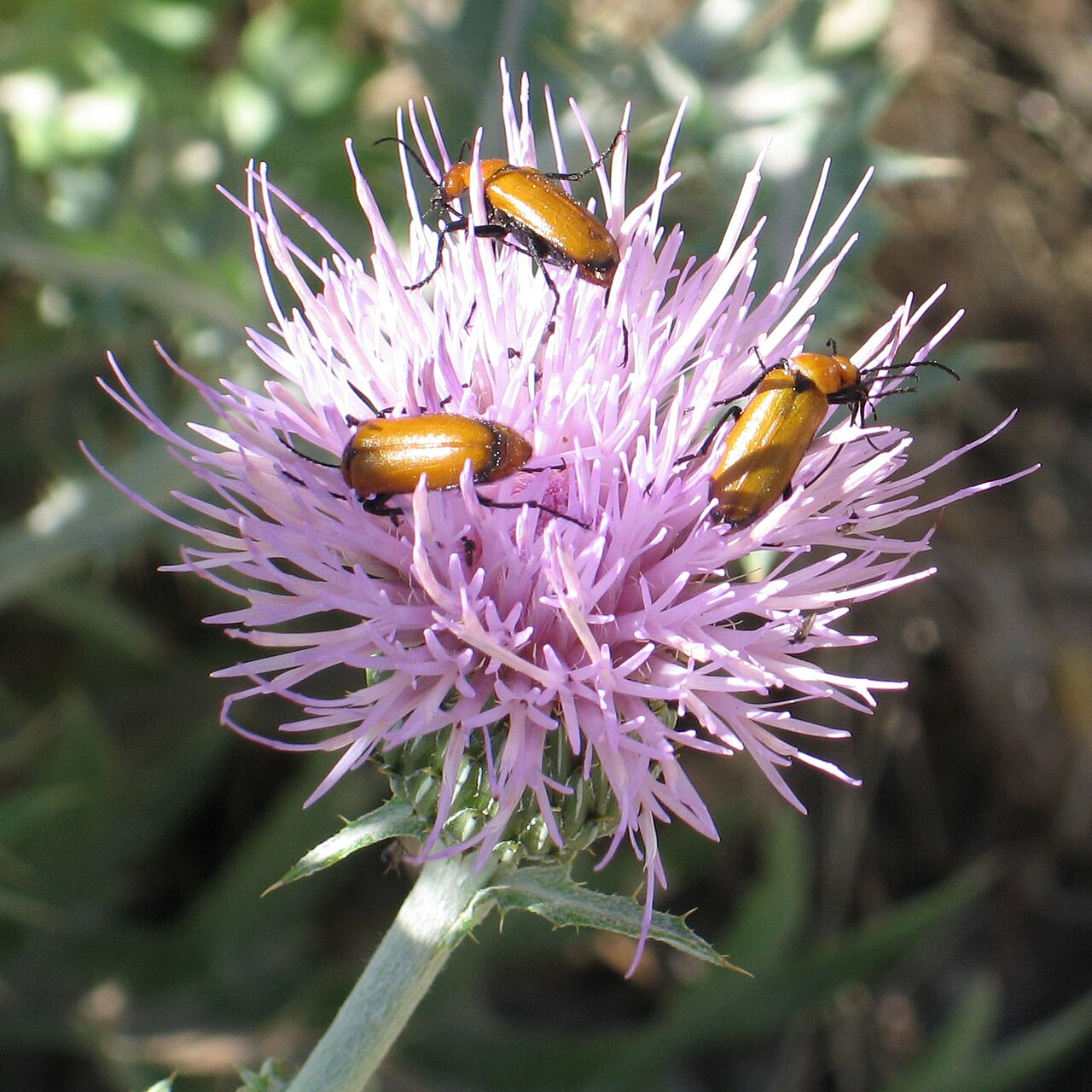
Cirsium undulatum, known as Wavyleaf Thistle or gray thistle, is a native thistle of the Great Plains and the interior West. It is a sturdy perennial, usually 1 to 3 feet tall, with silvery-gray, woolly leaves whose spiny edges are wavy and shallowly lobed. From late spring through summer it carries large, shaggy flower heads, 1 1/2 to 2 inches across, in shades of pale pink, lavender, rosy purple or nearly white.
Wavyleaf thistle grows from the southern Canadian prairies south through the Great Plains, the Rocky Mountains and the Great Basin to Texas, New Mexico and northern Mexico, and west to the dry steppe east of the Cascades. It is a normal part of healthy native grasslands and sagebrush steppe, where it usually grows as scattered plants rather than dense patches.
Native thistles like this one are often confused with invasive weeds such as Canada thistle and bull thistle and pulled or sprayed by mistake. In fact, wavyleaf thistle is a valuable wildflower: its flowers feed bees and butterflies, its seeds feed goldfinches, and it is a host plant for the painted lady butterfly.
Identification
Look for a gray-green, woolly thistle with wavy, spiny leaf edges, few to several large pale pink to lavender heads, and bracts with a sticky ridge down the back.
Growth Habit
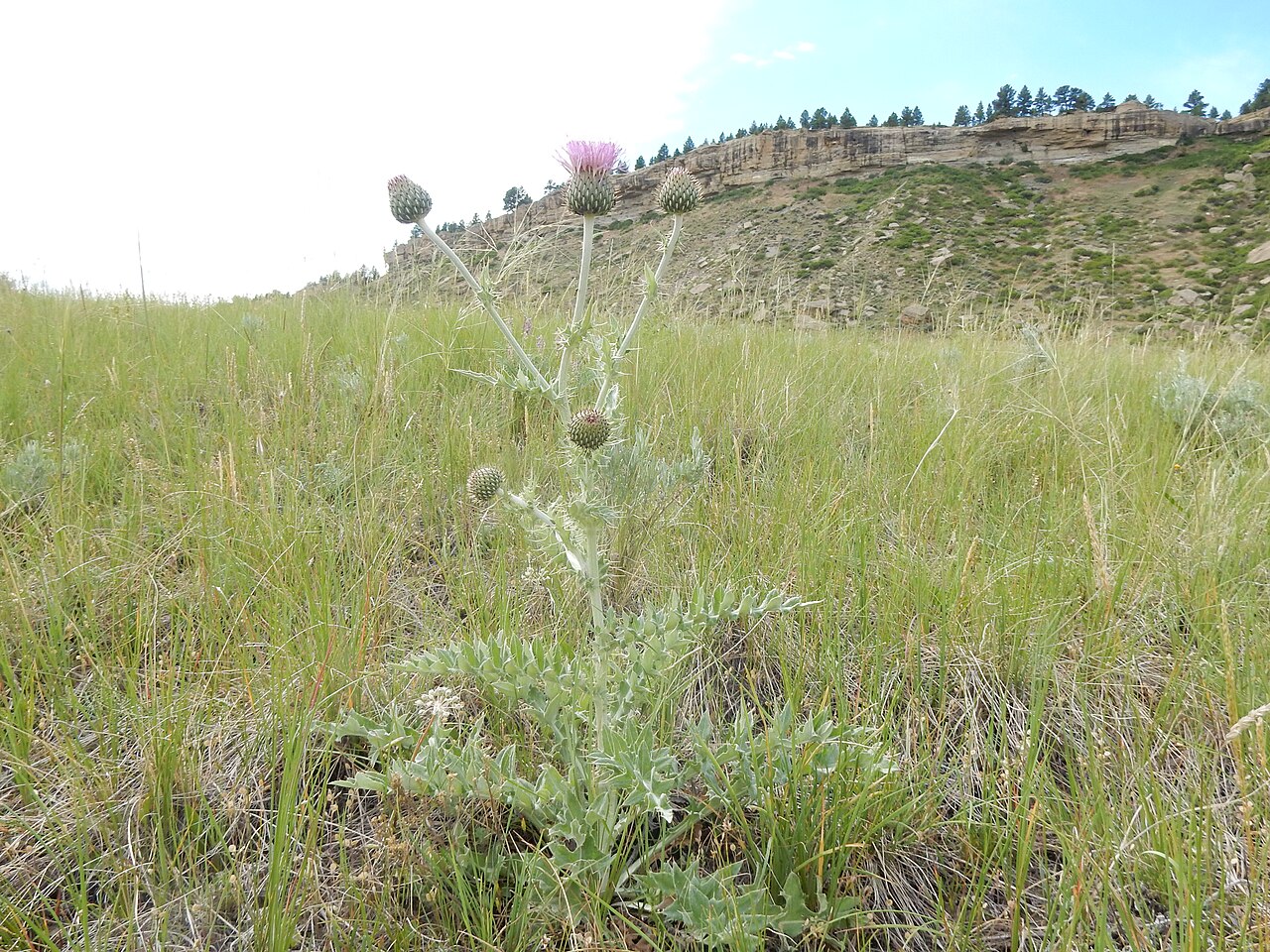
Wavyleaf thistle is a perennial with a deep taproot and spreading roots that can send up new shoots, so plants may form small groups. In its first year or two it forms a flat rosette of gray leaves; flowering stems follow, usually 1 to 3 feet tall and occasionally taller, and branch only a few times near the top.
Leaves
The leaves are covered with dense, white to gray wool, especially on the underside, which gives the whole plant a silvery look. They are lance-shaped, up to about 12 inches long at the base of the plant, with very wavy (undulate) edges that are shallowly to deeply lobed and tipped with yellowish spines. Stem leaves are smaller and only slightly run down the stem, so the stem is not strongly winged.
Flower Heads
The heads are 1 1/2 to 2 inches across and usually solitary at the ends of branches. Each is made of many tubular disk florets, pale pink, lavender or rosy purple, sometimes white. The bracts (phyllaries) around the base of the head are overlapping, spine-tipped, and have a pale, sticky (glutinous) ridge along the back, a good field mark. Bloom time is mostly June to August, starting earlier in the South.
Fruit
The seeds (achenes) are a few millimeters long and carry a long, feathery (plumose) pappus that carries them on the wind in late summer and fall.
Native vs. Invasive Thistles
Canada thistle (Cirsium arvense), an invasive weed from Eurasia, has much smaller (1/2 to 3/4 inch), numerous heads and green leaves, and spreads aggressively by creeping roots into dense patches. Bull thistle (Cirsium vulgare) has green, very spiny leaves whose bases run down the stem as spiny wings. Musk thistle (Carduus nutans) has nodding heads with broad, purple bracts. Native field thistle and Texas thistle have leaves that are green above and white below. Flodman's thistle (Cirsium flodmanii) of the northern plains is similar, but has more deeply cut leaves and spreads more by roots.
Quick Facts
| Scientific Name | Cirsium undulatum |
| Family | Asteraceae (aster family) |
| Plant Type | Herbaceous perennial thistle |
| Mature Height | 1–3 ft (occasionally to 4 ft) |
| Mature Spread | 1–2 ft |
| Growth Rate | Moderate |
| Sun Exposure | Full sun |
| Water Needs | Low; very drought tolerant |
| Soil Type | Well-drained sandy, loamy, gravelly or clay soils |
| Soil pH | Neutral to alkaline (about 6.5–8.5) |
| Bloom Time | May–September, mostly June–August |
| Flower Color | Pale pink, lavender or rosy purple; sometimes white |
| Fall Color | None; gray foliage |
| Fruit | Achenes with feathery white pappus |
| Deer Resistant | Yes; spiny foliage is rarely browsed |
| USDA Hardiness Zones | 3–8 |
Native Range
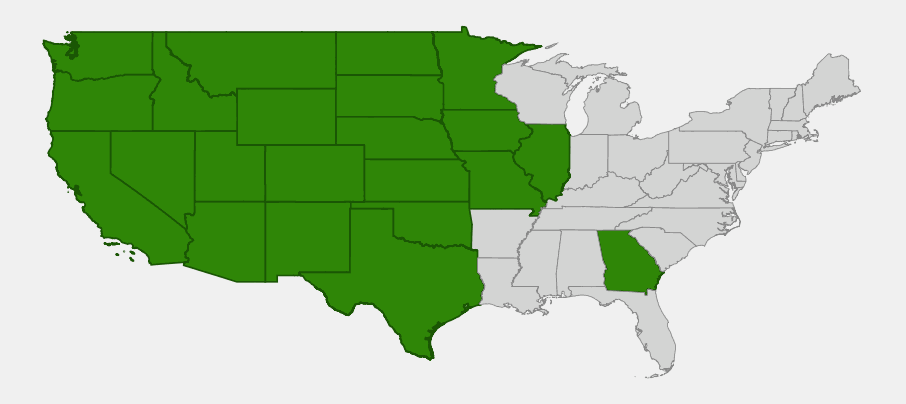
Wavyleaf thistle is native to central and western North America, from British Columbia, Alberta, Saskatchewan and Manitoba south to Texas, New Mexico, Arizona and northern Mexico. USDA PLANTS records it from 26 states. BONAP and NatureServe treat the scattered populations in Wisconsin, Michigan, Indiana and Pennsylvania as introduced, so those states are not shown on our map. The Georgia and Illinois records are outlying ones, and the species is rare at the eastern edge of its native range in western Iowa and Missouri.
The core of the range is the Great Plains from the Dakotas and western Minnesota to Nebraska, Kansas, western Oklahoma and the Texas Panhandle, plus the Rocky Mountain states, the Great Basin of Utah and Nevada, and the Colorado Plateau. In Washington, Oregon and Idaho it grows in the dry sagebrush steppe and grasslands east of the Cascades, and in California it is limited to the northeastern part of the state. In Texas it grows mainly in the Panhandle, the Rolling Plains and west to the Trans-Pecos, with scattered populations farther east.
It grows in prairies, plains grasslands, sagebrush steppe, pinyon-juniper woodland, open ponderosa pine forest, rocky slopes and road edges, from about 1,000 feet to over 9,000 feet in elevation.
📋 Regional plant lists featuring Wavyleaf Thistle: Idaho, Eastern Oregon & Eastern Washington · Montana & Wyoming · Michigan, Wisconsin & Eastern Minnesota · Nebraska, Kansas & Eastern Colorado · Utah & Western Colorado · Arizona & New Mexico · Illinois, Iowa & Missouri · South & West Texas · North Dakota, South Dakota & Western Minnesota · California & Nevada
Growing & Care Guide
Wavyleaf thistle is not a typical garden plant, but it is a good choice for prairie restorations, wildlife plantings and dry, sunny meadows within its native range, where its silvery foliage and large flowers can be appreciated.
Light
Full sun. It becomes weak and sparse in shade.
Soil & Water
Plant in well-drained, lean soil: sand, gravel, loam or clay. Rich, moist garden soil is not necessary and can make it floppy. Once established, its deep roots let it survive long droughts with no extra water.
Planting Tips
Sow seed in fall or plant young plants in spring, with plenty of space around them. Use it in a prairie or meadow with native grasses, or at the back of a dry, sunny wildlife bed where its spines will not catch passersby. Wear gloves when handling it.
Pruning & Maintenance
Little care is needed. Leave the seed heads for goldfinches and other birds, or cut them before they open fully if you want to limit self-seeding. Remove old stems in late winter.
Propagation
Grow it from seed collected as the heads turn fluffy in late summer. Sow in fall outdoors, or cold-moist stratify seed for several weeks before spring sowing. Because of the deep taproot, move only small plants.
Landscape Uses
- Prairie restoration: a native forb for dry grasslands and rangeland
- Wildlife gardens: nectar for bees and butterflies, seeds and nesting fluff for goldfinches
- Xeric landscapes: silvery foliage for dry, sunny spots
- Butterfly gardens: a larval host for the painted lady
- Deer-resistant plantings: spiny leaves are rarely browsed
Wildlife & Ecological Value
Native thistles are among the most important wildlife plants in western grasslands, and wavyleaf thistle is no exception.
For Pollinators
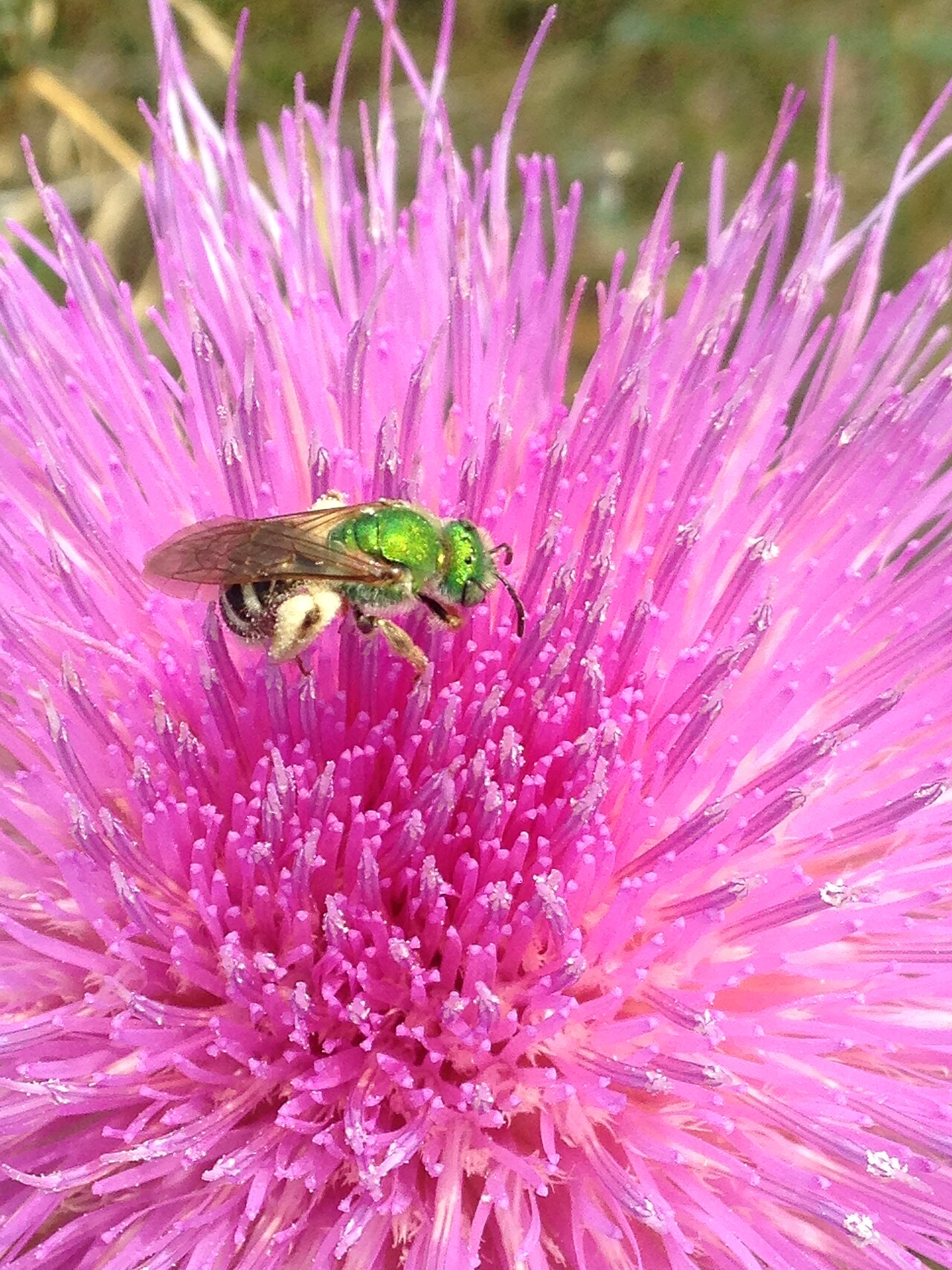
Bumble bees, long-horned bees, leafcutter bees, sweat bees and many butterflies visit the large flower heads for nectar and pollen. Thistles are larval host plants for the painted lady butterfly, and some native beetles and flies are specialists on native thistle heads.
For Birds
American goldfinches eat the seeds and line their late-summer nests with the thistle down. Other seed-eating birds, such as sparrows and finches, also feed on the seeds.
For Mammals
Its spines protect it from most grazing, though livestock and pronghorn may nibble young flower heads and the plant is sometimes grazed early in the season.
Ecosystem Role
Wavyleaf thistle supports a community of native insects, including specialized seed-feeding weevils and flies. A study in Colorado found that the European weevil Larinus planus, released to control Canada thistle, also attacks native thistles, including this species, and reduces their seed production. This is a cautionary example of how biological control can harm native plants.
Cultural & Historical Uses
The genus name Cirsium comes from the Greek kirsos, “swollen vein,” because thistles were once used to treat varicose veins. The species name undulatum means “wavy,” describing the leaf edges. Thomas Nuttall first described it in the early 1800s as Carduus undulatus.
Several Plains tribes and other peoples of the West peeled and ate the young stems and roots of native thistles as a food, and used them in traditional medicine. These uses depended on careful identification and preparation, and the plant is not recommended as a food today.
Many people treat all thistles as weeds, but most invasive thistles are introduced species from Europe and Asia. Native thistles such as wavyleaf thistle rarely become weedy in healthy grasslands, and conservation groups encourage landowners to learn to tell them apart and to spare the native ones.
Frequently Asked Questions
Is wavyleaf thistle a noxious weed?
No. It is a native wildflower, and it is not the target of federal noxious weed laws. Weed control efforts are aimed at introduced thistles such as Canada, bull and musk thistle, but native thistles are sometimes destroyed by mistake.
How can I tell wavyleaf thistle from Canada thistle?
Wavyleaf thistle has gray, woolly leaves with wavy spiny edges and a few large heads 1 1/2 to 2 inches across. Canada thistle has green leaves and many small heads under an inch across, and it forms dense patches.
Does wavyleaf thistle spread aggressively?
Not usually. It grows as scattered plants or small groups in native grasslands. It can increase on heavily overgrazed or disturbed land, but it does not form the dense colonies typical of Canada thistle.
What wildlife uses wavyleaf thistle?
Bees and butterflies visit the flowers, painted lady caterpillars feed on the leaves, and goldfinches eat the seeds and use the down in their nests.
Is wavyleaf thistle native east of the Mississippi?
Mostly no. A few records from Illinois and Georgia are outlying ones, and populations in Wisconsin, Michigan, Indiana and Pennsylvania are considered introduced.

Looking for a nursery that carries Wavyleaf Thistle?
Browse our native plant nursery directory: Arizona · California · Colorado & Georgia · Idaho, Illinois, Iowa & Kansas · Minnesota, Missouri & Montana · Nebraska, Nevada, New Mexico, North Dakota & Oklahoma · Oregon · South Dakota, Texas & Utah · Washington · Wyoming