
Striped Coralroot (Corallorhiza striata)
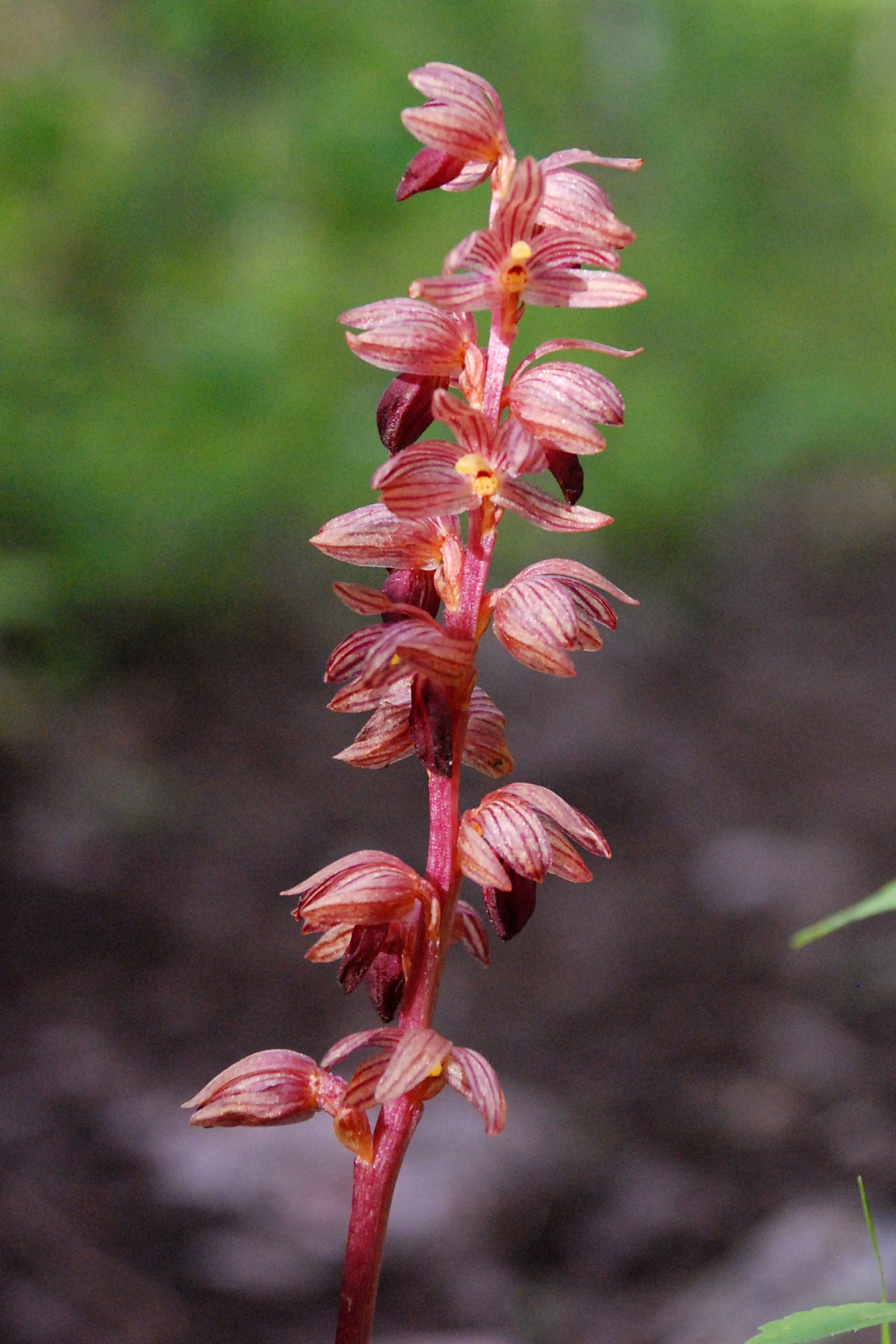
Corallorhiza striata, known as Striped Coralroot or hooded coralroot, is a leafless native orchid with some of the showiest flowers of any coralroot. In late spring and early summer it sends up a pinkish to reddish-purple stalk, 6 to 20 inches tall, carrying up to about 30 nodding flowers that are pale pink, cream or yellowish and boldly striped with dark red or purple.
Striped coralroot has no green leaves and makes little or no food by photosynthesis. Instead it is mycoheterotrophic: it gets its sugars from fungi in the soil, mainly species that also form partnerships with the roots of forest trees. Below ground it lives as a branched, coral-like rhizome, and in some years it does not flower at all.
It grows in shady coniferous and mixed forests across southern Canada and the western United States, with outlying populations around the Great Lakes and in New York. It cannot be grown from nursery stock or transplanted, and it should never be dug up. This page is a guide to finding, identifying and appreciating it in the wild.
Identification
Look for a leafless, reddish orchid stalk in shady forest in late spring or early summer, with hanging, cup-shaped flowers striped lengthwise in dark red or purple.
Growth Habit
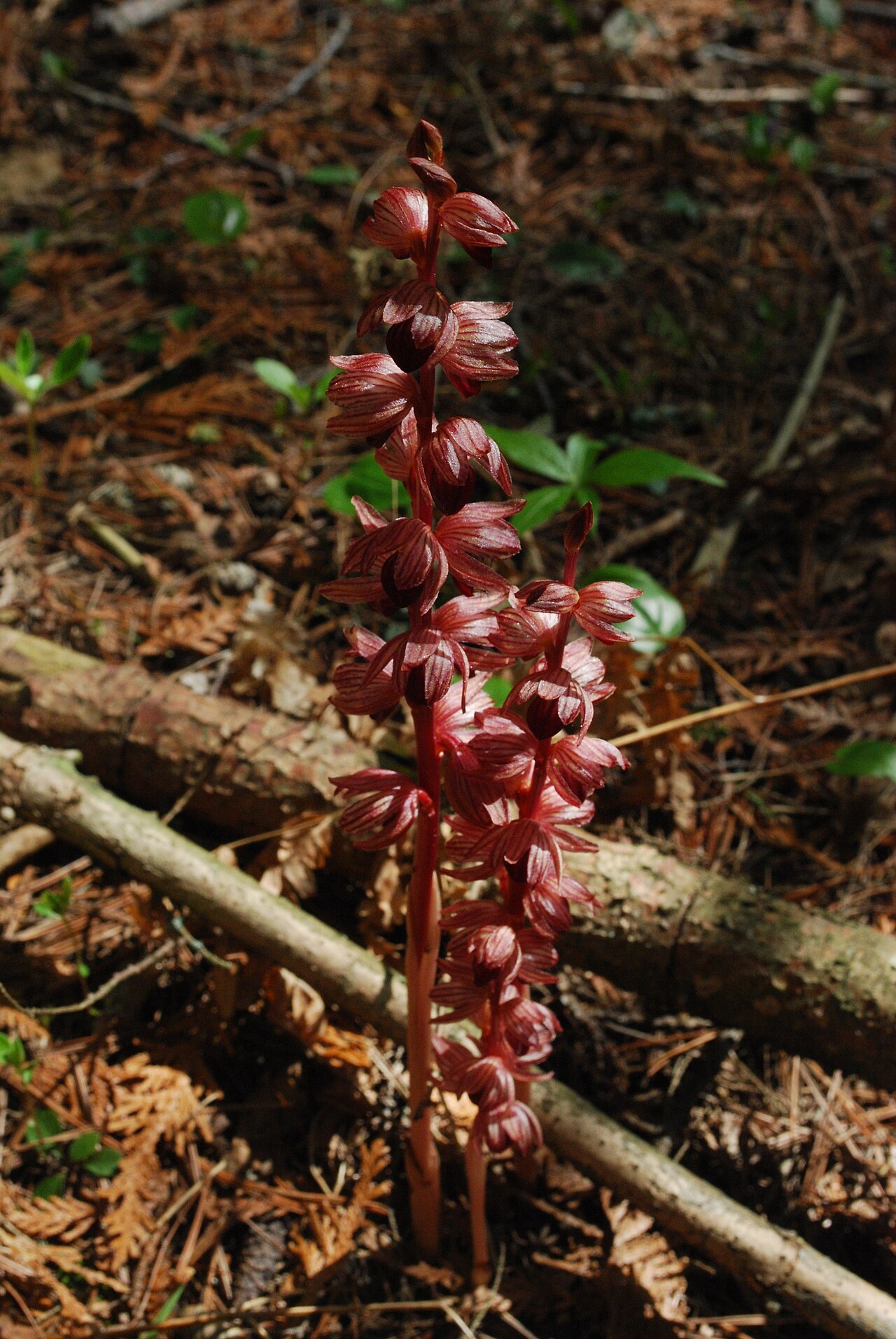
Each plant is a single, fleshy, leafless stalk 6 to 20 inches tall, sometimes up to about 2 feet, often in small clumps of several stems. The stems are pinkish, reddish or purplish, with a few papery, sheathing scales near the base instead of leaves. After seed is shed, the stalk turns brown and withers, but the underground rhizome persists for years.
Flowers
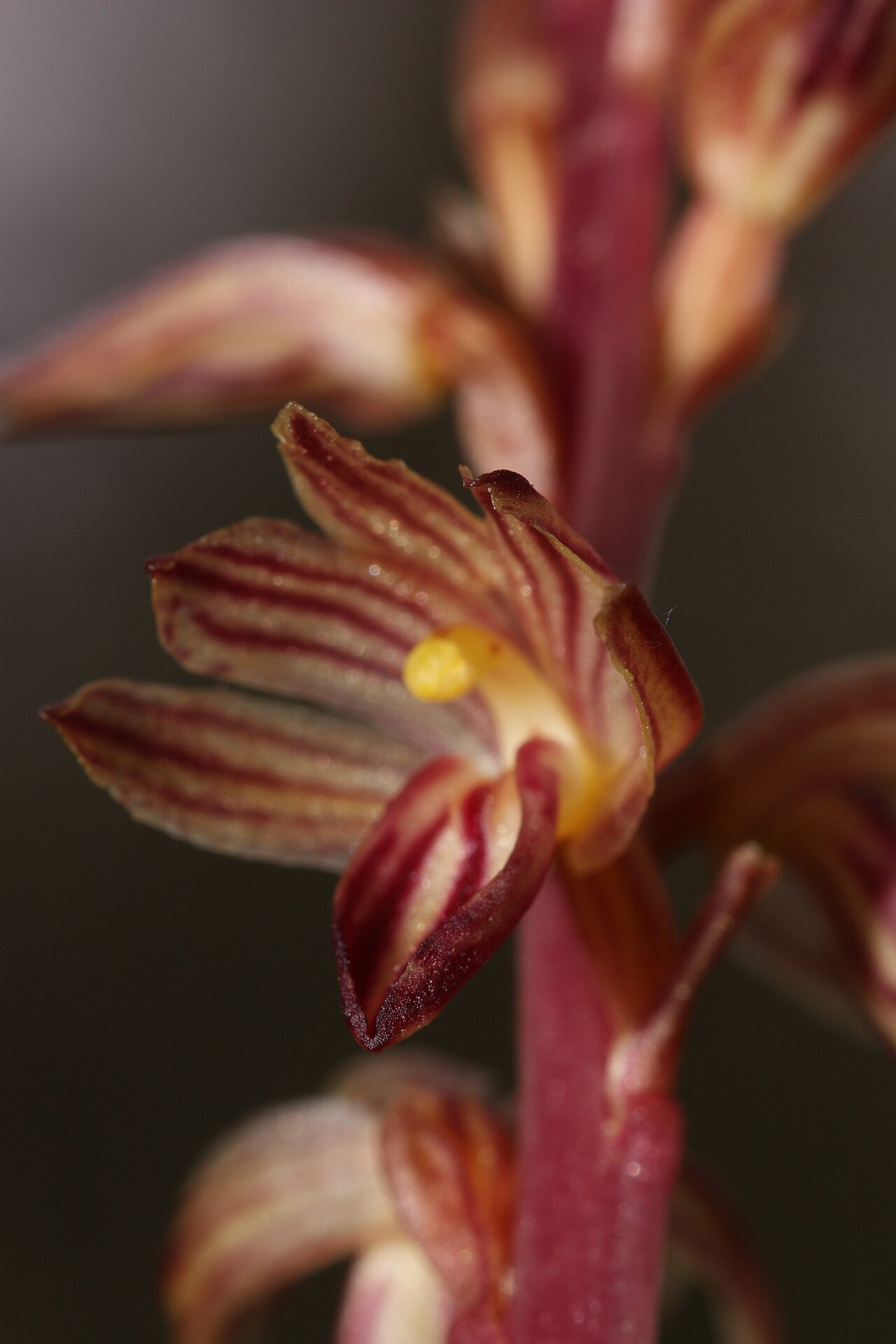
The flowers are about 3/4 to 1 1/4 inches long, larger than those of other coralroots. They hang or spread from the upper stalk in a loose spike of about 7 to 30. The three sepals and two side petals are pale pink, salmon, cream or yellowish with three to five bold, dark red or purple stripes. The lip is tongue-shaped, cupped and usually so heavily striped that it looks solid dark red. The upper sepal and petals curve forward over the column like a hood, which explains the name hooded coralroot.
Bloom Time
Flowering runs from about May to July, starting earliest at low elevations and in the south and later in the mountains and the north.
Fruit
The flowers are followed by drooping, oval capsules about 1/2 to 1 inch long, each holding thousands of dust-like seeds that are spread by the wind.
Varieties
Botanists recognize the typical variety, found across the north, and Vreeland's striped coralroot (var. vreelandii), with smaller, more widely spaced flowers, in the mountains of the West and Southwest. Rare pale forms lacking the red pigment, with yellow flowers and green-yellow stems, also turn up.
Look-alikes
Spotted coralroot (Corallorhiza maculata) has smaller flowers with a white lip dotted with purple spots, not stripes. Pacific coralroot (C. mertensiana) has a pinkish lip with a few dark veins and a chin-like spur at the base of each flower. Woodland pinedrops (Pterospora andromedea) is taller and sticky, with urn-shaped white flowers.
Quick Facts
| Scientific Name | Corallorhiza striata Lindl. |
| Family | Orchidaceae (orchid family) |
| Plant Type | Leafless mycoheterotrophic perennial orchid |
| Mature Height | 6–20 in (rarely to 24 in) |
| Mature Spread | Single stems or small clumps, 2–8 in |
| Growth Rate | Slow; flowering varies from year to year |
| Sun Exposure | Shade to part shade (does not need sunlight) |
| Water Needs | Medium; moist forest soils, often drying in summer |
| Soil Type | Humus-rich forest soil with needle and leaf litter; often over limestone |
| Soil pH | Slightly acidic to alkaline (about 6.0–8.0) |
| Bloom Time | May–July |
| Flower Color | Pale pink, salmon, cream or yellow with dark red to purple stripes |
| Fall Color | None |
| Fruit | Drooping oval capsules with dust-like seed |
| Deer Resistant | Unknown; rarely browsed |
| USDA Hardiness Zones | 3–8 (wild populations only; not cultivated) |
Native Range
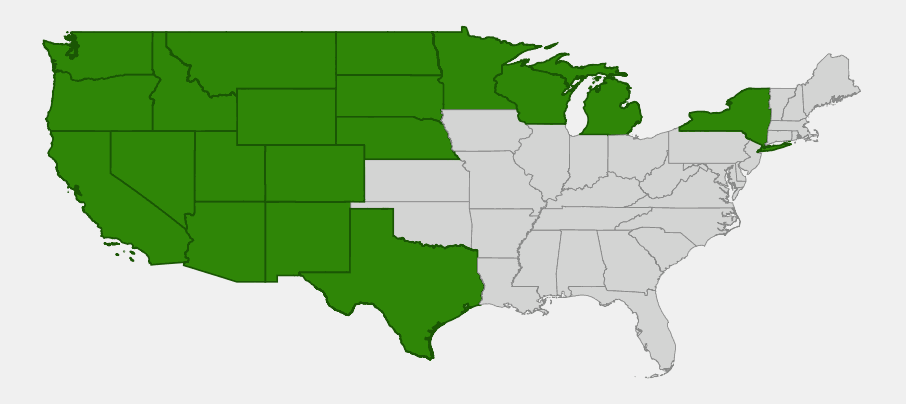
USDA PLANTS lists striped coralroot as native in 19 states. Its main range runs through the western mountains from Washington, Idaho and Montana south through Oregon, California, Nevada, Utah, Wyoming and Colorado to Arizona, New Mexico and the Guadalupe Mountains of far western Texas. It also grows in the Black Hills of South Dakota, the Pine Ridge of northwestern Nebraska and in North Dakota.
In the East it reaches Minnesota, Wisconsin and Michigan, with outlying populations in northern New York, most often in cool cedar and spruce woods on limestone. It is uncommon to rare at this eastern edge. In Canada it grows from British Columbia east across the prairie provinces, Ontario and Quebec to New Brunswick and Newfoundland, and it also extends into the mountains of Mexico.
It grows in shady, moist to fairly dry coniferous and mixed forests with deep litter, such as Douglas-fir, ponderosa pine, spruce, fir and northern white cedar woods, as well as aspen groves and wooded ravines, from near sea level in the north to about 9,500 feet in the southern Rockies.
📋 Regional plant lists featuring Striped Coralroot: New York, Pennsylvania & Northern New Jersey · Idaho, Eastern Oregon & Eastern Washington · Montana & Wyoming · Michigan, Wisconsin & Eastern Minnesota · Nebraska, Kansas & Eastern Colorado · Utah & Western Colorado · Delaware, Southern New Jersey & Long Island · Arizona & New Mexico · South & West Texas · North Dakota, South Dakota & Western Minnesota · California & Nevada
Can You Grow It?
No. Striped coralroot cannot be grown in gardens. No nursery propagates it, and plants that are dug up die, because they are cut off from the fungi that feed them. Never dig, transplant or buy wild-collected plants. The best way to enjoy it is to find it in the forest and protect its habitat.
Light
It does not need sunlight to grow. Look for it in shaded or dappled forest rather than open clearings. Its reddish stems stand out against brown needle litter once you know what to look for.
Soil & Water
It grows in humus-rich soil with a layer of needles, leaves and rotting wood, often over limestone. Flowering is heavier after a moist spring, and some plants skip flowering in dry years. Avoid trampling or compacting the forest floor where it grows.
Planting Tips
Do not try to plant, transplant or sow striped coralroot. If it grows on your land, protect the surrounding trees, logs and soil, since its fungal partners depend on living tree roots.
Pruning & Maintenance
None is needed. Do not pick the flowering stems; each one carries the plant’s seed crop for the year.
Propagation
It reproduces by dust-like seed, which can germinate only with the right fungus, and by slow branching of its rhizome. There is no practical way to propagate it. Keeping mature forests and their soils intact is the best way to help it.
Where to See It
- Mountain forest trails: often seen along shady trails in the Rockies, Cascades and Sierra Nevada in early summer
- Black Hills and Great Lakes woods: cedar and spruce forests in the Black Hills, Door County and northern Michigan
- Macro photography: the striped flowers are among the most photogenic of North American orchids
- Orchid study: a good introduction to the coralroots and other leafless orchids
- Forest ecology education: a vivid example of a plant fed by fungi linked to trees
Wildlife & Ecological Value
Striped coralroot is a visible sign of the hidden network of fungi that links trees and the forest floor.
For Pollinators
The flowers are visited and pollinated mainly by small wasps, especially ichneumon wasps, and some flies. Unlike some other coralroots, it relies largely on insects to set seed.
For Birds
Birds make little direct use of it.
For Mammals
Small mammals may occasionally nibble the stems. The fungi it depends on also produce mushrooms eaten by squirrels and other forest mammals.
Ecosystem Role
By drawing carbon from fungi that are partnered with trees, striped coralroot taps into the underground network that links forest plants. Its presence points to healthy, intact forest soil with an active community of mycorrhizal fungi.
Cultural & Historical Uses
The genus name Corallorhiza means “coral root,” for the branched, coral-like rhizome. The species name striata means “striped,” for the bold lines on the flowers. John Lindley, one of the leading orchid botanists of the nineteenth century, described the species in 1840.
Coralroots were long called saprophytes, as if they fed on decaying matter. Research has since shown that they get their food from living fungi. Studies of striped coralroot found that it partners mainly with fungi in the family Thelephoraceae, which also form mycorrhizae with conifers, so the orchid ultimately draws on sugars made by nearby trees.
Because it cannot be cultivated, every striped coralroot you see is a wild plant. Leave it where it grows, and share photos instead of stems. Other plants on this site that live the same way include Pacific Coralroot, Woodland Pinedrops and Indian Pipe.
Frequently Asked Questions
Can I grow striped coralroot in my garden?
No. It depends entirely on specific soil fungi that are linked to living trees, so it cannot be grown from nursery stock, and dug-up plants die. Enjoy it in the wild and never dig it up.
Why does striped coralroot have no leaves?
It is mycoheterotrophic: it gets its food from fungi in the soil instead of making it through photosynthesis, so it does not need green leaves.
How do I tell striped coralroot from spotted coralroot?
Striped coralroot has larger flowers with bold dark stripes on all the petals and a solid-looking dark red lip. Spotted coralroot has smaller flowers with a white lip dotted with purple spots.
When does striped coralroot bloom?
From about May to July, depending on elevation and latitude.
Where can I see striped coralroot?
In shady conifer and mixed forests of the western mountains, the Black Hills and the northern Great Lakes region, from British Columbia and Washington to Arizona, New Mexico and far west Texas, and east to Michigan and northern New York.

Looking for a nursery that carries Striped Coralroot?
Browse our native plant nursery directory: Arizona · California · Colorado · Idaho · Michigan, Minnesota & Montana · Nebraska, Nevada, New Mexico, New York & North Dakota · Oregon · South Dakota, Texas & Utah · Washington · Wisconsin & Wyoming