
Little Prince’s Pine (Chimaphila menziesii)
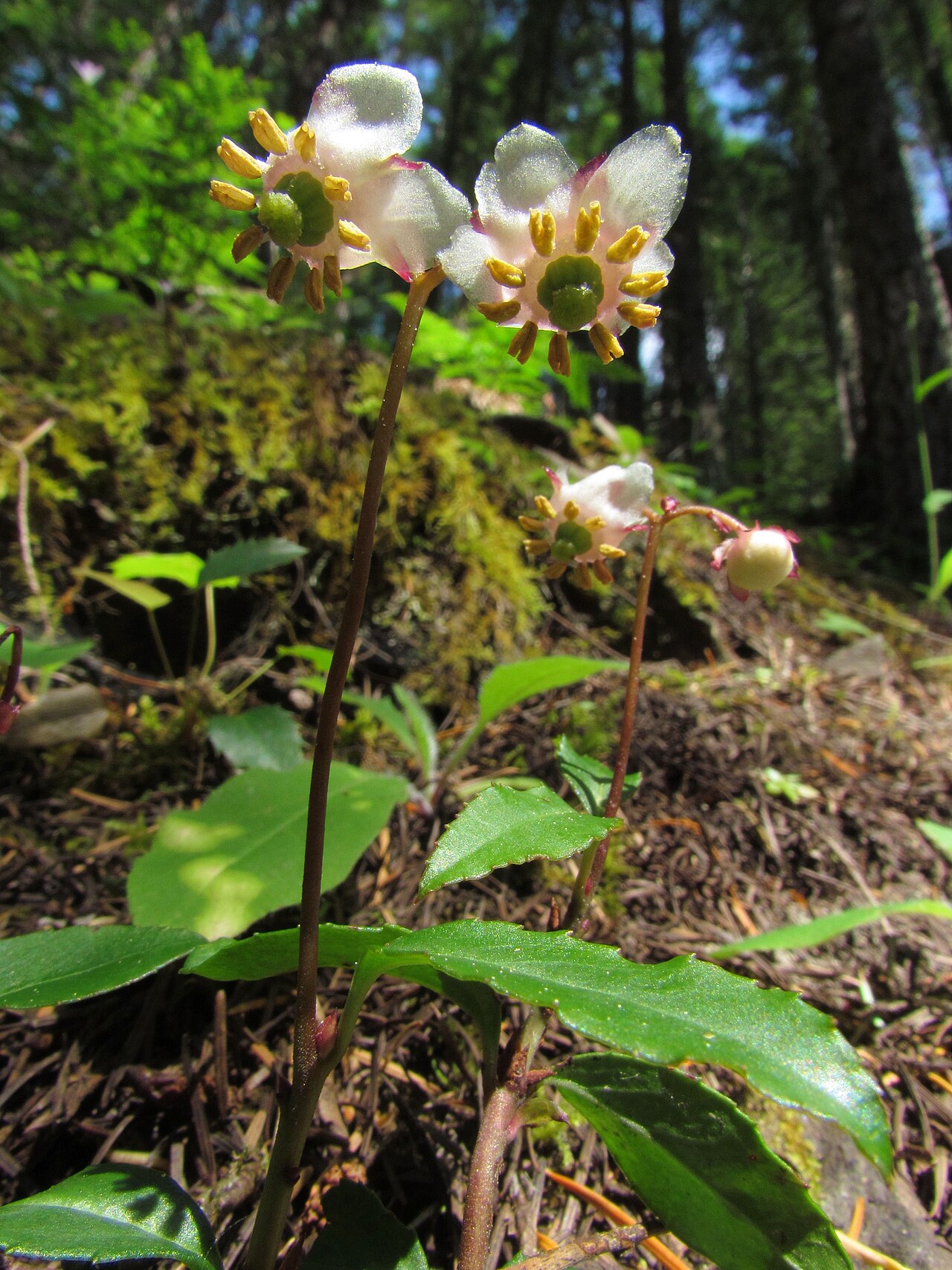
Chimaphila menziesii, known as Little Prince’s Pine, little pipsissewa or Menzies’ wintergreen, is a tiny evergreen subshrub of the shady conifer forests of western North America. Its slender, reddish stems rarely reach 6 inches tall. They carry a few leathery, dark green, finely toothed leaves and, in summer, one to three nodding, waxy flowers that are white to pale pink. It belongs to the heath family (Ericaceae), in the group of wintergreens once placed in their own family, Pyrolaceae.
It is a smaller, more delicate relative of pipsissewa (Chimaphila umbellata), with which it often grows. Like other wintergreens, it lives in close partnership with soil fungi that also connect to the roots of surrounding trees, and it obtains part of its nutrition through them. That partnership ties it firmly to intact forest floors.
Little prince’s pine is not a garden plant. It is not offered by nurseries, it depends on fungal partners in undisturbed forest soil, and dug plants almost never survive. Never dig it from the wild. This page is a guide to identifying and appreciating it where it grows: how to tell it from its relatives, where to look for it, and what it tells you about the forest around it.
Identification
Little prince’s pine is easy to overlook: it is often only 2 to 5 inches tall and grows scattered among moss, needles and other small plants. Once you notice its nodding waxy flowers or its narrow, toothed evergreen leaves, it is distinctive.
Stems & Growth Habit
Plants spread slowly by thin, creeping underground stems in the duff and upper soil. Short upright stems rise at intervals, usually 2 to 6 inches tall, woody at the base and often reddish. A plant may be a single stem or a small, loose patch of stems connected underground.
Leaves
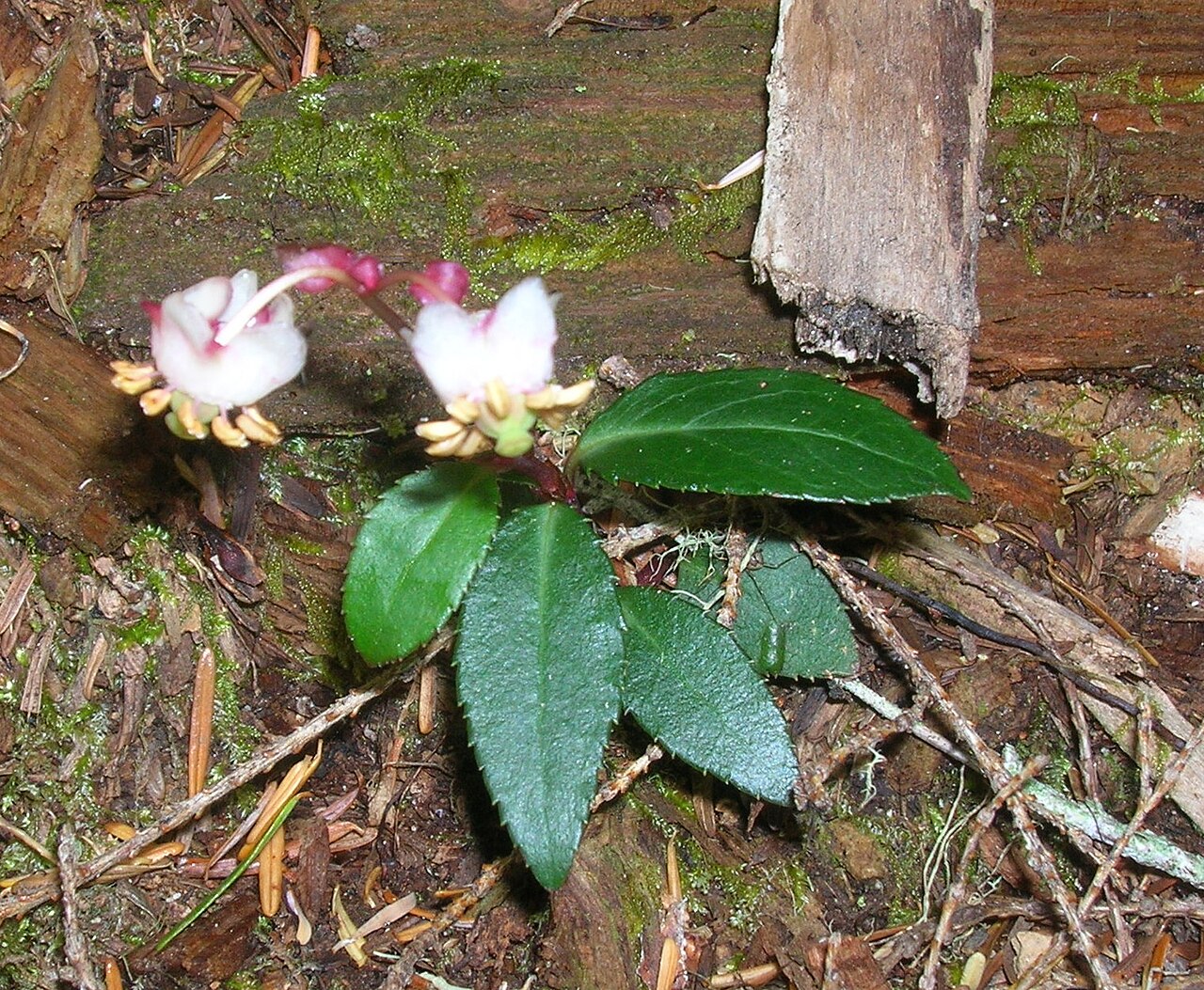
The leaves are few, alternate or loosely clustered in near-whorls along the stem, lance-shaped to elliptic and about ¾ to 2½ inches long. They are leathery, dark green and often bluish or bronze-tinged, with small, widely spaced teeth along the edges. The veins are frequently paler than the rest of the blade, giving some leaves a faintly mottled look, especially on young plants. The leaves stay green through winter.
Flowers
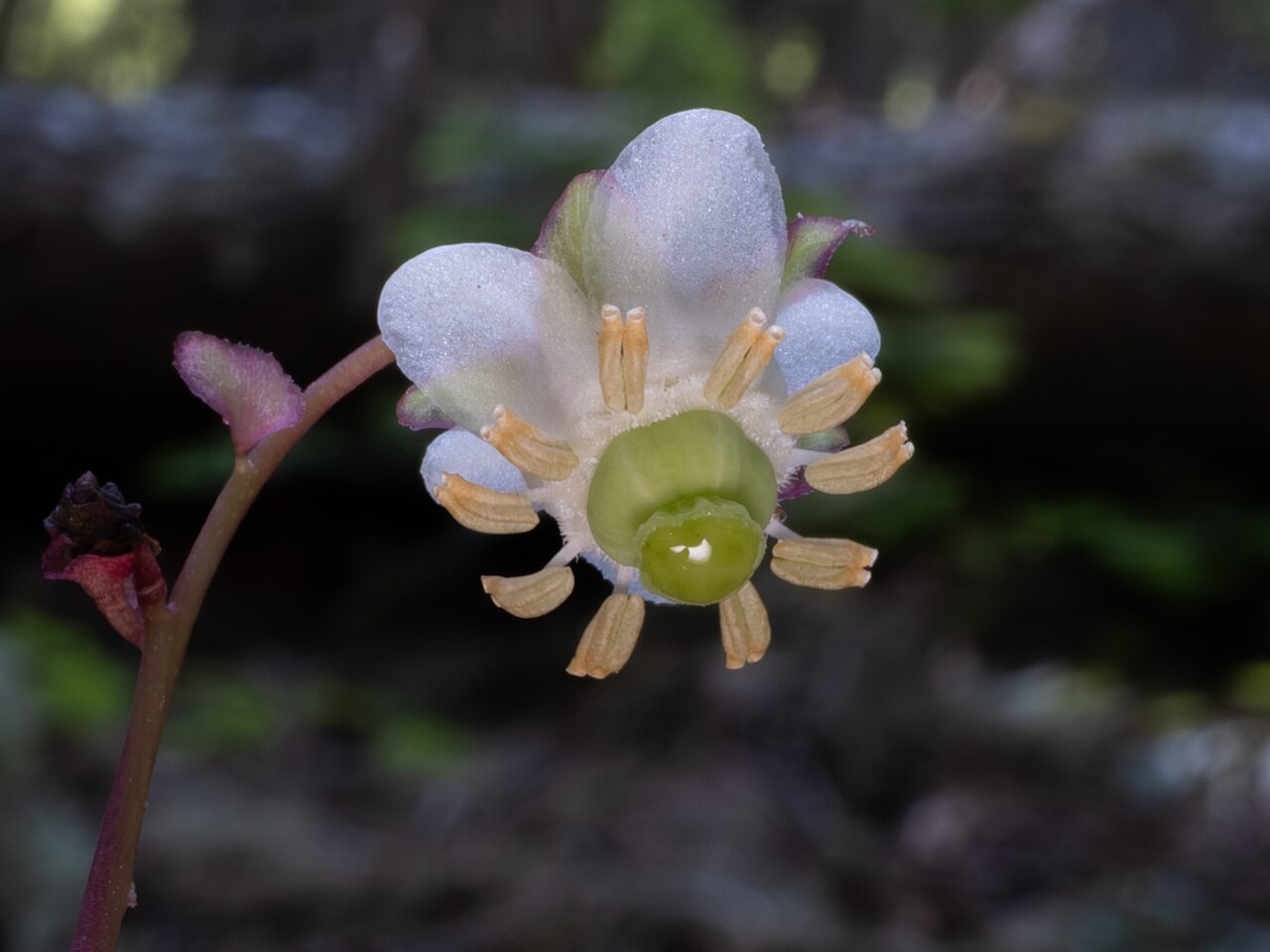
From about June to August, a slender reddish stalk rises above the leaves and carries one to three nodding flowers on long, curved stalks. Each flower is about ½ inch across, with five rounded, waxy petals that are white to pinkish and spread flat or curve back. In the center a broad, green, button-like stigma sits on a plump ovary, surrounded by a ring of ten stamens with swollen filament bases and large anthers that open by pores.
Fruit & Seeds
After flowering the stalks turn upright and each flower becomes a round, five-parted capsule about ¼ inch across. The capsules dry to brown and split to release very large numbers of dust-fine seeds that carry little stored food. Like orchid seeds, they depend on contact with suitable soil fungi to establish.
Look-alikes
Pipsissewa (Chimaphila umbellata) is larger, with glossy leaves that are widest above the middle, sharply toothed toward the tip, arranged in distinct whorls, and usually 4 or more flowers in a cluster. Little prince’s pine has narrower, lance-shaped leaves widest near or below the middle and only one to three flowers. In the East, striped wintergreen (Chimaphila maculata) has boldly white-striped leaves, but it does not grow in the West. Young little prince’s pine plants with pale veins are sometimes mistaken for it in photographs. Western rattlesnake plantain has a flat rosette of white-veined leaves and a spike of small white orchid flowers.
Quick Facts
| Scientific Name | Chimaphila menziesii |
| Family | Ericaceae (heath family); formerly Pyrolaceae |
| Plant Type | Small evergreen subshrub spreading by rhizomes; mycorrhiza-dependent |
| Mature Height | 2–6 in |
| Mature Spread | 2–8 in; scattered stems or small, loose patches |
| Growth Rate | Very slow |
| Sun Exposure | Part shade to full shade |
| Water Needs | Low to medium; dry to moist forest duff |
| Soil Type | Acidic forest duff and well-drained loam, sand or rocky soil under conifers |
| Soil pH | Acidic (about 4.5–6.0) |
| Bloom Time | June–August |
| Flower Color | White to pale pink |
| Fall Color | None; evergreen |
| Fruit | Round brown capsule with dust-like seeds |
| Deer Resistant | Not well documented; too small to be an important browse plant |
| USDA Hardiness Zones | 5–9 (wild habitat; not grown in gardens) |
Native Range
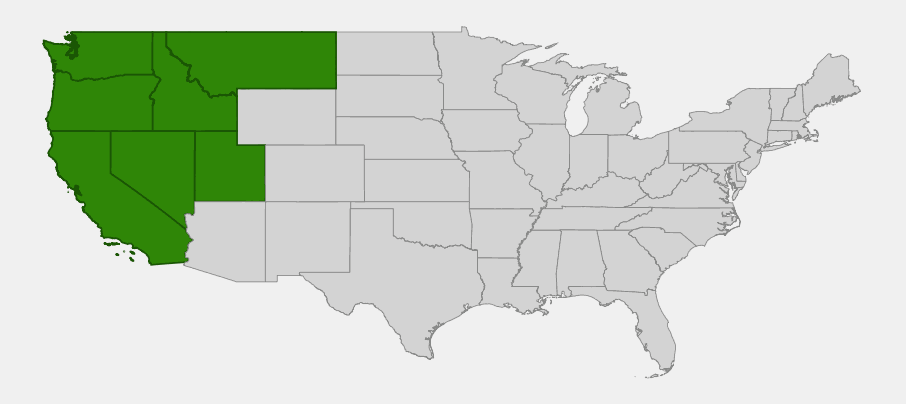
Little prince’s pine is a plant of the Pacific slope and the northern Rockies. In Canada it grows in southern British Columbia, including Vancouver Island. In the United States, USDA PLANTS records it as native in Washington, Oregon, California, Idaho, Montana, Nevada and Utah. It is most common in the Cascades, the Olympic Mountains, the Coast Ranges and the Klamath-Siskiyou region of Washington, Oregon and northern California.
From there it extends south through the Sierra Nevada and the higher Coast Ranges to the mountains of southern California, where it becomes scattered and local. East of the Cascades it grows in the moist conifer forests of northern and central Idaho and in western Montana, especially the Bitterroot and Clark Fork drainages. In Nevada it is limited to the forests of the Carson Range near Lake Tahoe, an extension of its Sierra Nevada range. The Utah record is an outlying one: the plant is very rarely reported there and is not part of the state’s regular forest flora.
Throughout its range it grows in shady, mature or older conifer forests: Douglas-fir, western hemlock, grand fir, white fir and red fir, mixed conifer and pine forests, often on slopes with a deep layer of needles and decaying wood. It ranges from lowland forests in the Puget Sound region to montane forests in the Sierra Nevada. It is usually scattered rather than abundant, and colonies are often small.
📋 Regional plant lists featuring Little Prince’s Pine: Montana & Wyoming · Utah & Western Colorado · Western Oregon & Western Washington · California & Nevada
Can You Grow It?
Realistically, no. Little prince’s pine is not sold by nurseries, there are no reliable methods for propagating it, and it depends on mycorrhizal fungi that link it to the trees of an established forest. Plants dug from the wild almost always die, and digging damages the forest floor where they grew. The best way to have it on your land is to own, or protect, a piece of mature conifer forest where it already grows.
Light
In the wild it grows in shade to dappled light under a closed or partly open conifer canopy. Opening the canopy sharply by heavy thinning or clearing usually leads to its decline.
Soil & Water
It needs undisturbed, acidic forest soil with an intact layer of needle duff, decaying wood and the fungal network that runs through it. It tolerates the dry summers typical of the West once established, but cannot be grown in ordinary garden soil, compost or potting mix.
Planting Tips
Do not plant or transplant it. If you have a wooded property where it grows, the most helpful actions are to leave needles, fallen branches and logs in place, avoid compacting the soil with paths or vehicles, and keep the trees that shade it.
Pruning & Maintenance
None. On forested land, avoid raking, scraping or burning slash piles where it grows. Keep invasive groundcovers such as English ivy and periwinkle out of the woods, since they smother small native plants of the forest floor.
Propagation
There is no practical propagation method for home growers. The seed is dust-fine and needs specific fungi to germinate, and divisions removed from their fungal partners rarely survive. Leave wild plants and seed alone.
Where to See It
- National parks and forests: Mount Rainier and Olympic national parks, and many national forests in the Cascades, Klamath Mountains and Sierra Nevada, have the old conifer forest it needs
- Old-growth trails: look along shady trails through older Douglas-fir, hemlock and fir forest in midsummer
- Idaho and western Montana forests: moist conifer forests of northern Idaho and the Bitterroot Valley
- Lake Tahoe basin: mixed conifer forests on the Nevada and California sides of the lake
- Woodland property: protect existing plants on forested land rather than trying to add new ones
Wildlife & Ecological Value
Little prince’s pine is small, but it belongs to a web of trees, fungi and insects on the forest floor. Its presence usually indicates a forest with intact soil and a long history of continuous tree cover.
For Pollinators
The nodding flowers are visited mainly by bumblebees, which hang beneath them and vibrate their flight muscles to shake pollen out of the pored anthers, a technique called buzz pollination that is common in the heath family. Small bees and flies may also visit.
For Birds
Little prince’s pine is not a significant bird food. Ground-foraging forest birds such as grouse, thrushes and juncos feed in the same needle-covered understory.
For Mammals
Its small size makes it a minor food plant. Deer and elk may occasionally nibble the evergreen leaves, especially in winter.
Ecosystem Role
Like pipsissewa and other wintergreens, little prince’s pine forms mycorrhizal partnerships with fungi that are also connected to nearby conifers. Research on these plants indicates that they obtain part of their carbon from the shared fungal network in addition to their own photosynthesis, a strategy called partial mycoheterotrophy. This is one reason the plant persists in deep shade, and why it disappears where the forest floor is scraped, compacted or severely burned. Its creeping underground stems may survive light ground fires, but severe fires that consume the duff layer remove it.
Cultural & Historical Uses
The species is named for Archibald Menzies (1754–1842), the Scottish surgeon and naturalist on George Vancouver’s voyage to the Pacific Northwest in the 1790s, who collected many of the region’s plants for the first time. Douglas-fir, Pseudotsuga menziesii, honors the same man. The genus name Chimaphila comes from the Greek cheima (winter) and philos (loving), for the evergreen leaves.
The common names little pipsissewa and little prince’s pine borrow from its larger relative. “Pipsissewa” is usually traced to a Cree word meaning roughly “it breaks into small pieces,” from the use of these plants to treat kidney stones. Several western Indigenous peoples used Chimaphila species medicinally, though most recorded uses refer to the more common pipsissewa. Safety note: Chimaphila leaves contain arbutin and related compounds that can be harmful in large or long-term doses and can irritate the skin. Do not use it as a medicine or tea.
Today little prince’s pine is valued mostly by hikers, botanists and photographers, as one of the small rewards of a walk through old western forest. Because it grows slowly and only in undisturbed forest soil, the best thing anyone can do for it is to leave it where it is and support the protection of mature forests.
Frequently Asked Questions
Can I grow little prince’s pine in my garden?
Not realistically. It is not sold by nurseries, it depends on specific soil fungi connected to forest trees, and transplanted plants almost always die. Enjoy it in the wild and protect it where it grows on your land.
How is little prince’s pine different from pipsissewa?
It is smaller and more delicate. Little prince’s pine has narrow, lance-shaped leaves with small, widely spaced teeth and only one to three flowers. Pipsissewa has glossy leaves widest toward the tip, sharply toothed and arranged in whorls, with a cluster of four or more flowers.
Is little prince’s pine poisonous?
It is not considered highly toxic, but like pipsissewa its leaves contain arbutin, which can be harmful in large or repeated doses, and the leaves can irritate skin. Do not eat it or use it as a medicine.
Is little prince’s pine a parasite?
No. It has green leaves and photosynthesizes, but it also gets part of its carbon from mycorrhizal fungi shared with nearby trees. That makes it partly dependent on the forest around it, which is why it cannot be moved.
When and where can I see it in flower?
Look from June to August in shady, older conifer forests from British Columbia south through Washington, Oregon and northern California, and in the Sierra Nevada, northern Idaho and western Montana. The evergreen leaves can be found year-round.

Looking for a nursery that carries Little Prince’s Pine?
Browse our native plant nursery directory: California · Idaho · Montana · Nevada · Oregon · Utah · Washington
