
Hairy Skullcap (Scutellaria elliptica)
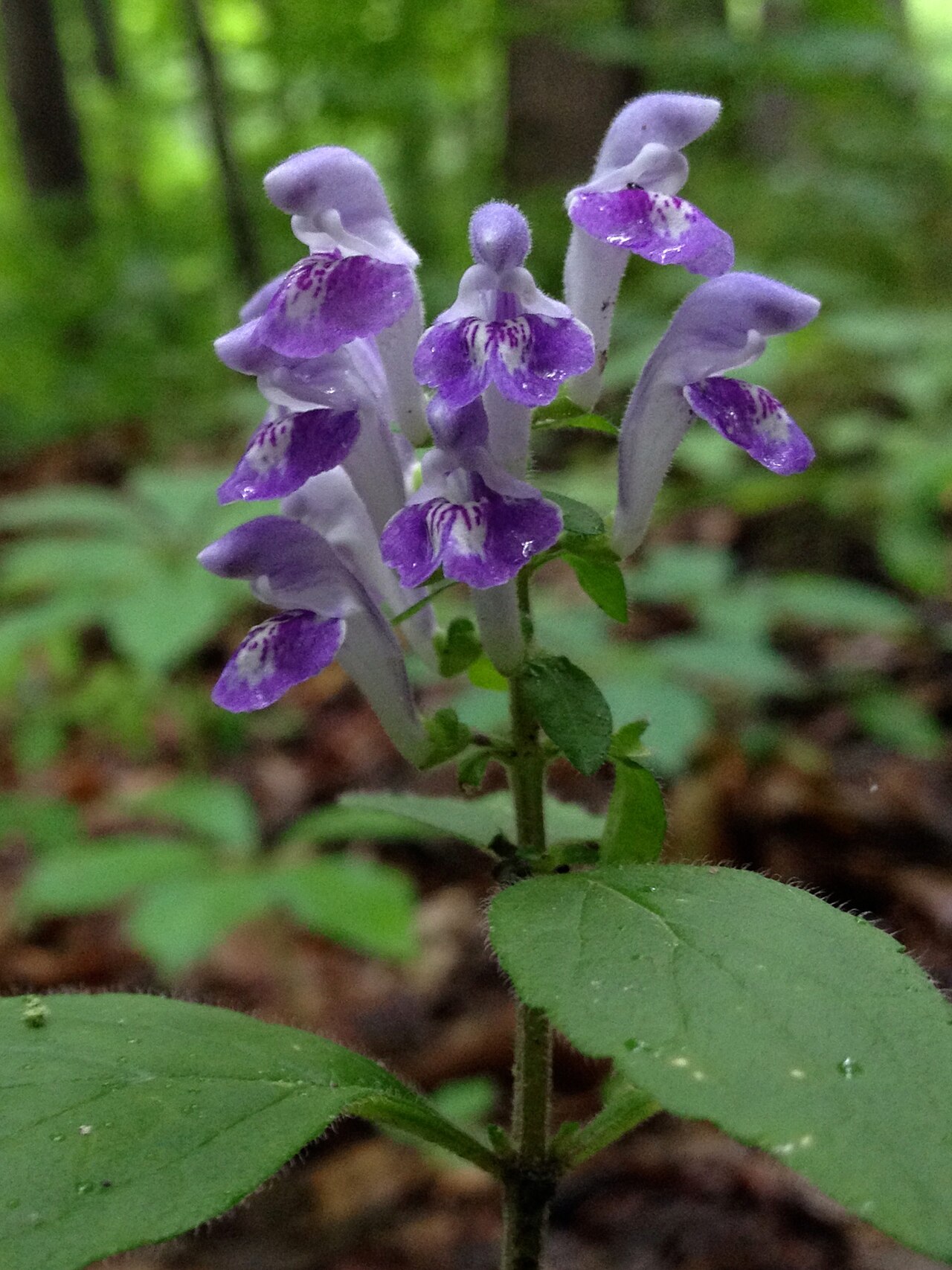
Scutellaria elliptica, known as Hairy Skullcap, is a woodland wildflower of the eastern and southern United States and a member of the mint family (Lamiaceae). It is one of the most widespread skullcaps of dry, open forests, growing from New York and Michigan south to northern Florida and west to Oklahoma and East Texas.
In late spring and early summer it raises short spikes of two-lipped, blue-violet flowers above pairs of soft, oval, round-toothed leaves. As the name says, the whole plant is hairy: stems, leaves and the small calyx cups are covered in fine hairs, and on many plants the hairs are tipped with tiny glands. Like other skullcaps it has a little raised crest on top of the calyx, the “skullcap” or “helmet” that gives the genus its name.
Hairy skullcap is a plant of dry to moderately moist oak and oak-pine woods, rocky slopes and woodland edges, usually in partial shade. It is a modest but charming plant for woodland gardens, where it blooms after the spring ephemerals have faded and feeds bumblebees and other long-tongued bees.
Identification
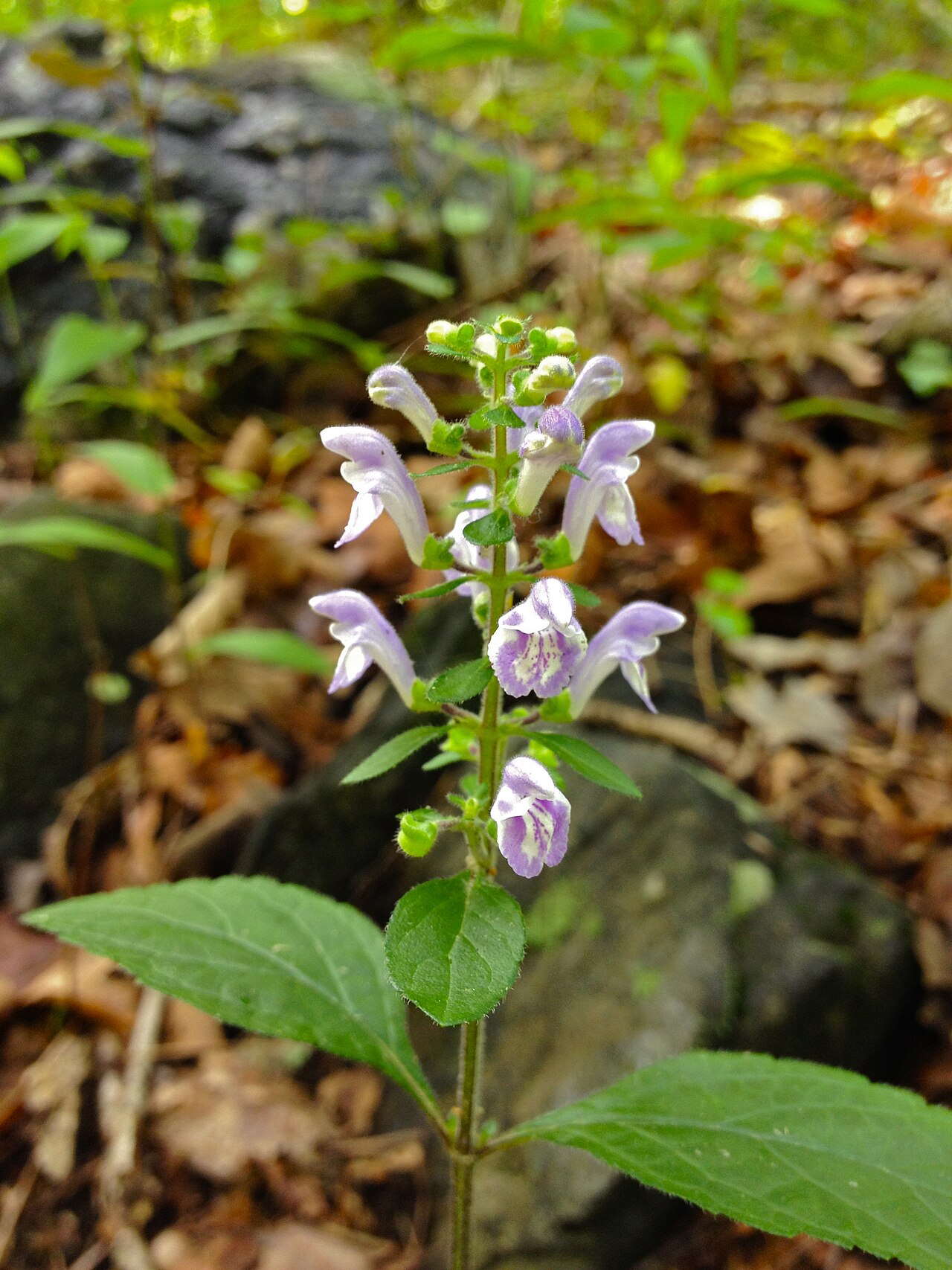
Look for a single, square, hairy stem 1 to 2 feet tall with paired, oval, scalloped leaves and a short spike of blue-violet, hooded flowers at the top in May to July.
Growth Habit
Hairy skullcap is a perennial forb that grows from slender rhizomes, so it often appears as small groups of stems. Each stem is usually unbranched or branched only near the top, square in cross-section as in most mints, and 6 inches to about 2 1/2 feet tall. The stems are densely hairy; in the common variety the hairs are spreading and often gland-tipped, while in var. hirsuta they are short and curved.
Leaves
The leaves are opposite, on short stalks, and elliptic to diamond-shaped or broadly oval, about 1 to 3 inches long and 1/2 to 1 1/2 inches wide. The edges have rounded, scalloped teeth, and both surfaces are soft-hairy. The leaves are largest near the middle of the stem and become smaller toward the flower spike. The lower leaves are not heart-shaped at the base.
Flowers
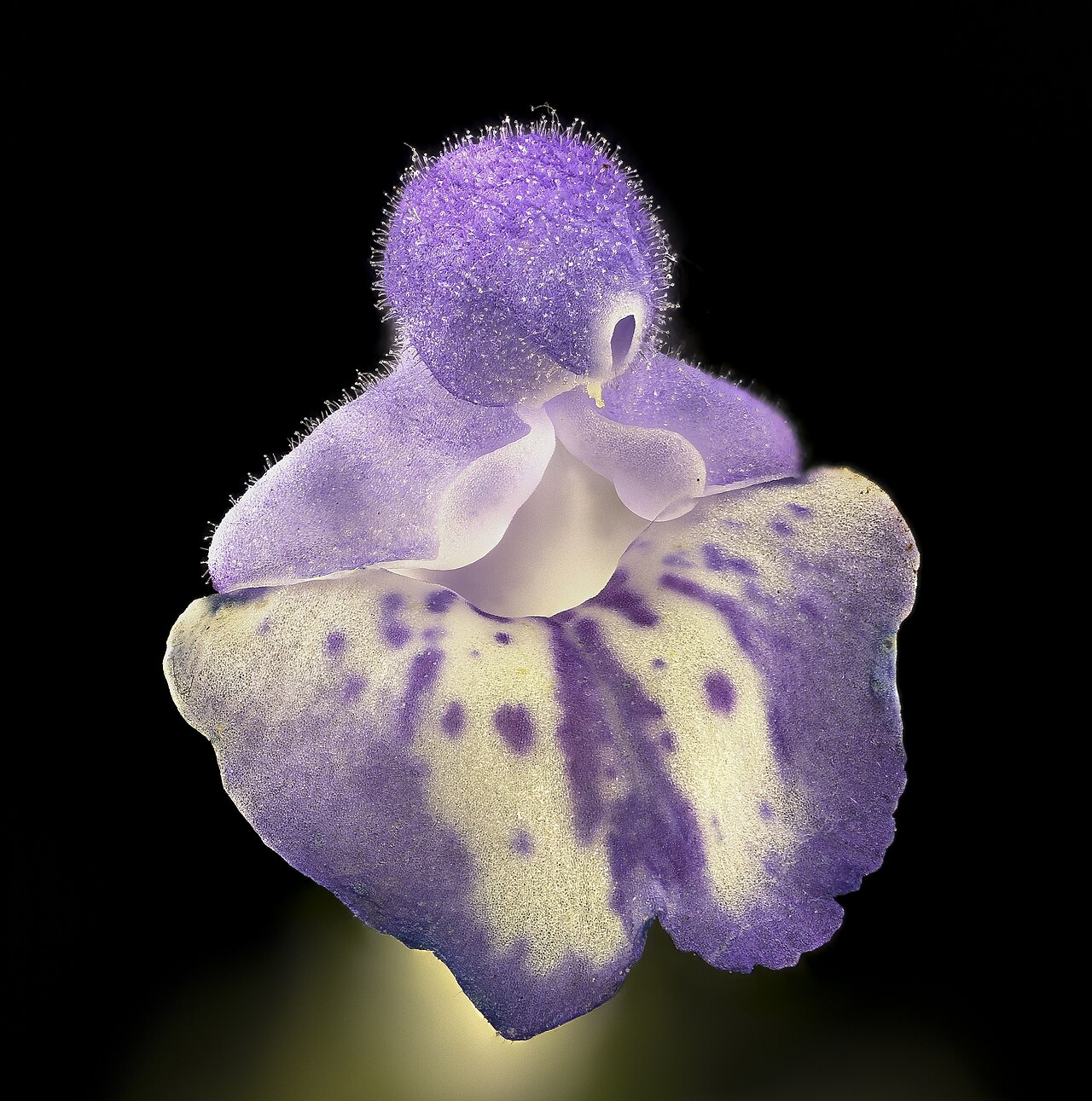
Flowers appear from about May to July and are held in pairs in one or a few short terminal spikes (racemes), all facing roughly the same way. Each flower is about 1/2 to 3/4 inch long, blue-violet to lavender, with a hooded upper lip and a broader, spreading lower lip that has white patches and purple spots in the center. The tubular corolla curves upward from a small, hairy, two-lipped calyx.
Fruit & Seeds
After flowering the calyx closes like a tiny clam shell around four small nutlets. The raised crest (scutellum) on top of the calyx enlarges in fruit. When dry the calyx splits and the nutlets are thrown out by passing animals or rain.
Look-alikes
Heart-leaved skullcap (Scutellaria ovata) has larger leaves with heart-shaped bases on long stalks. Downy skullcap (Scutellaria incana) is taller, with grayish, finely downy stems and a branched, many-flowered cluster blooming later in summer. Helmet skullcap (Scutellaria integrifolia) has narrow, mostly untoothed upper leaves and larger flowers. Mad-dog skullcap (Scutellaria lateriflora) grows in wet places and bears its small flowers in the leaf axils, not at the stem tip.
Safety Notes
Hairy skullcap is not known to be toxic to people or pets. Some skullcaps are used in herbal remedies, but products sold as skullcap have been adulterated with other plants, and the species are not interchangeable; don’t use wild-collected skullcap medicinally.
Quick Facts
| Scientific Name | Scutellaria elliptica |
| Family | Lamiaceae (mint family) |
| Plant Type | Herbaceous perennial wildflower |
| Mature Height | 1–2.5 ft |
| Mature Spread | 6–12 in (slowly spreading) |
| Growth Rate | Moderate |
| Sun Exposure | Partial shade (tolerates full sun to light shade) |
| Water Needs | Low to moderate; dry to medium soil |
| Soil Type | Well-drained loam, sandy or rocky soil |
| Soil pH | About 5.0–7.0 |
| Bloom Time | May–July |
| Flower Color | Blue-violet to lavender with white |
| Fall Color | None notable |
| Fruit | Four small nutlets in a capped calyx |
| Deer Resistant | Moderately; hairy, slightly bitter foliage |
| USDA Hardiness Zones | 5–9 |
Native Range
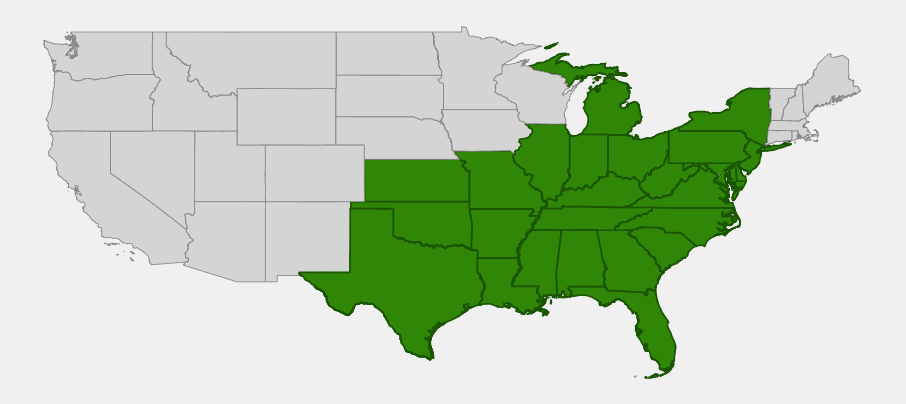
Hairy skullcap is native to the eastern and southern United States. USDA PLANTS lists it as native in Alabama, Arkansas, Delaware, Florida, Georgia, Illinois, Indiana, Kansas, Kentucky, Louisiana, Maryland, Michigan, Mississippi, Missouri, New Jersey, New York, North Carolina, Ohio, Oklahoma, Pennsylvania, South Carolina, Tennessee, Texas, Virginia and West Virginia, as well as the District of Columbia.
It is most common in the Piedmont, the Appalachians and the Ozarks, and on the inner Coastal Plain of the Southeast. Toward the edges of its range it becomes scattered or rare: in southern Michigan and New York, in the Florida Panhandle, and in eastern Texas, eastern Oklahoma and southeastern Kansas, where it is at the western limit of the eastern forest.
Typical habitats are dry to moist oak, oak-hickory and oak-pine woods, upland pine communities, rocky and wooded slopes, bluffs, woodland borders and openings, and roadsides through forest. It favors well-drained, often acidic soils and dappled shade.
📋 Regional plant lists featuring Hairy Skullcap: New York, Pennsylvania & Northern New Jersey · Delaware, Southern New Jersey & Long Island · Maryland, Virginia & West Virginia · North & South Carolina · Alabama, Georgia & Mississippi · North & South Florida · Kentucky & Tennessee · Ohio & Indiana · Michigan, Wisconsin & Eastern Minnesota · Illinois, Iowa & Missouri · Nebraska, Kansas & Eastern Colorado · Arkansas, Louisiana, Eastern Oklahoma & Eastern Texas
Growing & Care Guide
Hairy skullcap is sold by some native plant nurseries in the East and Southeast, and it grows easily from seed. It is a good choice for dry shade under oaks, where many garden perennials struggle.
Light
Grow it in partial shade or dappled light under deciduous trees. It tolerates morning sun and fairly bright edges, but in hot, full-sun sites it needs more moisture and may look tired by midsummer.
Soil & Water
It prefers well-drained, average to lean soil: loam, sandy loam or rocky woodland soil, slightly acidic to neutral. It is drought tolerant once established and does not like soggy soil. Water new plants during their first summer; after that, natural rainfall is usually enough in its range.
Planting Tips
Plant in small drifts of three or more at the front of a woodland border, along a shady path, or in a dry open-woodland planting with sedges, wild geranium, pussytoes and woodland goldenrods. Its soft hairy leaves and blue flowers look good against oak leaf litter, so a light leaf mulch suits it.
Pruning & Maintenance
Little care is needed. Leave the seed heads standing so the plant can self-sow lightly, and cut back old stems in late winter. Do not fertilize; rich soil makes it floppy.
Propagation
Sow seed outdoors in fall or give it about 30 to 60 days of cold, moist stratification before spring sowing. Collect seed when the calyces turn brown in summer. Established plants can be divided in early spring, and stem cuttings taken in late spring root fairly easily.
Landscape Uses
- Woodland and shade gardens: late-spring blue flowers after the spring ephemerals
- Dry shade under oaks: tolerates root competition and summer drought
- Bee gardens: nectar for bumblebees and other long-tongued bees
- Naturalizing: spreads gently by rhizomes and seed in open woods
- Restoration: oak and oak-pine woodland understory
Wildlife & Ecological Value
Hairy skullcap is a small but reliable nectar source in dry woodlands between the spring wildflowers and the summer bloomers.
For Pollinators
The tubular, two-lipped flowers are visited mainly by bumblebees and other long-tongued bees, which land on the broad lower lip and push into the tube for nectar. The white patches and purple spots on the lip act as nectar guides. Small bees, butterflies and bee flies also visit.
For Birds
It is not a major food plant for birds, but insects that feed on and around it provide food for woodland songbirds.
For Mammals
The hairy, slightly bitter foliage is not a preferred browse; deer usually leave it alone, though they may nibble it when food is scarce.
Ecosystem Role
As part of the herb layer of dry oak woods, it adds diversity to the forest floor, and its foliage and seeds feed a variety of plant-eating insects that in turn feed spiders, birds and other predators.
Cultural & Historical Uses
The species was named by Kurt Sprengel, building on notes by the American botanist and Lutheran minister Henry Muhlenberg, who studied the plants of Pennsylvania in the late 1700s and early 1800s. The species name elliptica refers to the elliptic leaves.
The genus name Scutellaria comes from the Latin scutella, “little dish” or “small shield,” for the raised crest on the calyx. The same feature inspired the English name skullcap, after a close-fitting cap.
Botanists recognize two varieties: var. elliptica, with spreading, often gland-tipped hairs, and var. hirsuta, with short, curved hairs and no glands. They overlap widely in range and habitat and are hard to tell apart without a hand lens.
Frequently Asked Questions
Why is it called hairy skullcap?
The whole plant is covered in fine hairs, and the calyx has a small raised crest that looks like a little cap or helmet, the feature that gives all skullcaps their name.
When does hairy skullcap bloom?
Mainly from May to July, a little later in the north and at higher elevations.
Will hairy skullcap grow in dry shade?
Yes. It is one of the better native wildflowers for dry, partly shaded spots under oaks and pines, once established.
How is it different from heart-leaved skullcap?
Heart-leaved skullcap has larger leaves with heart-shaped bases on long stalks, while hairy skullcap has smaller, oval to diamond-shaped leaves that taper or round off at the base.
Where does hairy skullcap grow?
It grows in dry to moist woods and woodland edges across the eastern and southern United States, from New York and Michigan to northern Florida and west to Oklahoma and East Texas.

Looking for a nursery that carries Hairy Skullcap?
Browse our native plant nursery directory: Alabama & Arkansas · Delaware, Florida & Georgia · Illinois, Indiana & Kansas · Kentucky, Louisiana, Maryland, Michigan, Mississippi & Missouri · New Jersey, New York, North Carolina, Ohio & Oklahoma · Pennsylvania, South Carolina, Tennessee, Texas & Virginia · West Virginia

