
Tall Cinquefoil (Potentilla arguta)
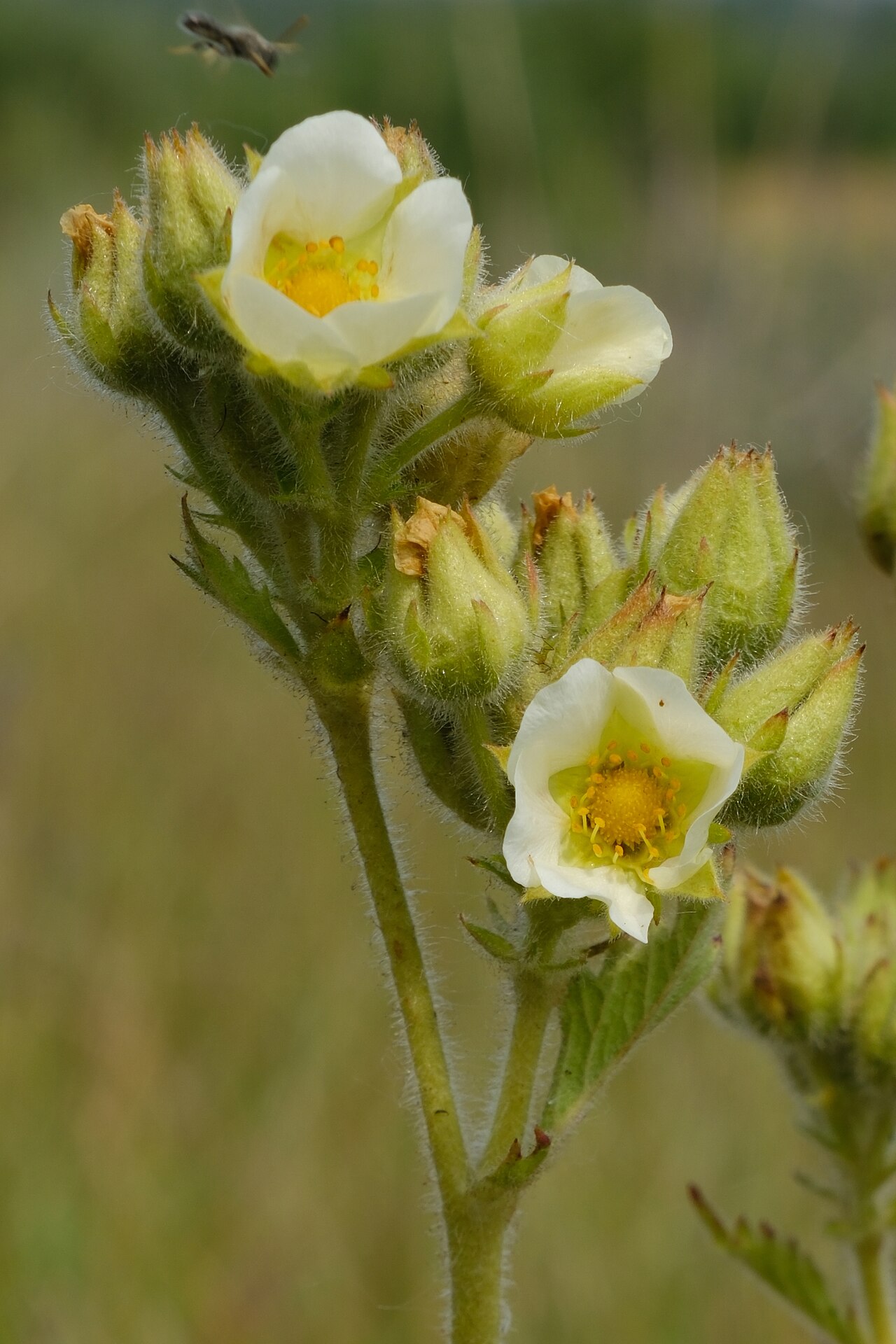
Potentilla arguta, known as Tall Cinquefoil or prairie cinquefoil, is a native perennial of the rose family (Rosaceae). It forms a clump of soft, hairy, divided leaves and in early summer sends up stiff stems 1 to 3 feet tall, topped with tight clusters of creamy white to pale yellow, five-petaled flowers. Many botanists now place it in the genus Drymocallis, as Drymocallis arguta, and in western North America its close relative is often treated as Drymocallis convallaria.
Tall cinquefoil is a plant of prairies, dry meadows, rocky slopes and open woods across a huge range, from New England and the Great Lakes across the northern Great Plains to the Rocky Mountains, the Great Basin and the Pacific Northwest, with scattered records in Alaska. Unlike the low, spreading cinquefoils that most people know, it is an upright, clump-forming plant with a deep, woody root, and its whole upper stem is sticky with glandular hairs.
It is a dependable, drought-tolerant plant for prairie gardens and meadow plantings. Its pale flowers mix well with grasses, it feeds many small bees, and its tall, brown seed heads stand through fall and winter.
Identification
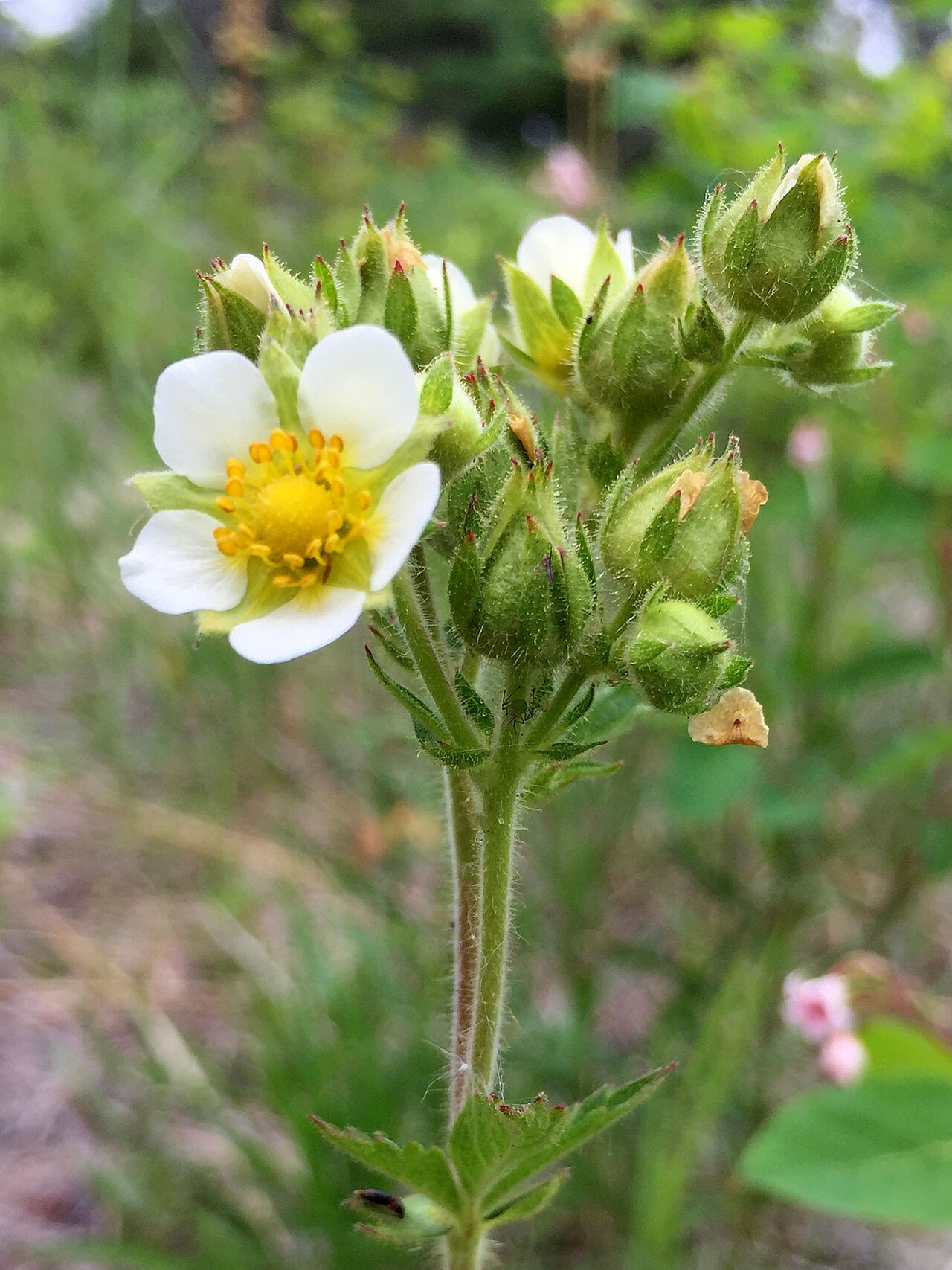
Look for an upright, hairy, somewhat sticky plant with pinnately divided leaves and dense, flat-topped to rounded clusters of creamy white flowers at the top of stiff stems.
Growth Habit
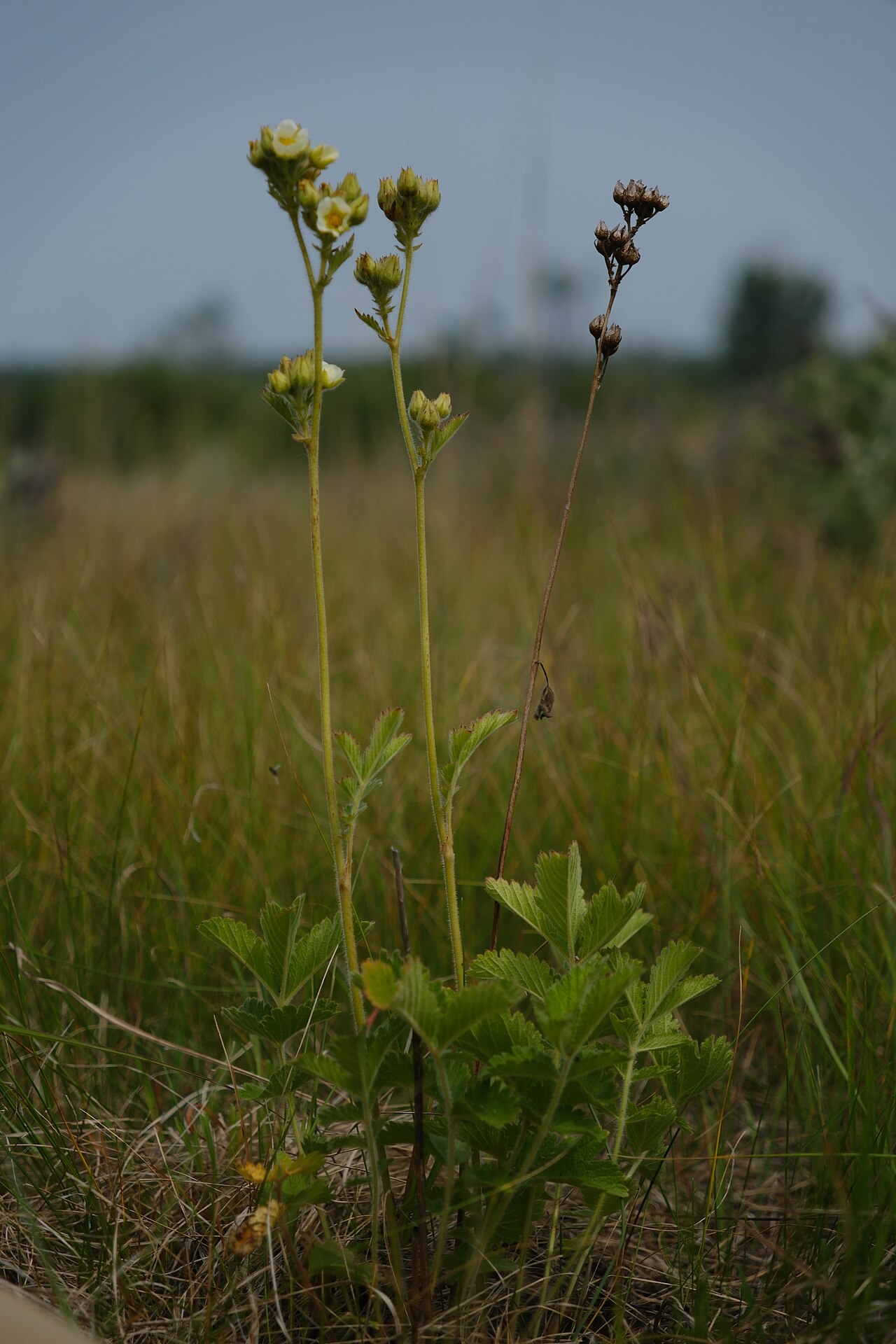
Tall cinquefoil grows from a thick, woody root crown and forms a clump of basal leaves. In late spring and summer it sends up one to several stiff, upright, unbranched stems, 1 to 3 feet tall (occasionally to 4 feet), that branch only in the flower cluster. The stems are covered with soft hairs, and the upper part is sticky with glandular hairs.
Leaves
The basal leaves are pinnately compound, 4 to 12 inches long, with 7 to 11 oval leaflets that are coarsely and doubly toothed, green above and paler and hairy beneath. The terminal leaflet is the largest. The few stem leaves are smaller, with fewer leaflets.
Flowers
The flowers are about 1/2 to 3/4 inch across, with five rounded, creamy white to pale yellow petals, five green sepals alternating with five small bracts, and a center of many stamens and pistils. They are borne in a dense, compact cluster at the top of the stem. Flowering runs mainly from June to August.
Fruit & Seeds
After flowering, the sepals close around a cluster of small, smooth, brown achenes. The dry, brown flower heads persist on the stiff stems into winter.
Look-alikes
Sticky cinquefoil (Potentilla glandulosa, or Drymocallis glandulosa) of the West is similar but has more open, branching flower clusters and often yellower flowers. Rough cinquefoil (Potentilla norvegica) has yellow flowers and three leaflets. Most other cinquefoils, such as graceful cinquefoil, are low, spreading plants with yellow flowers and palmately divided leaves.
Quick Facts
| Scientific Name | Potentilla arguta (syn. Drymocallis arguta) |
| Family | Rosaceae (rose family) |
| Plant Type | Herbaceous perennial |
| Mature Height | 1–3 ft (occasionally to 4 ft) |
| Mature Spread | 1–1.5 ft |
| Growth Rate | Moderate |
| Sun Exposure | Full sun to part shade |
| Water Needs | Low to medium; drought tolerant |
| Soil Type | Well-drained sandy, gravelly, rocky or loamy soils |
| Soil pH | Slightly acidic to alkaline (about 6.0–8.0) |
| Bloom Time | June–August |
| Flower Color | Creamy white to pale yellow |
| Fall Color | Basal leaves may turn reddish |
| Fruit | Small brown achenes in persistent dry heads |
| Deer Resistant | Moderately |
| USDA Hardiness Zones | 2–8 |
Native Range
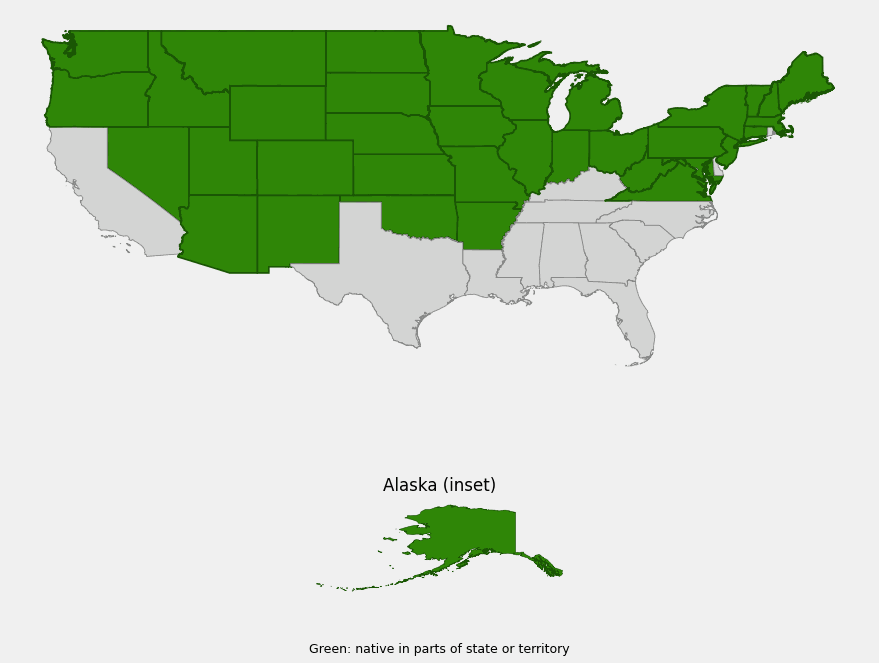
Tall cinquefoil has one of the widest ranges of any North American wildflower. USDA PLANTS lists it as native in 36 states and much of Canada, from New Brunswick and Quebec west to British Columbia and the Northwest Territories. It is common across the northern Great Plains, the upper Midwest and the Rocky Mountains, and less common in the Northeast and the southern part of its range, where it is rare in Arkansas, Oklahoma, Ohio and Virginia, historical in Maryland, and no longer found in West Virginia.
In the West it reaches the mountains of Arizona and New Mexico, the Great Basin of Nevada and Utah, and Idaho, eastern Oregon and eastern Washington, with smaller numbers west of the Cascades in the Siskiyou and Cascade mountains and the Puget Sound area. Many western plants are often separated as Drymocallis convallaria. In Alaska there are a few scattered herbarium records from rocky slopes and roadsides in the southcentral and eastern parts of the state, which are outlying records.
It grows in dry to mesic prairies, sand and gravel prairies, rocky and grassy hillsides, open aspen and pine woods, savannas, woodland edges and mountain meadows. It tolerates drought and grazing and often persists in prairie remnants along railroads and roadsides.
📋 Regional plant lists featuring Tall Cinquefoil: New York, Pennsylvania & Northern New Jersey · Idaho, Eastern Oregon & Eastern Washington · Ohio & Indiana · Montana & Wyoming · Michigan, Wisconsin & Eastern Minnesota · Nebraska, Kansas & Eastern Colorado · Utah & Western Colorado · Connecticut, Massachusetts & Rhode Island · New Hampshire, Maine & Vermont · Maryland, Virginia & West Virginia · Delaware, Southern New Jersey & Long Island · Arizona & New Mexico · Illinois, Iowa & Missouri · Alaska · Arkansas, Louisiana, Eastern Oklahoma & Eastern Texas · North Dakota, South Dakota & Western Minnesota · Western Oregon & Western Washington · California & Nevada
Growing & Care Guide
Tall cinquefoil is a tough, long-lived perennial that needs little care once established. It is grown in prairie gardens and restorations and is available as seed and plants from many native nurseries in the Midwest and Great Plains.
Light
Full sun to part shade. It flowers best in sun but tolerates the light shade of savannas and woodland edges.
Soil & Water
Plant it in well-drained soil: sand, gravel, rocky soil and loam all work. It is very drought tolerant once established because of its deep root, and it dislikes wet, poorly drained soil. It does not need fertilizer.
Planting Tips
Plant container plants in spring or fall, about 12 to 18 inches apart. It looks best in groups among bunchgrasses and other prairie wildflowers, where its tall flower stems rise above the grasses. Its deep root makes older plants hard to move, so choose the spot carefully.
Pruning & Maintenance
Leave the seed heads standing for winter interest and cut the stems back in late winter or early spring, or let a spring burn do it in a prairie planting.
Propagation
Grow it from seed. Sow seed outdoors in fall, or give it about 60 days of cold, moist stratification before spring sowing. Seed germinates readily, and seedlings usually flower in their second or third year. Clumps can also be divided in early spring.
Landscape Uses
- Prairie gardens: creamy summer flowers among grasses
- Restorations: a common component of prairie and savanna seed mixes
- Dry, rocky sites: tolerates drought, sand and gravel
- Pollinator gardens: abundant pollen for small native bees
- Winter interest: stiff brown seed heads that stand above snow
Wildlife & Ecological Value
Tall cinquefoil supports a wide range of insects and is a hardy, long-lived member of prairie and open woodland plant communities.
For Pollinators
The open, bowl-shaped flowers are visited by many small native bees, including sweat bees, mining bees and small carpenter bees, as well as flies and beetles that feed on the pollen.
For Birds
Small seed-eating birds pick at the achenes in the persistent seed heads in fall and winter.
For Mammals
It is grazed lightly by deer, elk and livestock, which usually prefer other plants, so it often persists in grazed prairies.
Ecosystem Role
With its deep, woody root, tall cinquefoil survives drought, fire and grazing, helping to hold soil on dry slopes and in sandy prairies. It is one of the plants that indicates a relatively intact native prairie or savanna.
Cultural & Historical Uses
The name Potentilla comes from the Latin potens, “powerful,” a reference to the medicinal reputation of some cinquefoils. Arguta means “sharply toothed,” describing the leaves. Drymocallis, the genus name used by many modern botanists, means “woodland beauty” in Greek.
Several Plains and northern tribes used the roots of tall cinquefoil in traditional medicine, including as an astringent for wounds and for digestive troubles. The roots are rich in tannins, like those of many plants in the rose family. It should not be used as a home remedy.
The name “cinquefoil” comes from the French for “five leaves,” because many cinquefoils have five leaflets. Tall cinquefoil, with its 7 to 11 leaflets and upright habit, is an exception that often surprises people who know only the low, yellow-flowered species.
Frequently Asked Questions
Is tall cinquefoil the same as Drymocallis arguta?
Yes. Drymocallis arguta is a newer name for the same plant. Many western plants are now treated as a related species, Drymocallis convallaria.
What color are tall cinquefoil flowers?
They are creamy white to pale yellow, unlike the bright yellow flowers of most cinquefoils.
Is tall cinquefoil drought tolerant?
Yes. Its deep, woody root lets it survive long dry periods once established. It prefers well-drained soil.
When does tall cinquefoil bloom?
Mainly from June to August, depending on latitude and elevation.
Is tall cinquefoil invasive?
No. It is a native, clump-forming perennial that spreads only slowly by seed and does not form runners.

Looking for a nursery that carries Tall Cinquefoil?
Browse our native plant nursery directory: Alaska, Arizona & Arkansas · Colorado & Connecticut · Idaho, Illinois, Indiana, Iowa & Kansas · Maine, Maryland, Massachusetts, Michigan, Minnesota, Missouri & Montana · Nebraska, Nevada, New Hampshire, New Jersey, New Mexico, New York, North Dakota, Ohio & Oklahoma · Oregon · Pennsylvania, South Dakota, Utah, Vermont & Virginia · Washington · West Virginia, Wisconsin & Wyoming

