
Zigzag Bladderwort (Utricularia subulata)
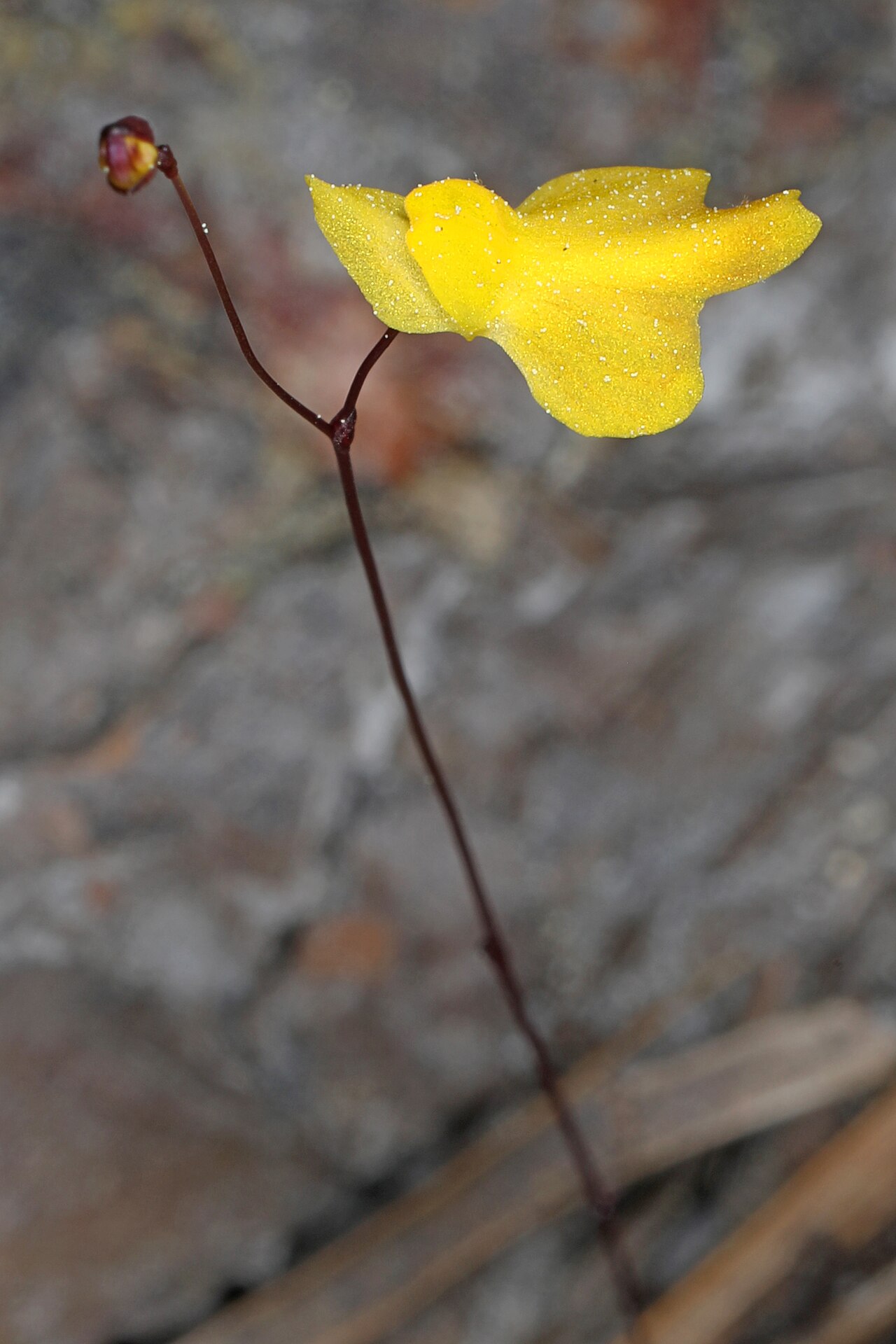
Utricularia subulata, known as Zigzag Bladderwort, is a tiny carnivorous plant of wet, sandy ground. Almost the whole plant lives hidden in the soil, where thread-like stems carry microscopic traps. Above ground you see only hair-thin flower stalks, 1 to 8 inches tall, that bend slightly at each node (the “zigzag” of its name) and carry one to several bright yellow, two-lipped flowers about 1/4 inch across. It belongs to the bladderwort family (Lentibulariaceae).
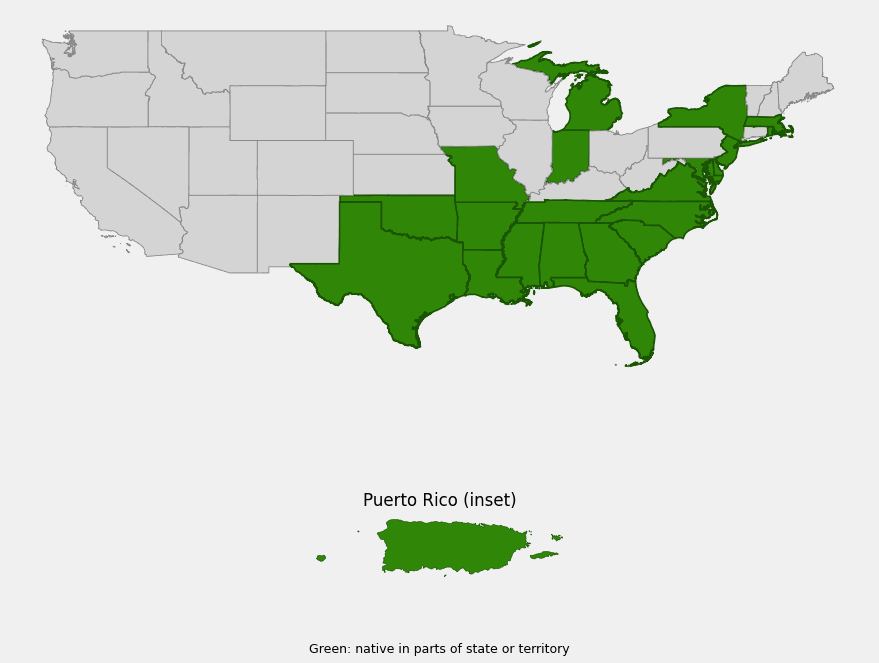
It is one of the most widespread bladderworts in the world, native to the tropical and warm-temperate Americas, Africa, Asia and Australia. In the United States it grows mainly on the Atlantic and Gulf Coastal Plain from Massachusetts to Florida and Texas, with scattered inland sites as far north as Michigan and Indiana. It is also native to Puerto Rico and reaches Nova Scotia in Canada.
Zigzag bladderwort is easy to overlook, but where it grows, it can turn wet sand and pond margins into a sprinkle of tiny yellow flowers. It is a favorite of carnivorous plant growers, who often find it appearing on its own in pots of sundews and pitcher plants.
Identification
Look for very thin, wiry, reddish to green stalks rising from wet sand or peat, each with a few small, bright yellow, two-lipped flowers, and no visible leaves.
Growth Habit
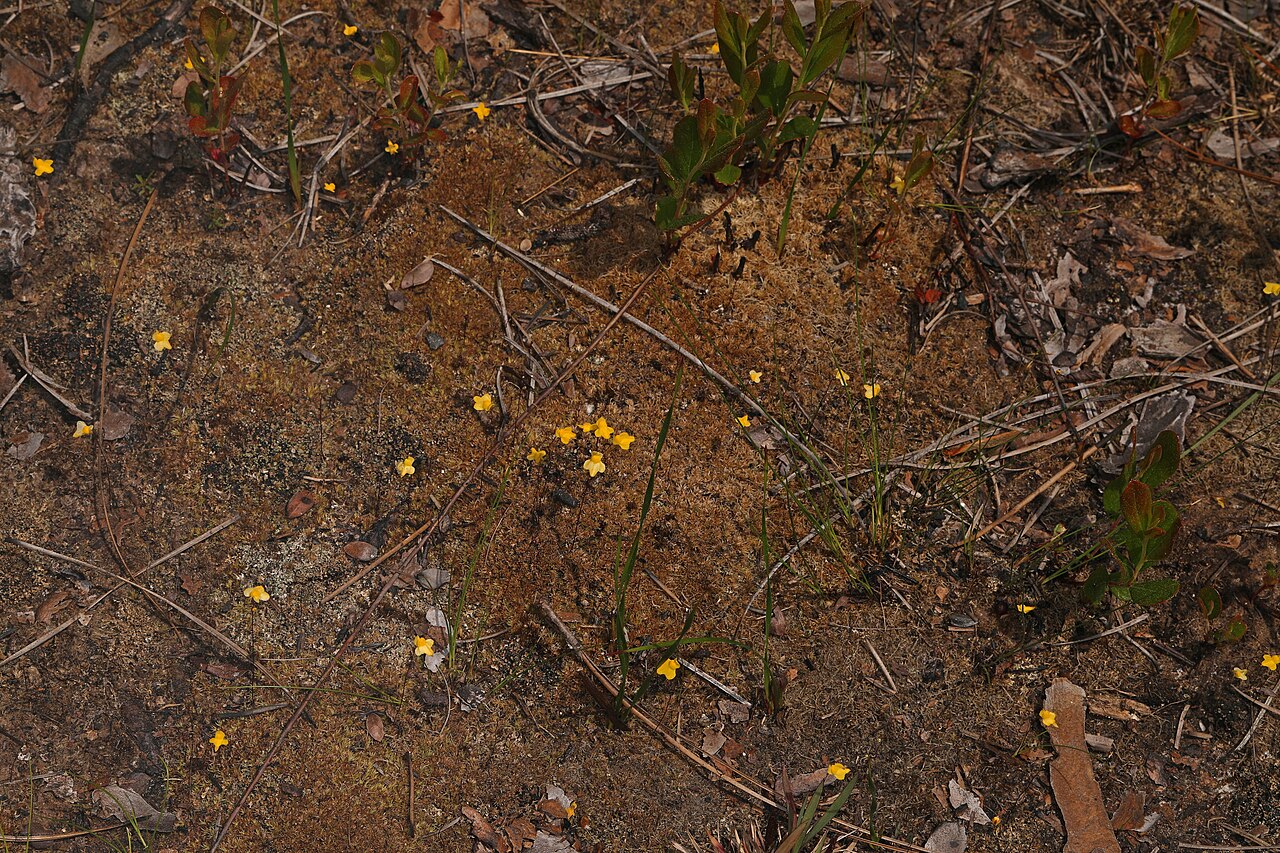
Zigzag bladderwort is a terrestrial (soil-dwelling) bladderwort. It forms a network of fine, branching underground stems (stolons) just below the surface of wet sand, peat or mud. It can behave as an annual or a short-lived perennial and spreads quickly by seed and stolons, often forming large colonies.
Leaves & Traps
The leaves are tiny, linear or thread-like, rarely more than about 1/4 inch long, and are usually hidden in the soil or moss. Along the stolons are many tiny bladders, less than 1/32 inch across. Each bladder has a trapdoor that springs open when tiny animals touch its trigger hairs, sucking in protozoa, rotifers and other microscopic organisms in the soil water.
Flowers
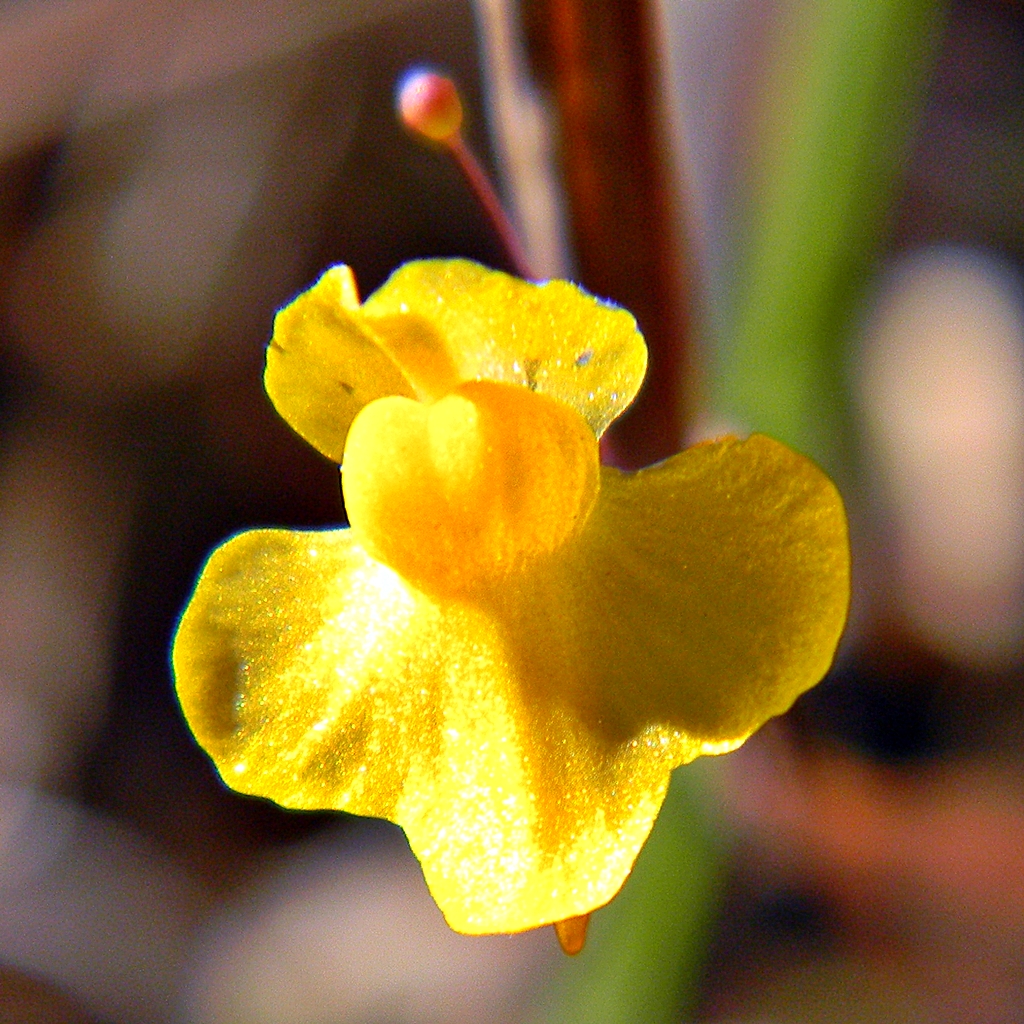
The flowering stalk (scape) is erect, hair-thin and 1 to 8 inches tall, often slightly zigzag, and green to reddish brown. It carries one to several flowers on short stalks. Each flower is bright yellow, about 1/4 inch across, with a broad, three-lobed lower lip, a smaller upper lip and a short spur below. Some plants produce tiny, closed (cleistogamous) flowers that self-pollinate without opening. Flowers appear mostly from spring to fall in the Southeast and nearly year-round in Florida and Puerto Rico.
Fruit
The fruit is a tiny, round capsule that releases many minute seeds.
Look-alikes
Horned bladderwort (Utricularia cornuta) has much larger yellow flowers, up to about 3/4 inch, with a long, downward-pointing spur. Other small yellow bladderworts, such as U. juncea, have several flowers on stiffer, straight stems. Yellow-eyed grasses (Xyris) grow in the same habitats but have flat, grass-like leaves and three-petaled flowers.
Quick Facts
| Scientific Name | Utricularia subulata |
| Family | Lentibulariaceae (bladderwort family) |
| Plant Type | Tiny carnivorous herb (annual or short-lived perennial) |
| Mature Height | 1–8 in (flower stalks) |
| Mature Spread | Spreads by underground stolons into colonies |
| Growth Rate | Fast |
| Sun Exposure | Full sun |
| Water Needs | High; constantly wet soil |
| Soil Type | Wet sand, peat or sandy muck |
| Soil pH | Acidic (about 4.0–6.0) |
| Bloom Time | Spring–fall; nearly year-round in the far South |
| Flower Color | Bright yellow |
| Fall Color | None |
| Fruit | Tiny round capsule |
| Deer Resistant | Yes; too small to be browsed |
| USDA Hardiness Zones | 5–11 |
Native Range
Zigzag bladderwort is found on every continent except Europe and Antarctica, in tropical and warm-temperate regions. USDA PLANTS lists it as native in 21 states and Puerto Rico. In Canada it is known only from Nova Scotia. It has become naturalized as an introduced plant in a few places outside its range, such as northern California.
In the United States it is most common on the Coastal Plain, from southeastern Massachusetts, Rhode Island, Long Island and the New Jersey Pine Barrens south through Delaware, Maryland, Virginia and the Carolinas to Florida, and west along the Gulf Coast to Louisiana and East Texas. Inland, it grows in scattered sandy wetlands in Tennessee, Arkansas, southeastern Oklahoma and Missouri, and in a few isolated sites in Indiana and Michigan, where it is rare.
In Texas it grows in the eastern part of the state, in the Pineywoods and nearby coastal prairies and bogs, not in South or West Texas. Typical habitats are wet pine savannas and flatwoods, seepage bogs, sandy pond and lake margins, wet ditches, sandy swales between dunes and the edges of pitcher-plant bogs, almost always in open, sunny places with bare, wet ground.
📋 Regional plant lists featuring Zigzag Bladderwort: New York, Pennsylvania & Northern New Jersey · Ohio & Indiana · Michigan, Wisconsin & Eastern Minnesota · Kentucky & Tennessee · Connecticut, Massachusetts & Rhode Island · New Hampshire, Maine & Vermont · Maryland, Virginia & West Virginia · Delaware, Southern New Jersey & Long Island · Illinois, Iowa & Missouri · Alabama, Georgia & Mississippi · North & South Florida · Puerto Rico · North & South Carolina · Arkansas, Louisiana, Eastern Oklahoma & Eastern Texas · South & West Texas
Growing & Care Guide
Zigzag bladderwort is a small plant for carnivorous plant enthusiasts and bog gardens. It is easy to grow if you can give it constant moisture, sun and acidic, low-nutrient soil. Get it from other growers or nurseries; never collect it from the wild.
Light
Full sun or very bright light. In shade it rarely flowers. Indoors it grows well under strong grow lights or on a sunny windowsill.
Soil & Water
Use an acidic, low-nutrient mix such as peat moss with sand or perlite. Keep it constantly wet, either in a tray of water or in a bog garden. Use rainwater, distilled or reverse-osmosis water, because minerals in tap water can harm it. Do not fertilize.
Planting Tips
Place a small clump of plants on the surface of moist peat and sand and keep it wet. It spreads quickly by stolons and seed and works well as a living groundcover in pots of sundews, pitcher plants and butterworts. In a bog garden, plant it on open, wet sand at the edge.
Pruning & Maintenance
No pruning is needed. Its main problem is being crowded out by mosses and taller plants, so keep some bare, wet soil. In colder areas, potted plants can be overwintered in a cool, bright place. Because it spreads easily, keep it away from pots where you do not want it.
Propagation
It reproduces by seed, which it produces freely, and by pieces of stolon. Transfer a small plug of soil with plants to a new pot.
Landscape Uses
- Bog gardens: a tiny, bright groundcover on wet sand
- Carnivorous plant pots: grows beneath pitcher plants and sundews
- Terrariums and windowsills: a small carnivore with frequent blooms
- Education: a fascinating example of plant carnivory for classrooms
- Wetland restoration: part of the natural flora of pine savannas and seepage bogs
Wildlife & Ecological Value
Zigzag bladderwort plays a small but interesting role in the nutrient-poor wetlands where it grows.
For Pollinators
Its tiny flowers are visited by small bees and other small insects, although many flowers are self-pollinated, and some never open at all.
For Birds
It provides little direct food for birds.
For Mammals
It is too small to be important food for mammals.
Ecosystem Role
Its underground traps capture protozoa, rotifers and other microscopic animals, letting it get nitrogen and phosphorus from soils that are very poor in nutrients. It is part of the diverse ground layer of fire-maintained pine savannas and seepage bogs, which depend on regular fire to stay open and sunny.
Cultural & Historical Uses
The genus name Utricularia comes from the Latin utriculus, “little bag,” for the small, bladder-shaped traps. The species name subulata means “awl-shaped,” describing its narrow leaves. Carl Linnaeus described the species in 1753.
Bladderwort traps are among the fastest moving structures in the plant world. Each trap pumps water out to create low pressure inside; when prey touches the trigger hairs, the door opens and the prey is sucked in in a tiny fraction of a second.
Because it grows so readily from seed, zigzag bladderwort is well known among carnivorous plant hobbyists as a “weed” in their collections, often arriving with other plants. In the wild, however, many of its habitats, such as pine savannas and coastal plain ponds, have been lost to drainage, development and lack of fire.
Frequently Asked Questions
Is zigzag bladderwort carnivorous?
Yes. It has tiny underground bladders that trap microscopic animals in wet soil. It cannot catch insects you would notice.
Why is it called zigzag bladderwort?
Its thin flower stalks often bend slightly at each node, giving them a zigzag look.
Can I grow zigzag bladderwort?
Yes. It grows easily in a pot or bog garden with wet, acidic peat and sand, full sun and pure water. It often spreads into neighboring pots.
Where does it grow in Texas?
In East Texas, in the Pineywoods and nearby wet savannas and bogs. It does not grow in South or West Texas.
Is zigzag bladderwort native to Puerto Rico?
Yes. USDA PLANTS lists it as native in Puerto Rico, where it grows in wet, open places.

Looking for a nursery that carries Zigzag Bladderwort?
Browse our native plant nursery directory: Alabama & Arkansas · Delaware, Florida & Georgia · Indiana · Louisiana, Maryland, Massachusetts, Michigan, Mississippi & Missouri · New Jersey, New York, North Carolina & Oklahoma · Rhode Island, South Carolina, Tennessee, Texas & Virginia

