
Nodding Ladies’ Tresses (Spiranthes cernua)
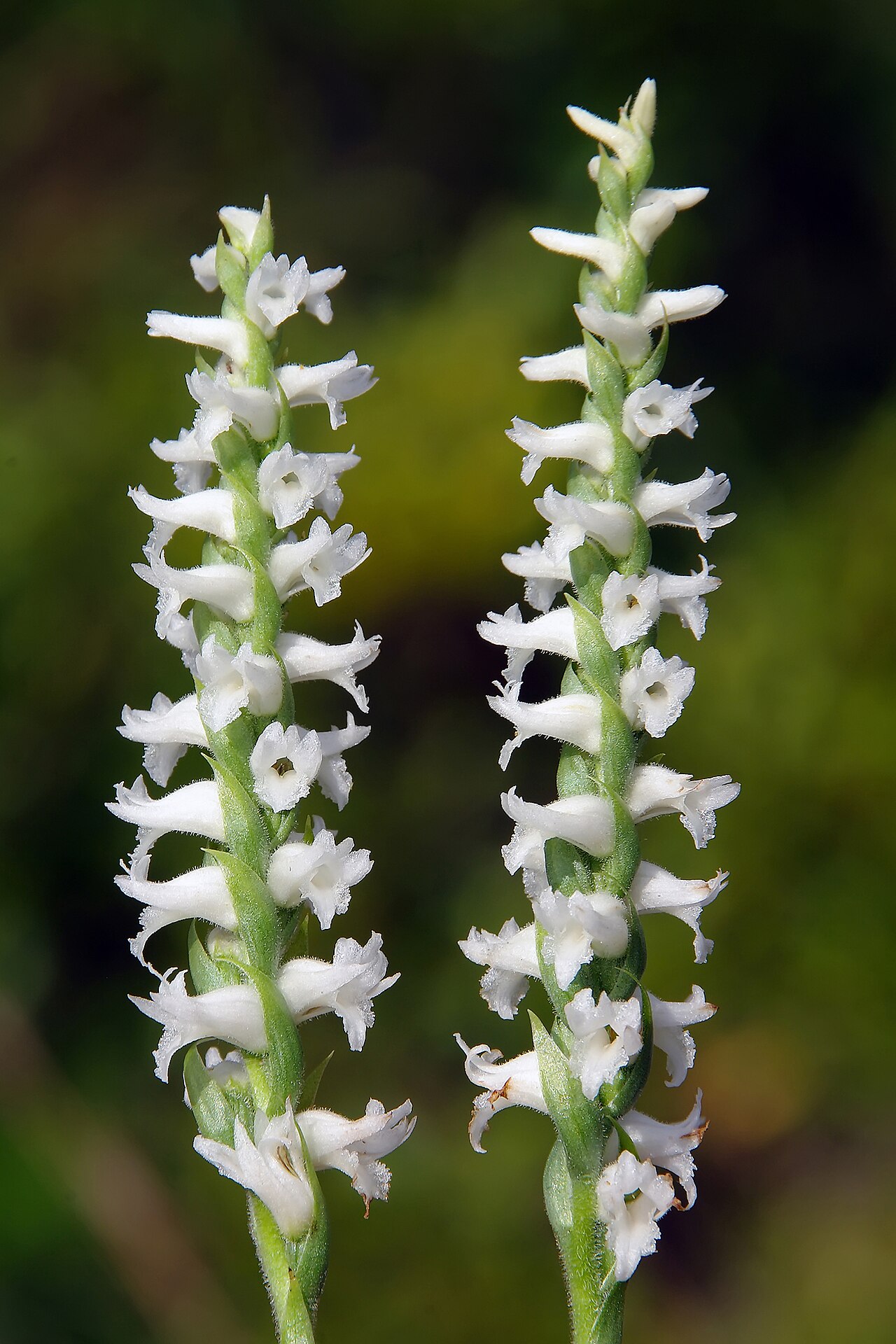
Spiranthes cernua, known as Nodding Ladies’ Tresses (USDA: nodding lady’s tresses), is a native terrestrial orchid of damp meadows, fields and shores in eastern and central North America. In late summer and fall it sends up a slender spike, usually 6 to 20 inches tall, wrapped in two to four spiraling rows of small, white, fragrant flowers that curve slightly downward, or nod, which gives the species its name.
It belongs to the orchid family (Orchidaceae), although few people would guess it from a distance. The genus name Spiranthes comes from the Greek for “coiled flowers”, and cernua is Latin for nodding. The common name compares the twisted spike to a braid of hair. It is one of the most widespread and variable ladies’ tresses, and many populations reproduce by seed that forms without pollination.
Nodding ladies’ tresses grows from the Great Lakes and New England south to the Gulf Coast and west to Texas, Kansas and Minnesota. Like all native orchids, it depends on soil fungi and should never be dug from the wild. This guide covers how to identify it, where it grows, how gardeners can grow nursery-propagated plants and its role in meadow and wetland ecosystems.
Identification
Look for nodding ladies’ tresses in late summer and fall, when most meadow orchids are long finished. Its white, spiraling spikes stand out in short grass, on damp roadsides and on open shores.
Growth Habit
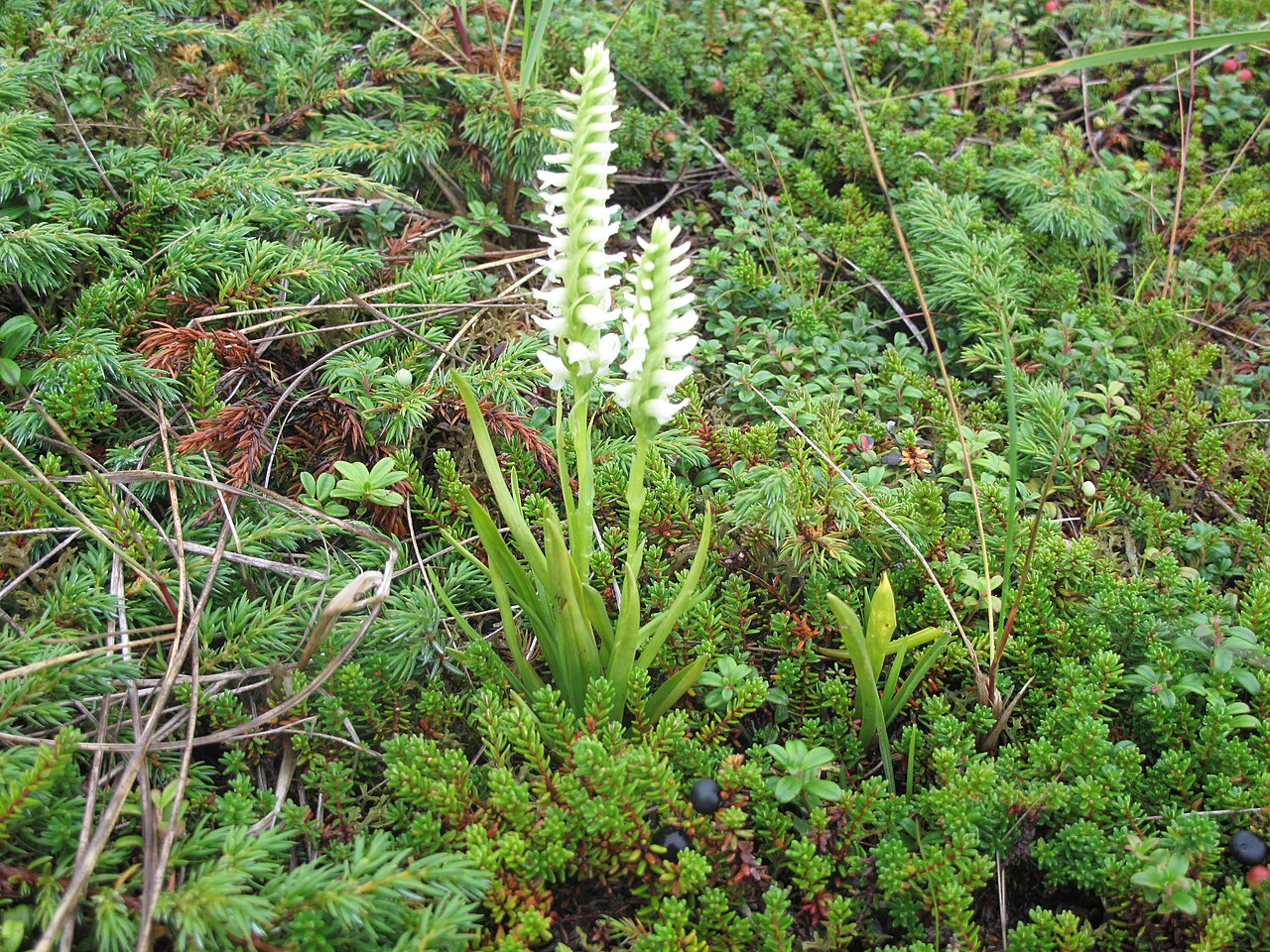
It is a perennial that grows from a cluster of thick, fleshy roots. Each plant usually produces a single flowering stem, 6 to 20 inches tall and occasionally taller, with sheathing bracts along it. The plants are often scattered, but in good years dozens can bloom in a small meadow.
Leaves
The leaves are narrow and grass-like, up to about 10 inches long, and grow mostly from the base. They are often present at flowering but may wither by the time the flowers open, which makes the plant hard to find out of bloom.
Flowers
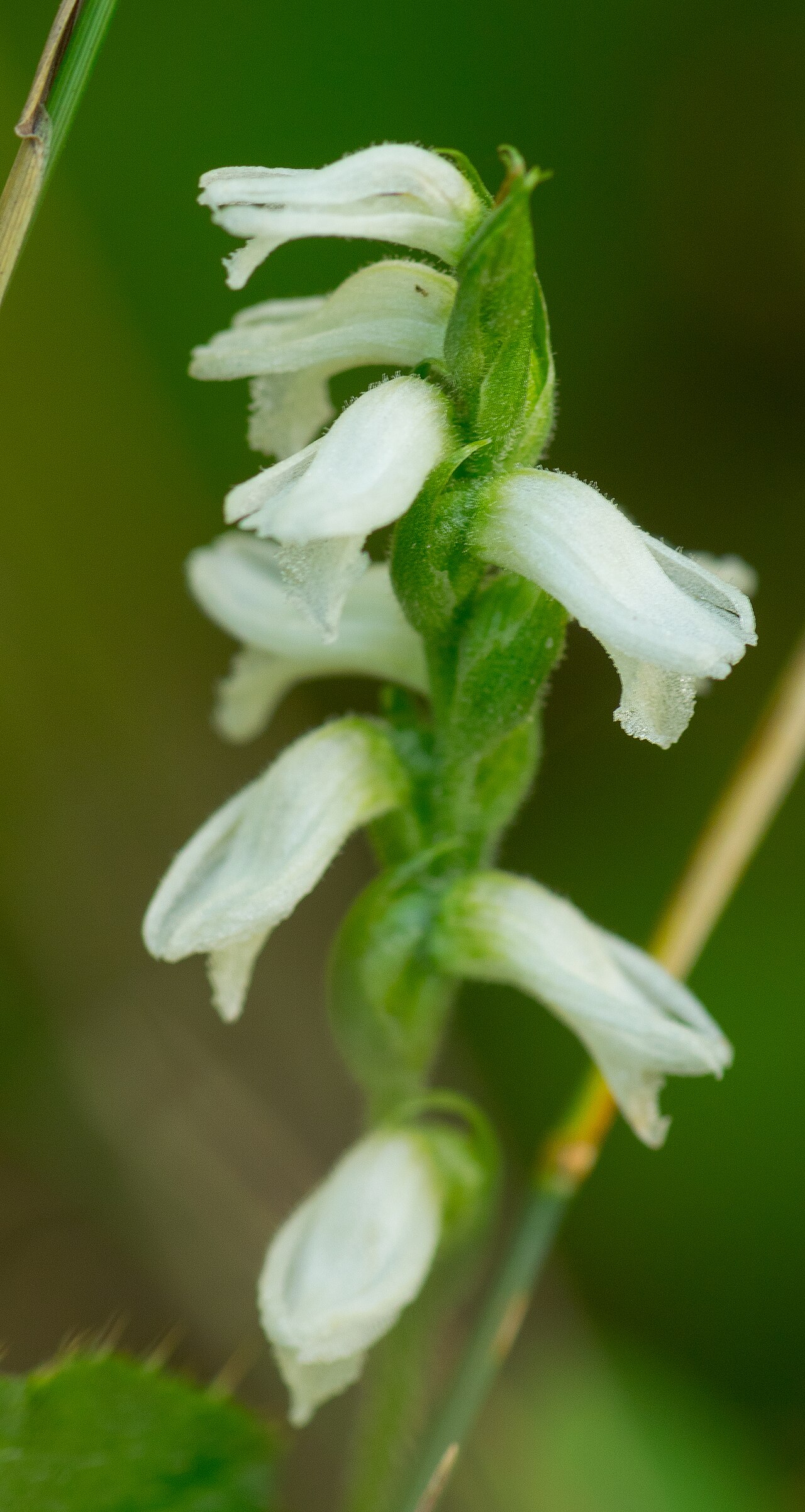
The flowers are white to cream, about 1/3 to 1/2 inch long, tubular and slightly curved downward. They are arranged in two to four tightly spiraling ranks, forming a dense spike 2 to 6 inches long. The lip has a crinkled, flaring edge, often with a creamy or yellowish center. The flowers are fragrant, with a sweet, vanilla-like scent. Bloom time is mainly August to October, into November in the South.
Fruit & Seeds
Each flower produces a small capsule filled with dust-like seeds that are spread by wind. Many populations produce seed without pollination, and the seeds often contain more than one embryo. Like all orchids, the seeds need a partner fungus in the soil to germinate.
Look-alikes
Several other ladies’ tresses bloom in late summer and fall. Great Plains ladies’ tresses (Spiranthes magnicamporum) grows in drier, often limy prairies and has leaves that wither before flowering and a strong fragrance. Fragrant ladies’ tresses (Spiranthes odorata), once treated as a variety of nodding ladies’ tresses, is a larger plant of southern swamps that spreads by stolons. Hooded ladies’ tresses (Spiranthes romanzoffiana) of northern wetlands has flowers with a hood-like top that bloom earlier in summer. Botanists have also separated some populations formerly included in Spiranthes cernua as distinct species, such as Spiranthes incurva and Spiranthes sheviakii, which are very hard to tell apart in the field.
Quick Facts
| Scientific Name | Spiranthes cernua (L.) Rich. |
| Family | Orchidaceae (orchid family) |
| Plant Type | Terrestrial orchid (herbaceous perennial) |
| Mature Height | 6–20 in (occasionally to 2 ft) |
| Mature Spread | 3–6 in |
| Growth Rate | Slow |
| Sun Exposure | Full sun to light shade |
| Water Needs | Moderate to high; moist to wet soil |
| Soil Type | Moist sandy, loamy or clay soils in open, sparsely vegetated ground |
| Soil pH | Acidic to near neutral (about 5.0–7.0) |
| Bloom Time | August–October (to November in the South) |
| Flower Color | White to cream |
| Fall Color | None; flowers are the fall feature |
| Fruit | Small capsule with dust-like seeds |
| Deer Resistant | Not well documented; deer may browse spikes |
| USDA Hardiness Zones | 3–9 |
Native Range
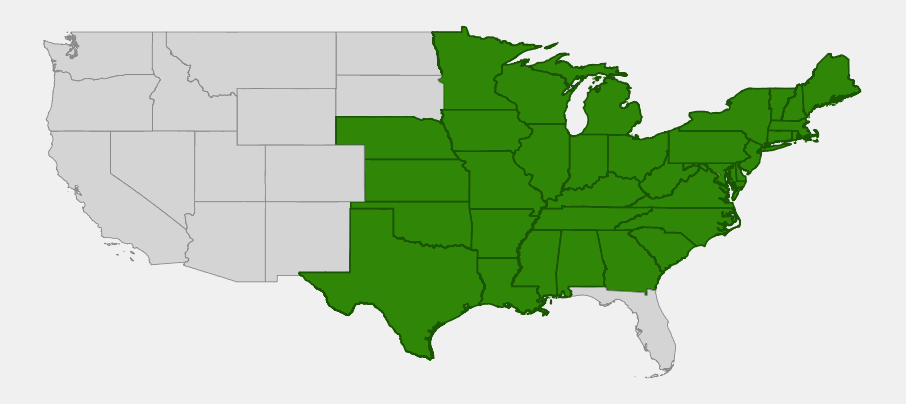
Nodding ladies’ tresses is native to eastern and central North America. USDA PLANTS lists it in 34 states, from Maine, Vermont and New Hampshire south to Georgia, Alabama, Mississippi and Louisiana, and west to Minnesota, Iowa, Nebraska, Kansas, Oklahoma and Texas. In Canada it grows in Ontario, Quebec, New Brunswick, Nova Scotia and Prince Edward Island.
It is widespread in the Northeast, the Great Lakes region and the Appalachian and Piedmont states, and scattered across the Midwest and the South. In Minnesota it reaches the prairie region in the west of the state. In Texas it grows mostly in the eastern half of the state, extending to the Hill Country and Edwards Plateau.
It grows in open, sunny, usually damp places with sparse vegetation: wet meadows, old fields, fens, seeps, lake and river shores, ditches, mowed roadsides and lawns, powerline corridors and the edges of bogs and swamps. It often appears on disturbed ground, where competition is low. It grows from near sea level into the mountains.
📋 Regional plant lists featuring Nodding Ladies’ Tresses: New York, Pennsylvania & Northern New Jersey · Ohio & Indiana · Michigan, Wisconsin & Eastern Minnesota · Kentucky & Tennessee · Nebraska, Kansas & Eastern Colorado · Connecticut, Massachusetts & Rhode Island · New Hampshire, Maine & Vermont · Maryland, Virginia & West Virginia · Delaware, Southern New Jersey & Long Island · Illinois, Iowa & Missouri · Alabama, Georgia & Mississippi · North & South Carolina · Arkansas, Louisiana, Eastern Oklahoma & Eastern Texas · South & West Texas · North Dakota, South Dakota & Western Minnesota
Growing & Care Guide
Nodding ladies’ tresses is one of the easier native orchids to grow, but only from nursery-propagated plants. Never dig it from the wild: wild plants rarely survive transplanting, and collecting harms populations that are already uncommon in parts of its range. Some specialty native nurseries sell laboratory- or division-propagated plants.
Light
Give it full sun or light shade. It needs an open site and does poorly when crowded or overtopped by taller plants.
Soil & Water
Plant it in moist to wet, well-aerated soil, such as a sandy or loamy bog-garden mix or a damp meadow. It prefers slightly acidic soil and should not dry out during the growing season. Avoid heavy fertilizer, which encourages competing plants.
Planting Tips
Plant nursery-grown plants in spring or fall at the same depth they were growing, with the fleshy roots spread out. It does well at the edge of a rain garden, in a bog garden, in a wet meadow planting or in a container kept moist. Keep the site open by surrounding it with low companions rather than tall, aggressive perennials.
Pruning & Maintenance
Leave the flower spikes to ripen and shed seed. In a meadow or lawn setting, avoid mowing from late summer until after the flowers have faded. Mark the location, since the plants are easy to lose when not in bloom.
Propagation
Established clumps can be carefully divided in early spring when they have several crowns. Seed requires specialized laboratory culture or the right soil fungus, so home seed-sowing rarely succeeds. Leave wild populations undisturbed.
Landscape Uses
- Bog and rain gardens: a fall-blooming orchid for constantly moist soil
- Wet meadow plantings: late-season white spikes among grasses and wildflowers
- Pollinator gardens: late nectar for bumblebees
- Lawn and meadow conservation: delaying fall mowing lets existing plants bloom and set seed
- Nature study: a fascinating, fragrant native orchid to observe up close
Wildlife & Ecological Value
As a late-blooming orchid, nodding ladies’ tresses offers nectar when most meadow flowers are finished, and its life cycle shows how closely native orchids depend on soil fungi and open habitats.
For Pollinators
Bumblebees are the main visitors. They work each spike from the bottom up, picking up pollen packets from the younger flowers near the top and carrying them to older flowers lower on the next spike they visit. Many populations also set seed without pollination.
For Birds
The tiny seeds have no food value for birds, but the open meadows where it grows support many ground-nesting and seed-eating birds.
For Mammals
Deer and rabbits may nibble the flower spikes. Its fleshy roots are not a known important food source.
Ecosystem Role
Like all orchids, nodding ladies’ tresses relies on mycorrhizal fungi to germinate and to supplement its nutrition. It is a good indicator of open, damp, low-competition habitats such as fens, wet meadows and shores. Many of these habitats are shrinking through drainage, development and succession to shrubs, so it is uncommon in parts of its range.
Cultural & Historical Uses
The species was first described by Carl Linnaeus as Ophrys cernua and moved to Spiranthes by the French botanist Louis Claude Richard. The name Spiranthes combines the Greek speira, coil, and anthos, flower, and cernua means nodding.
The name ladies’ tresses compares the spiraling flower spike to braided hair. Nodding ladies’ tresses is a famously complex species. Orchid specialists have shown that it arose through hybridization between other ladies’ tresses and that many populations reproduce largely without pollination, which helps explain its variation from place to place.
A garden selection called ‘Chadds Ford’, sold for wet gardens, came from plants long treated as Spiranthes cernua var. odorata, now usually recognized as fragrant ladies’ tresses. Its popularity has introduced many gardeners to native orchids and to the value of growing them only from propagated stock.
Frequently Asked Questions
Is nodding ladies’ tresses an orchid?
Yes. It is a native terrestrial orchid in the family Orchidaceae, with small white flowers arranged in a spiral on a slender spike.
When does nodding ladies’ tresses bloom?
Mainly from August to October, and into November in the South, later than most native orchids.
Where does nodding ladies’ tresses grow?
In open, damp places such as wet meadows, fields, fens, shores and roadsides, from New England and the Great Lakes south to the Gulf Coast and west to Texas, Kansas and Minnesota.
Can I dig up nodding ladies’ tresses to plant in my garden?
No. Never dig it from the wild. Wild plants rarely survive transplanting and collecting harms populations. Buy only nursery-propagated plants.
Are the flowers fragrant?
Yes. The flowers have a sweet, vanilla-like fragrance, which is unusual among the region’s small orchids.

Looking for a nursery that carries Nodding Ladies’ Tresses?
Browse our native plant nursery directory: Alabama & Arkansas · Connecticut, Delaware & Georgia · Illinois, Indiana, Iowa & Kansas · Kentucky, Louisiana, Maine, Maryland, Massachusetts, Michigan, Minnesota, Mississippi & Missouri · Nebraska, New Hampshire, New Jersey, New York, North Carolina, Ohio & Oklahoma · Pennsylvania, Rhode Island, South Carolina, Tennessee, Texas, Vermont & Virginia · West Virginia & Wisconsin

