
Manyflowered Gromwell (Lithospermum multiflorum)
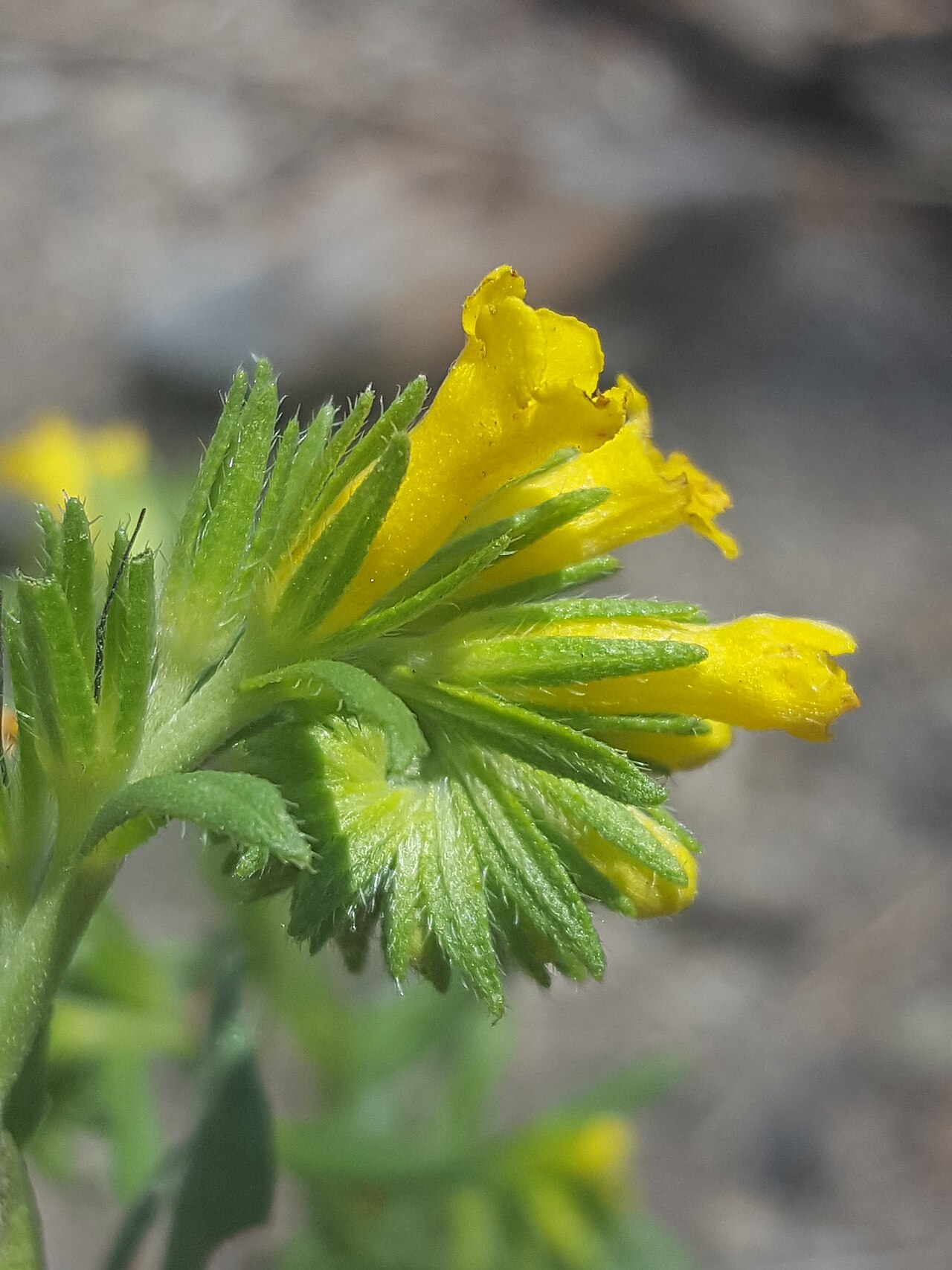
Lithospermum multiflorum, known as Manyflowered Gromwell or manyflowered stoneseed (the USDA name), is a native perennial wildflower of the mountains of the American Southwest and the southern Rocky Mountains. From a woody taproot it sends up a clump of slender, leafy stems, usually 8 to 20 inches tall, tipped in summer with clusters of narrow, trumpet-shaped yellow flowers. It is a common sight in open ponderosa pine forests and mountain meadows from Wyoming to southern Arizona and western Texas.
It belongs to the borage family (Boraginaceae), together with bluebells, forget-me-nots and fiddlenecks. The genus name Lithospermum means “stone seed,” from the Greek lithos, stone, and sperma, seed, a reference to the hard, shiny white nutlets that follow the flowers. The species name multiflorum means “many-flowered.” Gromwell and puccoon are traditional names for plants in this genus.
Unlike the showy, spring-blooming puccoons of the plains, manyflowered gromwell is a summer bloomer of higher elevations. This guide covers how to identify it, where it grows, how to grow it in a dry mountain or rock garden, its value to pollinators and its place in the cultural history of the Southwest.
Identification
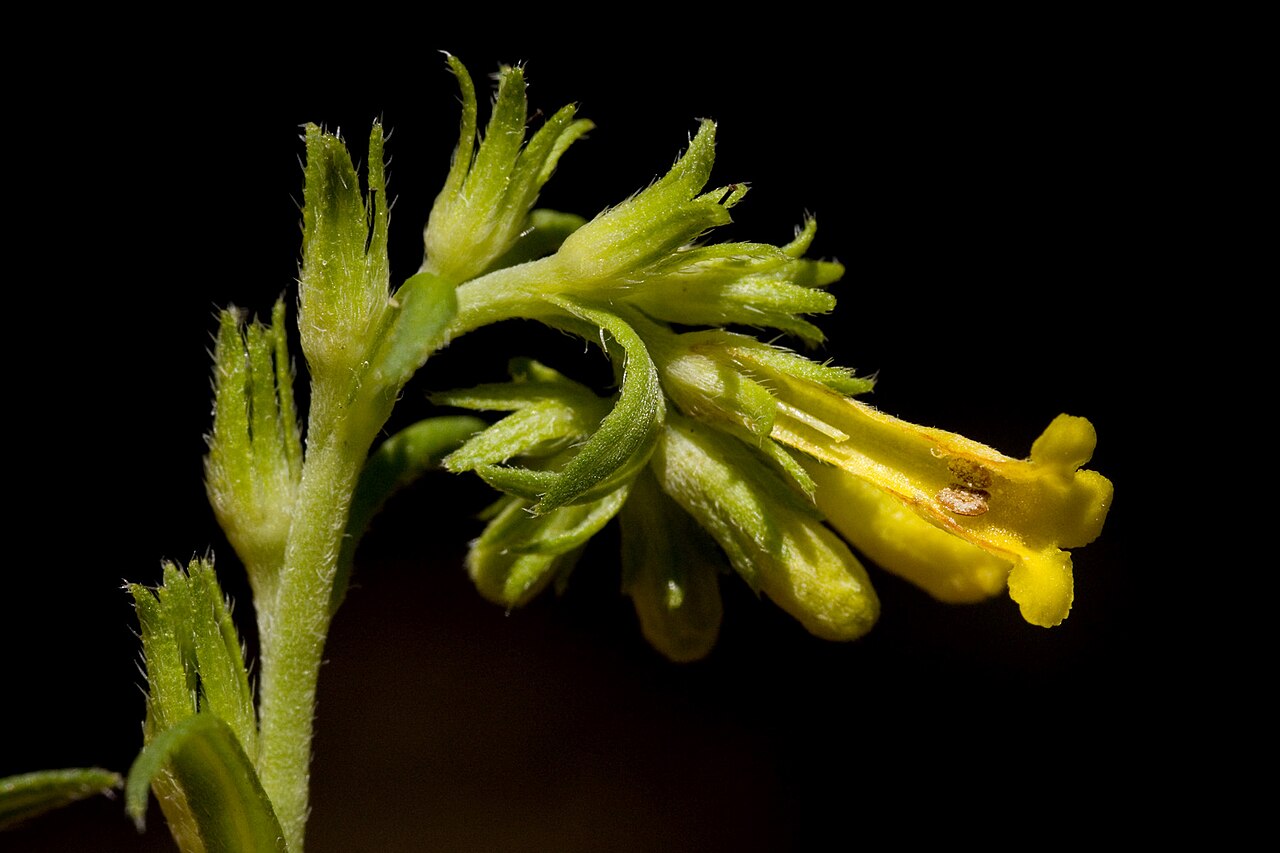
Manyflowered gromwell is a bushy, roughly hairy perennial with many leafy stems and tubular yellow flowers that stay narrow rather than flaring widely. Look for it in summer in open pine forests, oak scrub and meadows in the mountains of the Southwest.
Growth Habit
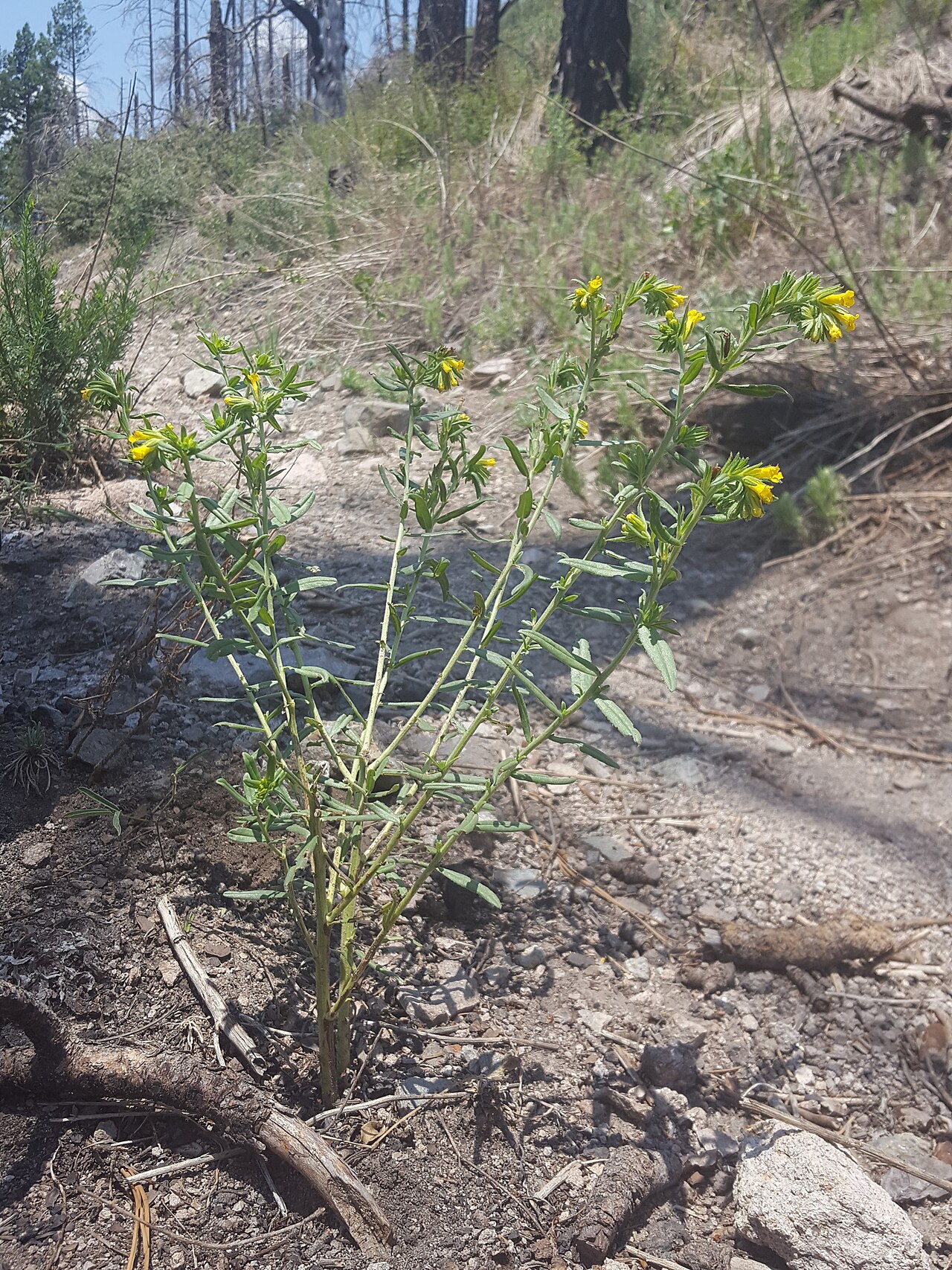
It forms a loose clump of several to many erect or ascending stems from a stout, woody taproot and crown. Plants are usually 8 to 20 inches tall, occasionally a little more. The stems are unbranched below and branch near the top into the flower clusters.
Leaves
The leaves are alternate, numerous and closely spaced along the stems, narrow (linear to lance-shaped) and mostly 1 to 2 1/2 inches long. They are stiff and roughly hairy, with flattened hairs that make them feel slightly sandpapery. The lowest leaves are small and often wither by flowering time.
Flowers
The flowers are carried in coiled, leafy clusters at the stem tips that uncurl as the buds open, a typical feature of the borage family. Each flower has a yellow to yellow-orange corolla, about 1/2 inch long, with a long, slender tube and five short, rounded lobes that spread only slightly. The edges of the lobes are smooth, not fringed. Five narrow, hairy sepals surround the base of the tube. It blooms mainly from June to September, depending on elevation.
Fruit & Seeds
Each flower produces up to four small nutlets. They are hard, smooth, glossy and white to ivory, like tiny polished stones, which is the origin of the names stoneseed and Lithospermum. They often remain in the old sepals on the dry stems into fall.
Roots
The plant grows from a deep, woody taproot. As in many members of the genus, the outer root tissue contains reddish to purple pigments.
Look-alikes
Narrowleaf puccoon (Lithospermum incisum) blooms in spring at lower elevations and has larger, bright lemon-yellow flowers with ruffled, toothed lobes. Western stoneseed (Lithospermum ruderale) is a larger, coarser plant of the northern Rockies and Great Basin with small, pale yellow flowers hidden among the leaves.
Quick Facts
| Scientific Name | Lithospermum multiflorum Torr. ex A. Gray |
| Family | Boraginaceae (borage family) |
| Plant Type | Herbaceous perennial wildflower |
| Mature Height | 8–20 in (occasionally to 2 ft) |
| Mature Spread | 8–18 in |
| Growth Rate | Slow to moderate |
| Sun Exposure | Full sun to part shade |
| Water Needs | Low; drought tolerant once established |
| Soil Type | Well-drained gravelly, rocky or sandy loam |
| Soil pH | About 6.0–8.0 |
| Bloom Time | June–September |
| Flower Color | Yellow to yellow-orange |
| Fall Color | None notable; stems dry tan |
| Fruit | Small, smooth, glossy white nutlets |
| Deer Resistant | Moderately; rough, hairy foliage is lightly browsed |
| USDA Hardiness Zones | 4–8 |
Native Range
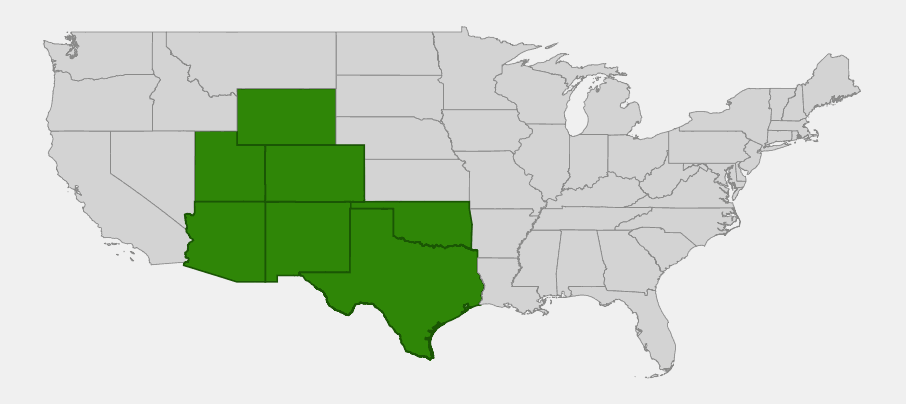
Manyflowered gromwell is native to the southern Rocky Mountains and the mountains of the Southwest. USDA PLANTS lists it in Arizona, Colorado, New Mexico, Oklahoma, Texas, Utah and Wyoming. It also extends south into the mountains of northern Mexico.
It is most common in Arizona, New Mexico and southern Colorado, in ranges such as the Mogollon Rim, the White Mountains, the Black Range, the Sacramento Mountains, the Jemez and Sangre de Cristo Mountains and the San Juan Mountains. It reaches its northern limit in southern Wyoming and extends into the mountains of Utah. In Texas it is found in the high mountains of the Trans-Pecos, and the Oklahoma records are from the far western part of the state, at the edge of the range.
It grows in dry to moderately moist openings in ponderosa pine, mixed conifer and aspen forests, in Gambel oak scrub, pinyon-juniper woodland near its lower limit and mountain meadows, usually on gravelly or rocky soils. It is a plant of mid to high elevations, mostly from about 6,000 to 10,000 feet.
📋 Regional plant lists featuring Manyflowered Gromwell: Montana & Wyoming · Utah & Western Colorado · Arizona & New Mexico · South & West Texas
Growing & Care Guide
Manyflowered gromwell is a tough, long-lived wildflower for dry gardens at higher elevations in the Southwest and Rocky Mountains. It is rarely sold by nurseries, and like other gromwells it can be slow and tricky to establish, but once its taproot is settled it needs little care and flowers for much of the summer.
Light
Grow it in full sun or light, open shade such as under the high canopy of pines. In deep shade it becomes sparse and flowers poorly.
Soil & Water
It needs well-drained, gravelly, rocky or sandy soil; heavy, wet clay causes the crown and taproot to rot. Water occasionally during the first growing season while the root establishes, then little or not at all except in long droughts. In its mountain home it relies on winter snow and summer monsoon rains.
Planting Tips
Start with small, container-grown plants and set them out in spring or early summer, disturbing the roots as little as possible, since the long taproot resents transplanting. Place it among bunchgrasses such as blue grama or mountain muhly, or in a rock garden with penstemons, paintbrushes and other mountain wildflowers.
Pruning & Maintenance
No pruning is needed. Cut the dry stems back to the base in late fall or early spring, or leave them for winter interest and seed. Avoid fertilizer and rich amendments, which encourage weak, floppy growth.
Propagation
Grow it from seed. The hard nutlets have deep dormancy and germinate best after a long period of cold, moist stratification over winter, so sow them outdoors in fall or stratify them in the refrigerator for several months; germination is often slow and uneven. Seedlings form a taproot early and should be grown in deep pots. Do not dig plants from the wild; they rarely survive.
Landscape Uses
- Mountain and rock gardens: a long-blooming yellow wildflower for dry, gravelly soils
- Pine forest restoration: for openings, burned areas and road cuts in ponderosa pine country
- Pollinator gardens: tubular flowers for long-tongued bees, butterflies and moths
- Meadow plantings: mixes well with native bunchgrasses at higher elevations
- Xeriscapes: needs little water once established
Wildlife & Ecological Value
Manyflowered gromwell adds nectar and color to dry mountain forests through the summer, and its long blooming season makes it a dependable resource for pollinators.
For Pollinators
The long, narrow corolla tube hides the nectar from short-tongued insects, so the flowers are visited mainly by long-tongued bees such as bumble bees and anthophorine bees, and by butterflies and moths. Smaller bees may collect pollen from the open mouth of the flower.
For Birds
The hard nutlets are eaten by some ground-feeding birds and are dispersed by them and by small mammals. The plants also provide some cover in open understories.
For Mammals
The rough foliage is browsed lightly by deer, elk and livestock, mostly when other forage is scarce. Rodents gather and cache the nutlets.
Ecosystem Role
As a deep-rooted perennial of fire-adapted ponderosa pine forests, manyflowered gromwell survives low-intensity fires and resprouts from its crown, and it often flowers well in burned and thinned forest openings. It is part of the diverse herbaceous understory that supports insects and wildlife in southwestern mountain forests.
Cultural & Historical Uses
Roots of several Lithospermum species contain red to purple pigments related to shikonin, and gromwells and puccoons were widely used by Indigenous peoples of North America as a source of dye and as medicine. The word puccoon comes from an Algonquian name for plants used to make red dye. Some species were also used medicinally, and several are known to contain compounds with strong physiological effects; the plants should not be eaten or used as home remedies.
Manyflowered gromwell was formally named by Asa Gray from a name proposed by John Torrey, the two botanists who described much of the flora collected in the American Southwest during the nineteenth century. The name gromwell comes from an old English and French name for the European Lithospermum officinale, and was later applied to the American species.
Today the plant is best known to hikers in the mountains of the Southwest as one of the steady yellow wildflowers of pine forest trails, blooming from early summer through the monsoon season.
Frequently Asked Questions
When does manyflowered gromwell bloom?
Mainly from June to September, depending on elevation, with a long flowering season that continues through the summer monsoon in the Southwest.
Why is it called stoneseed?
Its seeds are small, hard, glossy white nutlets that look like tiny polished stones. The genus name Lithospermum also means “stone seed.”
How is it different from narrowleaf puccoon?
Narrowleaf puccoon blooms in spring at lower elevations and has larger, bright lemon-yellow flowers with ruffled lobes. Manyflowered gromwell blooms in summer in the mountains and has narrower, smooth-edged flowers.
Can I grow manyflowered gromwell in my garden?
Yes, in dry, well-drained gravelly soil and full sun to light shade, especially at higher elevations in the Southwest. It is rarely sold, so it is usually grown from seed, which needs cold stratification.
Is manyflowered gromwell edible?
No. Several gromwells contain strong compounds and are not considered safe to eat. Enjoy it as a wildflower.

Looking for a nursery that carries Manyflowered Gromwell?
Browse our native plant nursery directory: Arizona · Colorado · New Mexico & Oklahoma · Texas & Utah · Wyoming

