
Native Bluestems (Andropogon)
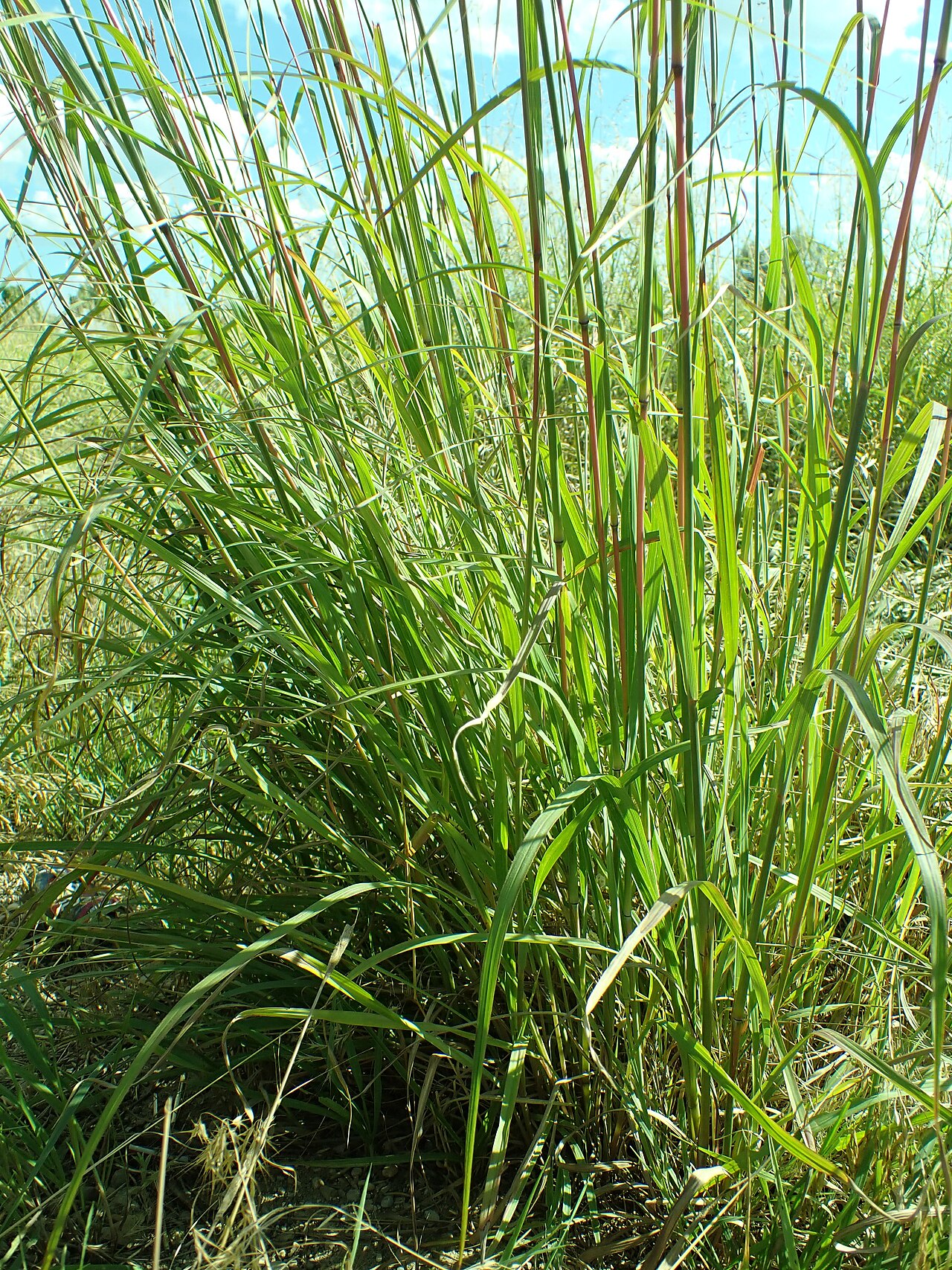
Bluestems in the genus Andropogon are warm-season bunchgrasses of the grass family (Poaceae). The name comes from the blue-green to purplish color of the stems and leaves in summer, and many species turn rich shades of orange, copper and red in fall. About 15 species are native to the United States, and they range from the towering big bluestem of the tallgrass prairie to the soft, silvery bluestems of Florida’s pine flatwoods and bogs.
If you arrived here from our Florida article, the “bluestem” that grows “throughout much of Florida” is not one plant but a group. Florida’s common native species include bushy bluestem, a fluffy-topped grass of wet ditches and pond edges; broomsedge, the tawny grass of old fields and roadsides; splitbeard bluestem of dry sandhills; and chalky bluestem, a silvery-blue form prized by Florida landscapers. All of them are perennial, grow best in full sun, and turn copper to orange in fall and winter. Their “flowers” are tiny and wind-pollinated, followed by plumes of silky white seed hairs that catch the light from fall into winter.
Bluestems are some of the most useful native grasses you can plant. They hold soil, feed and shelter wildlife, need no fertilizer and little water once established, and give a garden movement and winter color. The one caution is naming: several grasses called “bluestem” belong to other genera. little bluestem, the most popular native ornamental grass in the country, was once in Andropogon and is now Schizachyrium scoparium, and the aggressive “Old World bluestems” planted for pasture in Texas and Oklahoma come from Asia and Europe.
Identification
Bluestems are easiest to identify in late summer and fall, when they flower and set seed. Look at the flowering stems, the seed heads and the fall color.
Growth Form
All native Andropogon are perennial bunchgrasses that form upright clumps of leaves with taller flowering stems above. Size ranges from 2 to 3 feet (broomsedge, splitbeard bluestem) to 6 to 8 feet (big bluestem). Big bluestem and sand bluestem spread slowly by short rhizomes and can form sod; the southeastern species stay in tidy bunches. Stems are often blue-green or glaucous in summer, especially near the base.
Leaves
Leaves are long, flat or folded, 1/8 to 1/2 inch wide, and often hairy near the base where the blade meets the sheath. In many species the lower leaves and sheaths are flattened and keeled. In fall the foliage turns copper, orange, bronze or reddish purple, and most species hold that color through winter.
Flower & Seed Heads
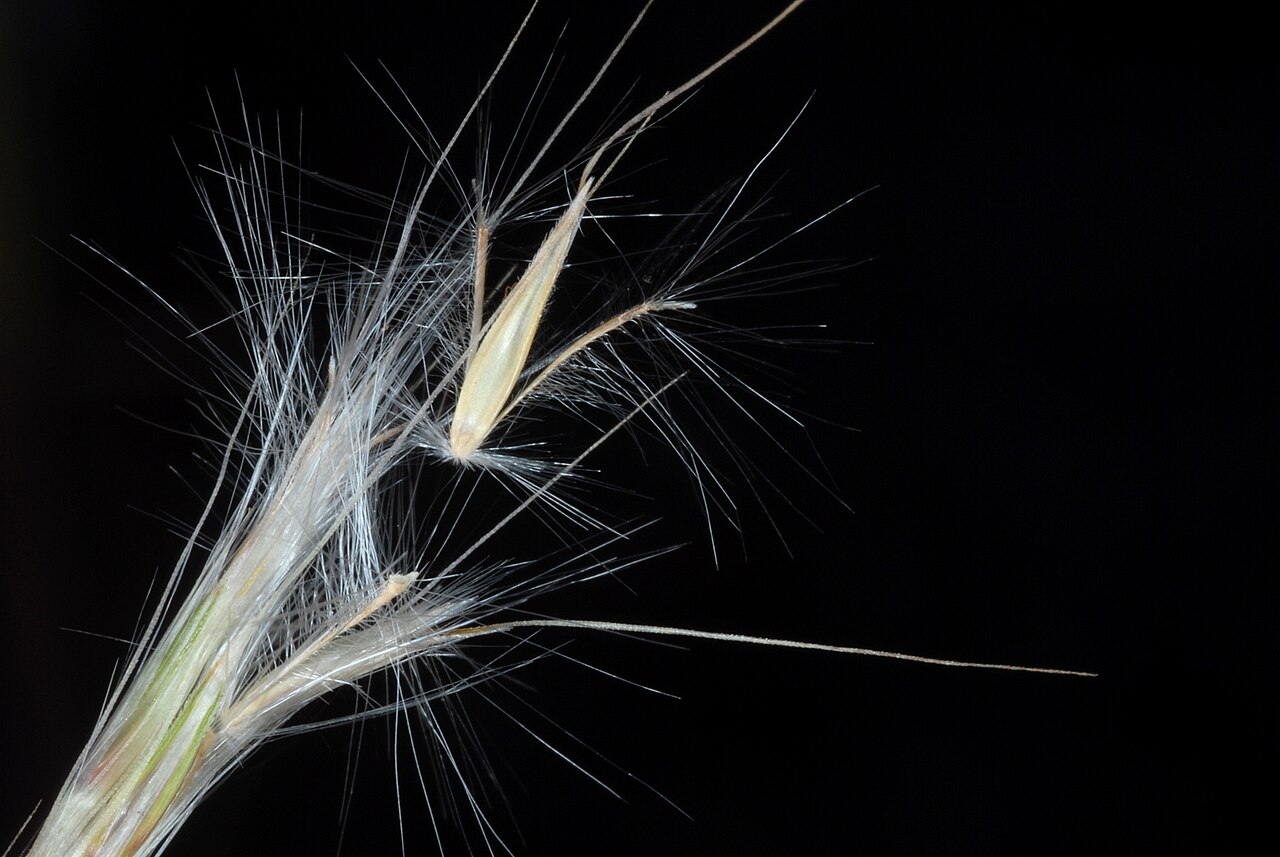
The flowers are tiny spikelets arranged in short, finger-like branches called racemes. In bluestems the racemes are usually borne in pairs (sometimes in threes or more), each pair partly hidden in a leafy sheath, and the joints of the racemes carry long, silky white hairs. As the seed ripens, the hairs fluff out so that the seed heads look like little cotton tufts or feathery plumes. Big bluestem is the exception in shape: its three (sometimes two to six) racemes spread from the top of the stem like a bird’s foot, earning it the name “turkeyfoot.”
Telling Bluestems Apart
Bushy bluestem has dense, broom-like clusters of fluffy seed heads at the top of the stem. Broomsedge has many small, scattered seed heads tucked in sheaths along the upper half of the stem. Splitbeard bluestem has silvery, widely split pairs of racemes on slender stalks. Little bluestem, in a separate genus, has single (not paired) racemes along the stem and fluffy white seeds that make whole plants shimmer in fall.
Quick Facts
| Scientific Name | Andropogon (genus) |
| Family | Poaceae (Grass) |
| U.S. Native Species | About 15, most in the Southeast |
| Plant Type | Warm-season perennial bunchgrasses |
| Mature Height | 2–3 ft (broomsedge, splitbeard) to 6–8 ft (big bluestem) |
| Mature Spread | 1–3 ft clumps |
| Growth Rate | Moderate; slow to establish, then long-lived |
| Sun Exposure | Full Sun |
| Water Needs | Low for prairie and sandhill species; moist to wet for bushy and Mohr’s bluestem |
| Soil Type | Sand, loam or clay; most prefer poor, well-drained soil |
| Soil pH | Acidic to slightly alkaline (about 5.0–7.5) |
| Bloom Time | Late summer – fall |
| Flower Color | Inconspicuous; purplish anthers, then silky white seed hairs |
| Fall Color | Copper, orange, bronze, red-purple; persists into winter |
| Fruit | Small grains carried on fluffy, hairy seed heads |
| Deer Resistant | Yes |
| USDA Hardiness Zones | 3–10 across the genus (big bluestem 3–9; southeastern species 6–10) |
Native Range
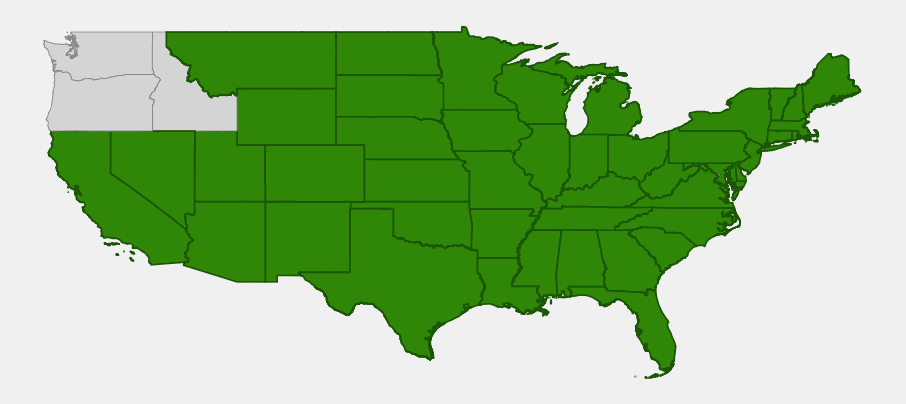
Native bluestems grow wild in 45 of the lower 48 states. Big bluestem alone covers most of the country east of the Rockies, from Maine and the Dakotas south to Florida and Texas, with scattered populations in Montana, Wyoming, Colorado, Utah, Arizona and New Mexico. It was one of the dominant grasses of the tallgrass prairie from Illinois and Iowa to eastern Kansas and Nebraska.
The greatest number of species is in the Southeast, especially the coastal plain from North Carolina to Florida and west to Texas. There, bluestems grow in longleaf pine savannas, flatwoods, sandhills, bogs, wet prairies and old fields, often several species together. Florida has a dozen or so native Andropogon species, more than almost any other state. Sand bluestem replaces big bluestem on the Nebraska Sandhills and other sandy soils of the Great Plains, and bushy bluestem extends west along wet ground to Arizona, southern Nevada and California.
No Andropogon is native to Washington, Oregon or Idaho, and none to Alaska. Broomsedge grows in Hawaii, but it is an introduced and invasive grass there, as it is in Australia and parts of Asia, so Hawaii is left off the map.
📋 Regional plant lists covering native bluestem country: Georgia, Alabama & Mississippi · North & South Carolina · Arkansas, Louisiana, Eastern Oklahoma & East Texas · South & West Texas · Kentucky & Tennessee · Maryland, Virginia & West Virginia · Delaware, South Jersey & Long Island · New York, Pennsylvania & North Jersey · Southern New England · Northern New England · Ohio & Indiana · Illinois, Iowa & Missouri · Michigan, Wisconsin & Eastern Minnesota · Dakotas & Western Minnesota · Nebraska, Kansas & Eastern Colorado · Montana & Wyoming · Arizona & New Mexico · Utah & Western Colorado · California & Nevada
Native Species
These are the main bluestems native to the United States, plus two closely related native grasses that were long classified in Andropogon and are still often sold or listed as bluestems. Every species with a full Plant Native profile is linked.
Big Bluestem (Andropogon gerardii)
The king of the tallgrass prairie, 4–8 ft tall, with blue-green summer foliage, three-branched “turkeyfoot” seed heads and bronze to wine-red fall color. Native from Maine and southern Canada to Florida and west through the Great Plains, with outlying populations in the Southwest. Deep roots make it superb for erosion control, but it can overwhelm small gardens in rich soil.
Sand Bluestem (Andropogon hallii)
A close relative of big bluestem (sometimes treated as a subspecies) adapted to deep sand, from Montana and North Dakota south through the Nebraska Sandhills to Texas, New Mexico, Arizona and Utah. It spreads by longer rhizomes, has yellowish hairs on the seed heads and is used to stabilize blowing sand.
Broomsedge (Andropogon virginicus)
The familiar orange-tan grass of eastern and southern old fields, 2–4 ft tall, with small seed heads hidden in sheaths along the upper stems. Native from southern New England and the lower Great Lakes south to Florida and Texas. It thrives on poor, acidic, eroded soil and was once taken as a sign of worn-out farmland. Its winter color is striking in meadows. We also have an earlier Broom Sedge profile of the same species. A silvery-blue variety, sold as chalky bluestem (A. virginicus var. glaucus, also listed as A. capillipes), is one of the most popular native grasses in Florida landscapes.
Bushy Bluestem (Andropogon glomeratus)
A grass of wet ground: ditches, pond and lake margins, bogs, seeps and wet pine flatwoods, 2–5 ft tall, topped in fall by dense, broom-like masses of fluffy seed heads that glow copper in winter. Native from the Atlantic coast to Florida and Texas, and west along springs and streams to Arizona, southern Nevada and California. One of the best native grasses for rain gardens and pond edges in Florida.
Mohr’s Bluestem (Andropogon mohrii)
A slender bluestem of wet pine savannas, bogs and seepage slopes on the southeastern Coastal Plain, with feathery seed heads held in narrow sheaths along the upper stem. Uncommon, and a good indicator of intact, frequently burned wetland savanna.
Splitbeard Bluestem (Andropogon ternarius)
A graceful 2–4 ft bunchgrass of dry, sandy pinelands, sandhills and old fields from Delaware and Missouri to Florida and Texas. Its pairs of racemes spread apart in a “split beard” of silvery-white hairs, and the foliage turns coppery red in fall. A fine ornamental for sandy, sunny sites.
Elliott’s Bluestem (Andropogon gyrans)
A low, 1–3 ft bluestem of the Southeast and lower Midwest whose seed heads are wrapped in conspicuous, inflated, coppery sheaths near the top of the stem. It grows in open woods, savannas and old fields and keeps good orange color in winter.
Pinewoods Bluestem (Andropogon arctatus)
A bluestem of dry to moist pine flatwoods and sandhills, found mainly in Florida. It flowers heavily after fire and is part of the classic flatwoods grass layer with wiregrass.
Little Bluestem (Schizachyrium scoparium)
Formerly Andropogon scoparius and still the grass most people mean by “bluestem” in gardens. A 2–4 ft bunchgrass native to every lower 48 state, with blue-green summer leaves and brilliant copper-red fall color. Its single racemes and shimmering white seeds distinguish it from true Andropogon. Cultivars include ‘The Blues’ and ‘Standing Ovation’.
Silver Beard Grass (Andropogon saccharoides)
Better known today as silver bluestem (Bothriochloa laguroides subsp. torreyana), a native bunchgrass of the southern Plains and Southwest, 1–3 ft tall, with silky, silvery-white seed heads. It belongs to the same genus as the invasive Old World bluestems below, but this one is native.
Non-Native Look-Alikes
“Bluestem” is used for several grasses that are not native. The most important to recognize are the Old World bluestems of the southern Great Plains.
Old World bluestems are a group of Eurasian and African grasses in the genera Bothriochloa and Dichanthium that were planted widely for pasture and erosion control in Texas, Oklahoma and Kansas in the mid-1900s. The most common are yellow bluestem or King Ranch bluestem (Bothriochloa ischaemum), Caucasian bluestem (B. bladhii), and Kleberg bluestem and Angleton bluestem (Dichanthium annulatum and D. aristatum). They are now invasive in native prairies and roadsides across Texas, Oklahoma and Kansas, where they form dense stands that crowd out native grasses and wildflowers and offer poor food and cover for wildlife. They also occur in parts of the Southeast, including Florida. Old World bluestems usually have finger-like seed heads clustered at the top of the stem and stay green-yellow or tan rather than taking on the coppery fall color of native bluestems.
Broomsedge outside its range: although broomsedge is native across the eastern U.S., it is an aggressive introduced weed in Hawaii, where it invades pastures and native shrublands and increases fire risk. Hawaiian gardeners should not plant it.
In Florida, a few other tall grasses are sometimes confused with bluestems. Cogongrass (Imperata cylindrica), one of the worst invasive plants in the Southeast, has fluffy white seed heads in spring, not fall, and spreads aggressively by sharp-tipped rhizomes; report it rather than planting near it. Natalgrass (Melinis repens), an African grass with pink to rosy seed heads, is common on Florida roadsides. Neither has the paired, hairy racemes of a true bluestem.
Finally, two native grasses often grouped with bluestems are not Andropogon: little bluestem (Schizachyrium) and silver bluestem and cane bluestem (Bothriochloa laguroides and B. barbinodis). These are excellent native choices.
Growing & Care Guide
Native bluestems are long-lived, low-maintenance grasses for sunny sites. Match the species to your soil moisture and they need almost no care.
Light
Give bluestems full sun, at least six hours a day. In shade they grow lanky, flop and color poorly in fall.
Soil & Water
Most bluestems prefer lean, well-drained soil. Broomsedge, splitbeard and pinewoods bluestem do best on poor, sandy or rocky ground, and big and sand bluestem handle dry prairie soils once established. In rich, irrigated garden soil, big bluestem grows very tall and may lodge. Bushy bluestem and Mohr’s bluestem are the exceptions: they need moist to wet soil and tolerate standing water for part of the year, making them ideal for rain gardens, swales and pond margins. Water all bluestems during their first growing season; after that, upland species need watering only in severe drought.
Planting Tips
Plant container-grown plugs in spring or early summer, when soils are warm; warm-season grasses root fastest in heat. In Florida and the Gulf Coast, planting at the start of the summer rainy season works well. Space clumps 18 to 24 inches apart for a meadow effect, or 3 ft apart for big bluestem. Seed can be sown in late spring or, with stratification, in late fall. Do not fertilize: extra nitrogen favors weeds and causes floppy growth.
Pruning & Maintenance
Leave the foliage standing through winter for color, seed and wildlife cover. Cut clumps back to 4 to 6 inches in late winter or early spring before new growth starts. In larger meadows, periodic prescribed burning or mowing in late winter mimics the fires that maintained bluestem prairies and savannas, removes thatch and stimulates flowering. Bluestems have few pests or diseases.
Propagation
All bluestems grow readily from seed. Collect seed heads in fall when the hairs fluff out, and sow fresh or after a month or two of cold, moist storage. Established clumps of big bluestem and bushy bluestem can be divided in spring.
Landscape Uses
- Prairie and meadow plantings with big bluestem, little bluestem, Indiangrass and wildflowers
- Rain gardens, swales and pond edges with bushy bluestem
- Florida habitat gardens with chalky bluestem, splitbeard bluestem and bushy bluestem
- Erosion control on slopes, roadsides and sandy sites with big, sand and broomsedge bluestems
- Winter interest: copper and orange color from fall until spring cutback
- Replacing non-native ornamental grasses such as maiden grass (Miscanthus)
Wildlife & Ecological Value
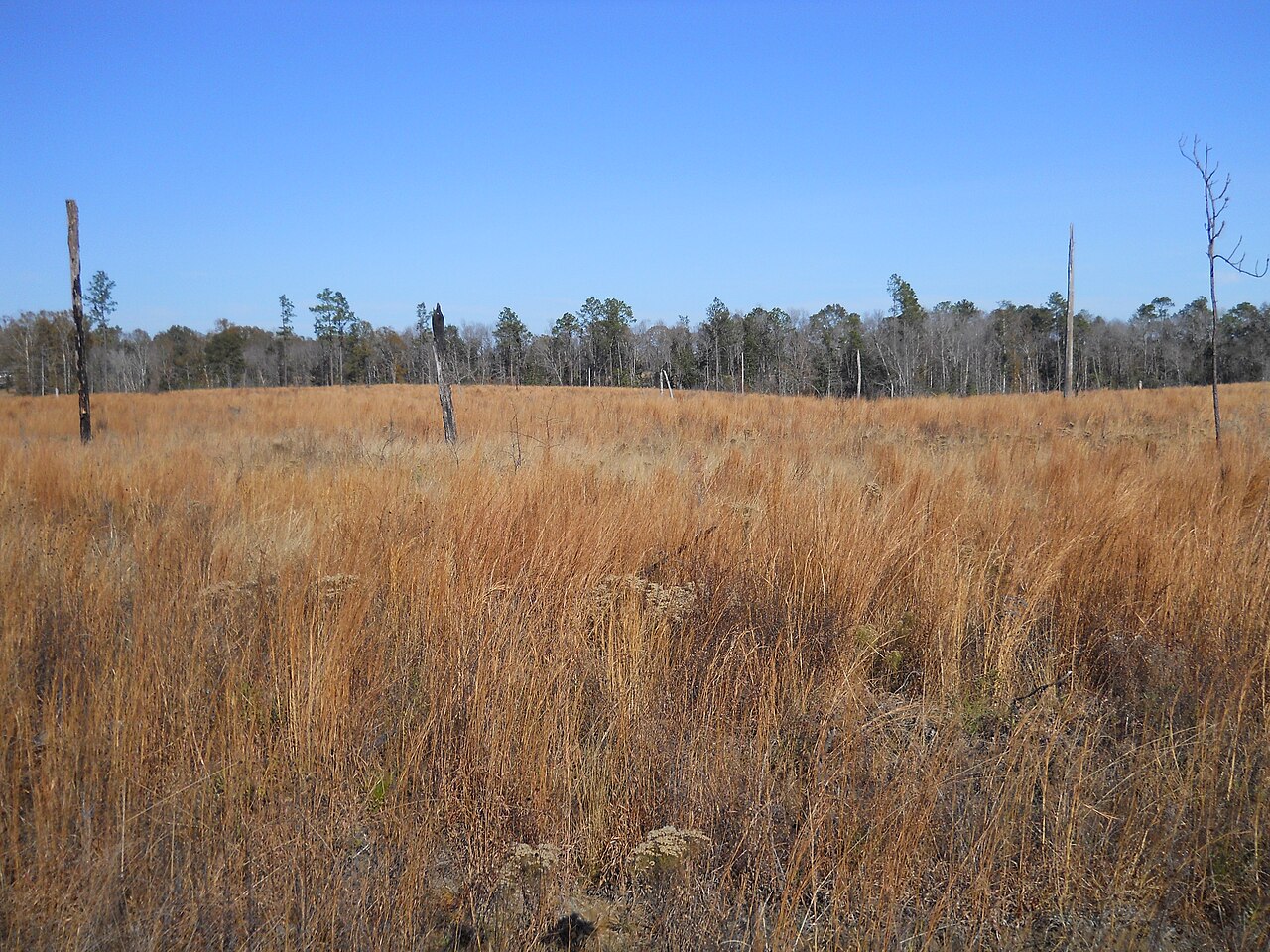
Bluestems are foundation plants of prairie and savanna ecosystems, supporting insects, birds and mammals from seed to winter cover.
For Pollinators
Bluestems are wind-pollinated and offer little to bees, but they are important larval host plants. Big bluestem, broomsedge and other bluestems feed the caterpillars of several grass skippers, including the Delaware skipper and dusted skipper, as well as many grass-feeding moths. Bunch-forming clumps provide overwintering shelter for ground-nesting bees and other insects.
For Birds
Sparrows, juncos, towhees and buntings eat bluestem seeds in fall and winter. Standing clumps give cover to northern bobwhite quail, wild turkeys and grassland birds, and many birds use the soft leaves and seed hairs to line their nests. Bushy bluestem stands along wetlands shelter rails, wrens and sparrows.
For Mammals
Big bluestem is highly nutritious forage, grazed by bison, elk and deer in the wild and long valued by ranchers. Broomsedge and the southeastern species are less palatable once mature. Rabbits and small rodents shelter and nest in the clumps.
Ecosystem Role
Deep, fibrous roots, often more than 6 ft down in big bluestem, build soil organic matter, hold slopes and help water soak into the ground. Bluestem grasslands depend on fire: the grasses resprout quickly after burns, and their dry fall foliage carries the low fires that keep prairies and pine savannas open.
Cultural & Historical Uses
Big bluestem was the tallest and most famous grass of the tallgrass prairie, and early settlers wrote of grass so tall it could hide a rider on horseback. Its deep sod was what the “breaking” plows of the 1800s cut through to turn prairie into cropland. Today big bluestem is the official state grass of Illinois and Missouri, and little bluestem, once considered an Andropogon, is the state grass of Nebraska and Kansas.
Broomsedge got its name from the brooms made from its stiff, dry stems in the rural South. It was also used as bedding and packing material. Because it colonizes poor, acidic soil, generations of farmers read a field of broomsedge as a sign that the land needed rest or lime.
In the twentieth century, bluestems became central to prairie restoration and soil conservation. After the Dust Bowl, the Soil Conservation Service and plant materials centers developed seed sources of big bluestem, sand bluestem and little bluestem for replanting eroded land, and many of those seed releases are still used in restorations today.
Frequently Asked Questions
What is the bluestem grass that grows all over Florida?
Florida has several native bluestems. The most common are broomsedge and its silvery variety chalky bluestem in dry, open areas, bushy bluestem in wet ditches and pond edges, and splitbeard and pinewoods bluestems in sandhills and flatwoods. All are native, sun-loving perennial grasses with fluffy fall seed heads.
Is little bluestem an Andropogon?
Not anymore. Little bluestem was once named Andropogon scoparius but is now Schizachyrium scoparium. It is a close relative, native to every lower 48 state, and one of the best native ornamental grasses.
Are bluestems invasive?
Native Andropogon species are not invasive in their native range, though broomsedge can be weedy in pastures. The invasive “bluestems” are the Old World bluestems (Bothriochloa and Dichanthium) from Eurasia, which spread through prairies in Texas, Oklahoma and Kansas. Broomsedge is invasive in Hawaii.
When should I cut back bluestem grass?
In late winter or early spring, before new green shoots appear. Leaving the foliage up through winter gives color, seed for birds and shelter for overwintering insects.
Which bluestem is best for wet soil?
Bushy bluestem. It grows naturally in ditches, bogs and along ponds and tolerates standing water for part of the year, while keeping its fluffy copper seed heads into winter.

Looking for a nursery that carries native bluestems?
Browse our native plant nursery directory: Alabama, Arizona & Arkansas · California · Colorado, Connecticut, Delaware, Florida & Georgia · Illinois, Indiana, Iowa & Kansas · Kentucky, Louisiana, Maine, Maryland, Massachusetts, Michigan, Minnesota, Mississippi, Missouri & Montana · Nebraska, Nevada, New Hampshire, New Jersey, New Mexico, New York, North Carolina, North Dakota, Ohio & Oklahoma · Pennsylvania, Rhode Island, South Carolina, South Dakota, Tennessee, Texas, Utah, Vermont & Virginia · West Virginia, Wisconsin & Wyoming

