
Native Mountain Ashes (Sorbus)
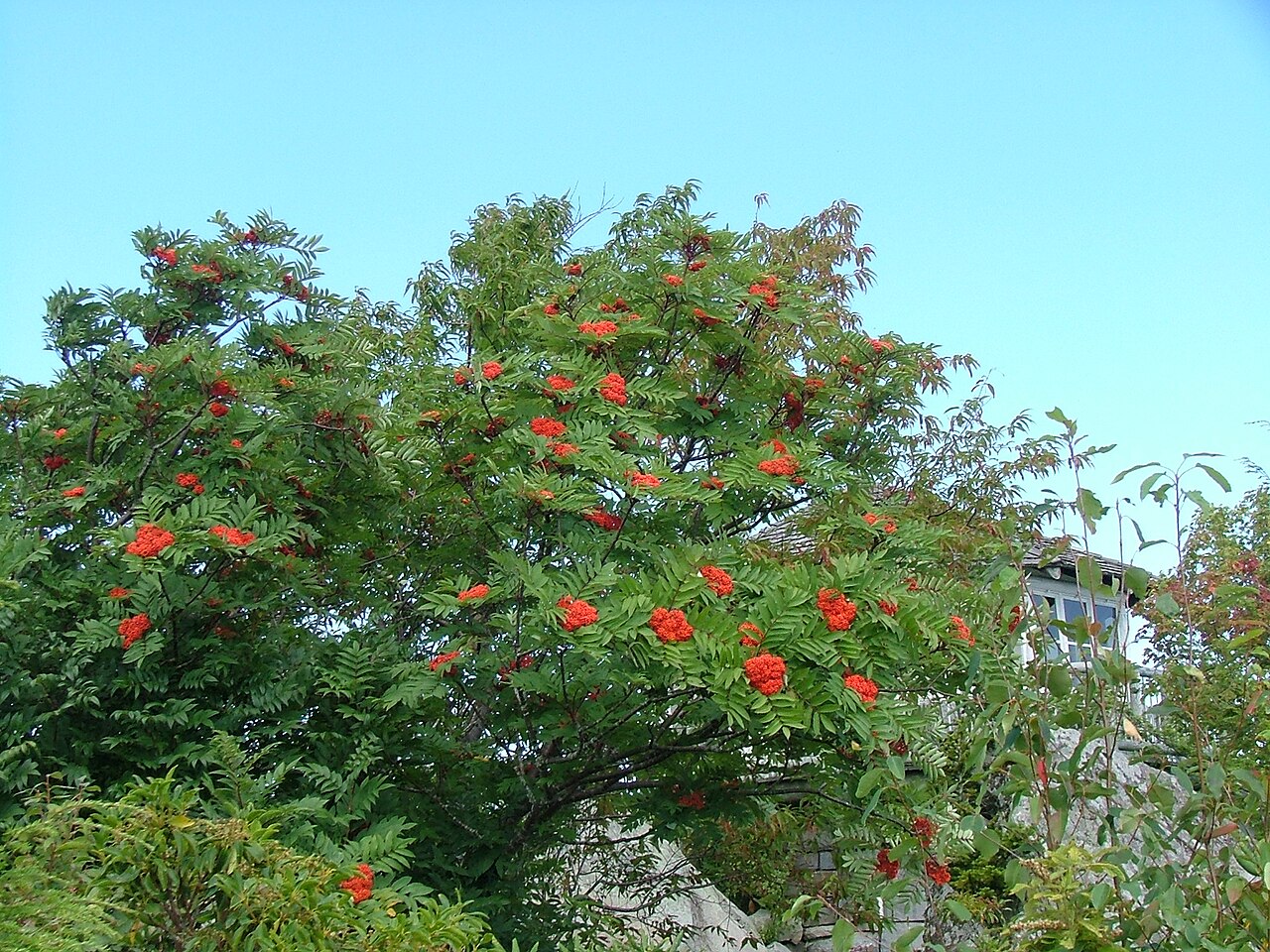
Mountain ashes (genus Sorbus) are small trees and shrubs of the rose family with feathery, compound leaves, flat clusters of white flowers in late spring and heavy bunches of orange to scarlet fruit that hang on into winter. The United States has five or six native species, depending on how botanists split them: American mountain ash and showy mountain ash in the Northeast, Great Lakes and Appalachians, and three or four shrubby species in the mountains of the West and Alaska (some botanists split the western shrubs more finely than others).
Many of the mountain ashes planted in yards and along streets, however, are not native. The European mountain ash or rowan (Sorbus aucuparia) has been planted across the northern United States for well over a century, and birds have carried its seeds into woods and fields from New England and Michigan to the Pacific Northwest and Alaska. If your mountain ash came from a garden center, there is a good chance it is the European species. This guide explains how to tell the native species from rowan and its relatives, where each native grows, and how to grow them.
Despite the name, mountain ashes are not ashes. True ashes (Fraxinus) belong to the olive family, have leaves in opposite pairs and dry, winged seeds. Mountain ashes have alternate leaves and fleshy fruit, and they are not attacked by the emerald ash borer, which has killed millions of true ash trees.
Identification
All mountain ashes share the same basic plan, so the genus is easy to recognize. Telling the species apart takes a closer look at leaflets, buds and fruit.
Growth Form
The two eastern natives are small, often multi-stemmed trees, usually 15 to 30 feet tall, with a narrow, open crown. The western natives are mostly shrubs 3 to 15 feet tall with several stems from the base. The bark is smooth, thin and gray to reddish-gray, with horizontal lenticels much like a cherry’s, becoming slightly scaly on old trunks.
Leaves
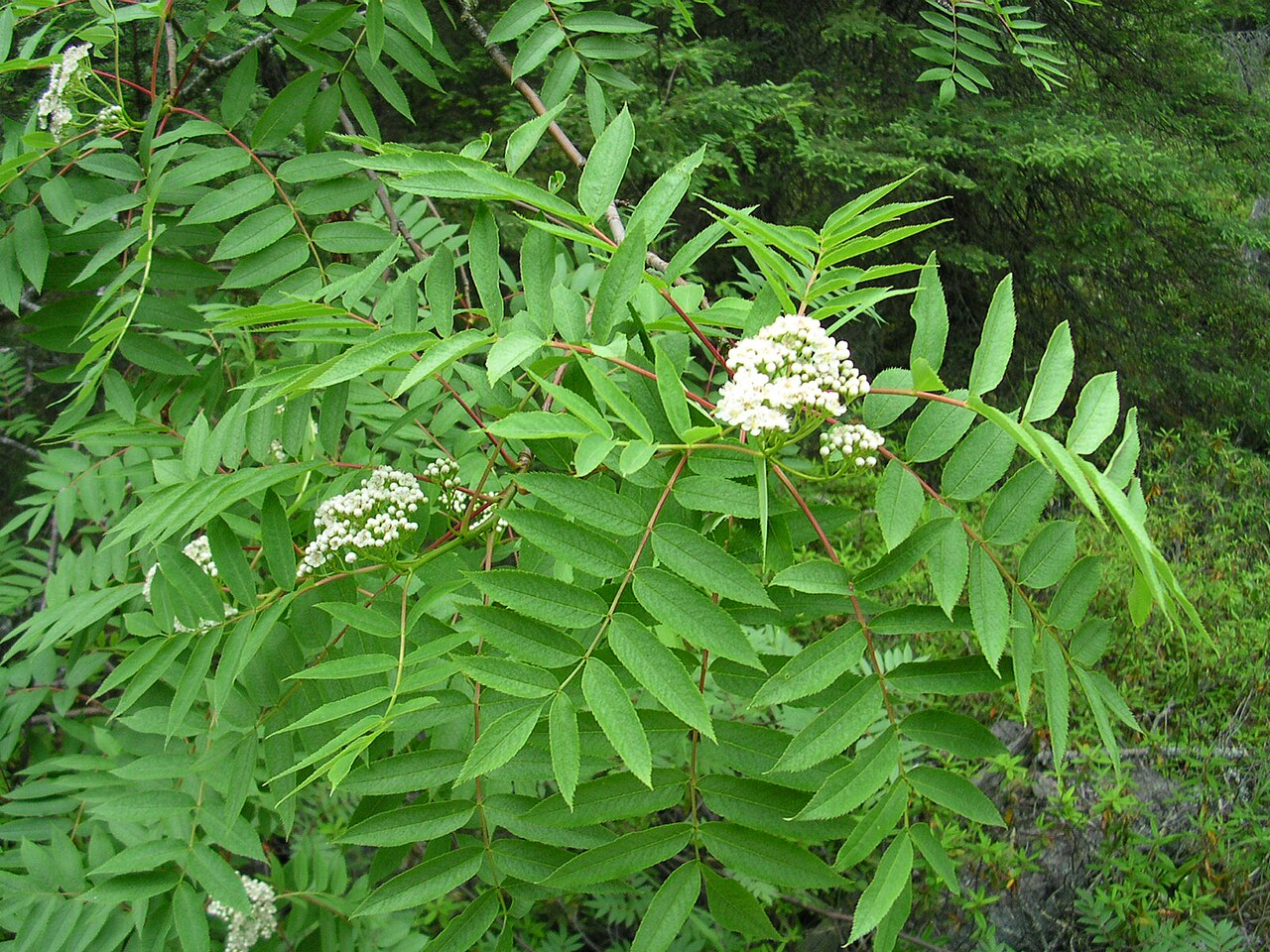
Leaves are alternate and pinnately compound, 6 to 10 inches long, with 7 to 17 toothed leaflets arranged in pairs along a central stalk, plus one at the tip. The number, shape and toothing of the leaflets are the main clues to species. Fall color ranges from yellow to orange and red, especially in the western shrubs.
Buds
Winter buds are a reliable field mark. American mountain ash has dark reddish-brown, sticky, mostly hairless buds. Showy mountain ash buds are also dark but usually somewhat hairy. European mountain ash has buds covered with gray-white wool and no stickiness.
Flowers
Small white flowers, about ¼ to ⅜ inch across, with five rounded petals and many stamens, open in flat or slightly domed clusters 3 to 6 inches wide in late spring and early summer. Some people find their scent unpleasant. Showy mountain ash blooms about a week to ten days earlier than American mountain ash where the two grow together.
Fruit & Seeds
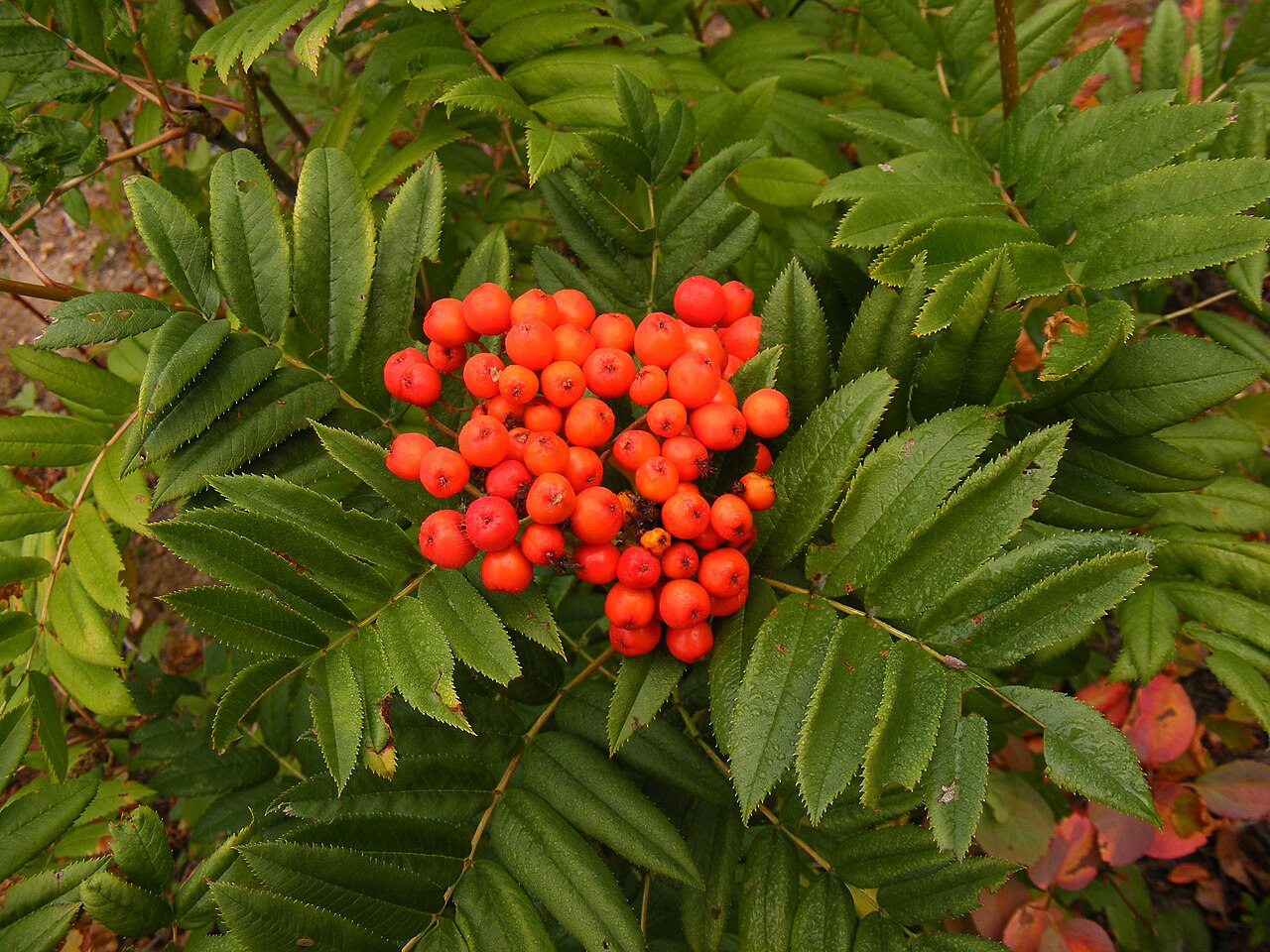
The fruit is a small pome, a miniature apple ¼ to ⅜ inch across, ripening orange, orange-red or scarlet in late summer and fall. Each holds a few small seeds. The fruit often stays on the branches well into winter, until birds strip it. Raw fruit is sour and bitter and contains parasorbic acid, which can upset the stomach, so it should not be eaten raw.
Quick Facts
| Scientific Name | Sorbus (mountain ashes); 5–6 species native to the United States |
| Family | Rosaceae (Rose family) |
| Plant Type | Deciduous small trees (eastern species) and multi-stemmed shrubs (western species) |
| Mature Height | 3–15 ft (western shrubs); 15–30 ft (American and showy mountain ash) |
| Mature Spread | 4–20 ft |
| Growth Rate | Moderate |
| Sun Exposure | Full sun to part shade |
| Water Needs | Moderate; needs evenly moist soil and cool summers |
| Soil Type | Moist, well-drained, acidic loam, sand or rocky soil |
| Soil pH | Acidic to neutral (about 4.5–7.0) |
| Bloom Time | May – July, depending on species and elevation |
| Flower Color | White, in flat clusters |
| Fall Color | Yellow, orange or red |
| Fruit | Orange to scarlet pomes in large clusters, persisting into winter |
| Deer Resistant | No; deer and moose browse the twigs |
| USDA Hardiness Zones | About 2–6 for eastern species; about 3–7 for western species |
Native Range
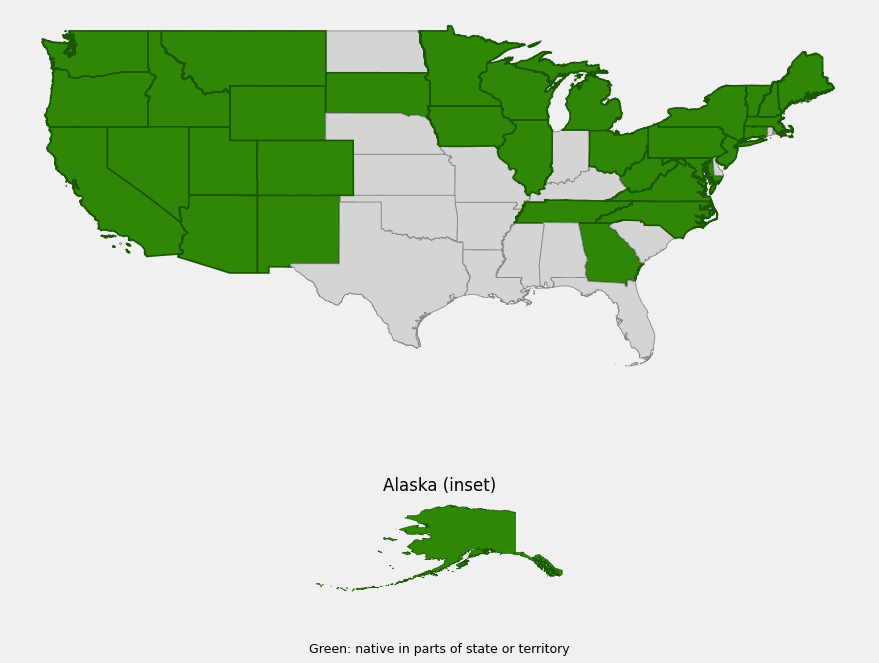
Native mountain ashes are plants of cold climates. In the East they grow across the boreal and northern hardwood forests of New England, New York and the Great Lakes states, and follow the Appalachians south on high ridges, rocky summits and spruce–fir forests to North Carolina, Tennessee and the northern edge of Georgia. In the West they grow in mountain forests, subalpine meadows and rocky slopes from Alaska south through the Cascades, Sierra Nevada and Rocky Mountains to Arizona and New Mexico, with an outlying population in the Black Hills of South Dakota.
Several states have only small, rare native populations: showy mountain ash in Ohio and Iowa, and American mountain ash in Illinois, Maryland, New Jersey and Georgia. In Rhode Island, both native species are absent or treated as introduced, and the mountain ashes growing wild in southern New England are often European rowan.
The European mountain ash has naturalized widely in the northern United States, including states such as Michigan, Wisconsin, Washington and Alaska, where it now grows alongside the natives. The map below shows only states with native Sorbus populations; states where mountain ash grows only as a planted or escaped tree are left blank.
📋 Regional plant lists with native mountain ashes: New Hampshire, Maine & Vermont · Connecticut, Massachusetts & Rhode Island · New York, Pennsylvania & Northern New Jersey · Maryland, Virginia & West Virginia · North Carolina & South Carolina · Georgia, Alabama & Mississippi · Kentucky & Tennessee · Ohio & Indiana · Illinois, Iowa & Missouri · Michigan, Wisconsin & Eastern Minnesota · North Dakota, South Dakota & Western Minnesota · Montana & Wyoming · Utah & Western Colorado · Arizona & New Mexico · Idaho, Eastern Oregon & Eastern Washington · Western Oregon & Washington · California & Nevada · Alaska
Native Species
These are the mountain ashes native to the United States. The four with links have full growing guides on Plant Native.
American mountain ash (Sorbus americana) is a small tree 15 to 30 feet tall of rocky woods, ridges and bog edges from Newfoundland and Minnesota south through New England and the Great Lakes, and along the Appalachian high country to North Carolina, Tennessee and Georgia. It has 11 to 17 long, narrow, sharply pointed leaflets, about three to four times as long as wide, sticky red-brown winter buds, and dense clusters of small orange-red fruit about ¼ inch across.
Showy mountain ash (Sorbus decora) is the more northern of the two eastern species, growing from Labrador and the Maritimes to Minnesota, south to New England, New York and the Great Lakes states. Its 11 to 17 leaflets are broader, about two to three times as long as wide, with short, abrupt tips, and its scarlet fruit is larger, about ⅜ inch across. It blooms about a week earlier than American mountain ash and is sometimes sold by native nurseries as the better ornamental of the two.
Greene’s or dwarf mountain ash (Sorbus scopulina) is the most widespread western species, a shrub 3 to 15 feet tall found from Alaska and British Columbia through the Cascades and Rockies to California, Arizona and New Mexico, and east to the Black Hills. It has 11 to 15 glossy, pointed leaflets that are toothed along most of their length, and shiny orange to red fruit. It grows at forest edges, on ridges, outcrops and roadcuts, and in clearings.
Sitka or western mountain ash (Sorbus sitchensis) is a shrub of the Pacific Northwest and Alaska, also found in northern California, Idaho and western Montana. It has fewer leaflets than other species, usually 7 to 11, with rounded or blunt tips and teeth mostly on the upper half. The fruit is red to orange-red. It grows in subalpine meadows, avalanche tracks and forest openings, often in deep snow country.
California mountain ash (Sorbus californica) is a shrub of the Sierra Nevada, Klamath Mountains and southern Cascades of California, reaching western Nevada and rarely southern Oregon. It is closely related to Sitka mountain ash and has 7 to 11 leaflets and red fruit. It grows on moist, rocky slopes and stream banks at middle to high elevations.
Non-Native Look-Alikes
Most mountain ashes sold for landscaping are European or Asian. They look similar to the natives, especially from a distance, so check the leaves and buds before buying.
- European mountain ash or rowan (Sorbus aucuparia): The common planted mountain ash across the northern United States, native to Europe and western Asia. It has 9 to 15 dull leaflets toothed along most of their length, woolly gray-white winter buds that are not sticky, and orange-red fruit. Birds spread its seeds, and it has naturalized in woods, bogs and old fields in New England, the Great Lakes states, the Pacific Northwest and Alaska, where it competes with native shrubs. Several agencies, including in Alaska, treat it as invasive. Cultivars such as ‘Cardinal Royal’ are rowans, not natives. It is the species named in the “Sorbus subg. Sorbus” heading on many tree lists: the subgenus includes both rowan and the American natives.
- Service tree (Sorbus domestica, also called Cormus domestica): A larger European tree with 13 to 21 leaflets and much larger, pear- or apple-shaped fruit about an inch long that turn brown when ripe. It is rarely planted in the United States and is not known to spread.
- Oak-leaf mountain ash (Sorbus × thuringiaca): A European hybrid of rowan and whitebeam, planted as a narrow street tree. Its leaves are lobed at the tip and divided into separate leaflets only near the base, unlike any native species.
- Whitebeams (Sorbus aria, S. intermedia and relatives, now often placed in separate genera such as Aria): European trees with simple, toothed or shallowly lobed leaves that are white or gray-felted beneath. They are related to mountain ashes but have undivided leaves.
- Korean mountain ash (Sorbus alnifolia, now Aria alnifolia): An Asian tree with simple, birch-like leaves and small red fruit, sometimes sold as a street tree.
- Tree-of-heaven (Ailanthus altissima): An unrelated, highly invasive Chinese tree with very long compound leaves that is sometimes mistaken for mountain ash. Its leaflets have one or two glandular teeth at the base only, it has no berries, and its crushed leaves smell rank.
- Staghorn sumac (Rhus typhina): A native shrub with similar compound leaves but velvety twigs and upright, cone-shaped clusters of fuzzy red fruit rather than hanging bunches of berries.
Growing & Care Guide
Native mountain ashes are beautiful in cold-climate gardens but need the right conditions. They do best where summers are cool and soils stay moist, and they are short-lived and stressed in hot, humid lowland summers.
Light
Plant in full sun to light shade. Full sun gives the heaviest bloom and fruit and the best fall color. In warmer parts of their range, afternoon shade helps.
Soil & Water
Mountain ashes need moist, well-drained, acidic soil. They tolerate sand, rocky ground and thin soils over bedrock as long as roots stay cool and moist, but they dislike compacted clay, alkaline soil, road salt and standing water. Water deeply in dry spells, especially the first few years, and keep a 2- to 3-inch layer of wood-chip mulch over the roots.
Planting Tips
Plant container or balled trees in spring. Choose sites away from hot pavement and south- or west-facing walls, since thin bark is prone to sunscald and cracking. Buy from a native plant nursery and confirm the scientific name, because many nurseries label European rowan simply as “mountain ash.”
Pests & Problems
As members of the rose family, mountain ashes are susceptible to fire blight, which blackens shoot tips, and to cankers and borers that enter stressed or sunscalded trunks. Avoid pruning in wet spring weather when fire blight spreads, prune out blighted shoots well below the damage and disinfect tools between cuts. Healthy trees in cool, moist sites have the fewest problems.
Pruning & Maintenance
Prune in late winter to remove dead, crossing or damaged branches. Avoid wounding the thin bark with mowers and string trimmers. Little else is needed.
Propagation
Collect ripe fruit in fall, clean the seeds and sow outdoors in fall or give them several months of cold, moist stratification before sowing in spring.
Landscape Uses
- Bird gardens: winter fruit for waxwings, robins and grosbeaks
- Small specimen trees for northern yards, in place of European rowan
- Woodland edges with paper birch, yellow birch and balsam fir
- Rock gardens and slopes in mountain areas (western shrub species)
- Cabin and lake-country landscapes in the North Woods and western mountains
Wildlife & Ecological Value
Mountain ash fruit is one of the most important winter foods for fruit-eating birds in the North.
For Birds
Cedar and Bohemian waxwings, American robins, pine grosbeaks, evening grosbeaks, thrushes, and ruffed grouse eat the fruit. Because it hangs on the trees into winter, it feeds birds that stay north or pass through during fall and winter migrations, and flocks of waxwings and robins can strip a tree in a single day.
For Pollinators
The spring flower clusters attract bees, flies and beetles. In mountain and northern areas, where few other shrubs bloom at the same time, they are a useful early-summer nectar source.
For Mammals
Moose browse the twigs, leaves and bark heavily, and deer and elk browse the western shrubs. Black bears and other mammals eat fallen fruit.
Ecosystem Role
Mountain ashes are pioneers of disturbed ground in northern and mountain forests, colonizing burns, avalanche paths, rock slides and logged areas, and their bird-dispersed seeds help reforest openings. In the southern Appalachians, American mountain ash is part of the rare high-elevation spruce–fir community alongside red spruce and Fraser fir.
Cultural & Historical Uses
The name Sorbus is the old Latin name for the service tree. “Mountain ash” comes from the ash-like leaves and the tree’s habit of growing on mountains and rocky ground; “rowan” is an old Scandinavian and Scottish name for the European species, which was planted near houses in European folklore to ward off witches and evil.
In Europe and northern North America, rowan and mountain ash berries have historically been cooked into jellies, sauces and preserves, usually mixed with apples or other fruit; cooking breaks down the parasorbic acid that makes the raw fruit irritating. Several Indigenous peoples of the North Woods and the western mountains used native mountain ash fruit, bark and wood. These are historical uses, not recommendations: the raw fruit can cause stomach upset, and, like apple seeds, the seeds contain compounds that release cyanide.
Frequently Asked Questions
Is mountain ash native to Michigan?
Yes. Both American mountain ash and showy mountain ash are native to Michigan, especially in the Upper Peninsula and the northern Lower Peninsula, on rocky shores, bog edges and northern forests. The European mountain ash (rowan), however, is the one most often planted in Michigan yards and has escaped into the wild there. For a native tree, look for Sorbus americana or Sorbus decora.
What does “Sorbus subg. Sorbus” mean?
It is the subgenus of mountain ashes with pinnately compound leaves. It includes the European rowan and all the native American mountain ashes, so the label alone does not tell you whether a tree is native. Check the species name.
How can I tell a native mountain ash from European mountain ash?
Look at the winter buds and leaflets. American mountain ash has sticky, hairless red-brown buds and long, narrow, pointed leaflets. Showy mountain ash has broader leaflets with short tips and larger scarlet fruit. European mountain ash has woolly, white-hairy buds that are not sticky.
Is mountain ash related to ash trees? Is it affected by emerald ash borer?
No. Mountain ashes are in the rose family, related to apples and serviceberries, not to true ashes (Fraxinus). The emerald ash borer does not attack them.
Are mountain ash berries poisonous?
The raw berries contain parasorbic acid and can cause stomach upset, and the seeds contain cyanogenic compounds. Birds eat them safely. Historically the berries were cooked into jelly, but we do not recommend eating them.
Can I grow mountain ash in a warm climate?
Native mountain ashes struggle in hot, humid summers and are short-lived south of about USDA zone 6 except at high elevations. In warmer areas, consider native alternatives with fruit for birds, such as serviceberries.

Looking for a nursery that carries Native Mountain Ashes?
Browse our native plant nursery directory: Alaska & Arizona · California · Colorado, Connecticut & Georgia · Idaho, Illinois & Iowa · Maine, Maryland, Massachusetts, Michigan, Minnesota & Montana · Nevada, New Hampshire, New Jersey, New Mexico, New York, North Carolina & Ohio · Oregon · Pennsylvania, South Dakota, Tennessee, Utah, Vermont & Virginia · Washington · West Virginia, Wisconsin & Wyoming

