
Thyme-leaved Speedwell (Veronica serpyllifolia)
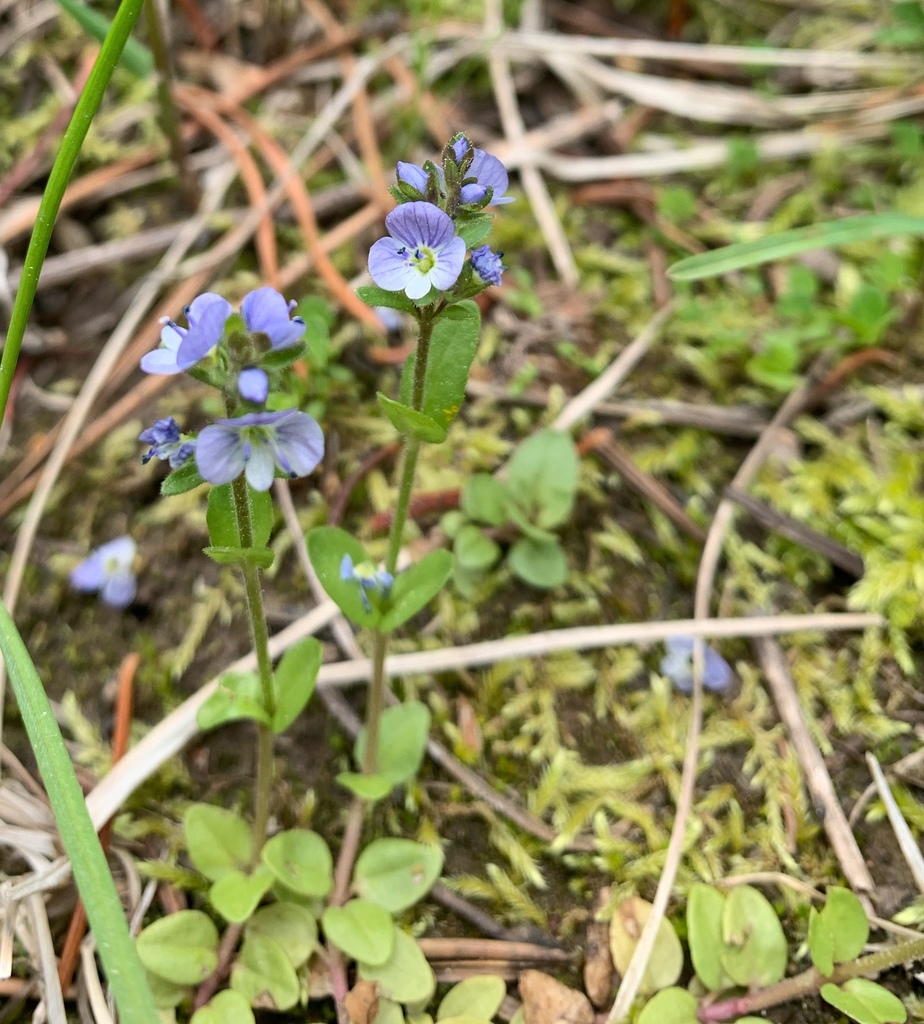
Veronica serpyllifolia, the Thyme-leaved Speedwell or thymeleaf speedwell, is a small, creeping perennial wildflower in the plantain family (Plantaginaceae). Its stems creep along the ground and root as they go, then turn upward 2 to 10 inches to carry short spikes of tiny, four-lobed blue flowers above small, oval, thyme-like leaves.
The species comes in two forms. The native North American form, subspecies humifusa (bright blue speedwell), has deep blue flowers and grows in moist mountain meadows, streambanks and woods across Alaska, the West and the cool Northeast and Great Lakes region. The more familiar lawn and roadside form, subspecies serpyllifolia, has pale blue to whitish flowers with dark stripes; it is native to Europe and Asia and was introduced to North America, where it is now common across most states.
This page focuses on the native subspecies. It is not a garden plant in the usual sense, but it is a pretty, well-behaved native ground layer plant in moist mountain meadows, and knowing the two forms helps gardeners and naturalists tell a native wildflower from a common lawn weed.
Identification
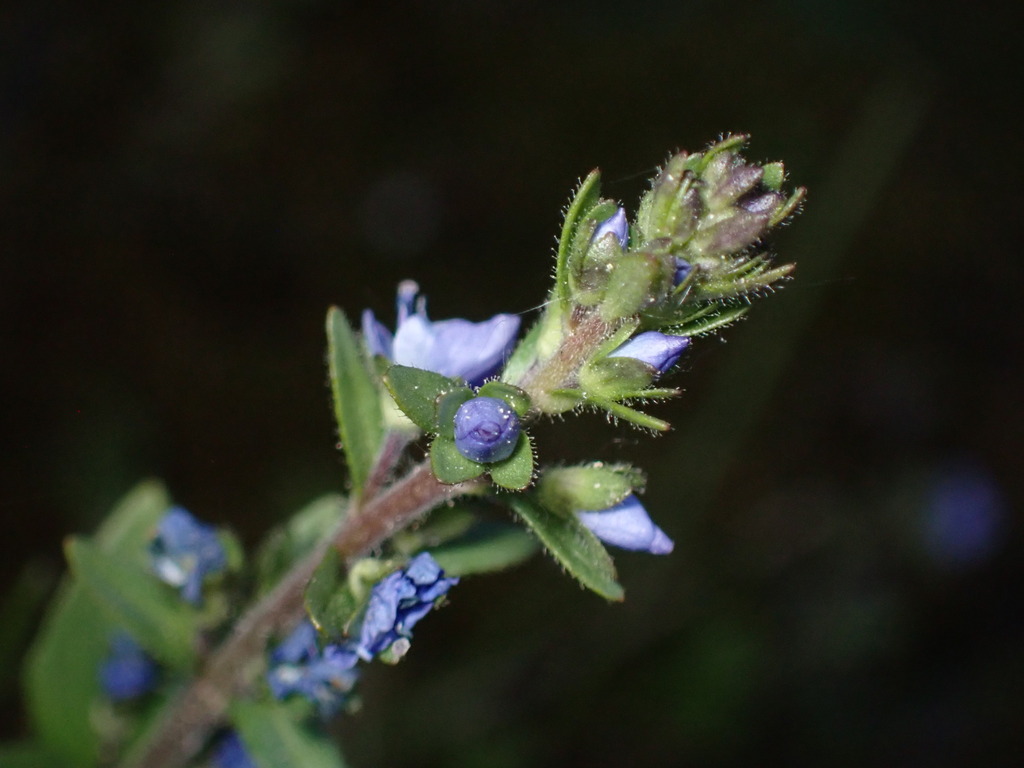
Look for a low, creeping speedwell with small, opposite, oval leaves and short, upright spikes of tiny four-lobed blue flowers in moist, cool places. The native form has deep blue flowers and sticky glandular hairs on the flower stalks.
Growth Habit
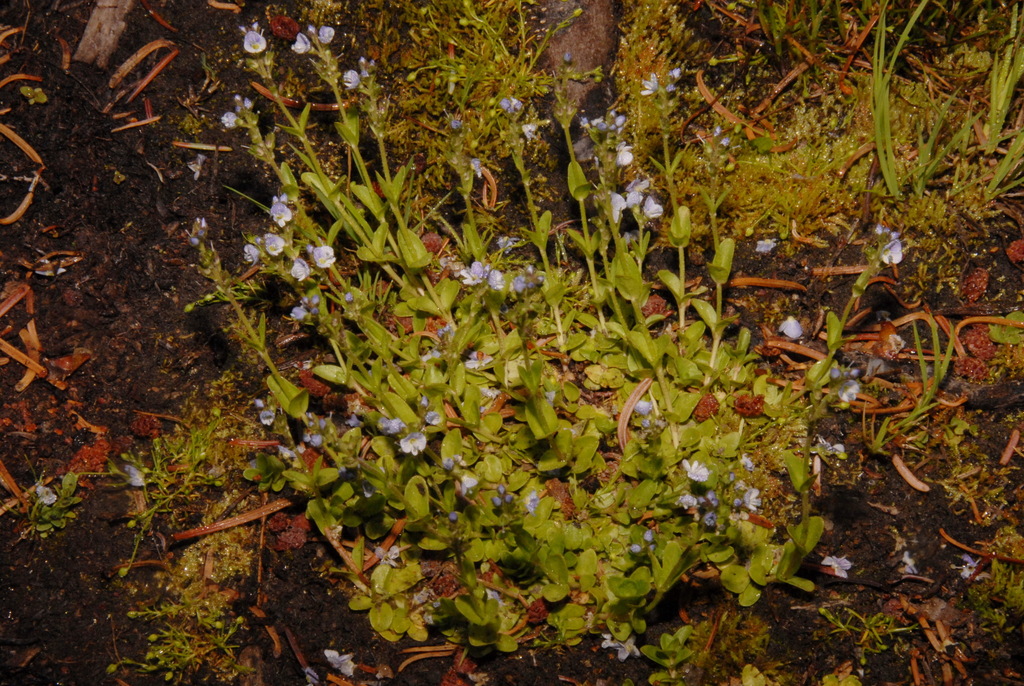
Thyme-leaved speedwell is a low perennial with slender stems that creep along the ground and root at the nodes, forming loose mats. The flowering stems turn upward, usually 2 to 10 inches tall. The native subspecies tends to have fewer, more upright stems with larger flowers than the introduced lawn form.
Leaves
The leaves are opposite, small (about 1/4 to 3/4 inch long), oval to nearly round, smooth or slightly hairy, with smooth or faintly toothed edges and very short stalks or none. They look much like thyme leaves, which gives the plant its name (serpyllum is a kind of thyme). Upward along the stem they grade into small, narrow bracts in the flower spike.
Flowers
The flowers grow in a short, loose spike (raceme) at the stem tips and open from the bottom upward, from late spring through summer. Each flower is about 1/4 to 3/8 inch across, with four unequal, rounded lobes and two stamens. In the native subspecies humifusa, they are bright to deep blue, and the flower stalks and sepals are covered with short, sticky glandular hairs. In the introduced subspecies serpyllifolia, they are pale blue to white with darker blue lines, and the hairs are not glandular.
Fruit & Seeds
The fruit is a small, flattened, heart-shaped capsule, wider than long and notched at the tip, with the style sticking out of the notch. It splits to release tiny, flat seeds.
Look-alikes
Other low speedwells can be confused with it. American alpine speedwell grows in similar mountain meadows but has hairy, unbranched stems with flowers clustered at the top, and does not creep. American brooklime is a larger, fleshier plant of streams with flowers in spikes from the leaf axils. Common lawn weeds such as corn speedwell and Persian speedwell (both introduced) are annuals with flowers single in the leaf axils.
Quick Facts
| Scientific Name | Veronica serpyllifolia (native: ssp. humifusa) |
| Family | Plantaginaceae (plantain family) |
| Plant Type | Creeping herbaceous perennial |
| Mature Height | 2–10 in |
| Mature Spread | 6–12 in |
| Growth Rate | Moderate |
| Sun Exposure | Full sun to part shade |
| Water Needs | Moderate to high; moist soil |
| Soil Type | Moist loam, gravel or organic soil |
| Soil pH | Slightly acidic to neutral (about 5.5–7.0) |
| Bloom Time | May–August |
| Flower Color | Bright blue (native form); pale blue or white with dark lines (introduced form) |
| Fall Color | None notable |
| Fruit | Small, flattened, heart-shaped capsule |
| Deer Resistant | Moderately |
| USDA Hardiness Zones | 2–8 |
Native Range
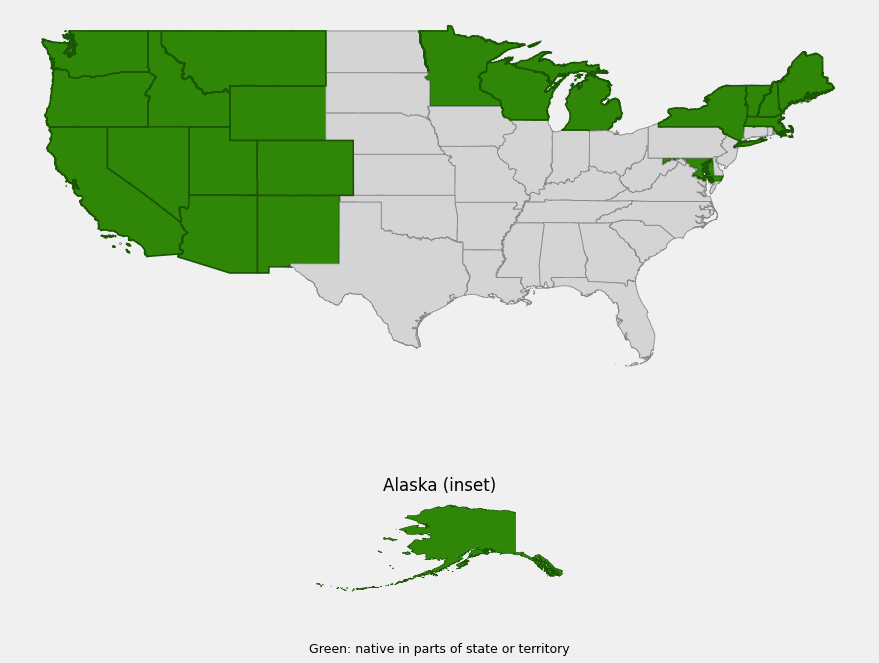
USDA PLANTS lists thyme-leaved speedwell as both native and introduced in the United States, because it includes two subspecies. The native subspecies humifusa is recorded from Alaska; the western states of Washington, Oregon, California, Idaho, Nevada, Montana, Wyoming, Utah, Colorado, Arizona and New Mexico; and in the East from Maine, New Hampshire, Vermont, Massachusetts, New York, Michigan, Wisconsin and Minnesota. A Maryland record is an outlying one. It also grows across Canada from British Columbia to Newfoundland and Labrador, and in Greenland, Europe and Asia.
The introduced subspecies serpyllifolia came from Europe and is now found in lawns, fields, roadsides and disturbed ground in nearly every state, including Hawaii. Those weedy populations are not shown on the map.
In the West, the native form grows in moist mountain meadows, streambanks, seeps, wet trailsides and openings in subalpine and montane forests, from the foothills up to near timberline. In the Northeast and Great Lakes, it grows in cool, damp woods, clearings, shores and mountain areas.
📋 Regional plant lists featuring Thyme-leaved Speedwell: Alaska · Arizona & New Mexico · California & Nevada · Montana & Wyoming · Utah & Western Colorado · Idaho, Eastern Oregon & Eastern Washington · Western Oregon & Western Washington · New Hampshire, Maine & Vermont · Connecticut, Massachusetts & Rhode Island · Maryland, Virginia & West Virginia · Michigan, Wisconsin & Eastern Minnesota · New York, Pennsylvania & Northern New Jersey · Delaware, Southern New Jersey & Long Island
Growing & Care Guide
The native bright blue speedwell is rarely sold, but it can be part of a moist native meadow, rain garden edge or rock garden in cool climates. Grow it from seed or from a small division from a friend’s garden, and never dig wild plants on public land.
Light
Full sun to part shade. In cool mountain and northern gardens it does well in sun; in warmer areas give it some afternoon shade.
Soil & Water
It needs moist, well-drained soil that does not dry out for long, such as a meadow, a streamside, the edge of a rain garden or a damp spot in a rock garden. It tolerates gravelly and organic soils. Water during dry spells in summer.
Planting Tips
It is best suited to cool climates, roughly zones 2 to 8, and struggles in hot, humid summers. Use it as a low filler among taller meadow plants or between stepping stones in a damp, shady path. Because the introduced weedy subspecies looks similar, buy seed from a reliable native seed source that lists subspecies humifusa or local origin.
Pruning & Maintenance
Very little care is needed. Trim back sprawling stems if they spread too far. It is short-lived in dry sites but spreads gently by rooting stems and self-seeding in moist spots.
Propagation
Divide rooted stem pieces in spring or early fall, or sow seed in fall or early spring on the surface of moist soil; the tiny seeds need light to germinate.
Landscape Uses
- Moist native meadows: a low blue-flowered layer under taller wildflowers
- Rain garden edges: tolerates damp soil at the margins
- Rock gardens: small enough for damp crevices and gravel beds
- Shady paths: creeps between stepping stones in moist shade
- Pollinator gardens: small bees and flies visit the flowers
Wildlife & Ecological Value
Thyme-leaved speedwell is a small part of the colorful wildflower carpet of wet mountain meadows.
For Pollinators
The small blue flowers are visited by small native bees, syrphid flies and other small insects, which collect pollen and nectar. The flowers can also pollinate themselves if insects do not visit.
For Birds
Small seed-eating birds, such as finches and juncos, may pick the tiny seeds from the capsules.
For Mammals
It is grazed lightly by elk, deer and other mountain herbivores as part of mixed meadow vegetation.
Ecosystem Role
As a creeping plant that roots along its stems, it helps cover and hold bare, wet soil along streams, seeps and trails in mountain meadows. It is one of many small wildflowers that make up the low layer of subalpine meadows.
Cultural & Historical Uses
The genus Veronica is traditionally linked to Saint Veronica. The name speedwell is an old English word meaning roughly ‘prosper’ or ‘farewell’, perhaps because the flowers drop quickly or because speedwells grew along roadsides and were said to speed travelers on their way. The species name serpyllifolia means thyme-leaved, after wild thyme (Thymus serpyllum).
The two subspecies were described in Europe. Subspecies humifusa grows in the mountains of Europe and in the Arctic and northern and mountain regions of North America, and it is the form native to the United States. The lowland form, subspecies serpyllifolia, spread from Europe with agriculture and is now a common lawn plant around the world.
Speedwells were once used in European folk medicine, often as teas for coughs and skin problems. These uses are not supported by modern evidence, and wild plants should not be used as remedies.
Frequently Asked Questions
Is thyme-leaved speedwell native?
Partly. The bright blue subspecies humifusa is native to Alaska, the western mountains and the northern United States. The pale, striped lawn form (subspecies serpyllifolia) was introduced from Europe.
How can I tell the native form from the lawn weed?
The native form has bright to deep blue flowers and sticky, glandular hairs on the flower stalks, and grows in moist mountain or northern habitats. The introduced form has pale blue or whitish flowers with dark lines and grows in lawns and disturbed ground.
Is thyme-leaved speedwell invasive?
The introduced subspecies is a common weed of lawns, fields, trails and other disturbed ground, but it is rarely a serious problem. The native subspecies is a well-behaved part of mountain meadows.
Where can I see the native thyme-leaved speedwell?
In moist meadows, streambanks and trailsides in the Rocky Mountains, Cascades and Sierra Nevada in summer, and in cool, damp places in the Northeast and Alaska.
Can I grow thyme-leaved speedwell in my garden?
Yes, in a moist, cool spot in sun or part shade. Look for native seed of subspecies humifusa from a local native seed source.

Looking for a nursery that carries Thyme-leaved Speedwell?
Browse our native plant nursery directory: Alaska & Arizona · California · Colorado · Idaho · Maine, Maryland, Massachusetts, Michigan, Minnesota & Montana · Nevada, New Hampshire, New Mexico & New York · Oregon · Utah & Vermont · Washington · Wisconsin & Wyoming

