
Curlytop Gumweed (Grindelia nuda)
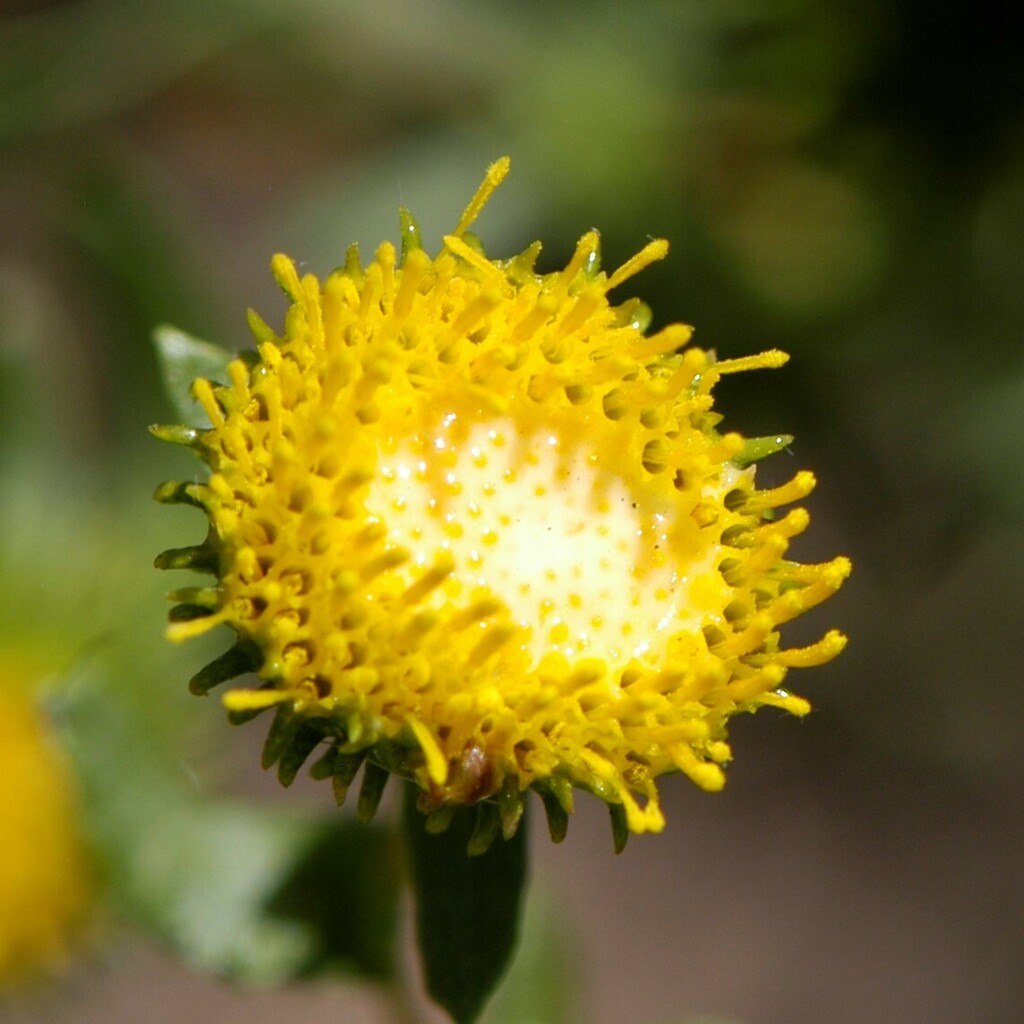
Grindelia nuda, the Curlytop Gumweed, is a native wildflower of the southern Great Plains and the Southwest in the aster family (Asteraceae). It is a branched, upright biennial or short-lived perennial 1 to 3 feet tall, with toothed, clasping leaves and button-like yellow flower heads in late summer and fall. Its heads are wrapped in rows of sticky, curled-back bracts and usually have no ray petals, which gives it the alternative name rayless gumweed.
It grows on plains, grasslands, mesas and open woodlands from Kansas and Oklahoma west through Texas, New Mexico and Colorado to Arizona and Utah. Like other gumweeds it thrives on disturbed ground, so it is often seen along roads, in overgrazed pastures and in vacant lots.
Curlytop gumweed is very similar to the more widespread curlycup gumweed (Grindelia squarrosa), and some botanists include it in that species. USDA PLANTS and the Flora of North America treat it as a separate species, distinguished mainly by its rayless heads. It is a tough, drought-tolerant late-season nectar plant for dry, sunny sites.
Identification
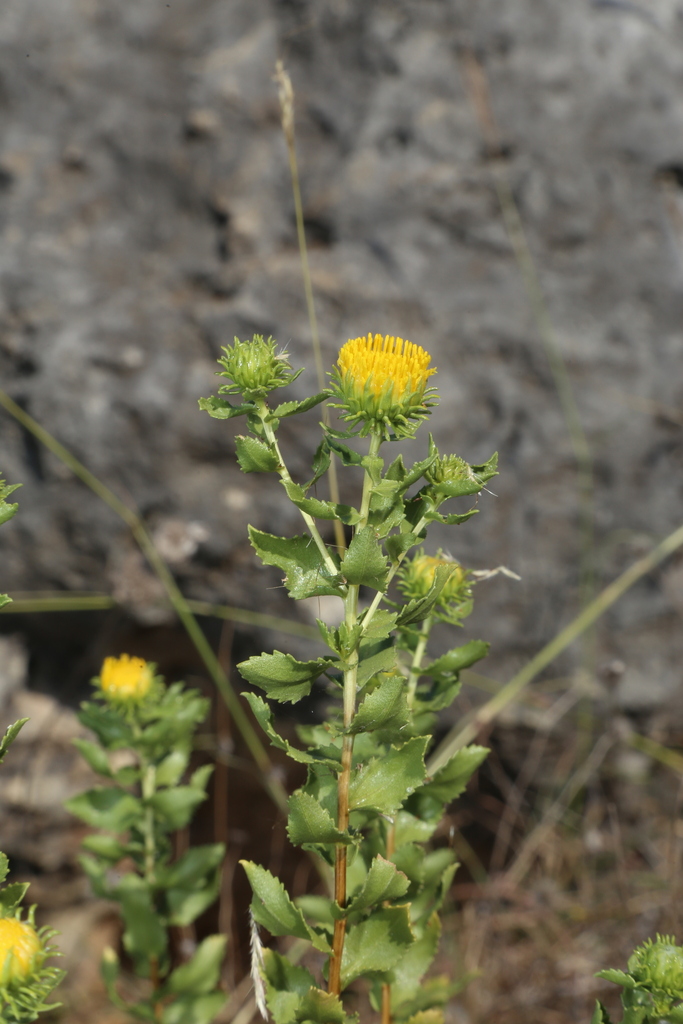
Look for a sticky, branched plant 1 to 3 feet tall with oblong, toothed leaves clasping the stem and round, rayless yellow heads with strongly curled-back, resin-coated bracts, blooming from midsummer into fall on dry plains and roadsides.
Growth Habit
Curlytop gumweed is a biennial or short-lived perennial. In its first year it forms a low rosette; then it produces one or more upright, branched, often reddish stems 1 to 3 feet tall from a taproot. The whole plant is smooth to slightly rough and dotted with resin glands, making it sticky and aromatic.
Leaves
The leaves are alternate, oblong to lance-shaped, about 1 to 3 inches long, with toothed or wavy edges. The upper leaves are stalkless and clasp the stem. They are stiff, gray-green to bright green and dotted with resin.
Flowers
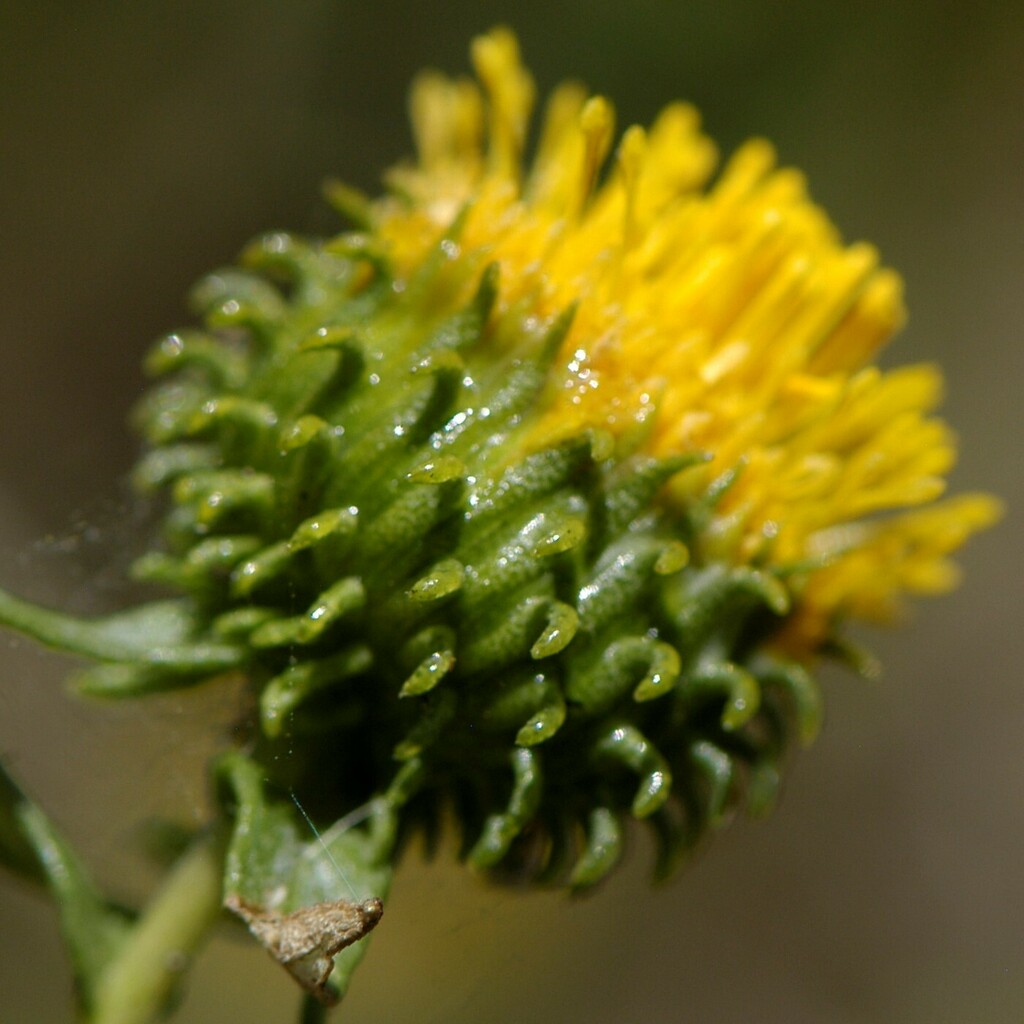
The flower heads are 3/4 to 1 inch across and grow singly at the ends of the branches. Each head is a dome of small yellow disk flowers; ray flowers are usually absent, though a few short rays are occasionally present. Before and as they open, the heads are filled with a white, milky, gummy resin. Below the flowers are several rows of narrow green bracts with tips that curl strongly back or downward. Flowering is from about July to October.
Fruit & Seeds
The seeds (achenes) are small, brown and ribbed, each topped by a few stiff, easily shed bristles (awns). They fall near the plant or are carried by animals and vehicles.
Look-alikes
Curlycup gumweed (Grindelia squarrosa) is nearly identical but usually has bright yellow ray petals around each head and ranges much farther north, into the northern plains and Canada. Where the two meet, intermediate plants occur. Narrowleaf gumweed has long, narrow leaves and showy rays and is more eastern. Golden asters have hairy leaves and lack the sticky, curled bracts.
Quick Facts
| Scientific Name | Grindelia nuda |
| Family | Asteraceae (aster family) |
| Plant Type | Biennial or short-lived perennial |
| Mature Height | 1–3 ft |
| Mature Spread | 1–2 ft |
| Growth Rate | Fast |
| Sun Exposure | Full sun |
| Water Needs | Low; drought tolerant |
| Soil Type | Clay, loam, sandy or gravelly; tolerates poor and disturbed soils |
| Soil pH | Neutral to alkaline (about 6.5–8.5) |
| Bloom Time | July–October |
| Flower Color | Yellow (usually rayless) |
| Fall Color | None notable |
| Fruit | Small achenes with a few bristles |
| Deer Resistant | Yes; bitter, resinous and rarely browsed |
| USDA Hardiness Zones | 4–9 |
Native Range
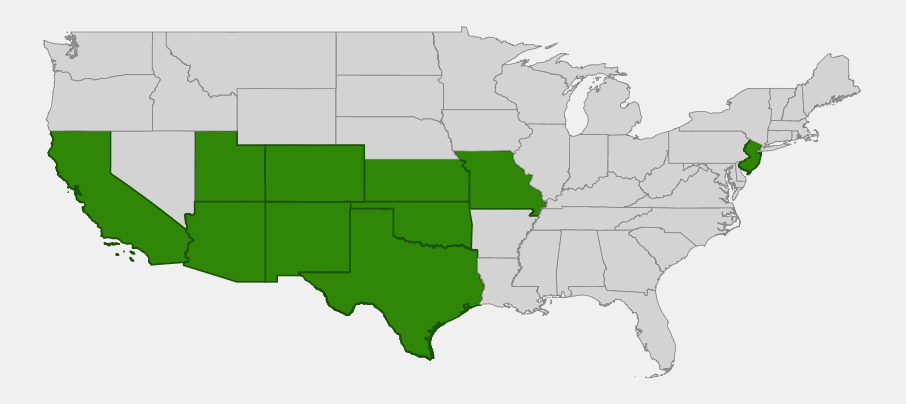
USDA PLANTS lists curlytop gumweed as native to Arizona, California, Colorado, Kansas, Missouri, New Jersey, New Mexico, Oklahoma, Texas and Utah. Its main native range is the southern Great Plains and the Southwest: Kansas, Oklahoma, Texas, eastern and southern Colorado, New Mexico, Arizona and southern Utah, extending into northern Mexico.
The records from Missouri, New Jersey and California lie well outside that core range and are outlying records. Gumweeds readily travel along railroads and highways and in hay and seed, and eastern records such as those from New Jersey are most likely adventive populations that arrived this way rather than part of the natural range. For that reason this page links only the regional lists for its core range.
It grows on shortgrass and mixed-grass prairie, plains, mesas, open pinyon-juniper and pine woodlands, washes and especially disturbed ground, including roadsides, railroad rights-of-way, overgrazed pastures, old fields and vacant lots, from about 1,000 to 8,000 feet.
📋 Regional plant lists featuring Curlytop Gumweed: Arizona & New Mexico · Utah & Western Colorado · Nebraska, Kansas & Eastern Colorado · South & West Texas
Growing & Care Guide
Curlytop gumweed is rarely sold, but it is easy to grow from seed and needs almost no care in a dry, sunny spot. Use it in naturalistic plantings rather than formal beds, since it is sticky, weedy-looking and reseeds.
Light
Full sun. It becomes leggy and flowers poorly in shade.
Soil & Water
It grows in almost any well-drained soil, including clay, caliche and gravel, and tolerates poor, compacted and somewhat alkaline or saline soils. Once established it needs no watering beyond rainfall in most of its range.
Planting Tips
Sow seed on the soil surface in fall or early spring, or scatter it in a prairie seed mix. It fills in quickly on bare ground and can act as a nurse plant while slower perennial grasses establish. Space plants about 18 inches apart.
Pruning & Maintenance
Cut stems back after seed set if you want to limit reseeding. Gloves help, because the resin is sticky and hard to wash off.
Propagation
Grow from seed, which germinates readily without special treatment, though a short cold-moist period can improve germination. Collect seed in fall when the heads turn brown and dry.
Landscape Uses
- Pollinator gardens: late-season nectar and pollen for bees and butterflies
- Prairie restoration: a quick-establishing native for disturbed ground
- Xeriscapes: drought tolerant on poor, dry soils
- Roadsides and rough areas: thrives where little else grows
- Deer-resistant plantings: bitter, resinous foliage is rarely browsed
Wildlife & Ecological Value
Curlytop gumweed blooms when many prairie wildflowers are finished, making it a valuable late-summer and fall resource.
For Pollinators
The yellow heads attract many bees, including bumble bees, leafcutter bees, sweat bees and specialist bees that collect pollen from gumweeds and other asters, as well as butterflies, wasps and beetles. Fall-flying butterflies visit for nectar.
For Birds
Seed-eating birds such as sparrows and finches pick at the seed heads in fall and winter.
For Mammals
Livestock and deer generally avoid it because of its bitter, resinous foliage. Like curlycup gumweed, it can accumulate selenium on seleniferous soils, one reason it is considered unpalatable or potentially toxic to grazing animals.
Ecosystem Role
As an early-successional plant, curlytop gumweed is one of the first natives to cover bare, eroded or heavily grazed ground. Its abundance in pastures is often a sign of overgrazing, and it gives way to perennial grasses as rangeland recovers.
Cultural & Historical Uses
Gumweeds (Grindelia) have a long history in traditional medicine. Native peoples of the plains and Southwest used the sticky flower heads and leaves for skin conditions, including poison ivy rash, and for coughs and asthma, and dried gumweed was once listed in the U.S. Pharmacopoeia. This page describes historical uses only, not medical advice.
The genus is named for David Hieronymus Grindel, an 18th- and 19th-century Baltic German botanist and pharmacist. The species name nuda means “naked,” referring to the heads, which lack ray petals.
Curlytop gumweed was described by Alphonso Wood, a 19th-century American botanist and author of popular botany textbooks. Its relationship to curlycup gumweed is still debated: some modern references merge the two, while USDA PLANTS and the Flora of North America keep them separate.
Frequently Asked Questions
What is the difference between curlytop gumweed and curlycup gumweed?
They are very similar and closely related. Curlytop gumweed (Grindelia nuda) usually has rayless, button-like heads and grows mainly in the southern plains and Southwest. Curlycup gumweed (Grindelia squarrosa) usually has yellow ray petals and is widespread across the West and northern plains.
Why is gumweed so sticky?
The flower heads and leaves are coated with a gummy resin that helps protect the plant from insects, grazing animals and drying out.
Is curlytop gumweed a weed?
It is a native plant, but it thrives on disturbed ground and in overgrazed pastures, so ranchers often see it as a weed. In gardens it is a tough, drought-tolerant pollinator plant.
Is curlytop gumweed toxic to livestock?
Animals usually avoid it because it is bitter and resinous. It can accumulate selenium on some soils, so heavy grazing of it is not recommended.
When does curlytop gumweed bloom?
From about July through October, with the heaviest bloom in late summer and early fall.

Looking for a nursery that carries Curlytop Gumweed?
Browse our native plant nursery directory: Arizona · California · Colorado · Kansas · Missouri · New Jersey, New Mexico & Oklahoma · Texas & Utah

