
Floating Pondweed (Potamogeton natans)
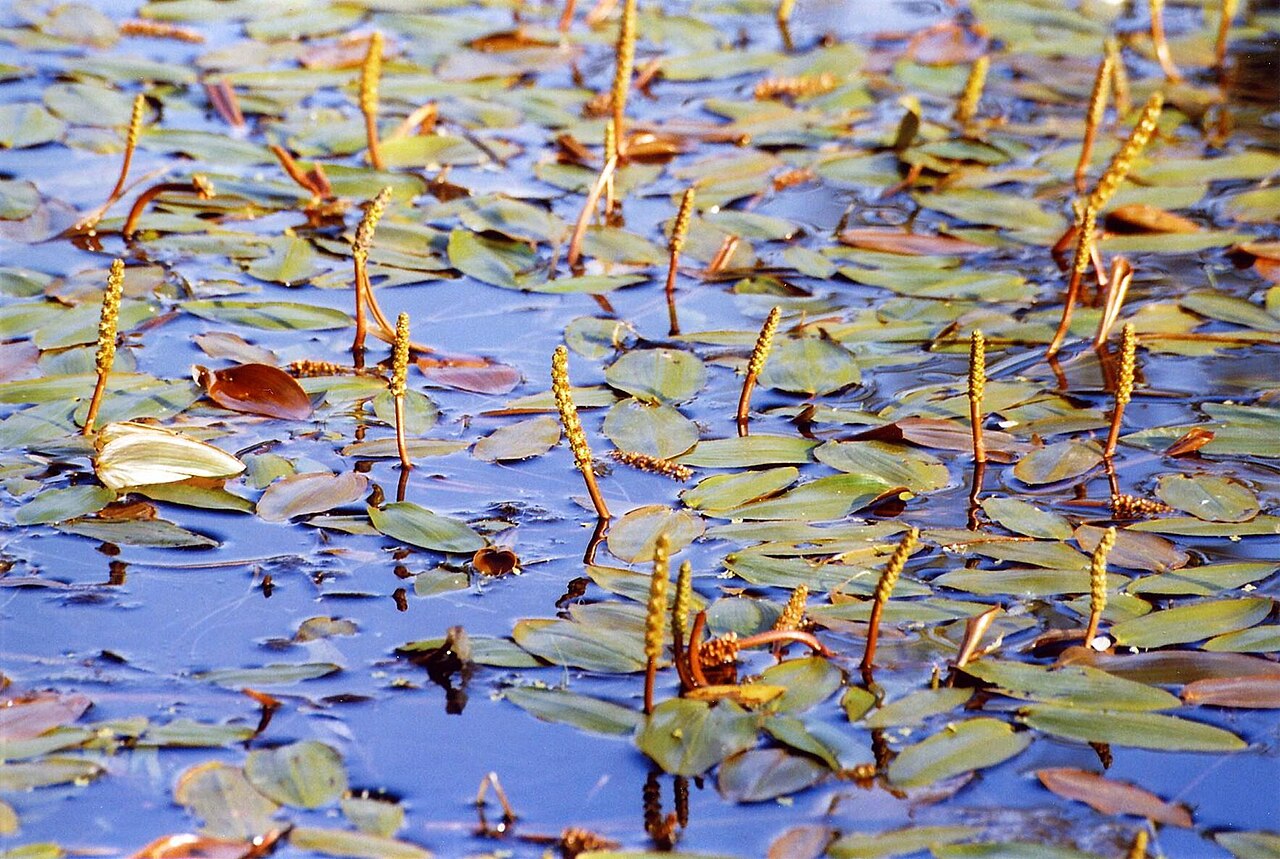
Potamogeton natans, known as Floating Pondweed or broad-leaved pondweed, is a rooted aquatic perennial of ponds, lakes and slow streams. Its oval, leathery leaves float flat on the water on long stalks, and in summer it raises dense, finger-like spikes of small greenish flowers just above the surface. Below the water, its stems carry only narrow, stalk-like leaves with no blade.
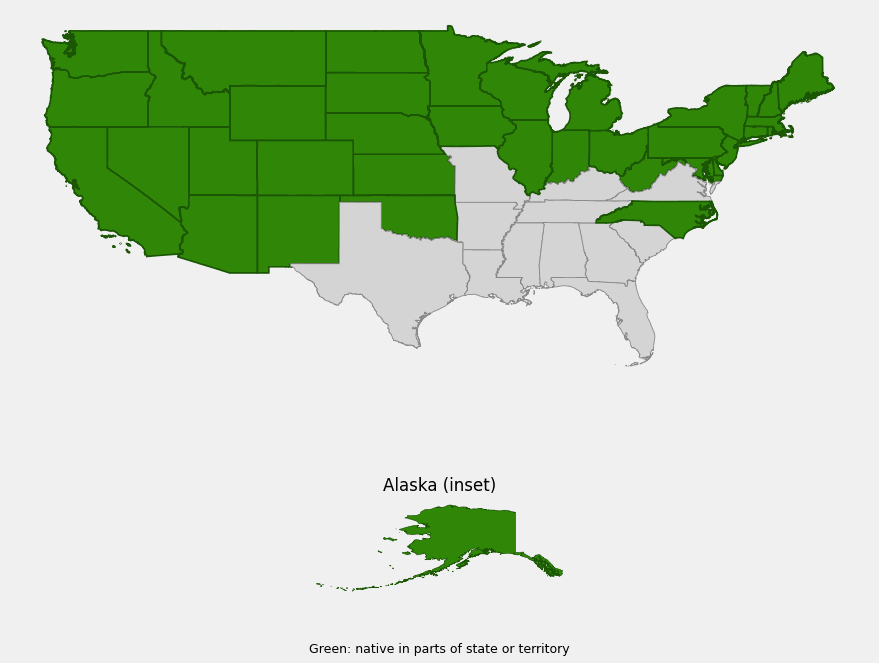
It is one of the most widespread pondweeds in the world, found around the Northern Hemisphere. In the United States it is native from Alaska and the Pacific Northwest across the Rocky Mountains and northern Plains to the Great Lakes and New England, reaching south to Arizona, New Mexico, Oklahoma and North Carolina. It is common in northern lakes and in high mountain ponds.
Floating pondweed is a valuable wildlife plant. Ducks, geese and swans eat its seeds and rhizomes, muskrats, beavers and moose feed on it, and its floating leaves shade the water and shelter fish, frogs and aquatic insects. This guide covers how to identify it, where it grows, how to use it in a pond, and its role in wetland ecosystems.
Identification
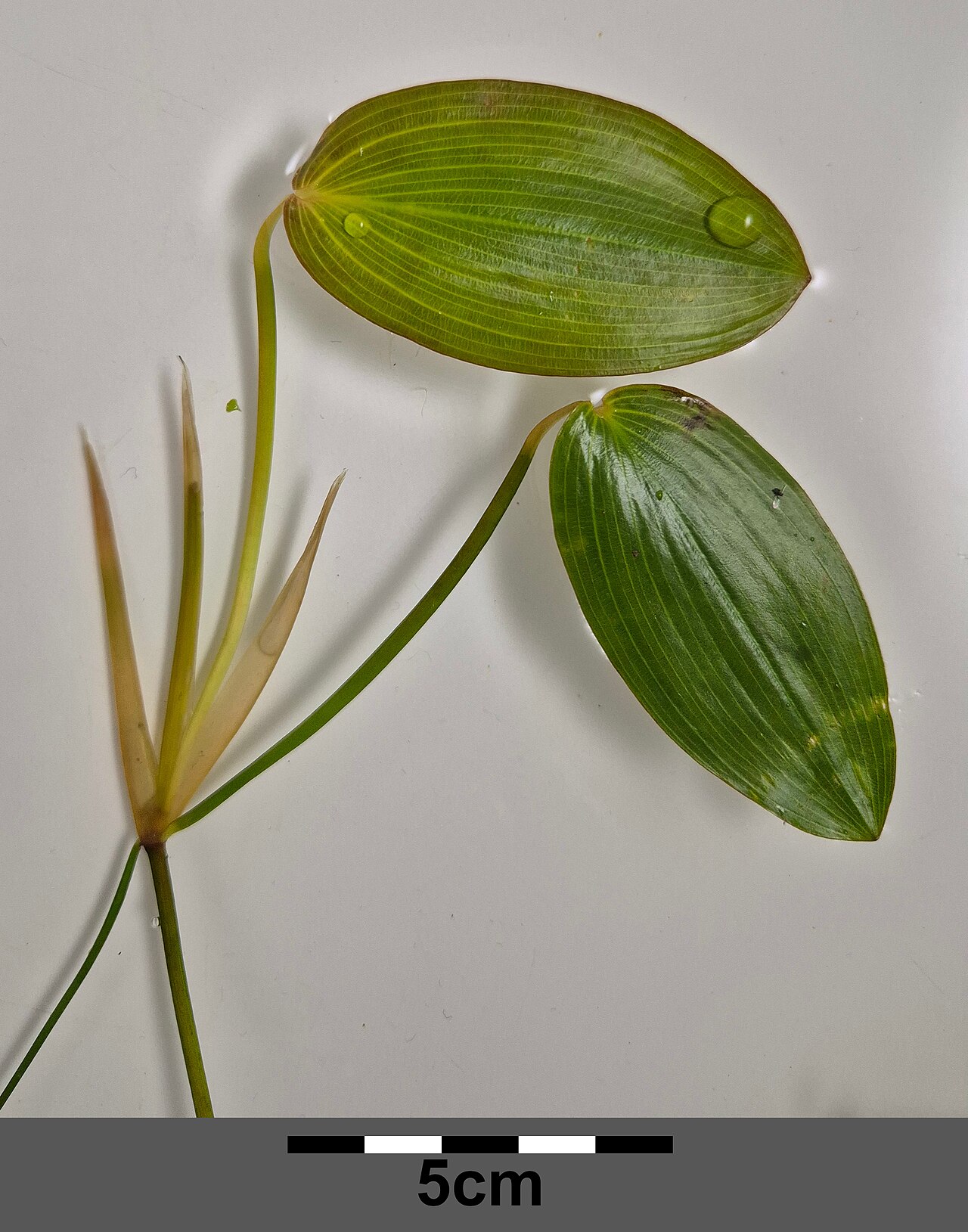
Pondweeds (Potamogeton) can be hard to tell apart, but floating pondweed has one reliable clue. Look at where the floating leaf blade meets its stalk: a short, paler, flexible joint lets the blade bend at an angle to the stalk, as if hinged.
Stems & Growth Habit
Floating pondweed spreads by creeping rhizomes in the bottom mud, often forming large colonies. Its round, mostly unbranched stems grow up through the water column, usually 2 to 6 feet long depending on depth. In cold climates the plant dies back in fall and regrows from rhizomes in spring.
Floating Leaves
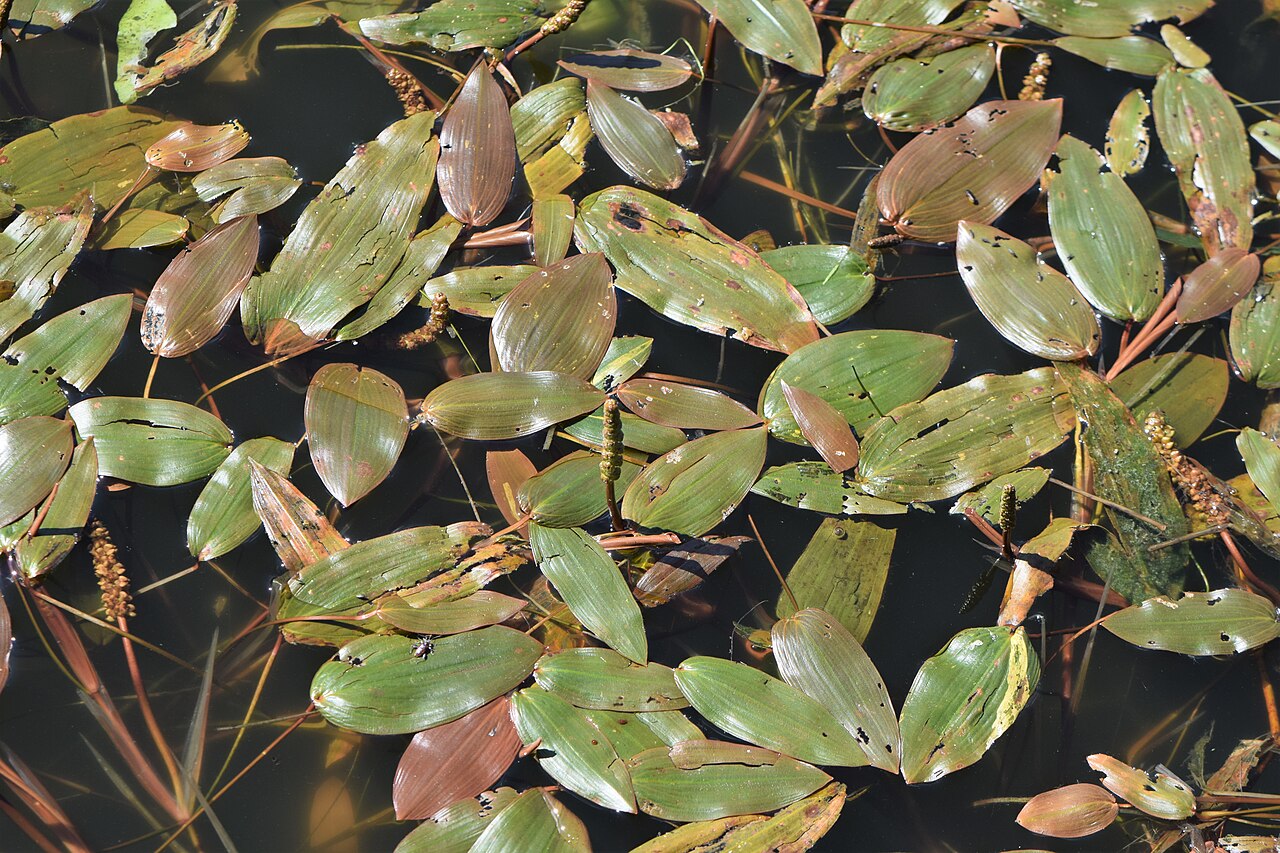
The floating leaves are oval to broadly elliptic, about 2 to 4 1/2 inches long, thick and leathery, with a rounded or slightly heart-shaped base and many fine parallel veins. They sit on long stalks that are usually longer than the blade. The pale, discolored joint just below the blade is the best field mark. Leaves are bright green, often turning bronze or reddish late in the season.
Underwater Leaves
The submerged leaves are reduced to long, narrow, bladeless “phyllodes” that look like stiff stalks, about 4 to 8 inches long and less than 1/8 inch wide. They often decay by the time the plant flowers. Long, fibrous stipules, 1 1/2 to 4 inches long, sheath the stem at the leaf bases.
Flowers & Fruit
From June to September, dense cylindrical spikes about 1 to 2 inches long rise above the water on stout stalks. They carry many tiny greenish flowers without showy petals, pollinated mainly by wind at the surface. The flowers develop into small olive-green to brown seeds (achenes) about 1/8 to 3/16 inch long, which sink and are eaten by waterfowl.
Look-alikes
Longleaf pondweed (Potamogeton nodosus) has similar floating leaves but no hinge-like joint, and its underwater leaves have real, lance-shaped blades. Large-leaf pondweed (P. amplifolius) has broad, arching underwater leaves. Ribbonleaf pondweed (P. epihydrus) has flat, ribbon-like underwater leaves. Water smartweed (Persicaria amphibia) also has floating oval leaves but bears bright pink flower spikes. Watershield has round, shield-shaped leaves with the stalk attached in the center.
Quick Facts
| Scientific Name | Potamogeton natans L. |
| Family | Potamogetonaceae (pondweed family) |
| Plant Type | Rooted aquatic perennial with floating leaves |
| Mature Height | Stems 2–6 ft long, depending on water depth |
| Mature Spread | Spreads by rhizomes into colonies |
| Growth Rate | Fast in summer |
| Sun Exposure | Full sun to part shade |
| Water Needs | Aquatic; still or slow water about 1–6 ft deep |
| Soil Type | Soft mud, muck or silt bottoms |
| Soil pH | Acidic to neutral water |
| Bloom Time | June–September |
| Flower Color | Greenish (inconspicuous) |
| Fall Color | Floating leaves turn bronze to reddish |
| Fruit | Small olive-brown achenes on a dense spike |
| Deer Resistant | Not applicable (aquatic); browsed by moose |
| USDA Hardiness Zones | 2–8 |
Native Range
USDA PLANTS lists floating pondweed as native in Alaska and 36 states of the lower 48: Arizona, California, Colorado, Connecticut, Delaware, Idaho, Illinois, Indiana, Iowa, Kansas, Maine, Maryland, Massachusetts, Michigan, Minnesota, Montana, Nebraska, Nevada, New Hampshire, New Jersey, New Mexico, New York, North Carolina, North Dakota, Ohio, Oklahoma, Oregon, Pennsylvania, Rhode Island, South Dakota, Utah, Vermont, Washington, West Virginia, Wisconsin and Wyoming. It is most common in the glaciated North, the Great Lakes region, New England and the mountain West. Records from North Carolina, Oklahoma, Arizona and New Mexico mark the southern edge of its range, where it is mostly found in cooler, higher-elevation waters.
It grows in quiet fresh water: ponds, lakes, beaver ponds, slow streams, oxbows, marsh pools and ditches. It roots in soft mud or muck and usually grows in water from about 1 to 6 feet deep, often in slightly acidic or neutral water. It is common in northern bog lakes and mountain lakes and ponds, from near sea level up into the subalpine zone of the Rocky Mountains.
Floating pondweed is circumboreal. Beyond the United States it ranges across Canada, from British Columbia and the Northwest Territories to Newfoundland, and through Europe, northern Asia and North Africa. In Britain it is one of the most familiar pond plants.
📋 Regional plant lists featuring Floating Pondweed: Alaska · Western Oregon & Western Washington · Idaho, Eastern Oregon & Eastern Washington · California & Nevada · Arizona & New Mexico · Utah & Western Colorado · Montana & Wyoming · Nebraska, Kansas & Eastern Colorado · North Dakota, South Dakota & Western Minnesota · Michigan, Wisconsin & Eastern Minnesota · Illinois, Iowa & Missouri · Ohio & Indiana · New York, Pennsylvania & Northern New Jersey · Delaware, Southern New Jersey & Long Island · Maryland, Virginia & West Virginia · North & South Carolina · Connecticut, Massachusetts & Rhode Island · New Hampshire, Maine & Vermont
Growing & Care Guide
Floating pondweed is an easy, hardy plant for natural ponds and wildlife water gardens, especially in the northern half of the country. Buy plants from an aquatic plant nursery rather than moving them from wild waters, which can spread invasive plants, snails and diseases between ponds.
Light
Full sun gives the best growth and flowering. It tolerates part shade, but grows sparsely in heavily shaded ponds.
Soil & Water
Plant it in still or slow-moving water about 1 to 6 feet deep, rooted in mud, heavy loam or a clay-based aquatic soil. It prefers clean, cool, slightly acidic to neutral water and does poorly in warm, stagnant, nutrient-rich water. It cannot survive if the pond dries out completely for long periods.
Planting Tips
Plant rhizome sections or potted plants in spring. In a lined pond, grow it in a wide, shallow aquatic basket filled with heavy soil topped with gravel, and lower it gradually to its final depth so the leaves can reach the surface. In an earth-bottomed pond, press rhizome pieces into the mud in shallow water.
Pruning & Maintenance
In a small pond it can spread quickly and cover much of the surface. Thin it each summer by pulling or cutting excess stems, and keep about half the water surface open. Growing it in a container makes it much easier to control. Remove cut material from the water so it does not rot there.
Propagation
Divide the rhizomes in spring and replant the pieces. It can also be grown from seed, but the seeds are slow and erratic to germinate, so division is the usual method.
Landscape Uses
- Wildlife ponds: floating leaves shelter fish, frogs, dragonfly larvae and other pond life
- Natural shade for ponds: leaf cover keeps water cooler and can reduce algae growth
- Waterfowl habitat: seeds and rhizomes are a food source for ducks, geese and swans
- Wetland and lake restoration: a native floating-leaf plant for northern and mountain wetlands
- Native water gardens: an alternative to non-native floating plants in cool-climate ponds
Wildlife & Ecological Value
Floating pondweed is one of the most useful pondweeds for wildlife across northern North America.
For Pollinators
The flowers are wind-pollinated and offer little to bees. However, the floating leaves are perches and egg-laying sites for damselflies, dragonflies and other aquatic insects, and their undersides carry many small invertebrates.
For Birds
Pondweed seeds and rhizomes are important waterfowl foods. Ducks such as mallards, teal, wood ducks and ring-necked ducks eat the seeds, and swans and geese eat the leaves and rhizomes. Wading birds hunt for fish and frogs among the leaves.
For Mammals
Muskrats and beavers eat the stems and rhizomes, and moose wade into ponds in summer to feed on pondweeds and other aquatic plants.
Ecosystem Role
Its floating leaves shade the water, slow algae growth and give cover to fish fry, frogs and tadpoles. The underwater stems and leaves carry films of algae and tiny animals that feed fish and insects. Its rhizomes help hold soft sediment in place.
Cultural & Historical Uses
The genus name Potamogeton comes from the Greek potamos (river) and geiton (neighbor), “river neighbor.” The species name natans is Latin for “floating.” Carl Linnaeus named it in 1753.
Pondweeds are one of the largest groups of truly aquatic plants. Many species hybridize and change shape with water depth and current, which makes them a famous challenge for botanists. Floating pondweed is often the first one people learn because of its distinctive hinged leaf joint.
Because it is so widespread and so important to waterfowl, floating pondweed is often mentioned in wetland management and duck habitat guides across the northern United States and Canada.
Frequently Asked Questions
How do I identify floating pondweed?
Look for oval, leathery leaves floating on long stalks, with a short, paler, flexible joint where the blade meets the stalk. Its underwater leaves are narrow and bladeless, and green flower spikes rise above the water in summer.
Is floating pondweed good for a pond?
Yes, in moderation. It provides shade, cover for fish and frogs and food for waterfowl. In small ponds it can spread quickly, so grow it in a container or thin it each summer.
How do I control floating pondweed?
Pull or rake out excess plants in summer and remove them from the water, or grow it in containers from the start. Keep about half the water surface open. Check local rules before using any aquatic herbicide.
Where does floating pondweed grow?
In ponds, lakes and slow streams across the northern United States, Alaska and Canada, south in the mountains to Arizona and New Mexico. It is also native to Europe and Asia.
Do ducks eat floating pondweed?
Yes. Its seeds and rhizomes are eaten by many ducks, geese and swans, and muskrats, beavers and moose also feed on it.

Looking for a nursery that carries Floating Pondweed?
Browse our native plant nursery directory: Alaska & Arizona · California · Colorado, Connecticut & Delaware · Idaho, Illinois, Indiana, Iowa & Kansas · Maine, Maryland, Massachusetts, Michigan, Minnesota & Montana · Nebraska, Nevada, New Hampshire, New Jersey, New Mexico, New York, North Carolina, North Dakota, Ohio & Oklahoma · Oregon · Pennsylvania, Rhode Island, South Dakota, Utah & Vermont · Washington · West Virginia, Wisconsin & Wyoming

