
Cylindricfruit Primrose-willow (Ludwigia glandulosa)
Ludwigia glandulosa, known as Cylindricfruit Primrose-willow or small-flowered seedbox, is a perennial wetland herb of the southeastern and south-central United States. It grows in swamps, wet woods, marshes, pond and stream margins, and roadside ditches from Texas and Oklahoma east to Florida and north to Virginia, Maryland, Kentucky, southern Illinois and Indiana.
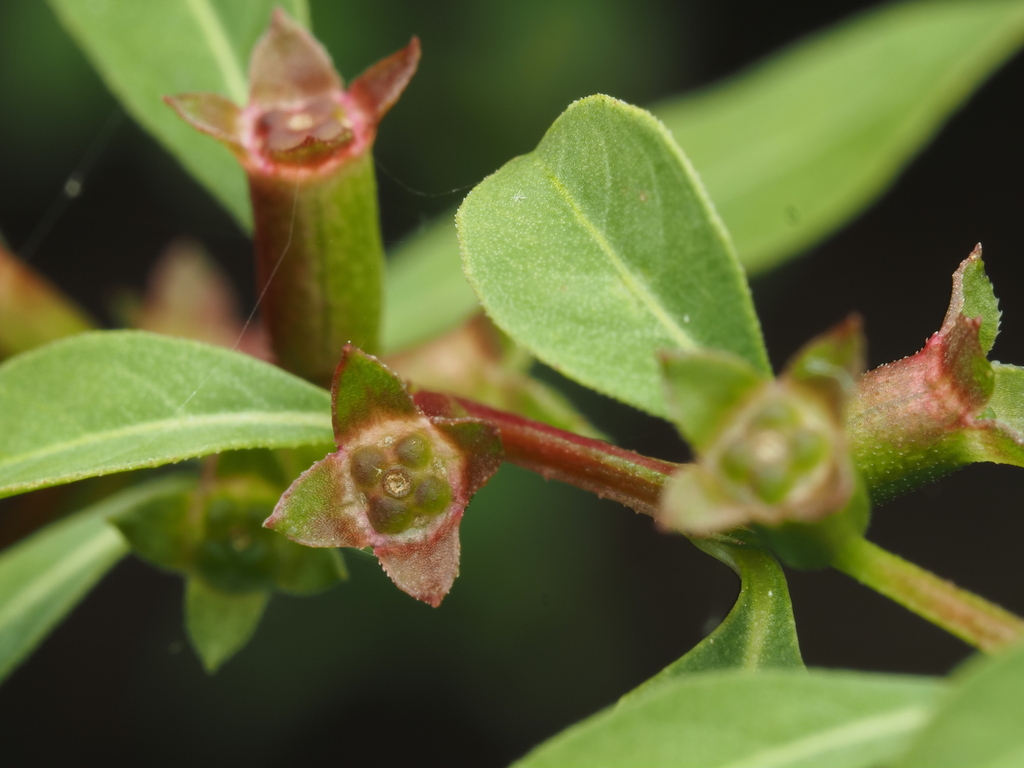
It is an upright, branching plant usually 1 to 3 feet tall, with narrow, willow-like leaves and often reddish stems. Its flowers are tiny and easy to miss: they have four green sepals and no petals and sit directly in the leaf axils. The small, cylindrical seed capsules that follow, longer than wide and not angled, give it its common name and help tell it apart from other primrose-willows and seedboxes.
Though inconspicuous, it is a useful native plant for wet ground and is known to aquarium hobbyists, who grow it underwater for its narrow reddish leaves. It is rare at the northern edge of its range and is state-listed in Indiana and Maryland. This guide covers how to identify it, where it grows, how to grow it, and its value in wetlands.
Identification
Cylindricfruit primrose-willow belongs to a large genus of wetland plants that are often hard to tell apart. Look for its alternate, narrow leaves, petal-less flowers with four sepals, and smooth, cylindrical fruits.
Growth Habit
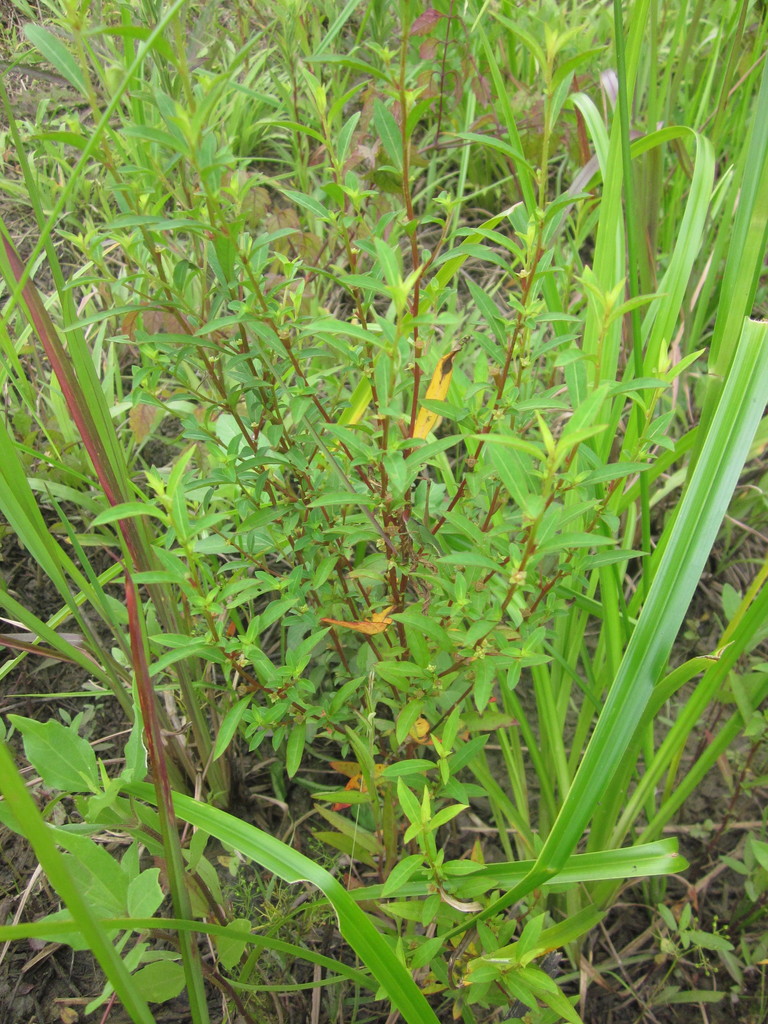
An erect, many-branched perennial herb, 1 to 3 feet tall, with smooth stems that are often reddish, especially in sun. In fall it often produces leafy runners (stolons) at the base, from which new plants grow the following year. Submerged plants in aquariums and deep water have narrower, often red to purplish leaves.
Leaves
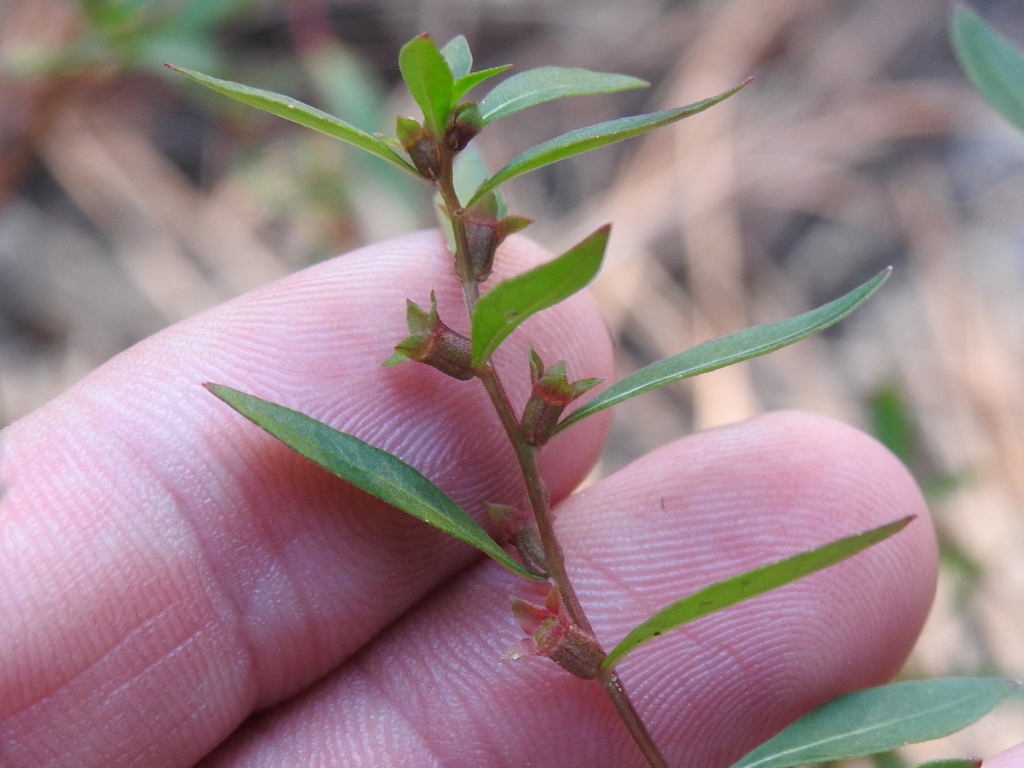
Leaves are alternate, narrowly elliptic to lance-shaped, about 1 to 4 inches long, tapering at both ends to a short stalk, with smooth margins. They are bright green above and may be tinged red.
Flowers
From about June to October, tiny flowers appear singly in the leaf axils without stalks. Each has four small, green, triangular sepals, no petals, and four stamens, and is less than ⅛ inch across. Small glands at the base of the flower give the species name glandulosa.
Fruit & Look-alikes
The fruit is a smooth, cylindrical capsule, about ⅛ to ⅜ inch long and clearly longer than wide, topped by the persistent sepals and containing many tiny seeds. Seedbox (L. alternifolia) has showy yellow petals and cube-shaped fruits. Creeping Primrose-willow has opposite leaves and creeps along the ground. Other petal-less primrose-willows, such as Ludwigia polycarpa, have four-angled, top-shaped fruits with leafy bracts.
Quick Facts
| Scientific Name | Ludwigia glandulosa Walter |
| Family | Onagraceae (evening primrose family) |
| Plant Type | Herbaceous perennial wetland forb |
| Mature Height | 1–3 ft |
| Mature Spread | 1–2 ft; spreads by basal runners |
| Growth Rate | Moderate |
| Sun Exposure | Full sun to partial shade |
| Water Needs | Wet; saturated soil to shallow water |
| Soil Type | Mucky, silty, sandy or clay wetland soils |
| Soil pH | Acidic to neutral |
| Bloom Time | June–October |
| Flower Color | Green (petals absent) |
| Fall Color | Leaves and stems often turn red |
| Fruit | Small, smooth, cylindrical capsule |
| Deer Resistant | Not well documented |
| USDA Hardiness Zones | About 6–10 |
Native Range
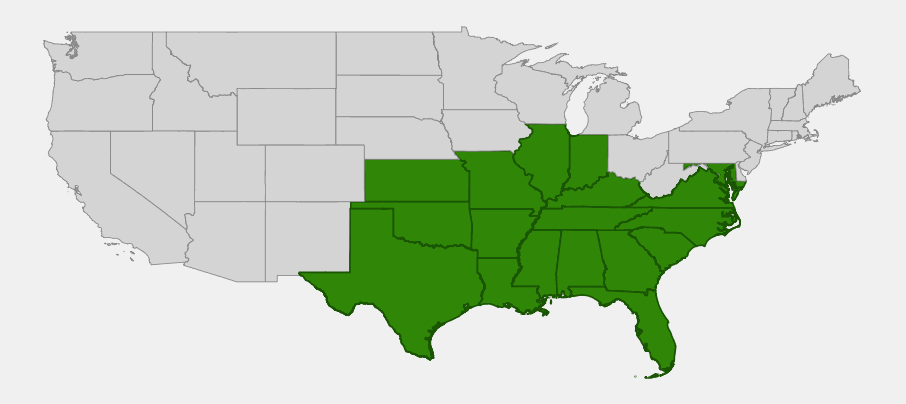
Cylindricfruit primrose-willow is native to the southeastern and south-central United States. USDA PLANTS lists it in 18 states: Alabama, Arkansas, Florida, Georgia, Illinois, Indiana, Kansas, Kentucky, Louisiana, Maryland, Mississippi, Missouri, North Carolina, Oklahoma, South Carolina, Tennessee, Texas and Virginia. It is most common on the Gulf and Atlantic Coastal Plains and in the lowlands of the Mississippi River valley, and becomes rarer northward.
It reaches its northern limits in southern Illinois and Indiana, southeastern Kansas, Kentucky, Virginia and Maryland. At these edges it is uncommon, and it is listed as threatened in Indiana and endangered in Maryland. In Texas it grows mainly in the eastern half of the state, and in Florida mostly in the northern part and the Panhandle.
Its habitats include swamp forests and wet bottomland woods, marshes, the margins of ponds, lakes and streams, wet meadows, and ditches. It tolerates partial shade and grows in mud, wet sand or shallow water. A study of swamp plants found that its seeds did not germinate while flooded, so it typically establishes on exposed, wet mud as water levels drop.
📋 Regional plant lists featuring Cylindricfruit Primrose-willow: Alabama, Georgia & Mississippi · Arkansas, Louisiana, Eastern Oklahoma & Eastern Texas · North & South Florida · Illinois, Iowa & Missouri · Ohio & Indiana · Nebraska, Kansas & Eastern Colorado · Kentucky & Tennessee · Maryland, Virginia & West Virginia · North & South Carolina · South & West Texas
Growing & Care Guide
Cylindricfruit primrose-willow is seldom sold as a garden plant, but it is easy to grow in wet soil and is sometimes available from wetland restoration nurseries. It is better known in the aquarium trade, where it is grown submerged. Outdoors it is hardy in about USDA zones 6 to 10. Where it is state-listed, such as Indiana and Maryland, do not collect it from the wild.
Light
Full sun to partial shade. Plants in more sun are bushier and redder; in shade they are greener and more open.
Soil & Water
Constantly moist to wet soil, or shallow water at the edge of a pond. It tolerates mucky, sandy and clay soils. Do not let it dry out in summer.
Planting Tips
Use it along pond margins, in rain gardens that stay wet, in bog gardens and in wetland restoration. Plant 1 to 2 feet apart. In an aquarium, plant stem cuttings in fine substrate with bright light; strong light and added carbon dioxide bring out the reddish leaf color.
Pruning & Maintenance
Little care is needed outdoors. Cut back old stems in late winter. It is not aggressive like some non-native primrose-willows, and spreads modestly by basal runners.
Propagation
Stem cuttings root easily in wet soil or water. It also spreads by basal runners, which can be separated in spring. Seed can be surface-sown on moist soil that is not flooded.
Landscape Uses
- Wetland restoration: native cover for marsh edges, ditches and bottomlands in the Southeast
- Pond margins and rain gardens: a fine-textured native for permanently wet soil
- Aquariums and water gardens: grown submerged for its narrow, reddish leaves
- Native plant collections: an example of the diverse, petal-less primrose-willows
Wildlife & Ecological Value
Like other primrose-willows, it is a modest but useful part of southeastern wetland plant communities.
For Pollinators
Its tiny, petal-less flowers are visited by small bees, flies and other insects, though it is not a major nectar plant.
For Birds
Waterfowl and other wetland birds may eat the tiny seeds, and dense stands provide cover along wetland edges.
For Mammals
It has no recognized importance as food for mammals, though small mammals use wetland edges where it grows for cover.
Ecosystem Role
As a perennial that colonizes wet mud when water levels drop, it helps stabilize soils in ditches, marsh margins and bottomlands. Its foliage feeds plant-eating insects, including flea beetles that specialize on Ludwigia.
Cultural & Historical Uses
The Charleston botanist Thomas Walter described Ludwigia glandulosa in his Flora Caroliniana in 1788, one of the earliest floras of the southeastern United States. The genus Ludwigia was named by Linnaeus for Christian Gottlieb Ludwig, an 18th-century German botanist.
The name primrose-willow combines the plant’s family, the evening primroses (Onagraceae), with its narrow, willow-like leaves. Many of its relatives have showy yellow petals, but this species and several others have lost their petals entirely.
In the aquarium hobby, “Ludwigia glandulosa” is sold as a red stem plant, prized for its narrow reddish to purplish leaves under strong light. It is a reminder that some of the familiar plants of the aquarium trade are native wildflowers of North American wetlands.
Frequently Asked Questions
Why is it called cylindricfruit primrose-willow?
Its small seed capsules are cylindrical, longer than wide and not angled, unlike the boxy or four-angled fruits of many other primrose-willows.
Does it have flowers?
Yes, but they are tiny and green, with four sepals and no petals, so they are easily overlooked.
Where does it grow?
In swamps, marshes, pond and stream margins, wet woods and ditches across the Southeast, from Texas and Oklahoma to Florida and north to Virginia, Maryland, Kentucky, Illinois and Indiana.
Is it rare?
It is common in much of the Southeast but rare at the northern edge of its range. It is listed as threatened in Indiana and endangered in Maryland.
Can it be grown in an aquarium?
Yes. It is sold as an aquarium plant and grows submerged under bright light, where its leaves turn reddish.

Looking for a nursery that carries Cylindricfruit Primrose-willow?
Browse our native plant nursery directory: Alabama & Arkansas · Florida & Georgia · Illinois, Indiana & Kansas · Kentucky, Louisiana, Maryland, Mississippi & Missouri · North Carolina & Oklahoma · South Carolina, Tennessee, Texas & Virginia

