
American Water-plantain (Alisma subcordatum)
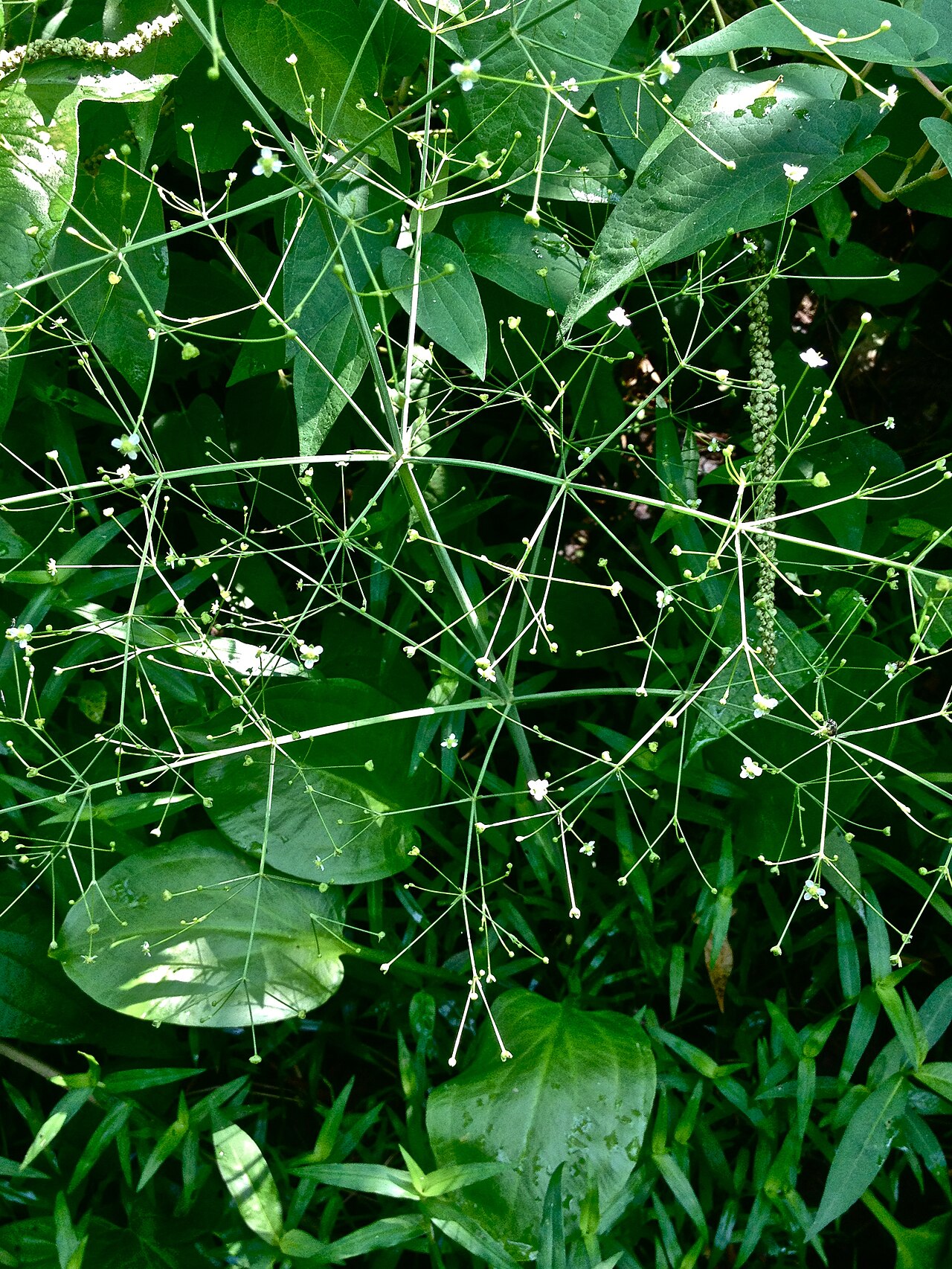
Alisma subcordatum, known as American Water-plantain or southern water-plantain, is an emergent aquatic perennial of pond edges, marshes, ditches and slow streams across eastern and central North America. It belongs to the water-plantain family (Alismataceae), alongside the arrowheads. From a rosette of long-stalked, oval to slightly heart-shaped leaves it sends up a tall, open, many-branched flower stalk, 1 to 3 feet high, scattered with tiny white flowers from early summer into fall.
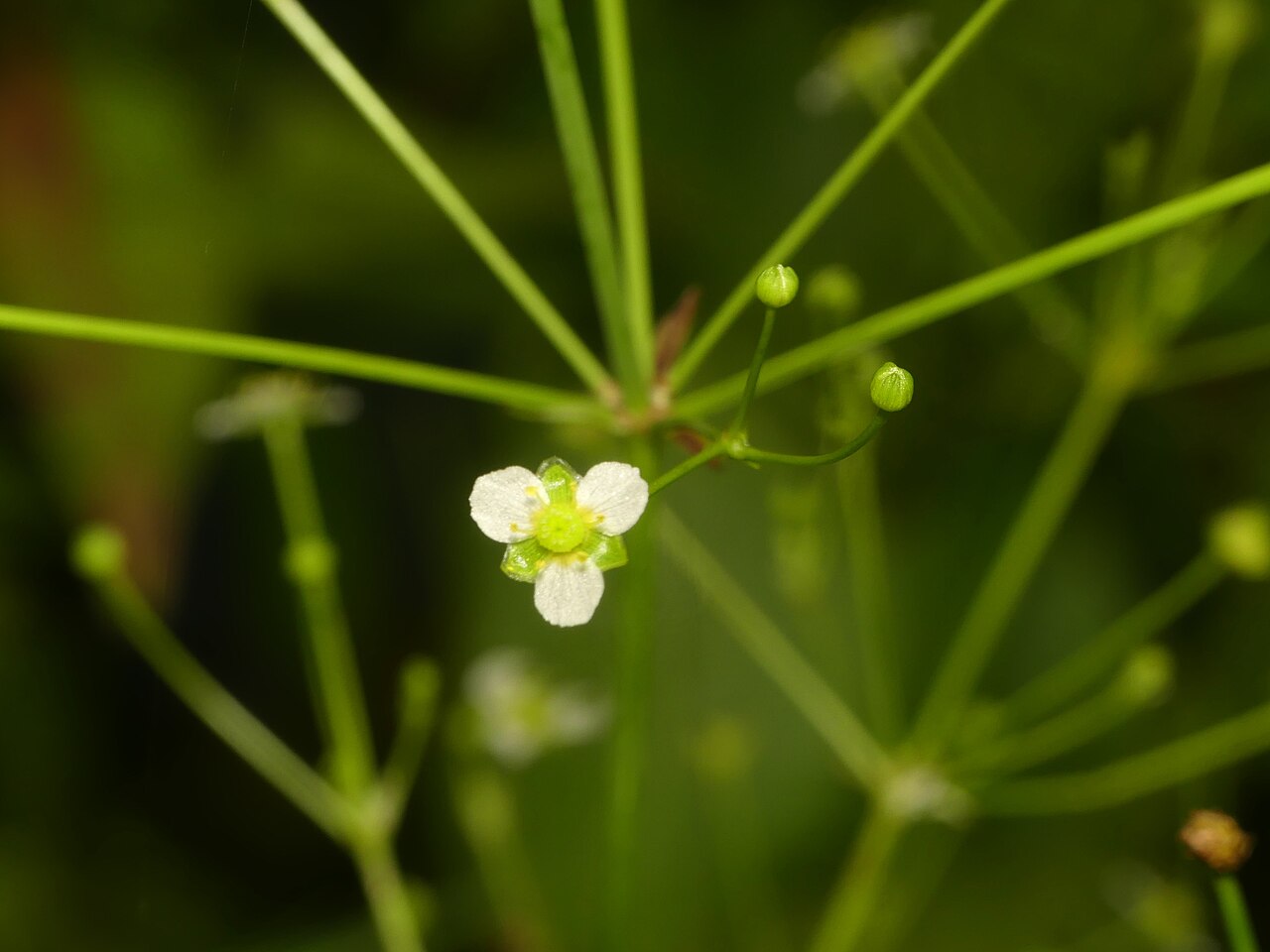
Its name comes from the broad, plantain-like leaves, though it is unrelated to the lawn plantains. The species name subcordatum means “somewhat heart-shaped,” describing the leaf bases. Each flower lasts only a day and is barely ⅛ inch across, so the plant is noticed more for its delicate, candelabra-like flowering stalk than for its blossoms.
American water-plantain is easy to grow in a water garden, rain garden or the wet edge of a pond, and its seeds feed ducks and other waterfowl. This guide covers how to identify it, where it grows, how to grow it, and its value to wildlife.
Identification
American water-plantain is easiest to recognize in bloom, when its open, whorled flower stalk stands above a clump of broad leaves in shallow water or mud.
Leaves & Growth Habit
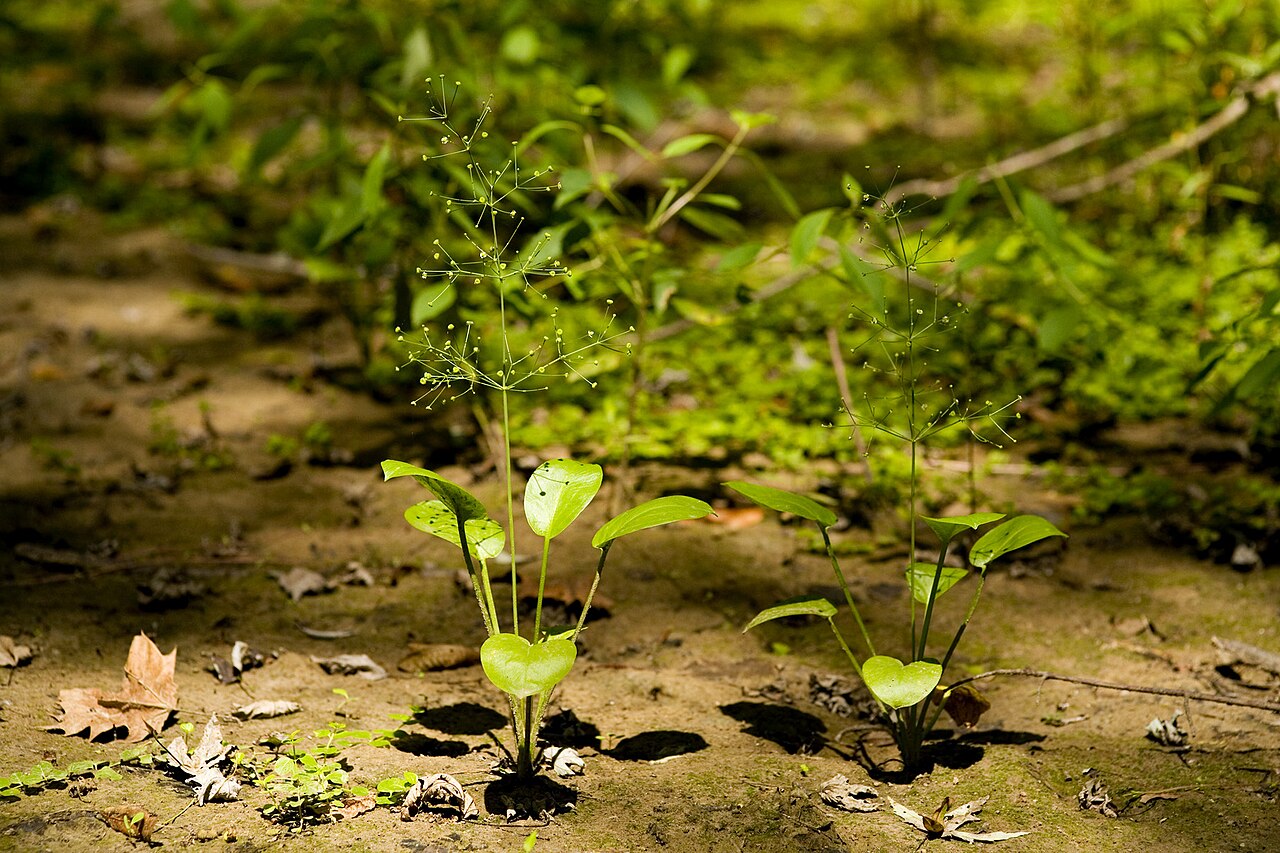
A clump-forming perennial from a short, thick, corm-like base with fibrous roots. Emergent leaves are basal, with long stalks and blades 2 to 6 inches long, elliptic to oval, rounded or slightly heart-shaped at the base, with several prominent parallel veins curving from base to tip. Leaves formed underwater are narrow and ribbon-like, rot quickly, and are seldom seen on mature plants.
Flowers
Flowers appear from June into September or October on a leafless stalk 1 to 3 feet tall that branches repeatedly in whorls, forming a loose, pyramidal panicle. Each flower is tiny, about ⅛ inch (2 to 4 mm) across, with three green sepals and three white, occasionally pinkish, petals around a ring of pistils. Flowers open for a single day, usually from morning to early afternoon.
Fruit
The fruit is a small, flat, rounded head of seed-like achenes, each with a ridge along its back. The heads are green at first and turn brown as they ripen in late summer and fall; the achenes float, which helps spread them along shorelines.
Look-alikes
Northern water-plantain (Alisma triviale, also treated as A. plantago-aquatica var. americanum) is very similar but has larger petals, about ⅛ to ¼ inch long, and a longer style; botanists in some areas treat the two together. The European water-plantain (Alisma plantago-aquatica) is also similar. Arrowheads such as Duck Potato have larger white flowers in whorls of three on an unbranched or little-branched stalk and usually arrow-shaped leaves. Burheads (Echinodorus) have spiny, bur-like fruit heads.
Quick Facts
| Scientific Name | Alisma subcordatum (syn. Alisma plantago-aquatica var. parviflorum, Alisma parviflorum) |
| Family | Alismataceae (water-plantain family) |
| Plant Type | Emergent aquatic herbaceous perennial |
| Mature Height | 1–3 ft in bloom |
| Mature Spread | 1–2 ft |
| Growth Rate | Fast |
| Sun Exposure | Full sun to partial shade |
| Water Needs | Wet; saturated soil or shallow water up to about 6 in deep |
| Soil Type | Mud, muck, silt, clay or sandy soils at the water’s edge |
| Soil pH | Slightly acidic to alkaline |
| Bloom Time | June–October |
| Flower Color | White, occasionally pale pink |
| Fall Color | None significant; foliage yellows and dies back |
| Fruit | Small rounded heads of flattened achenes |
| Deer Resistant | Moderately; occasionally browsed |
| USDA Hardiness Zones | 3–9 |
Native Range
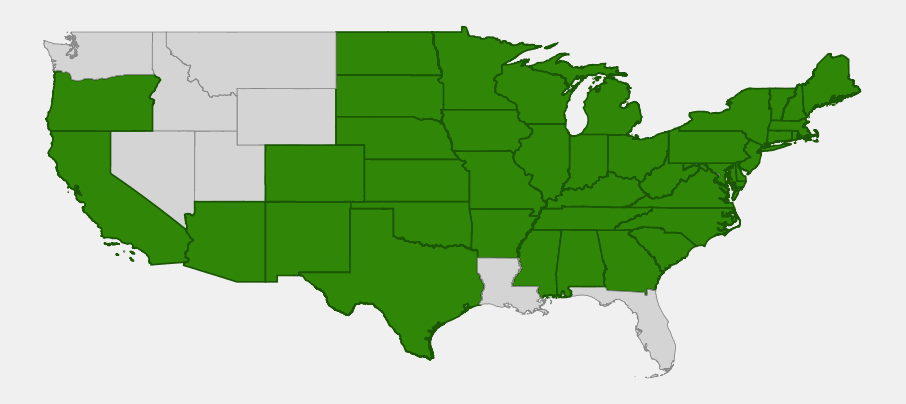
American water-plantain is native to eastern and central North America. USDA PLANTS lists it in 40 U.S. states, from Maine and the New England states south to Georgia and west across the Midwest and Great Plains to the Dakotas, Nebraska, Kansas, Oklahoma and Texas, and in Canada in Manitoba, Ontario, Quebec and New Brunswick. It is not native to Florida.
In the West, USDA also lists scattered records in Colorado, New Mexico, Arizona, California and Oregon. These are outlying records at the edge of the range; western floras such as Calflora treat most California plants as the closely related northern water-plantain (Alisma triviale), so the species is far more common east of the Rockies.
It grows in shallow water and mud along the margins of ponds, lakes and slow streams, and in marshes, wet meadows, seeps, ditches, wet roadsides and floodplain pools. It is an obligate wetland plant in every region of the National Wetland Plant List and readily colonizes newly exposed mud as water levels drop in summer.
📋 Regional plant lists featuring American Water-plantain: Alabama, Georgia & Mississippi · Arkansas, Louisiana, Eastern Oklahoma & Eastern Texas · Arizona & New Mexico · California & Nevada · North Dakota, South Dakota & Western Minnesota · Delaware, Southern New Jersey & Long Island · Illinois, Iowa & Missouri · Ohio & Indiana · Kentucky & Tennessee · Maryland, Virginia & West Virginia · Michigan, Wisconsin & Eastern Minnesota · North & South Carolina · Nebraska, Kansas & Eastern Colorado · New Hampshire, Maine & Vermont · Connecticut, Massachusetts & Rhode Island · New York, Pennsylvania & Northern New Jersey
Growing & Care Guide
American water-plantain is one of the easiest native plants for a pond edge or water garden. It is sold by many native and aquatic plant nurseries, often as bare-root plants or plugs, and it establishes quickly from seed.
Light
Full sun to partial shade. It flowers best with at least a half day of sun, but tolerates more shade than many emergent plants.
Soil & Water
Plant it in mud or in shallow water up to about 6 inches deep. It grows in almost any wet soil, including heavy clay and muck, and tolerates water levels that rise and fall through the season. It can grow in a rain garden or low spot that stays wet for long periods, but it will decline if the soil dries out completely in summer.
Planting Tips
Set plants in spring at the water’s edge, or in aquatic baskets of heavy garden soil (not potting mix, which floats) placed on a pond shelf. Space them 12 to 18 inches apart. In small water features, keep it in a container: it self-sows freely on bare mud.
Pruning & Maintenance
Little care is needed. Cut back the flower stalks after the seeds ripen if you want to limit self-seeding, and remove dead foliage in late fall or early spring. Plants can be divided every few years if they crowd out neighbors.
Propagation
Sow fresh seed on the surface of wet soil in fall, or cold-moist stratify it for about 2 months before spring sowing and keep the soil saturated; seed germinates best in light on wet mud. Established clumps can also be divided in spring.
Landscape Uses
- Pond and water garden edges: airy summer flowers above bold foliage in shallow water
- Rain gardens and wet swales: for the wettest, longest-flooded zones
- Wetland restoration: a fast colonizer of exposed mud and shorelines
- Wildlife ponds: seeds for waterfowl and cover for aquatic insects and amphibians
Wildlife & Ecological Value
American water-plantain is a modest but useful member of the shallow-water plant community.
For Pollinators
The small flowers produce nectar and pollen and are visited by small bees, syrphid flies and other small flies. Because each flower opens for only part of one day, a single plant offers a long, steady trickle of blooms through the summer.
For Birds
Ducks, geese and other waterfowl eat the seeds, which are produced in large numbers and float on the water. Marsh birds and some upland birds also feed on them, and the dense clumps give cover to wading birds hunting along the shore.
For Mammals
Muskrats and other wetland mammals feed on water-plantains, and deer occasionally graze the leaves.
Ecosystem Role
Its leaves and submerged stems shelter aquatic insects, snails, tadpoles and small fish, and its roots help stabilize mud along shorelines. As a pioneer of newly exposed mudflats and drawdown zones, it is often among the first plants to recolonize disturbed wetlands.
Cultural & Historical Uses
The naturalist Constantine Rafinesque described Alisma subcordatum in the early 1800s. For much of the 20th century many botanists treated American water-plantains as varieties of the Eurasian Alisma plantago-aquatica, the “water plantain” of European herbals, and this species often appears in older books as A. plantago-aquatica var. parviflorum. Today the North American plants are generally treated as two native species: the smaller-flowered A. subcordatum and the larger-flowered A. triviale.
Several Native American peoples dried and cooked the starchy, corm-like bases of water-plantains as food. The fresh plant is acrid and was used in some traditional medicine, and it should not be eaten raw.
The genus name Alisma is an ancient Greek name for a water plant, used by Dioscorides. The common name “water-plantain” comes from the leaves, whose shape and curved parallel veins resemble those of broadleaf plantain (Plantago), a resemblance that is only skin deep.
Frequently Asked Questions
Is American water-plantain native?
Yes. It is native to eastern and central North America, from the Atlantic Coast west to the Great Plains and Texas, and USDA PLANTS lists it in 40 states and four Canadian provinces.
How deep can it grow in a pond?
It grows best in mud or in shallow water up to about 6 inches deep. It tolerates seasonal flooding and drawdowns, but it needs its leaves to rise above the water to thrive.
Is it invasive?
No. It is a native plant, though it self-sows readily on bare mud. In small ponds, grow it in a container and cut off seed heads if you want to keep it in check.
How is it different from northern water-plantain?
Northern water-plantain (Alisma triviale) has larger petals and is more northern and western. American water-plantain has very small flowers, about ⅛ inch across, with short styles. They are hard to tell apart without a close look at the flowers.
Is water-plantain edible?
Native Americans dried and cooked the starchy bases as food, but the fresh plant is acrid and irritating and should not be eaten raw. It is best enjoyed as a pond plant and wildlife food.

Looking for a nursery that carries American Water-plantain?
Browse our native plant nursery directory: Alabama, Arizona & Arkansas · California · Colorado, Connecticut, Delaware & Georgia · Illinois, Indiana, Iowa & Kansas · Kentucky, Maine, Maryland, Massachusetts, Michigan, Minnesota, Mississippi & Missouri · Nebraska, New Hampshire, New Jersey, New Mexico, New York, North Carolina, North Dakota, Ohio & Oklahoma · Oregon · Pennsylvania, Rhode Island, South Carolina, South Dakota, Tennessee, Texas, Vermont & Virginia · West Virginia & Wisconsin

