
American Sweet-Flag (Acorus americanus)
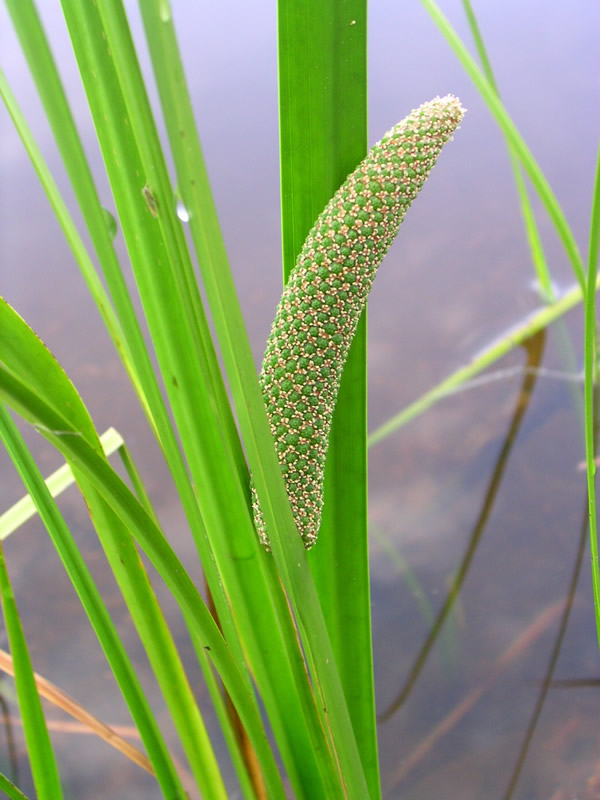
Acorus americanus, American Sweet-Flag, is the native sweet-flag of North America: an aromatic, iris-like wetland perennial that forms dense stands of upright, sword-shaped leaves along marshes, pond edges, wet meadows and slow streams. Bruise any part of the plant and it releases a warm, spicy, citrus-and-cinnamon scent. In late spring a stubby, finger-like spadix of tiny greenish-yellow flowers juts out at an angle partway up what looks like an ordinary leaf.
For most of the last two centuries, North American sweet-flag was simply lumped with the Eurasian Acorus calamus, and many books and nurseries still use that name for both. Botanists now separate them. American sweet-flag is a fertile diploid species native from Alaska and the Canadian prairies to New England and the Great Lakes. The European and Asian plant usually sold as calamus is a sterile triploid that was carried to North America by settlers and has spread mainly by its rhizomes. Our separate Sweet Flag (Acorus calamus) page covers that plant in the broad, traditional sense.
Sweet-flag is not an iris or a cattail. It belongs to its own small family, the Acoraceae, which DNA studies place at the very base of the monocot family tree, the sister group to all other monocots. This guide covers how to tell the native species from its introduced cousin, where it grows, how to grow it in a pond or rain garden, its value to wildlife, and its long history as one of the most important medicinal plants of northern Indigenous peoples.
Identification
Out of flower, sweet-flag is easy to mistake for blue flag iris, yellow flag iris or a young cattail. The quickest test is to crush a leaf: sweet-flag is strongly and pleasantly aromatic, and irises and cattails are not. The leaves are also bright yellow-green, and the base of each fan is often tinged pink or red.
Rhizome & Habit
American sweet-flag spreads by a thick, branching, creeping rhizome up to about an inch in diameter, buried in mud or shallow water. The rhizome is spongy, aromatic and marked by old leaf scars, with fibrous roots below. Over time a single plant forms a dense colony of overlapping leaf fans.
Leaves
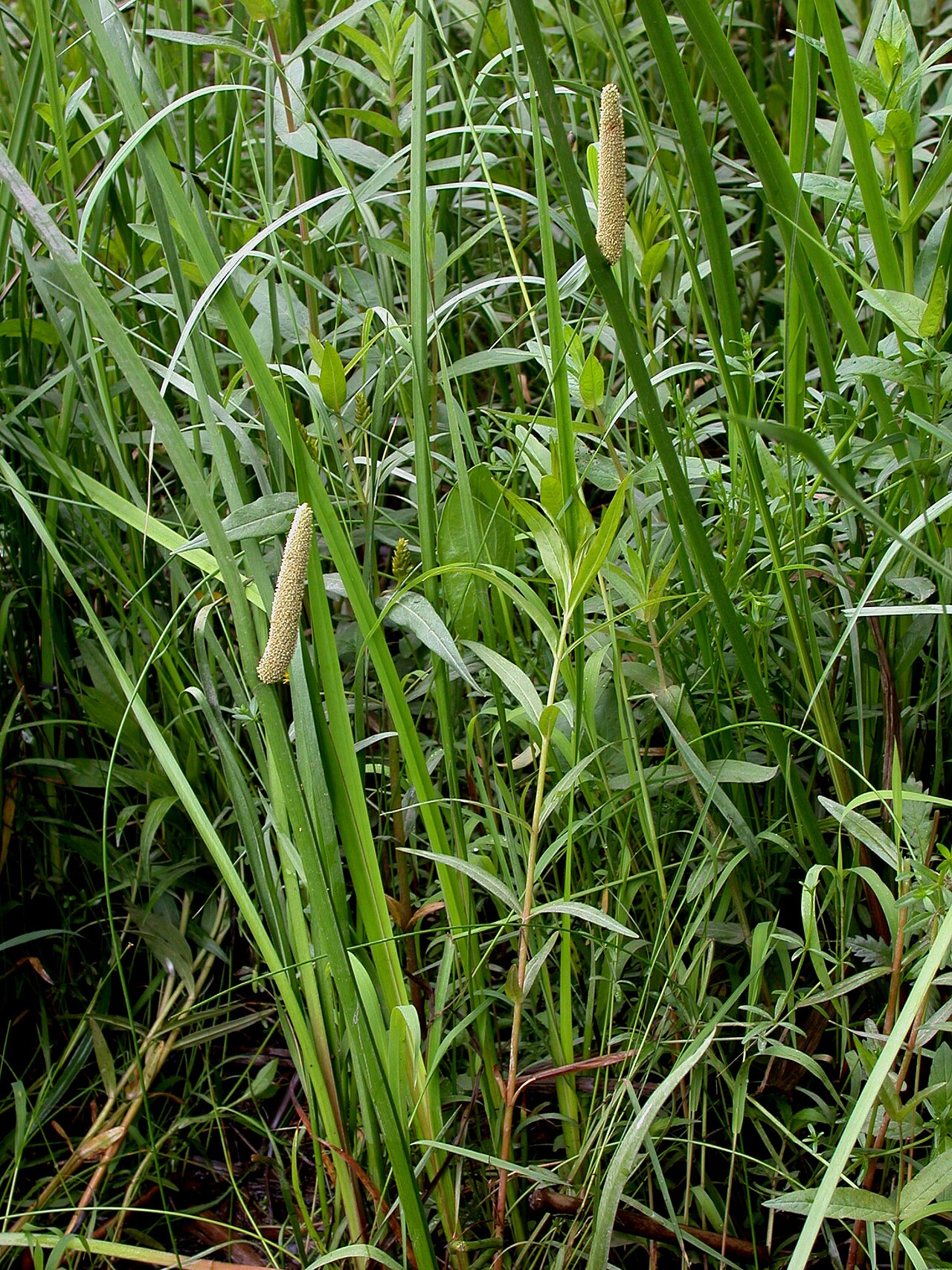
Leaves are sword-shaped, flattened and arranged in flat fans like an iris, typically 1 to 4 feet tall (occasionally to about 5 feet) and up to about an inch wide. The best field mark for the native species is the venation: an American sweet-flag leaf has two to six raised veins of about equal prominence running its length, visible on both faces. The introduced A. calamus has a single prominent midrib, often slightly off center, with fainter veins on either side. Leaf margins are smooth and often wavy or crimped toward the tip.
Flowers
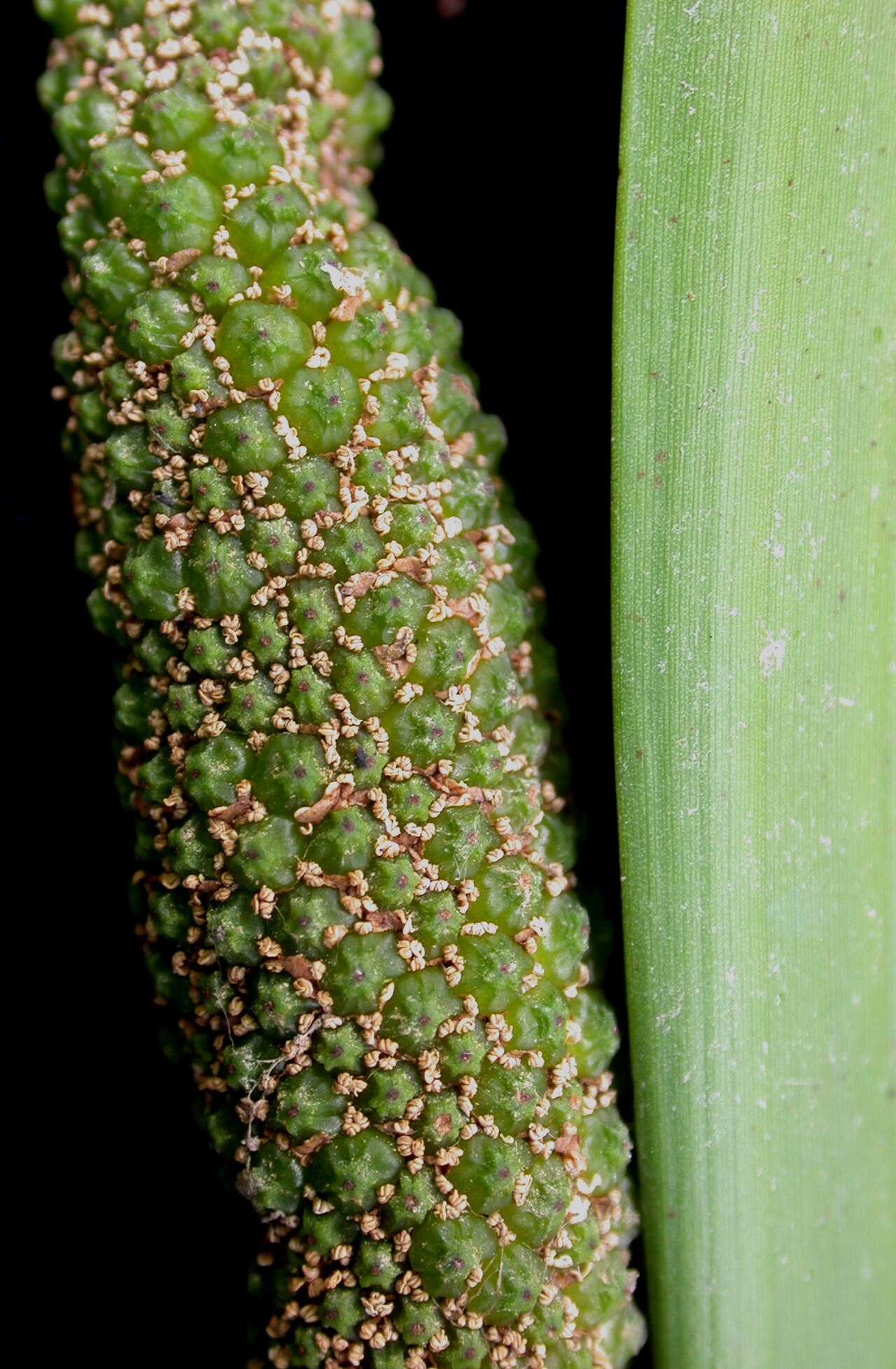
The flowering stem looks just like a leaf. Partway up it, a cylindrical spadix 2 to 4 inches long angles out sideways, and the stem continues above it as a leaf-like spathe. The spadix is densely covered with hundreds of tiny, bisexual, six-parted flowers in a diamond pattern, greenish-yellow to tan. Flowering runs from late spring into early summer, roughly May to July depending on latitude.
Fruit & Seeds
After flowering, a fertile American sweet-flag spadix develops small, reddish-brown to greenish berries, each with a few seeds. This is a useful clue: the triploid A. calamus in North America is sterile and its spadix withers without fruit. The two species also differ in chemistry. Diploid American sweet-flag lacks the compound beta-asarone, which is abundant in the triploid and tetraploid Old World forms.
Quick Facts
| Scientific Name | Acorus americanus (syn. A. calamus var. americanus) |
| Family | Acoraceae (sweet-flag family) |
| Plant Type | Aromatic emergent wetland perennial from a creeping rhizome |
| Mature Height | 1–4 ft (occasionally to about 5 ft) |
| Mature Spread | Spreads by rhizomes into colonies several feet wide |
| Growth Rate | Moderate |
| Sun Exposure | Full sun to part shade |
| Water Needs | High; wet soil to standing water up to about 6–9 in deep |
| Soil Type | Mucky, silty or loamy wet soils; tolerates sand and clay |
| Soil pH | About 5.5–7.5 |
| Bloom Time | May–July |
| Flower Color | Greenish-yellow to tan (tiny flowers on a spadix) |
| Fall Color | Leaves turn tan to golden brown |
| Fruit | Small reddish-brown berries on the spadix |
| Deer Resistant | Yes; the aromatic foliage is rarely browsed |
| USDA Hardiness Zones | 2–8 |
Native Range
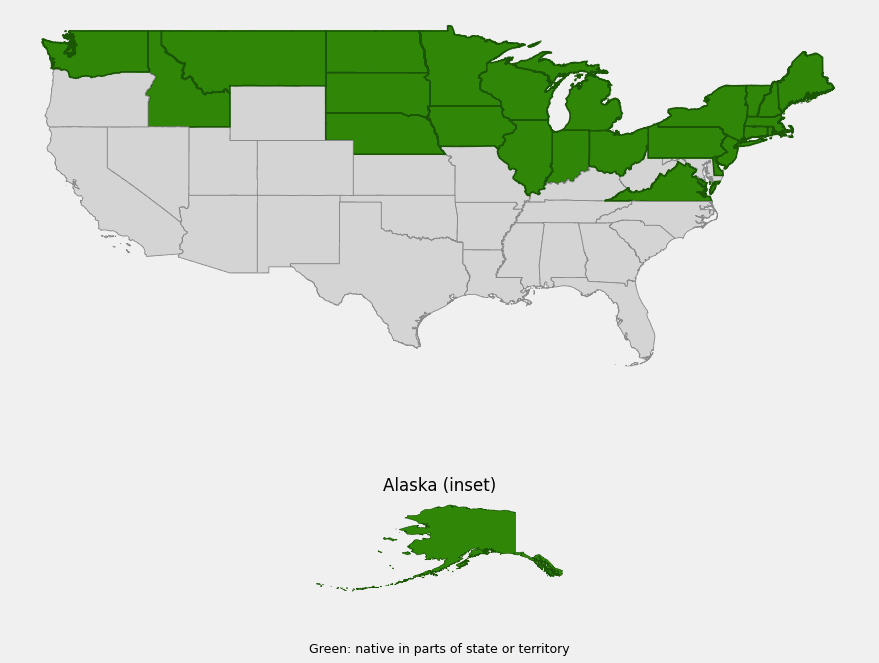
American sweet-flag is a plant of the northern half of the continent. USDA PLANTS records it as native in Alaska and in 24 of the lower 48 states: across New England, New York, New Jersey and Pennsylvania, west through the Great Lakes states, Iowa, Nebraska and the Dakotas, and in Montana, Idaho and Washington, with outlying records south to Delaware and Virginia. It is also native across most of Canada, from British Columbia, Alberta and the Northwest Territories east to Newfoundland, and it is the only sweet-flag in much of the boreal north and the prairies.
Its range overlaps that of introduced Acorus calamus mainly in the Northeast and the Great Lakes region, where both can grow in the same marsh. Farther south, in the Ohio and Mississippi valleys and the Southeast, most sweet-flag populations are the introduced triploid, which often grows near old homesites and along streams where it was once planted. If you are unsure which you have, check the leaf veins and look for fruit in midsummer.
In the wild it grows in shallow water and saturated soil: marshes, wet meadows, fens, sedge meadows, ditches, stream banks, lake shores and beaver ponds, usually in full sun. It is a wetland obligate in every U.S. region in the National Wetland Plant List.
📋 Regional plant lists featuring American Sweet-Flag: Alaska · Michigan, Wisconsin & Eastern Minnesota · North Dakota, South Dakota & Western Minnesota · Illinois, Iowa & Missouri · Ohio & Indiana · Nebraska, Kansas & Eastern Colorado · Montana & Wyoming · Idaho, Eastern Oregon & Eastern Washington · New York, Pennsylvania & Northern New Jersey · Delaware, Southern New Jersey & Long Island · Maryland, Virginia & West Virginia · Connecticut, Massachusetts & Rhode Island · New Hampshire, Maine & Vermont
Growing & Care Guide
American sweet-flag is one of the easiest native plants for a pond edge or permanently wet spot. It needs constant moisture, full sun to part shade, and some room to spread. When buying, ask for Acorus americanus by name and plants of known North American origin. Plants sold simply as “sweet flag” or Acorus calamus are often the Eurasian triploid, and the small grassy “sweet flag” sold for containers is Acorus gramineus, an Asian species.
Light
Full sun gives the densest, most upright foliage and the best flowering. It tolerates part shade, especially in the southern part of its range, but grows thinner and floppier in deep shade.
Soil & Water
Any wet soil works, from muck and silt to sand and clay. Plant it in saturated soil at a pond margin, a wet ditch or a bog garden, or in standing water up to about 6 to 9 inches deep. It tolerates water levels that fluctuate through the season and survives brief dry spells once established, but it will decline in soil that dries out regularly. No fertilizer is needed.
Planting Tips
Plant rhizome divisions or potted plants in spring, setting the rhizome horizontally just below the soil surface. Space plants 1 to 2 feet apart for a solid planting within two or three seasons. In a lined pond, grow it in a wide aquatic basket of heavy loam to keep it from spreading across the shelf. It is far less aggressive than cattails or reed canarygrass, but it does form steadily widening colonies.
Pruning & Maintenance
Cut back the old foliage in late winter or early spring before new growth starts. Divide crowded clumps every few years. Sweet-flag has few pest problems; its aromatic leaves deter most insects and browsers.
Propagation
Division is easy: in spring or early fall, cut the rhizome into pieces 3 to 4 inches long, each with a fan of leaves or a growing bud. Unlike the triploid calamus, American sweet-flag produces viable seed, which can be sown fresh on wet, muddy soil and kept saturated, though division is much faster.
Landscape Uses
- Pond and stream margins: stabilizes muddy banks with its dense rhizomes and adds fragrance where people brush past
- Rain gardens and bioswales: in the wettest zone, where water stands for days at a time
- Wetland restoration: a native alternative to invasive yellow flag iris and reed canarygrass in northern marshes
- Bog and water gardens: fine-textured vertical foliage contrasts with round-leaved plants such as wild calla and pickerelweed
- Ethnobotanical and heritage gardens: a culturally significant plant for many northern Indigenous nations
Wildlife & Ecological Value
American sweet-flag is not a major wildlife food plant, but its dense stands provide structure and cover in shallow water and help hold shorelines together.
For Pollinators
The tiny flowers produce pollen but little or no nectar, and they are visited by small flies, beetles and bees. Pollination biology of the species is poorly studied. Its main value to pollinators is indirect, as part of the diverse wetland plant community that supports them.
For Birds
Waterfowl and marsh birds use sweet-flag stands for cover, and red-winged blackbirds and other marsh songbirds nest among emergent plants like it. The small berries of fertile native plants may be eaten by some waterbirds, but the seeds are not an important food.
For Mammals
Muskrats eat the rhizomes, which is why sweet-flag is known as “rat root” across much of northern Canada and the Great Lakes region. Deer, moose and livestock rarely eat the foliage, probably because of its aromatic oils.
Ecosystem Role
Like other emergent plants, sweet-flag slows water flow, traps sediment and takes up nutrients along pond and stream edges. Because it spreads by stout rhizomes, it helps bind soft mud against wave and ice action. Native stands are also an important genetic resource as the two sweet-flag species become better understood.
Cultural & Historical Uses
Sweet-flag is one of the most widely used medicinal plants in northern North America. Cree, Ojibwe, Dakota, Lakota, Blackfoot and many other nations chewed small pieces of the dried rhizome for colds, sore throats, coughs, toothache and fatigue, and used it in ceremonies and as a protective charm. Its Cree name is commonly written wihkes, and in English it is still widely called “rat root” or “muskrat root.” It was traded far beyond its natural range, and some isolated populations may have been planted by Indigenous people.
European settlers knew the triploid calamus as a medicine, candy (candied rhizome), aromatic strewing herb and flavoring for bitters and liqueurs, and they planted it widely. Since 1968 the U.S. Food and Drug Administration has prohibited calamus and its derivatives as food additives because beta-asarone, abundant in the Old World forms, caused cancer in laboratory animals. Diploid American sweet-flag contains little or no beta-asarone, but rhizomes of the two species look alike. Do not use sweet-flag as a food or medicine without expert guidance, and keep it away from pets that chew plants.
The botanical story is newer. Constantine Rafinesque named Acorus americanus in the 19th century, but most 20th-century floras treated all North American plants as A. calamus. Studies of chromosome number, leaf anatomy and chemistry in the 1990s and 2000s showed that the native fertile diploid and the introduced sterile triploid are distinct, and the Flora of North America and USDA PLANTS now recognize A. americanus as a separate species.
Frequently Asked Questions
What is the difference between Acorus americanus and Acorus calamus?
Acorus americanus is the native North American diploid sweet-flag. It sets fruit, has two to six equally raised veins on each leaf, and contains little or no beta-asarone. Acorus calamus in North America is a Eurasian triploid introduced by settlers. It is sterile, has one prominent off-center midrib, and is rich in beta-asarone. See our Sweet Flag page for the traditional broad treatment.
Is American sweet-flag invasive?
No. It is native across the northern United States and Canada and spreads at a moderate pace by rhizomes. In a small lined pond, grow it in a container to keep it in its spot.
Is sweet-flag poisonous?
The rhizome has strong-tasting oils, and the Old World triploid forms contain beta-asarone, which the FDA bans as a food additive. Native diploid plants have little of it, but the two are hard to tell apart, so do not eat or brew sweet-flag without expert guidance.
Can sweet-flag grow in standing water?
Yes. It grows well in saturated soil and in water up to about 6 to 9 inches deep, and it tolerates water levels that rise and fall through the season.
Why does sweet-flag rarely flower in my pond?
Plants in deep shade, in very deep water, or that were recently divided often flower sparsely. Give it full sun and a few years to settle in. If a plant flowers but never produces fruit, it is probably the sterile triploid A. calamus rather than the native species.

Looking for a nursery that carries American Sweet-Flag?
Browse our native plant nursery directory: Alaska · Connecticut & Delaware · Idaho, Illinois, Indiana & Iowa · Maine, Massachusetts, Michigan, Minnesota & Montana · Nebraska, New Hampshire, New Jersey, New York, North Dakota & Ohio · Pennsylvania, Rhode Island, South Dakota, Vermont & Virginia · Washington · Wisconsin

