
Bosc’s Panicgrass (Dichanthelium boscii)
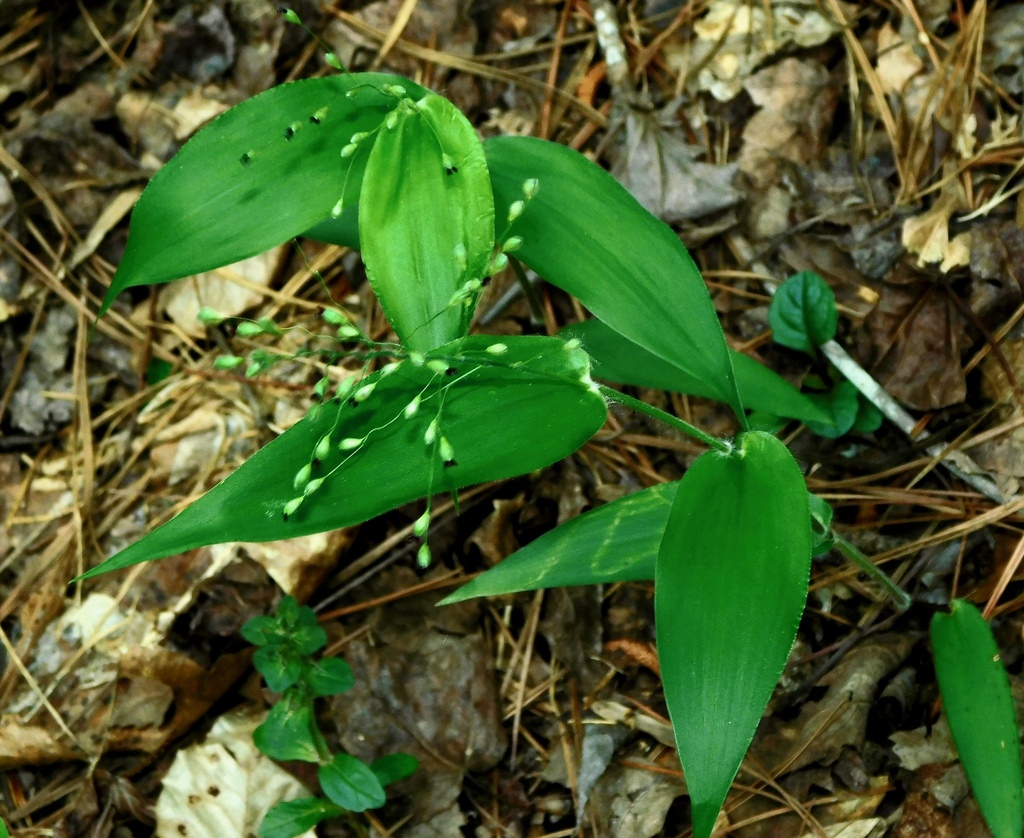
Dichanthelium boscii, known as Bosc’s Panicgrass or Bosc’s witchgrass, is a low, clump-forming woodland grass of the eastern and south-central United States. It has some of the broadest leaves of any panicgrass: short, bright green blades up to about an inch wide that make a clump look more like a small bamboo than a typical grass. In spring it sends up open, airy panicles of plump, round spikelets, and it stays green through much of the year.
It belongs to the grass family (Poaceae) and to Dichanthelium, the rosette panicgrasses, a large group of small, cool-season grasses once included in Panicum. Older references list it as Panicum boscii. Like its relatives, it forms a winter rosette of short basal leaves, flowers in spring, and then branches in summer and fall to produce a second set of small, hidden flower clusters among the leaves.
Bosc’s panicgrass grows in dry to moist deciduous and mixed forests, on wooded slopes and along woodland edges from southern New England and New York south to Florida and west to Kansas, Oklahoma and Texas. It is one of the few native grasses that does well in shade, which makes it useful for woodland gardens and restoration. This guide covers how to identify it, where it grows and how to grow it.
Identification
Bosc’s panicgrass is easy to pick out among woodland grasses by its short, broad, lance-shaped leaves with heart-shaped bases, its bearded stem nodes and its relatively large, round spikelets.
Growth Habit
It is a cool-season perennial bunchgrass with upright to leaning stems usually 1 to 2½ feet tall. In fall and winter it forms a low rosette of short, broad basal leaves that stays green through mild winters. Flowering stems rise from the rosette in spring; later in the season they branch from the middle nodes, giving older plants a bushy look.
Leaves
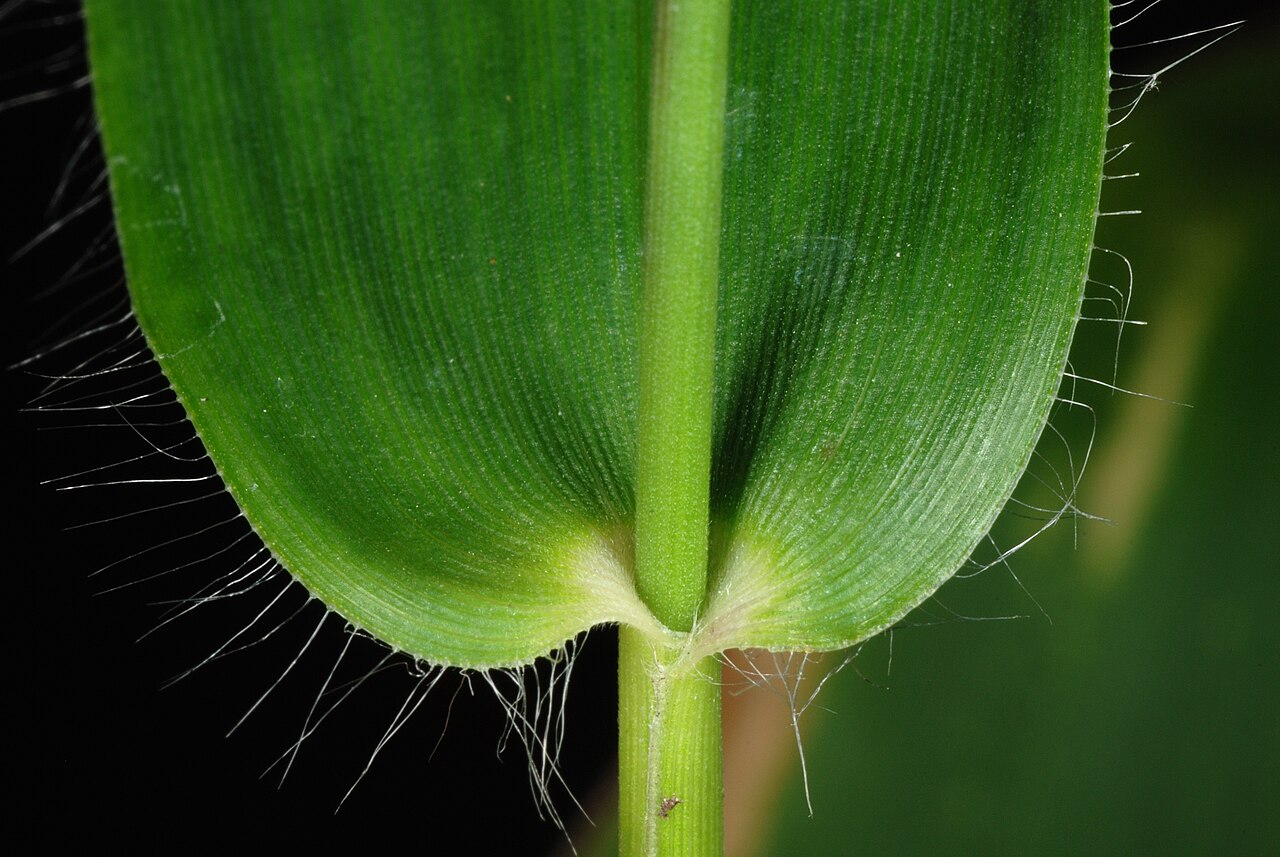
The stem leaves are broadly lance-shaped, about 2½ to 5 inches long and roughly ½ to 1¼ inches wide, flat, bright to dark green and often finely veined. Their bases are rounded to heart-shaped and clasp the stem, and the edges near the base are fringed with long hairs. The leaf sheaths are often hairy, and the stem nodes carry a ring of soft, downward-pointing hairs, a useful feature for separating it from similar species.
Flowers & Spikelets
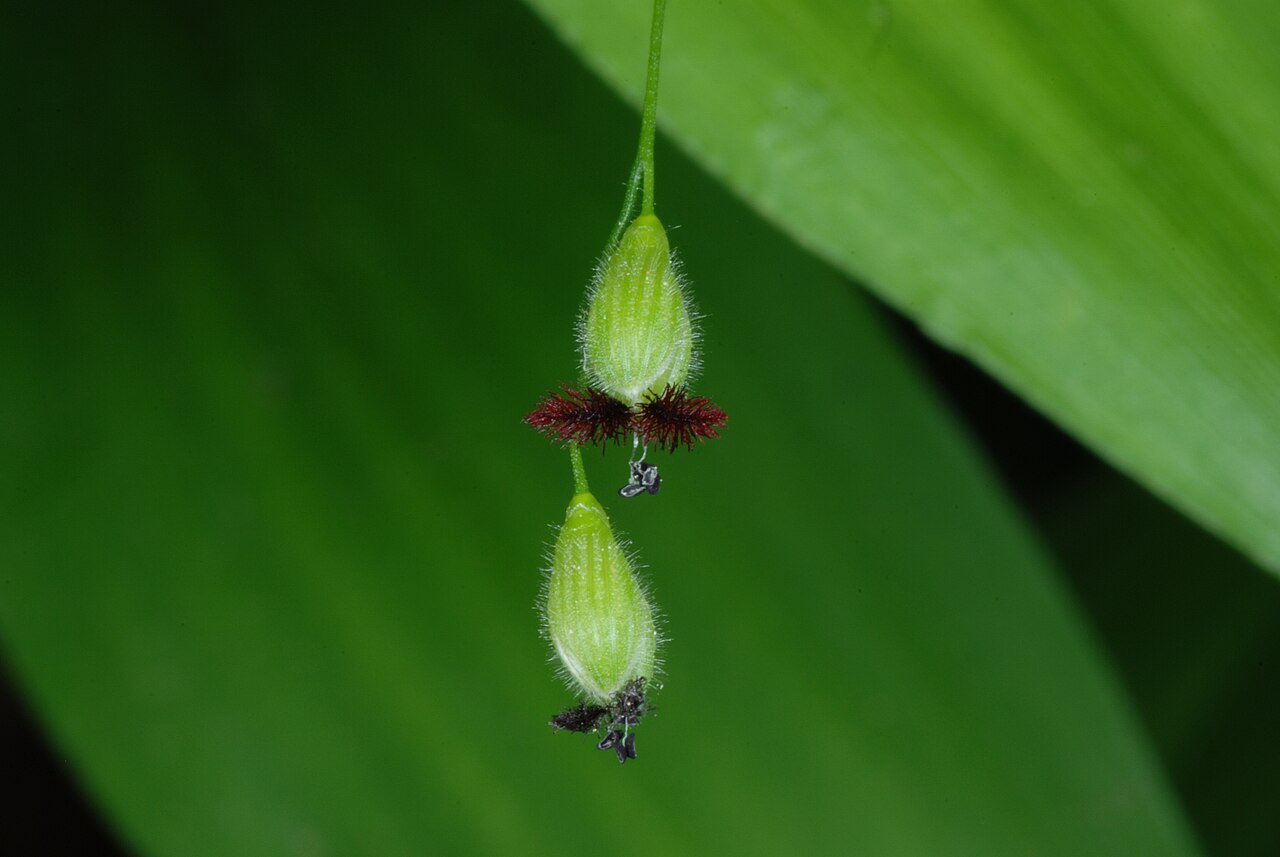
The spring panicles are open and loosely branched, about 2 to 4 inches long, with long-stalked spikelets. Each spikelet is egg-shaped to nearly round, about 4 to 5 mm long, green to purplish and finely hairy, which is large for the genus. During flowering the feathery purple stigmas and yellow anthers hang out of the spikelets. The main bloom is from about April to June.
Fall Phase & Seeds
In summer and fall the plant branches and produces small, reduced panicles partly hidden in the leaf sheaths. Many of these flowers never open and pollinate themselves (cleistogamy), so plants set seed even in deep shade. The seeds are hard, shiny grains enclosed in the spikelet.
Similar Species
Deertongue (Dichanthelium clandestinum) also has broad leaves but is taller, has rough-hairy sheaths and smaller spikelets, and grows in moister, sunnier places. Other woodland rosette grasses, such as Dichanthelium commutatum, have narrower leaves, smaller spikelets and hairless nodes.
Quick Facts
| Scientific Name | Dichanthelium boscii (Poir.) Gould & C.A. Clark |
| Family | Poaceae (grass family) |
| Plant Type | Cool-season perennial bunchgrass |
| Mature Height | 1–2½ ft |
| Mature Spread | 1–1½ ft |
| Growth Rate | Moderate |
| Sun Exposure | Part shade to full shade |
| Water Needs | Low to medium; dry to moist soil |
| Soil Type | Well-drained loam, sandy or rocky woodland soils |
| Soil pH | About 5.0–7.5 |
| Bloom Time | April–June (main bloom); hidden fall flowers |
| Flower Color | Green to purplish spikelets with purple stigmas |
| Fall Color | Green to tan; basal rosette often semi-evergreen |
| Fruit | Small hard grain inside the spikelet |
| Deer Resistant | Moderately; browsed lightly |
| USDA Hardiness Zones | 5–9 |
Native Range
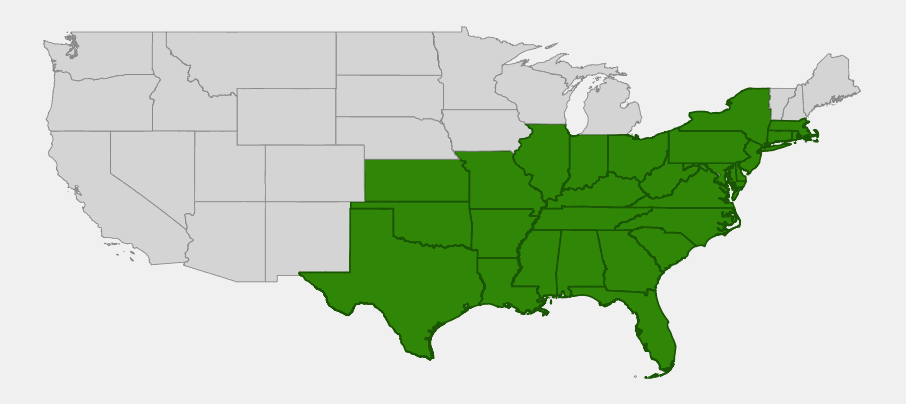
Bosc’s panicgrass is native to the eastern and south-central United States. USDA PLANTS lists it in Alabama, Arkansas, Connecticut, Delaware, Florida, Georgia, Illinois, Indiana, Kansas, Kentucky, Louisiana, Maryland, Massachusetts, Mississippi, Missouri, New Jersey, New York, North Carolina, Ohio, Oklahoma, Pennsylvania, Rhode Island, South Carolina, Tennessee, Texas, Virginia and West Virginia, as well as the District of Columbia. It is most common in the Southeast and the Ozarks and becomes scattered toward its northern edge in New England and New York.
It is a grass of forests rather than open prairies. It grows in dry to mesic oak-hickory and mixed hardwood forests, on wooded slopes and ravine sides, on rocky and sandy woodland soils, and along shady trails and forest edges. In the western part of its range, in Kansas, Oklahoma and Texas, it is limited to the wooded eastern sections.
It tolerates the light shade under deciduous trees well, using the bright weeks of early spring before the canopy closes to make most of its growth and flowers. It is found from coastal plain woods up into the Appalachian and Ozark uplands at low to moderate elevations.
📋 Regional plant lists featuring Bosc’s Panicgrass: North & South Florida · Alabama, Georgia & Mississippi · North & South Carolina · Maryland, Virginia & West Virginia · Kentucky & Tennessee · Arkansas, Louisiana, Eastern Oklahoma & Eastern Texas · Illinois, Iowa & Missouri · Ohio & Indiana · Nebraska, Kansas & Eastern Colorado · New York, Pennsylvania & Northern New Jersey · Delaware, Southern New Jersey & Long Island · Connecticut, Massachusetts & Rhode Island · New Hampshire, Maine & Vermont
Growing & Care Guide
Bosc’s panicgrass is an understated but useful grass for shady native gardens, where few grasses thrive. It stays low, does not spread aggressively and adds fine texture and early-season green under trees. It is offered occasionally by native plant nurseries and seed suppliers in the eastern United States.
Light
Give it light to full shade, such as the dappled shade under oaks and hickories. It also tolerates morning sun. In full afternoon sun it may scorch in hot, dry summers.
Soil & Water
It prefers well-drained woodland soil, from sandy or rocky to loamy, and tolerates dry shade once established. Avoid soggy soil. Water during its first growing season; afterward rainfall is usually enough. A light layer of leaf litter suits it better than heavy mulch.
Planting Tips
Plant in spring or fall, 12 to 18 inches apart, in small groups among woodland wildflowers and ferns. It works well as a low, natural-looking filler between spring ephemerals and taller perennials, and along shady paths.
Pruning & Maintenance
Little care is needed. Trim back dead stems in late winter before new growth starts, leaving the green basal rosette. Plants may reseed lightly; seedlings are easy to remove or move.
Propagation
Sow seed in fall outdoors, or cold-stratify it for about 30 to 60 days before spring sowing. Established clumps can be divided in early spring.
Landscape Uses
- Woodland and shade gardens: one of the few native grasses that thrives under trees
- Dry shade: tolerates root competition and dry soil under oaks once established
- Naturalistic groundlayer: fine texture among ferns, sedges and spring wildflowers
- Forest restoration: adds a native grass layer to oak-hickory woodland plantings
- Wildlife plantings: seeds and cover for woodland birds
Wildlife & Ecological Value
Like other rosette panicgrasses, Bosc’s panicgrass is a small but steady contributor to woodland food webs, providing seeds, larval food and cover close to the forest floor.
For Pollinators
It is wind-pollinated, so it offers no nectar, but rosette panicgrasses are larval host plants for several grass-feeding skipper butterflies. Its clumps and leaf litter also shelter overwintering insects.
For Birds
Wild turkeys, bobwhite quail and ground-feeding songbirds such as sparrows and juncos eat the seeds of rosette panicgrasses, which ripen in early summer and again in fall.
For Mammals
Deer and rabbits graze the tender leaves, especially the green winter rosettes when other food is scarce, but it is rarely eaten heavily. Small rodents eat the seeds.
Ecosystem Role
It is part of the native grass and sedge groundlayer of eastern hardwood forests, helping hold soil on wooded slopes and providing early green growth in spring and winter.
Cultural & Historical Uses
The species name honors Louis Augustin Guillaume Bosc, a French naturalist who collected plants and animals in the Carolinas in the 1790s. French botanist Jean Louis Marie Poiret described it as Panicum boscii in the early nineteenth century, and botanists Frank W. Gould and C. A. Clark moved it to Dichanthelium in 1978.
Dichanthelium means “twice flowering,” after the spring and fall flowering phases of these grasses. Rosette panicgrasses are notoriously difficult to identify, with dozens of similar species and many hybrids, but Bosc’s panicgrass is one of the easier ones because of its broad leaves, bearded nodes and large spikelets.
Botanists and restoration ecologists use rosette panicgrasses as indicators of healthy, open woodlands, and Bosc’s panicgrass is a typical member of the oak-hickory groundlayer that develops where forests are not overly shaded or disturbed.
Frequently Asked Questions
Does Bosc’s panicgrass grow in shade?
Yes. It is a woodland grass that grows best in light to full shade under deciduous trees, which makes it a good choice where most grasses fail.
How tall does Bosc’s panicgrass get?
Usually 1 to 2½ feet including the flower stems, with a low basal rosette of leaves only a few inches high in winter.
Is Bosc’s panicgrass the same as Panicum boscii?
Yes. It was long known as Panicum boscii. Most botanists now place the rosette panicgrasses in the genus Dichanthelium, though you may still see the old name in older books.
Is it evergreen?
Partly. Its basal winter rosette often stays green through mild winters, while the taller stems turn tan and die back.
Will Bosc’s panicgrass spread in my garden?
It is a clump-former and does not spread by runners. It may reseed lightly in open spots, but it is not aggressive.

Looking for a nursery that carries Bosc’s Panicgrass?
Browse our native plant nursery directory: Alabama & Arkansas · Connecticut, Delaware, Florida & Georgia · Illinois, Indiana & Kansas · Kentucky, Louisiana, Maryland, Massachusetts, Mississippi & Missouri · New Jersey, New York, North Carolina, Ohio & Oklahoma · Pennsylvania, Rhode Island, South Carolina, Tennessee, Texas & Virginia · West Virginia

