
Feltleaf Everlasting (Pseudognaphalium canescens)
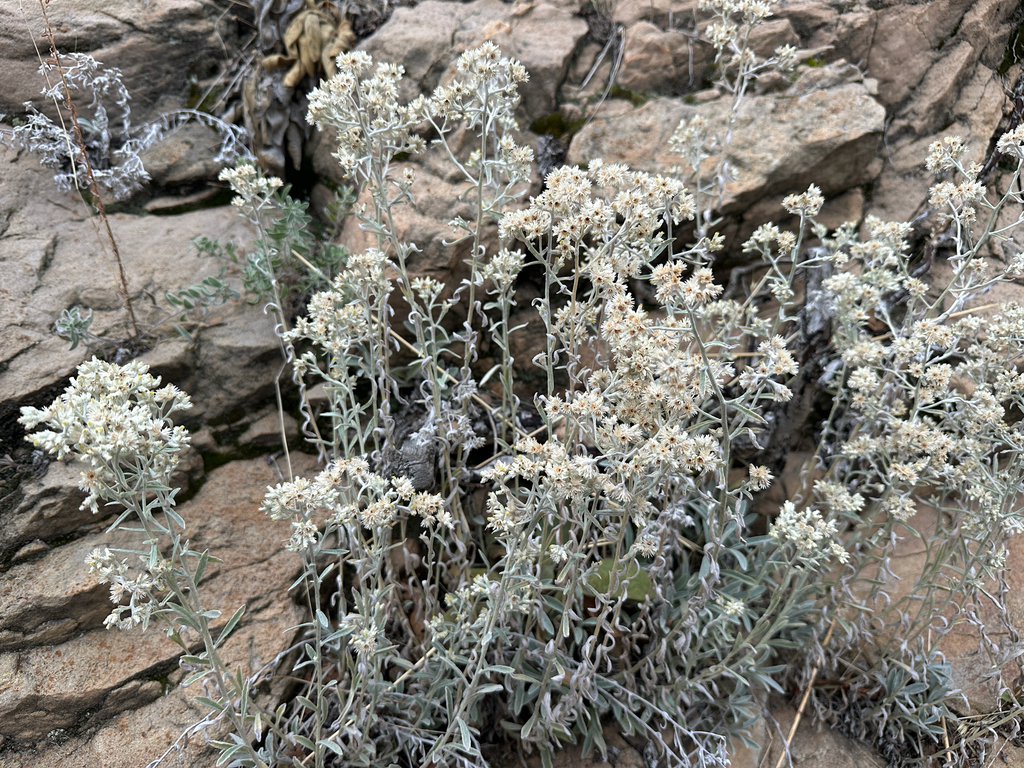
Pseudognaphalium canescens, known as Feltleaf Everlasting and called Wright’s cudweed by USDA PLANTS, is a silvery, woolly perennial in the aster family (Asteraceae). It grows 1 to 3 feet tall, with long, narrow leaves covered in dense white felt, and in late summer and fall it carries rounded clusters of small, papery, whitish flower heads with tiny yellow florets in the center.
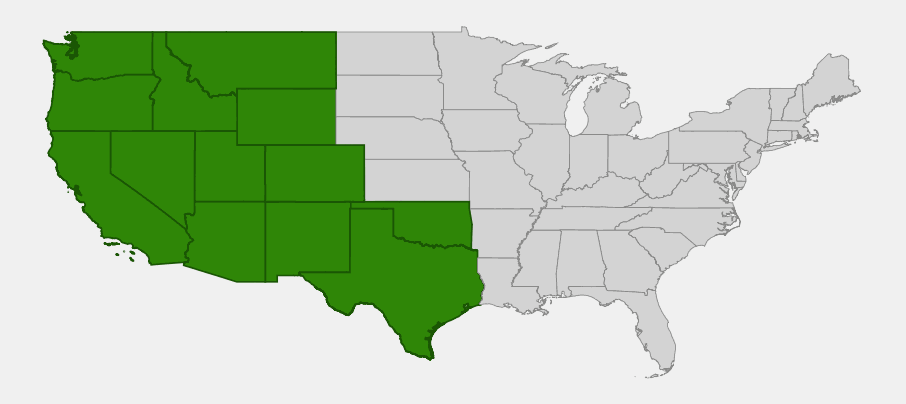
In the broad sense used by USDA PLANTS, it is native across much of the western United States, from Washington, Oregon and California east to Montana, Wyoming, Colorado and West Texas, with outlying records in Oklahoma, and in Alberta and British Columbia. It grows on dry, open, often rocky or disturbed ground: slopes, chaparral and coastal sage scrub, pine and oak woodlands, canyons, burns and roadsides.
It is a tough, drought-tolerant plant for dry, sunny native gardens. Its silver foliage stands out among green plants all season, its long-lasting flower heads are good for dried arrangements, and its leaves are food for caterpillars of the American lady butterfly.
Identification
Look for an upright, silvery-white woolly plant with long, narrow leaves and branched clusters of small, papery, whitish to straw-colored flower heads in late summer and fall.
Growth Habit
Feltleaf everlasting is a short-lived perennial, sometimes behaving as a biennial, that forms a clump of upright stems 1 to 3 feet tall from a woody base. In its first season it often forms a flat rosette of white, woolly leaves. The stems are densely covered in white or grayish wool.
Leaves
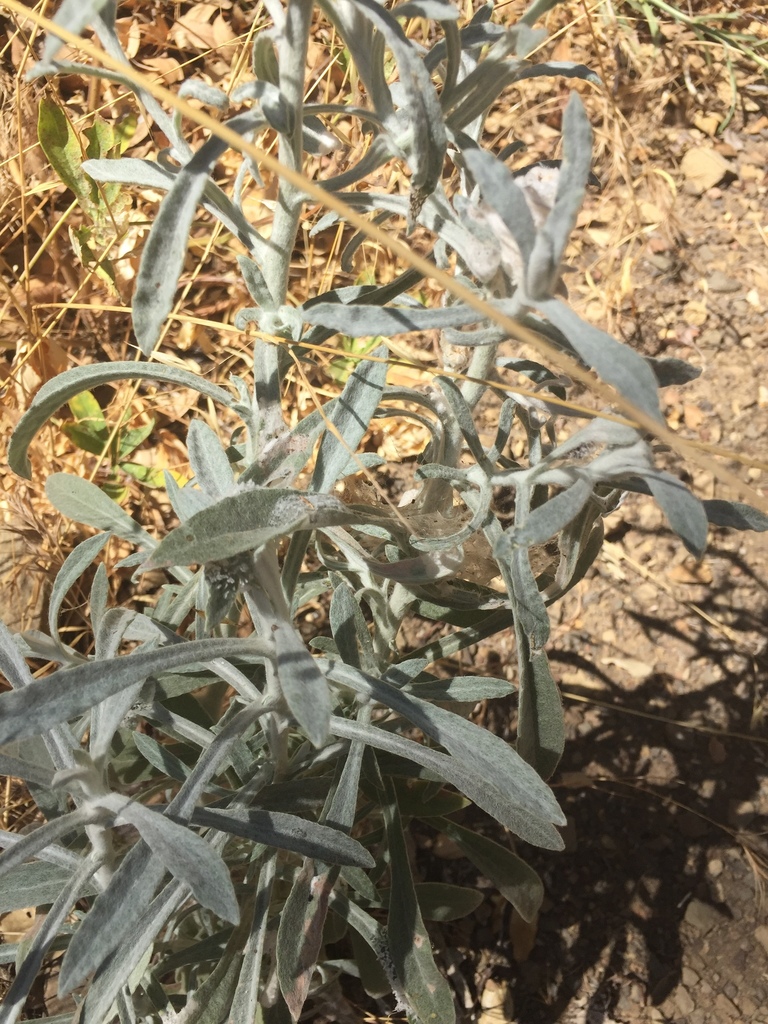
The leaves are alternate, linear to narrowly lance-shaped, about 1 1/2 to 4 inches long and less than 1/2 inch wide. Both sides, or at least the underside, are covered in thick, white, felt-like wool, giving the plant a silvery look. In some forms the upper side is greener and slightly glandular. The leaf bases may run a short way down the stem.
Flowers
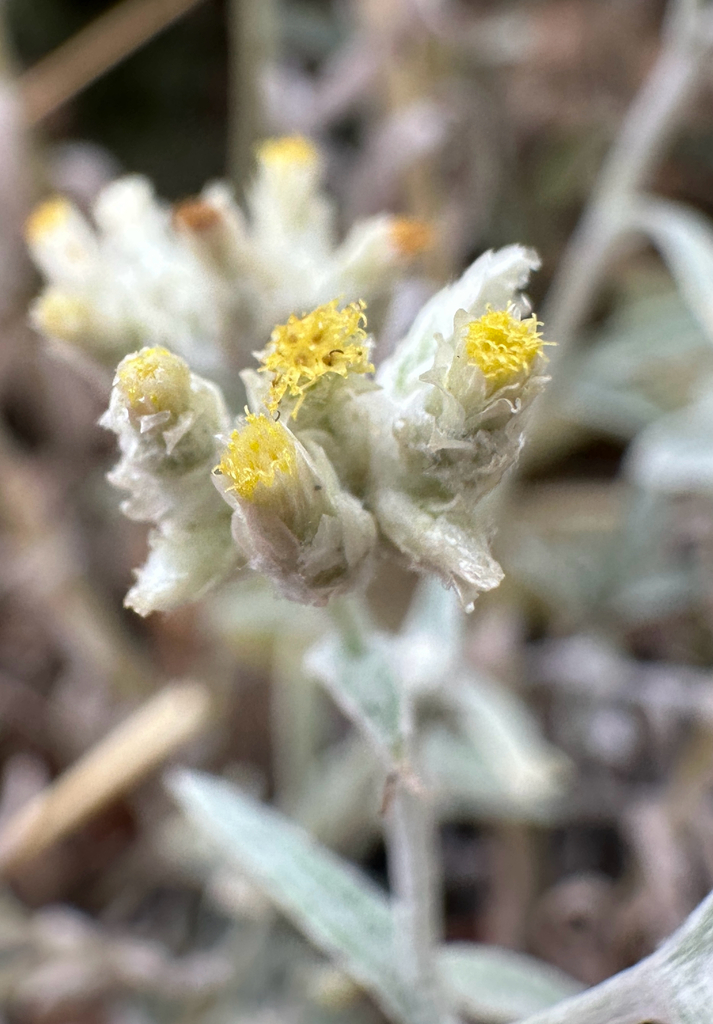
The flower heads are small, about 1/4 inch long, and grouped in rounded or flat-topped clusters at the tips of the branches. Each head is surrounded by several rows of overlapping, papery bracts that are white to pale straw-colored, sometimes tinged pink or brown. Inside are many tiny, yellowish disk florets, with no showy rays. It flowers from about July to October, and into early winter in coastal California.
Fruit & Seeds
The seeds are tiny achenes with a ring of fine, white bristles that carry them on the wind. The dry, papery heads hold their shape after the seeds disperse, which is why plants in this group are called everlastings.
Look-alikes
California cudweed has greener, sticky, glandular leaves and pure white heads. Pearly everlasting has broader, greener upper leaves and heads with bright, pearly white bracts and male and female flowers on separate plants. Weedy cudweeds such as the introduced jersey cudweed are low annuals with smaller heads.
Quick Facts
| Scientific Name | Pseudognaphalium canescens |
| Family | Asteraceae (aster family) |
| Plant Type | Short-lived perennial or biennial herb |
| Mature Height | 1–3 ft |
| Mature Spread | 1–2 ft |
| Growth Rate | Fast |
| Sun Exposure | Full sun |
| Water Needs | Low; very drought tolerant |
| Soil Type | Dry, well-drained sandy, gravelly or rocky soil |
| Soil pH | Slightly acidic to alkaline (about 6.0–8.0) |
| Bloom Time | July–October; into early winter near the coast |
| Flower Color | Whitish to pale straw; yellowish florets |
| Fall Color | Silvery foliage; heads turn tan |
| Fruit | Tiny achenes with white bristles |
| Deer Resistant | Yes (woolly, aromatic foliage) |
| USDA Hardiness Zones | 5–10 |
Native Range
The name situation for this plant is a little tangled. USDA PLANTS treats Pseudognaphalium canescens as one species with several subspecies: subsp. canescens of the Southwest and southern Rockies, subsp. microcephalum (white everlasting) of California, subsp. thermale of the Pacific Northwest, Great Basin and northern Rockies, and subsp. beneolens (fragrant everlasting) of California and Oregon. Flora of North America and several state floras treat these as four separate species, with the name Wright’s cudweed belonging only to the southwestern plant. iNaturalist follows the broad treatment and calls the whole group feltleaf everlasting. This page follows the broad species.
In that broad sense, USDA PLANTS lists it as native in Arizona, California, Colorado, Idaho, Montana, Nevada, New Mexico, Oklahoma, Oregon, Texas, Utah, Washington and Wyoming, and in Alberta and British Columbia in Canada. The Oklahoma records are outlying, at the eastern edge of the range. In Texas it grows in the mountains of the Trans-Pecos, and it also extends south into Mexico.
It grows in dry, open places from near sea level to about 9,000 feet: rocky and gravelly slopes, chaparral and coastal sage scrub, pinyon-juniper, pine and oak woodlands, canyon sides, burned areas, sandy washes and roadsides. Like other everlastings, it is quick to appear after fire or soil disturbance.
📋 Regional plant lists featuring Feltleaf Everlasting: Arizona & New Mexico · California & Nevada · Utah & Western Colorado · Montana & Wyoming · Idaho, Eastern Oregon & Eastern Washington · Western Oregon & Western Washington · South & West Texas · Nebraska, Kansas & Eastern Colorado
Growing & Care Guide
Feltleaf everlasting is seldom sold as plants, but it is easy to grow from seed in dry, sunny, well-drained sites across the West, and it often reseeds on its own. Treat it as a short-lived perennial that renews itself from seed.
Light
Full sun. In shade it grows lanky and loses much of its silver color.
Soil & Water
Plant it in lean, fast-draining soil: sand, gravel, decomposed granite or rocky slopes. It needs no water once established and rots in rich, wet soil or with frequent summer watering, especially in heavy clay.
Planting Tips
Use it as a silver accent in a dry border, rock garden, slope or chaparral or sagebrush planting, or in a wildflower area where it can reseed. It contrasts well with green-leaved buckwheats, penstemons and grasses. Space plants about 12 to 18 inches apart.
Pruning & Maintenance
Leave the dry stems and heads standing into winter if you like their look; cut them back in late winter. Remove extra seedlings if it spreads more than you want. Individual plants may live only two or three years, so allow some to set seed.
Propagation
Sow the tiny seeds on the surface of a sandy mix or directly on bare soil in fall or early spring; they need light to germinate. Seedlings grow quickly and may flower in their first or second year.
Landscape Uses
- Silver accent: white, felted foliage all season in dry gardens
- Butterfly gardens: larval host for the American lady butterfly
- Dried flowers: long-lasting papery flower heads
- Erosion control: quickly covers bare, disturbed slopes
- Xeriscapes: needs no irrigation once established
Wildlife & Ecological Value
Feltleaf everlasting is a valuable host plant for butterflies and a late-season source of pollen for small insects.
For Pollinators
The tiny florets are visited by small bees, flies, wasps and small butterflies in late summer and fall. Everlastings in this genus are well-known larval host plants of the American lady butterfly (Vanessa virginiensis), whose caterpillars hide in small silk shelters woven among the woolly leaves and flower heads.
For Birds
Small seed-eating birds such as finches and sparrows may eat the tiny seeds, and the plants add cover on open, disturbed ground.
For Mammals
The woolly, aromatic foliage is seldom browsed by deer or livestock.
Ecosystem Role
As a fast-growing plant of burns, landslides and other bare ground, feltleaf everlasting is an early colonizer that helps cover and stabilize soil after disturbance, before slower shrubs and grasses fill in.
Cultural & Historical Uses
The genus name Pseudognaphalium means “false Gnaphalium.” Its species were long included in Gnaphalium, the cudweeds, and many older books list this plant as Gnaphalium canescens, G. microcephalum, G. thermale or G. wrightii. The species name canescens means “becoming gray or white,” for the woolly foliage.
Everlastings get their name from their papery flower heads, which keep their shape and color for a long time after picking and have long been used in dried flower arrangements.
Several western everlastings are pleasantly aromatic, with a scent often compared to maple syrup or curry. Some Native American peoples of the West used everlastings in their traditional medicine. Wild plants should not be used without expert knowledge.
Frequently Asked Questions
Is feltleaf everlasting the same as Wright’s cudweed?
USDA PLANTS calls the whole species Wright’s cudweed. Many botanists split it into four species and use Wright’s cudweed only for the southwestern plant; the broad group is also called feltleaf everlasting.
Does feltleaf everlasting attract butterflies?
Yes. It is a larval host plant for the American lady butterfly, and its small flowers feed small pollinators in late summer and fall.
Is feltleaf everlasting a perennial?
It is a short-lived perennial or biennial. Individual plants last a few years, but they reseed readily in open, dry soil.
Can I use the flowers in dried arrangements?
Yes. Cut the stems when the heads are just opening and hang them upside down to dry; the papery heads keep their shape.
Where does feltleaf everlasting grow?
On dry, open, often rocky or disturbed ground across much of the West, from Washington and California east to Montana, Colorado and West Texas.

Looking for a nursery that carries Feltleaf Everlasting?
Browse our native plant nursery directory: Arizona · California · Colorado · Idaho · Montana · Nevada, New Mexico & Oklahoma · Oregon · Texas & Utah · Washington · Wyoming

