
Meadow Horsetail (Equisetum pratense)
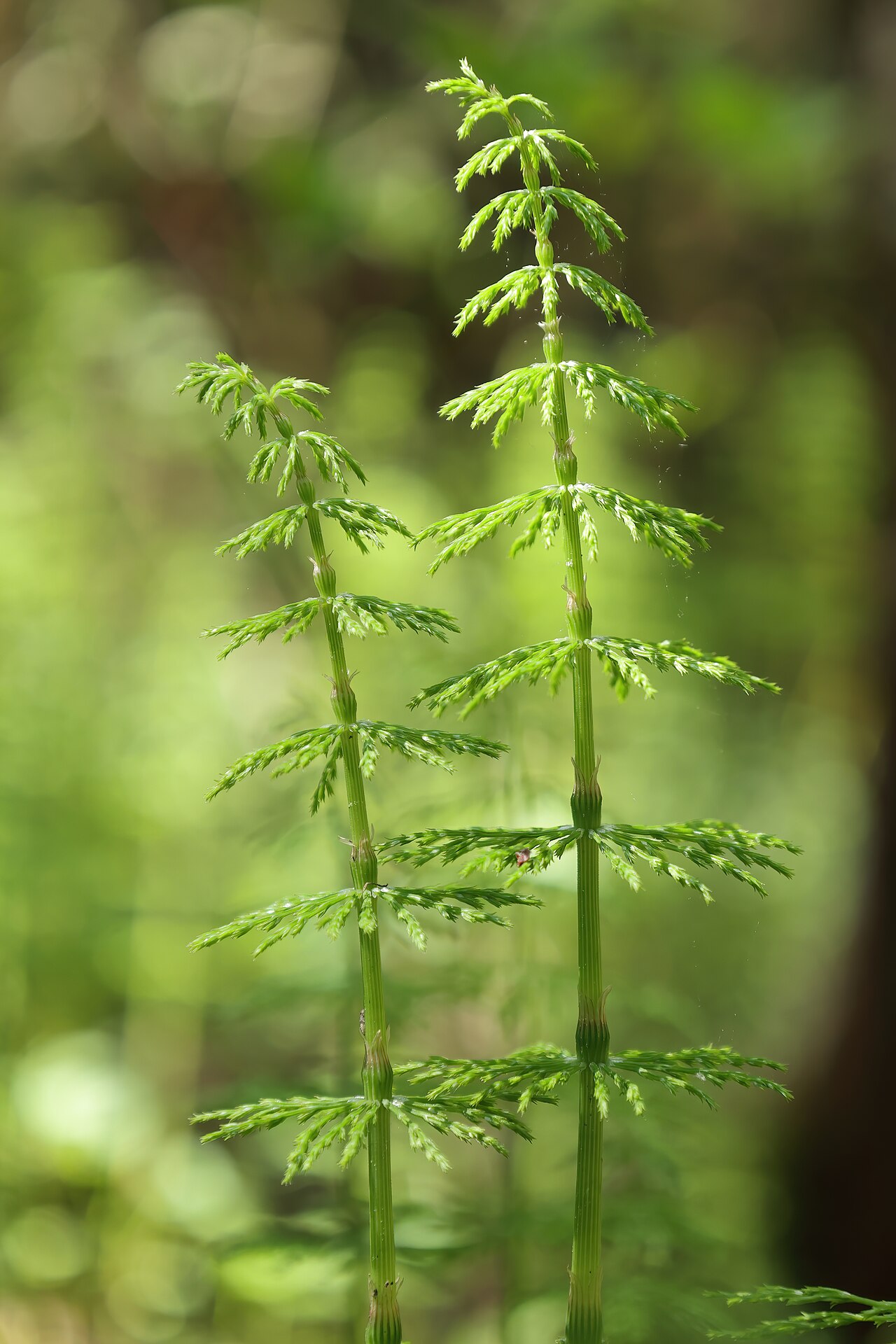
Equisetum pratense, the Meadow Horsetail, also called shade horsetail or shady horsetail, is a delicate, spore-bearing perennial of moist woods, stream banks and shady meadows across the northern parts of North America, Europe and Asia. Its slender green stems carry neat whorls of thin, horizontal branches, giving each stem the look of a tiny bottlebrush or a miniature conifer. Like all horsetails, it has no flowers or seeds; it reproduces by spores and spreads through underground rhizomes.
Meadow horsetail is a close relative of the very common Field Horsetail and the lacy Wood Horsetail, and it is often overlooked among them. In the United States it grows from Alaska and the northern Rockies across the Dakotas and the Great Lakes to New England and New York, in places that stay cool and moist. It is much less common than field horsetail in most states.
Safety note: like other horsetails, meadow horsetail contains thiaminase, an enzyme that destroys vitamin B1, along with silica and other compounds. Eaten in quantity, particularly in hay, horsetails can poison horses and other livestock. Do not use it as a food or herbal remedy. This guide covers identification, native range and how to use it in moist, shady native plantings.
Identification
Horsetails have two kinds of stems: green, sterile stems that photosynthesize, and fertile stems that carry a spore-bearing cone. To identify meadow horsetail, look closely at a stem node and the first branch segment, and at what happens to the fertile stems after they shed their spores.
Sterile Stems
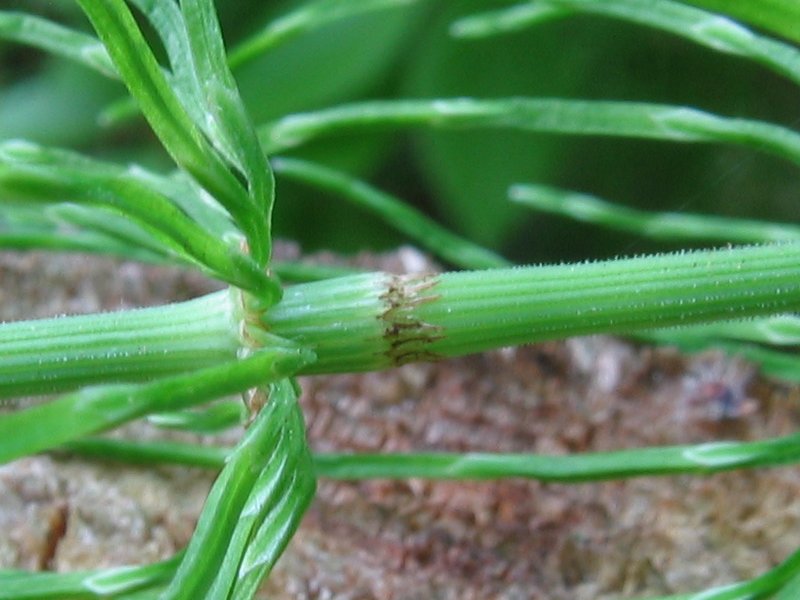
The green sterile stems are 6 to 20 inches tall and slender, about an eighth of an inch thick, with 8 to 20 fine ridges that are rough with tiny spinules. They are hollow, with a central cavity only about a sixth of the stem’s width. At each node is a pale sheath ending in slender, dark brown teeth with white, papery margins.
Branches
Regular whorls of very slender, solid, three-angled branches grow from the nodes and spread horizontally or droop slightly. The branches are not branched again. A key feature: the first segment of each branch is shorter than the stem sheath next to it. In field horsetail, the first branch segment is longer than the sheath. The upper part of the stem is often bare of branches, so the stem tip stands above the branch whorls.
Fertile Stems & Cones
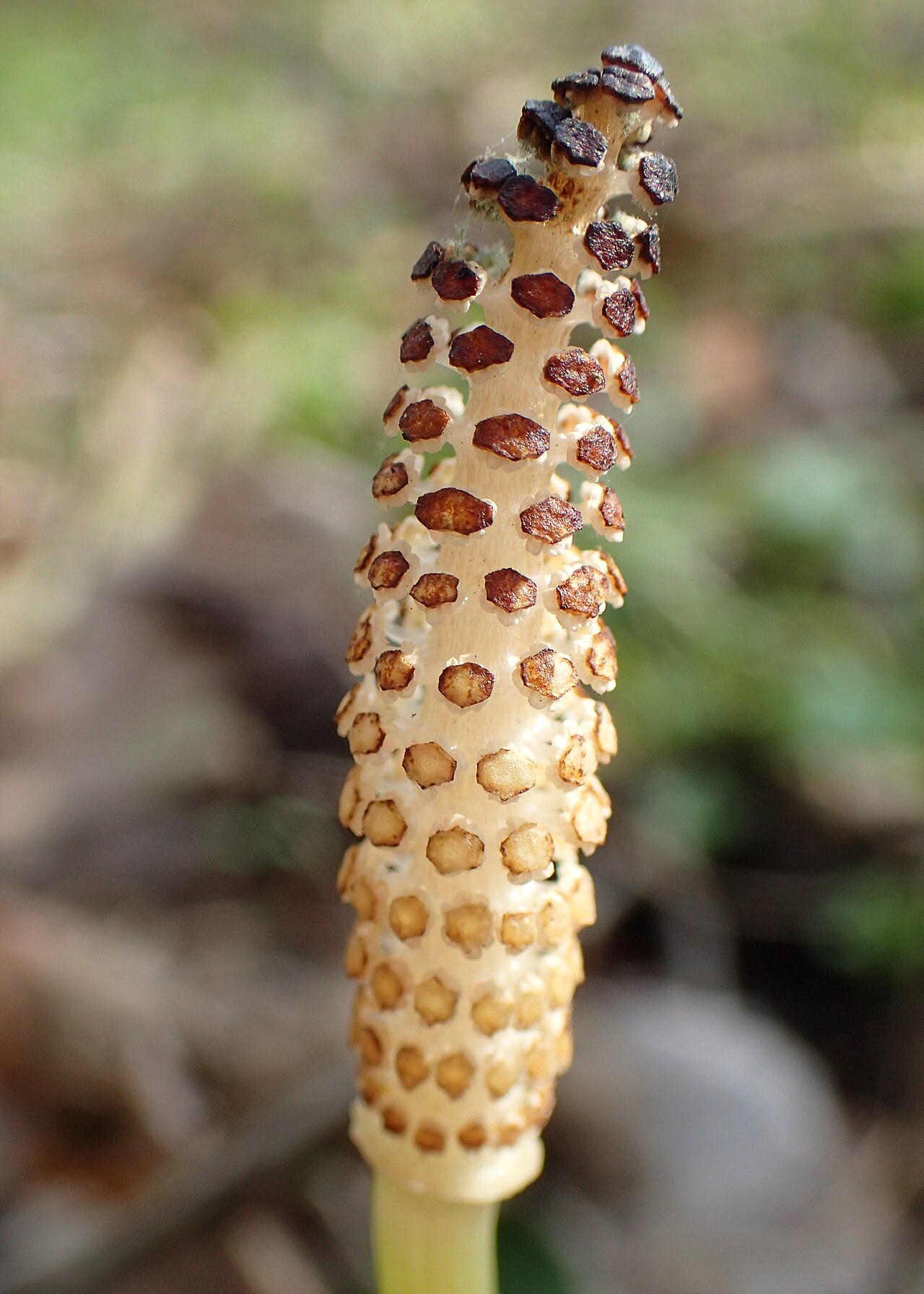
Fertile stems appear in spring, usually April to May. They are pale, whitish to light brown and unbranched at first, topped by a small, blunt cone (strobilus) about half an inch to an inch long that releases green spores. After the spores are shed, the cone withers and the fertile stem turns green and grows whorls of branches, so it ends up looking much like the sterile stems. This is unlike field horsetail, whose brown fertile stems wither soon after shedding spores.
Rhizomes
Meadow horsetail spreads through dark, creeping rhizomes that can run deep in moist soil. A single plant can form a loose patch or colony of many stems.
Similar Species
Field horsetail is coarser, with longer first branch segments and short-lived brown fertile stems. Wood horsetail has branches that branch again, giving a feathery look. Marsh Horsetail has fewer, coarser branches and sheaths with fewer, broader teeth, and grows in wetter, more open places.
Quick Facts
| Scientific Name | Equisetum pratense Ehrh. |
| Family | Equisetaceae (horsetail family) |
| Plant Type | Rhizomatous, spore-bearing perennial (fern ally) |
| Mature Height | 6–20 in |
| Mature Spread | Spreads by rhizomes to form loose colonies |
| Growth Rate | Moderate |
| Sun Exposure | Part shade to full shade; tolerates sun in cool, moist sites |
| Water Needs | Medium to high; consistently moist soil |
| Soil Type | Moist sandy or silty alluvium, humus-rich loam |
| Soil pH | About 5.5–7.5; often on calcium-rich soils |
| Bloom Time | No flowers; spore cones April–May |
| Flower Color | None (green stems; pale spring cones) |
| Fall Color | Stems fade to tan |
| Fruit | None; reproduces by spores and rhizomes |
| Deer Resistant | Yes; rarely browsed |
| USDA Hardiness Zones | 2–6 |
Native Range
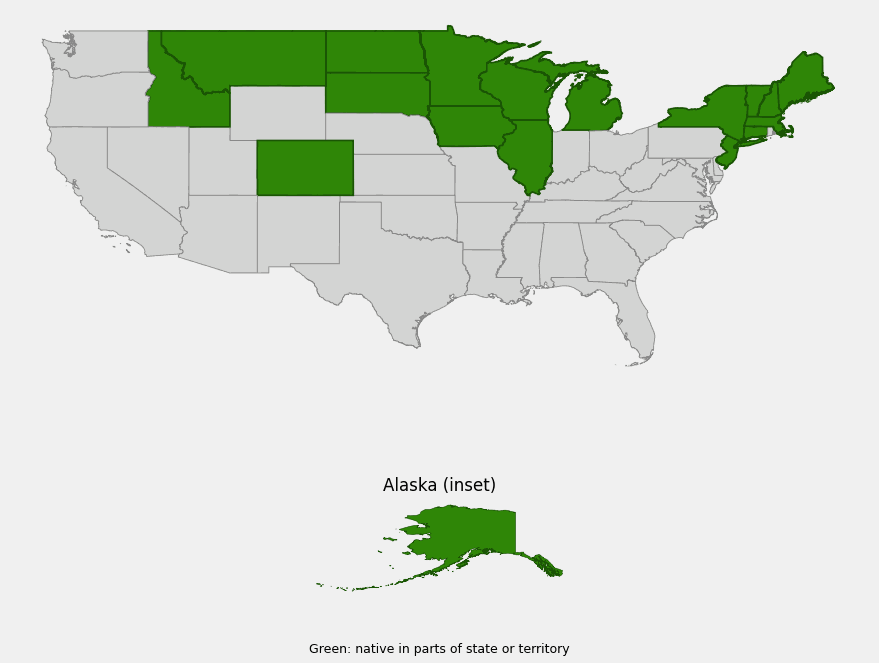
Meadow horsetail is circumboreal, growing across northern Europe from Iceland and Britain to Scandinavia and the Alps, across northern Asia to Japan, and across northern North America. In Canada it ranges from the Yukon and Northwest Territories to Labrador and Newfoundland. In the United States, USDA PLANTS records it from Alaska, Colorado, Connecticut, Idaho, Illinois, Iowa, Maine, Massachusetts, Michigan, Minnesota, Montana, New Hampshire, New Jersey, New York, North Dakota, South Dakota, Vermont and Wisconsin.
It is most common in Alaska, the northern Great Lakes states and northern New England. Farther south it is local and often rare, confined to cool, shaded ravines, spring-fed slopes and river floodplains. The Colorado, Iowa, Illinois, New Jersey and Connecticut populations are outlying records near the southern edge of its range, where it is local and uncommon.
Typical habitats include alluvial woods and thickets along streams, mossy glades, shady riverbanks, moist meadows, and the edges of swamps and wet forests, often on sandy or silty alluvium and calcium-rich soils. It is a pioneer on newly deposited sand and silt beside streams; as other vegetation fills in, it persists as sparse, smaller stems.
📋 Regional plant lists featuring Meadow Horsetail: Alaska · Connecticut, Massachusetts & Rhode Island · New Hampshire, Maine & Vermont · New York, Pennsylvania & Northern New Jersey · Illinois, Iowa & Missouri · Michigan, Wisconsin & Eastern Minnesota · North Dakota, South Dakota & Western Minnesota · Montana & Wyoming · Idaho, Eastern Oregon & Eastern Washington
Growing & Care Guide
Meadow horsetail is rarely sold, but it can be a graceful groundcover in cool, moist, shady corners of a native garden in the northern states. It is far less aggressive than field horsetail and its fine, airy texture contrasts well with ferns and broad-leaved woodland plants. Like other horsetails, its rhizomes run deep, so plant it only where a spreading patch is welcome.
Light
Part shade to full shade suits it best, such as the dappled shade of a streamside woodland. In cool northern gardens it tolerates more sun if the soil stays moist.
Soil & Water
Give it moist, well-aerated soil: sandy or silty loam, or humus-rich woodland soil that never dries out. It tolerates neutral to slightly alkaline conditions. It is not suited to hot, dry gardens or heavy clay that bakes in summer.
Planting Tips
Plant divisions in spring in a moist, shaded spot, along a stream, or at the edge of a rain garden. To keep it in bounds in a small garden, plant it in a large sunken container or contain it with a deep root barrier. Never plant horsetails in or near pastures or hay fields, because they are toxic to livestock.
Pruning & Maintenance
It needs little care. Cut back old stems in late fall or early spring if you prefer a tidier look. Keep the soil evenly moist during dry summers, especially in the first year. Pull stems that spread where they are not wanted, digging out as much rhizome as possible.
Propagation
The easiest method is dividing rhizomes in spring, keeping several nodes and a few stems on each piece. Horsetails can also be grown from spores, but the green spores are short-lived and must be sown within days on moist, sterile soil, so this is rarely practical for home gardeners.
Landscape Uses
- Woodland gardens: fine, airy texture among ferns and broad-leaved shade plants
- Stream banks: helps hold moist sandy and silty soil along cool streams
- Rain gardens: suits the shady, moist edges of rain gardens in northern climates
- Native groundcover: forms loose colonies in cool, moist shade
- Educational gardens: a living example of an ancient plant lineage
Wildlife & Ecological Value
Horsetails offer little food to wildlife, but they are part of the moist groundlayer of northern forests and streamsides.
For Pollinators
Horsetails have no flowers, nectar or pollen, so meadow horsetail does not feed pollinators. Its stems and the litter beneath them shelter small insects and other invertebrates.
For Birds
It offers little direct food for birds. The dense, moist groundcover in streamside woods provides foraging habitat for ground-feeding birds that hunt insects and other invertebrates.
For Mammals
Deer rarely browse horsetails. In the north, bears, moose and some rodents are known to eat horsetails in spring, but the plants’ silica and thiaminase limit their value as food. Horses and livestock can be poisoned by horsetails in hay.
Ecosystem Role
Meadow horsetail is a pioneer on fresh sand and silt deposited by streams, and its rhizomes help stabilize these banks. Horsetails absorb large amounts of silica from the soil. As a member of a lineage that dates back more than 300 million years, it is a living link to the ancient forests whose giant relatives formed much of the world’s coal.
Cultural & Historical Uses
The name Equisetum comes from the Latin equus, horse, and seta, bristle, a reference to the bushy, horse-tail look of the branched stems. The epithet pratense means “of meadows.” The species was named by the German botanist Jakob Friedrich Ehrhart in the eighteenth century.
Horsetails as a group have a long history of human use. Their silica-rich stems were used as natural scouring pads for pots and as fine sandpaper, which is why some species are called scouring rushes. Several species have been used in folk medicine, but because of their thiaminase and other compounds, modern sources caution against eating them or using them as remedies.
Horsetails are the last surviving members of a group of plants that dominated the swamp forests of the Carboniferous period, when some relatives grew as tall as trees. Today about 15 to 20 species survive worldwide, several of them in North America, including meadow horsetail.
Frequently Asked Questions
Is meadow horsetail poisonous?
Yes, to livestock especially. It contains thiaminase, which destroys vitamin B1, and horses that eat horsetails in hay can become seriously ill. Do not eat horsetails or use them as a home remedy.
How do I tell meadow horsetail from field horsetail?
Look at a node: in meadow horsetail, the first segment of each branch is shorter than the stem sheath, while in field horsetail it is longer. Meadow horsetail’s fertile stems turn green and branch after shedding spores, while field horsetail’s brown fertile stems wither.
Is meadow horsetail invasive?
It is native and much less aggressive than field horsetail, but it spreads by deep rhizomes and can be hard to remove once established. Plant it only where a spreading patch is welcome.
Does meadow horsetail have flowers?
No. Horsetails are spore-bearing plants related to ferns. Meadow horsetail produces spores in small cones on pale fertile stems in spring.
Where does meadow horsetail grow?
It grows in cool, moist, shaded places such as alluvial woods, stream banks and moist meadows across Alaska, Canada and the northern United States, as well as northern Europe and Asia.

Looking for a nursery that carries Meadow Horsetail?
Browse our native plant nursery directory: Alaska · Colorado & Connecticut · Idaho, Illinois & Iowa · Maine, Massachusetts, Michigan, Minnesota & Montana · New Hampshire, New Jersey, New York & North Dakota · South Dakota & Vermont · Wisconsin

