
Narrow-fruited Water-starwort (Callitriche palustris)
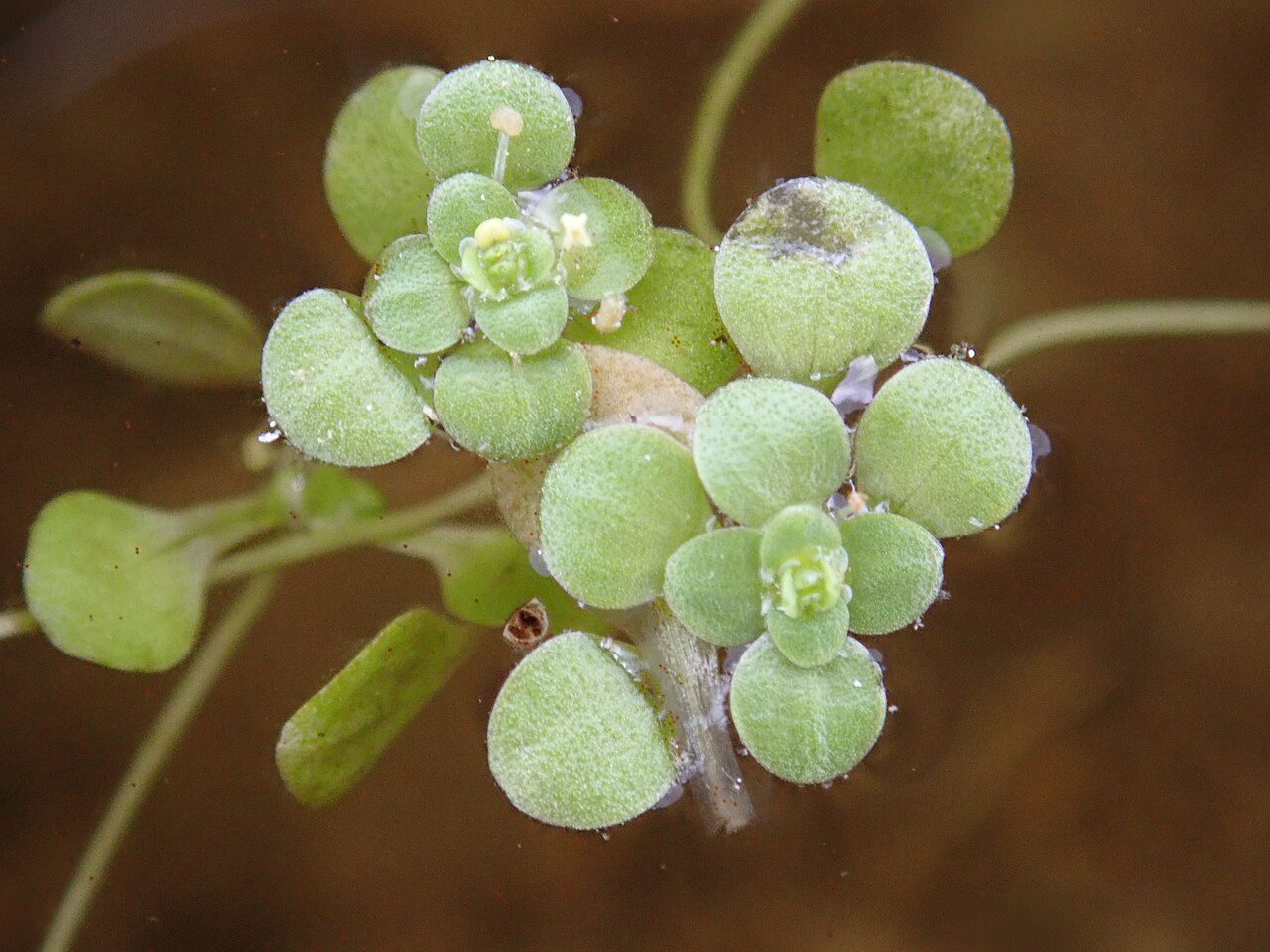
Callitriche palustris, the Narrow-fruited Water-starwort (USDA: vernal water-starwort; also called spring water-starwort, and long known as Callitriche verna), is a small, delicate aquatic plant of shallow, quiet water. Its slender stems grow underwater with narrow, grass-like leaves, and where they reach the surface they end in floating rosettes of small rounded leaves that look like little green stars on the water.
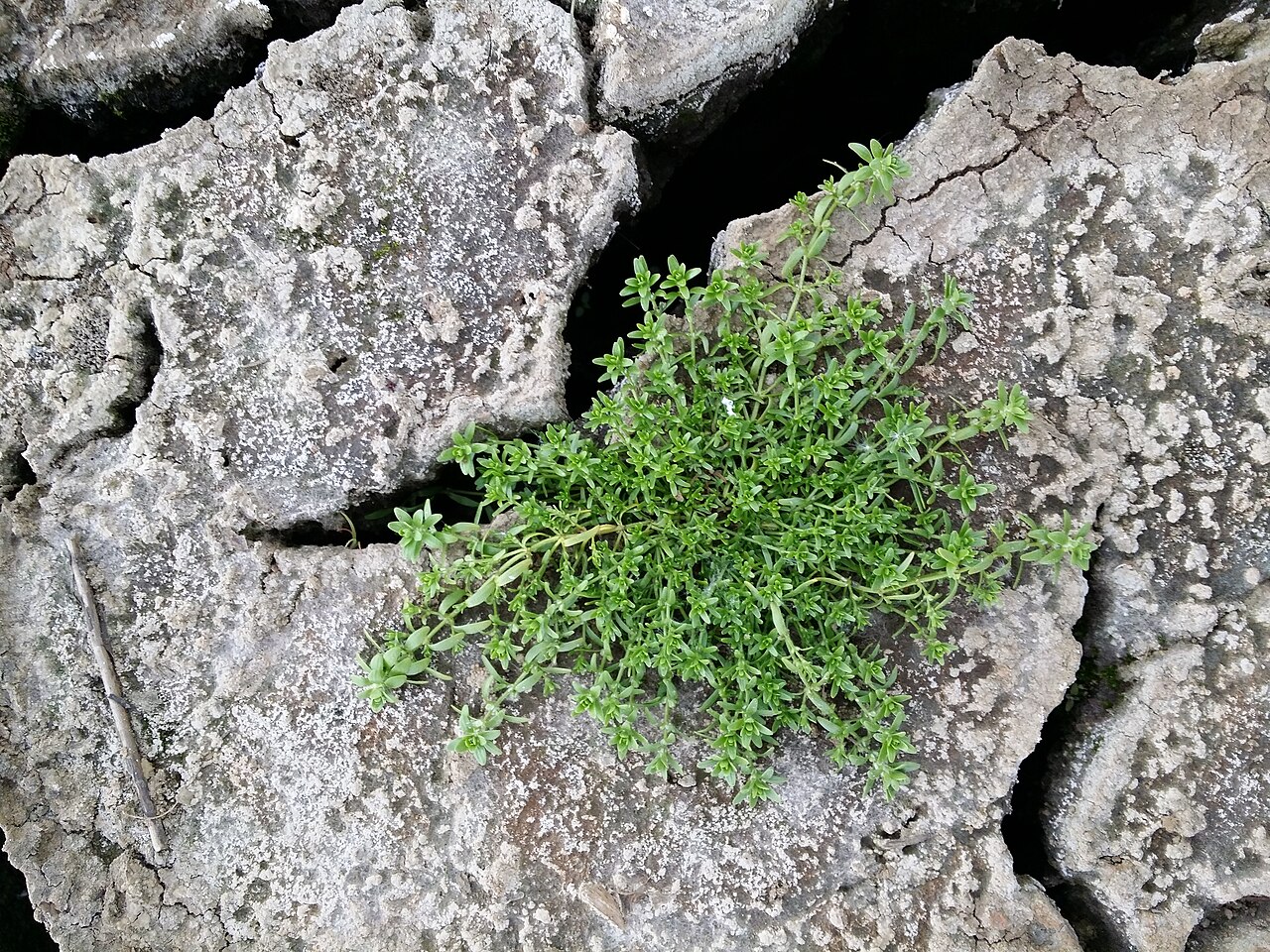
It is one of the most widespread aquatic plants of the Northern Hemisphere, found across Europe, Asia and North America. In the United States it grows from Alaska and the West to the Great Lakes and New England, in ponds, ditches, slow streams, seasonal pools and wet mud. Water levels shape the plant: in deeper water it trails long and lax, while on drying mud it forms a low, compact mat.
This guide covers how to recognize it and tell it from other water-starworts, where it grows, how to use it in a pond or wildlife water garden, and its value to waterfowl and aquatic life. It is easy to overlook but forms a quietly important part of many shallow wetlands.
Identification
Water-starworts (Callitriche) are slender aquatic herbs with opposite leaves and tiny, petal-less flowers. Telling the species apart usually requires looking at the fruits with a hand lens.
Stems & Leaves
The stems are thread-like, branching, and a few inches to a foot or more long depending on water depth. Leaves are opposite. Submerged leaves are linear, narrow and pale green with a small notch at the tip. Leaves near the surface widen into spoon-shaped to oval blades about ¼ to ½ inch long, crowded into floating rosettes. Plants stranded on mud have short stems and small, spoon-shaped leaves.
Flowers
The flowers are tiny and easy to miss: there are no petals or sepals, just a single stamen (male flower) or a single pistil with two threadlike styles (female flower), usually in the axils of the rosette leaves and often with two small, whitish bracts. Flowering runs from late spring through summer.
Fruit
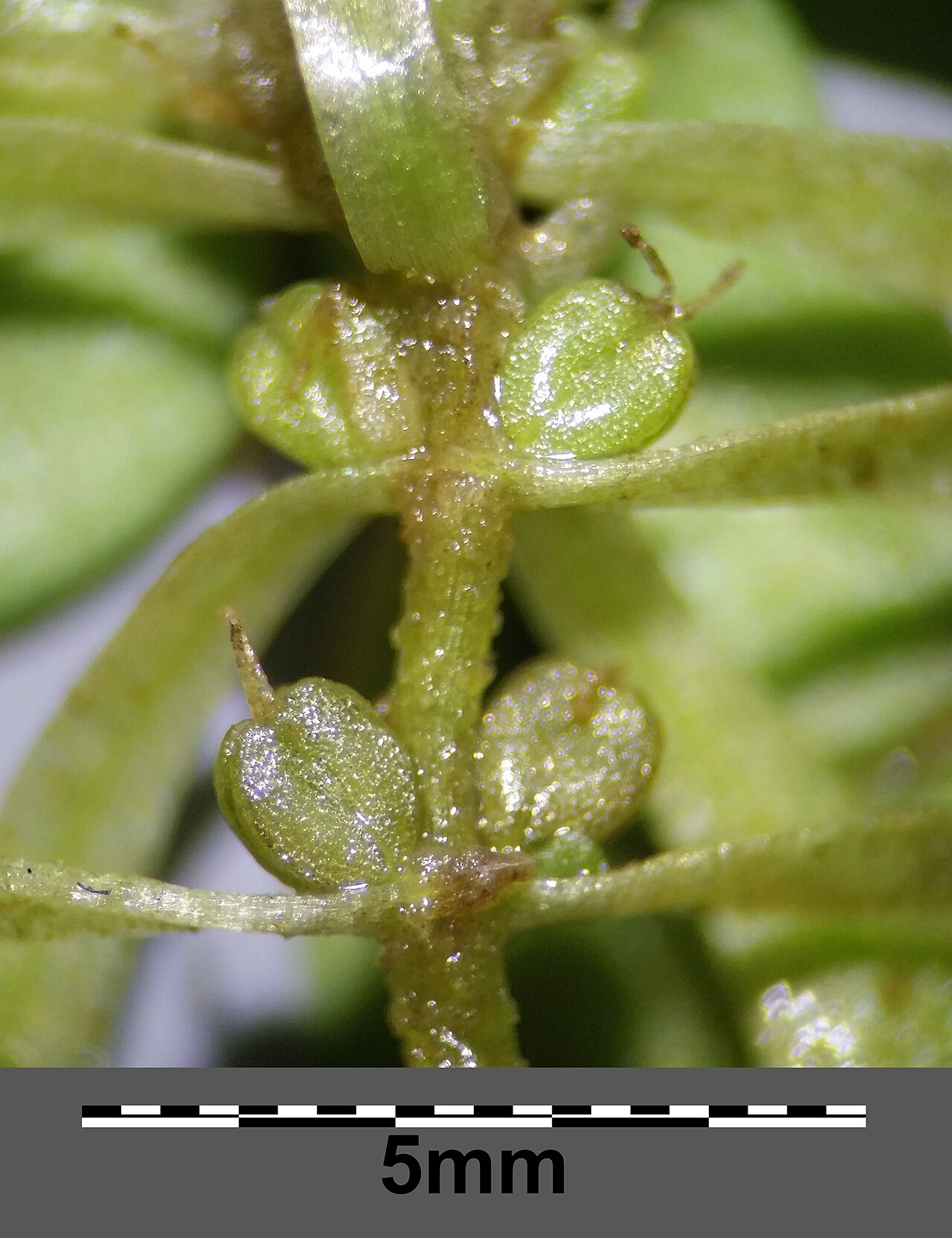
The fruit is the key to identification. It is very small, about 1 millimeter long, slightly longer than wide, dark brown when ripe, and splits into four one-seeded nutlets. The nutlets have a narrow wing or keel that is most noticeable near the top of the fruit, so the fruit looks narrowed at the base. The styles usually fall off early.
Look-alikes
Two-headed or larger water-starwort (C. heterophylla) has rounder fruits that are about as broad as long and not obviously winged. Pond water-starwort (C. stagnalis), introduced from Europe, has broader floating leaves and fruits with a broad wing all around. Autumn water-starwort (C. hermaphroditica) grows entirely underwater and has no floating rosettes. Common Mare’s-tail and Whorled Water-milfoil have leaves in whorls, not opposite pairs.
Quick Facts
| Scientific Name | Callitriche palustris L. |
| Family | Plantaginaceae (plantain family; formerly Callitrichaceae) |
| Plant Type | Aquatic annual or short-lived perennial herb |
| Mature Height | Stems 2–12 in or longer, floating or trailing |
| Mature Spread | Forms loose mats; spreads by stem fragments and seed |
| Growth Rate | Fast |
| Sun Exposure | Full sun to partial shade |
| Water Needs | Aquatic; shallow water to wet mud |
| Soil Type | Mud, silt or sandy pond and stream bottoms |
| Soil pH | About 5.5–8.0 |
| Bloom Time | May–September |
| Flower Color | Inconspicuous, greenish (no petals) |
| Fall Color | None |
| Fruit | Tiny four-lobed fruit, narrowly winged near the top |
| Deer Resistant | Not a deer food; grazed by waterfowl |
| USDA Hardiness Zones | 2–9 |
Native Range
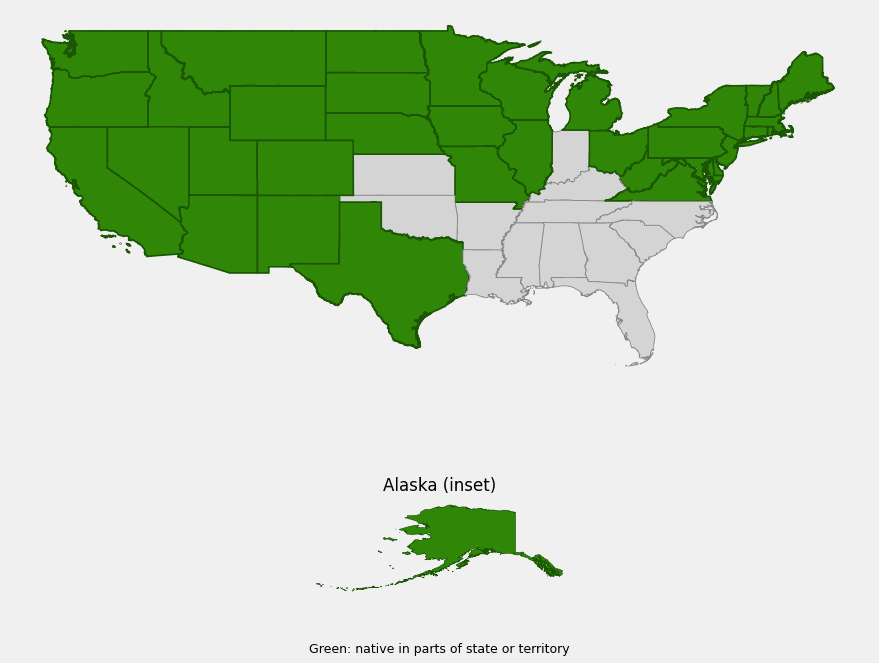
Narrow-fruited water-starwort is circumboreal: it grows across northern and temperate Europe and Asia as well as North America. USDA PLANTS lists it as native in Alaska, throughout Canada from British Columbia and the Yukon to Newfoundland and Labrador, and in Greenland and St. Pierre and Miquelon. In the lower 48 it is recorded in most western and northern states, from Washington, Oregon and California east through the Rocky Mountains and northern plains to the Great Lakes, New England and south to Virginia and West Virginia. The Texas record is an outlying one at the southern edge of its range.
It grows in shallow, still or slow-moving fresh water and on wet mud: the edges of ponds and lakes, beaver ponds, marshes, ditches, slow streams and spring runs, wet meadows, and especially seasonal pools that fill in spring and dry in summer, which is how it got the name vernal water-starwort. In the West it climbs to subalpine ponds well above 9,000 feet.
Because it can complete its life cycle quickly and sets seed even on drying mud, it is well suited to places where water levels rise and fall. Its tiny seeds and stem fragments travel easily with water and on the feet and feathers of waterbirds, which helps explain its very wide range.
📋 Regional plant lists featuring Narrow-fruited Water-starwort: Alaska · Western Oregon & Western Washington · Idaho, Eastern Oregon & Eastern Washington · California & Nevada · Arizona & New Mexico · Utah & Western Colorado · Montana & Wyoming · North Dakota, South Dakota & Western Minnesota · Nebraska, Kansas & Eastern Colorado · Illinois, Iowa & Missouri · Michigan, Wisconsin & Eastern Minnesota · Ohio & Indiana · New York, Pennsylvania & Northern New Jersey · Delaware, Southern New Jersey & Long Island · Maryland, Virginia & West Virginia · Connecticut, Massachusetts & Rhode Island · New Hampshire, Maine & Vermont
Growing & Care Guide
Narrow-fruited water-starwort is not a typical nursery plant, but it often arrives on its own in new wildlife ponds and can be welcomed as a native oxygenating plant. Where it is offered, buy from native aquatic plant suppliers. Never move aquatic plants between water bodies without checking them for invasive hitchhikers, and do not take plants from protected wetlands.
Light
Full sun to partial shade. It grows best in open, sunny shallows, but tolerates some shade at pond edges.
Soil & Water
Grow it in shallow, clean, still or slowly moving water from a few inches to about 2 feet deep, on a mud, silt or sandy bottom. It also grows on permanently wet mud. It prefers cool, clear water and does not compete well in warm, nutrient-rich water choked with algae.
Planting Tips
Press bunches of stems into the mud of the shallows in spring, or anchor them in a planting basket filled with heavy loam and topped with gravel, and set it in shallow water. It works well in wildlife ponds, rain gardens with standing water and the margins of natural ponds.
Pruning & Maintenance
Little care is needed. If it becomes thick in a small pond, simply pull out handfuls of stems, leaving them on the bank for a day so small animals can return to the water. Plants may die back in hot summers or when pools dry and return from seed the next season.
Propagation
It spreads easily from stem fragments, which root wherever they settle in mud. It also seeds itself freely, and seed in the mud of a seasonal pool will sprout when water returns.
Landscape Uses
- Wildlife ponds: native oxygenator and cover for aquatic insects and amphibians
- Vernal pool and wetland restoration: a typical plant of seasonal pools
- Natural pond margins: floating rosettes soften shallow edges
- Education: an easy example of how aquatic plants change leaf shape in water and on land
Wildlife & Ecological Value
Although tiny, water-starworts are important in shallow wetlands as food and shelter for many animals.
For Pollinators
It is mainly water-pollinated or self-pollinated, and its tiny, petal-less flowers do not attract bees or butterflies. Its value is to aquatic life rather than pollinators.
For Birds
Ducks, geese and swans eat the stems, leaves and fruits, and dabbling ducks feed heavily in the shallow ponds and seasonal pools where it grows. Waterbirds also feed on the snails and insect larvae that live among its stems.
For Mammals
Muskrats and beavers may eat it along with other aquatic plants. Its stems are too small and watery to be important for larger mammals.
Ecosystem Role
Its dense, fine stems release oxygen into the water and provide shelter and egg-laying sites for aquatic insects, snails, tadpoles and small fish. In seasonal pools it is part of the plant life that supports breeding frogs and salamanders. It also helps trap fine sediment in shallow water.
Cultural & Historical Uses
Carl Linnaeus named Callitriche palustris in 1753. Callitriche comes from the Greek kalli, beautiful, and thrix, hair, for the fine, hair-like stems, and palustris means “of marshes.” For many years North American botanists called it Callitriche verna, the spring water-starwort; that name is now usually treated as a synonym.
The common name starwort comes from the star-like floating rosettes. Water-starworts were once placed in their own family, Callitrichaceae; DNA studies showed that they belong in the plantain family, Plantaginaceae, alongside unlikely relatives such as plantains, penstemons and speedwells.
Water-starworts are a classic example of plants that are pollinated with the help of water. Some species even release pollen underwater, and botanists have long studied the genus to understand how flowering plants returned to aquatic life.
Frequently Asked Questions
Why is it called narrow-fruited water-starwort?
Its fruits are slightly longer than wide and narrowed toward the base, with a wing only near the top, which separates it from the rounder fruits of other water-starworts.
Is Callitriche palustris the same as Callitriche verna?
Yes. Callitriche verna is an older name for the same species and is treated as a synonym; USDA PLANTS calls it vernal water-starwort.
Is water-starwort good for ponds?
Yes. It is a native oxygenating plant that provides food for waterfowl and shelter for aquatic insects, tadpoles and small fish. It rarely becomes a problem and is easy to thin by hand.
Can water-starwort grow out of water?
Yes. When ponds and seasonal pools dry, it can keep growing as a low, compact land form on the wet mud, with short stems and small spoon-shaped leaves.
Where does narrow-fruited water-starwort grow?
Across northern North America, Europe and Asia. In the United States it grows from Alaska and the West across the northern plains and Midwest to New England and the mid-Atlantic, in shallow ponds, ditches, slow streams and vernal pools.

Looking for a nursery that carries Narrow-fruited Water-starwort?
Browse our native plant nursery directory: Alaska & Arizona · California · Colorado, Connecticut & Delaware · Idaho, Illinois & Iowa · Maine, Maryland, Massachusetts, Michigan, Minnesota, Missouri & Montana · Nebraska, Nevada, New Hampshire, New Jersey, New Mexico, New York, North Dakota & Ohio · Oregon · Pennsylvania, Rhode Island, South Dakota, Texas, Utah, Vermont & Virginia · Washington · West Virginia, Wisconsin & Wyoming

