
Native Coralroot Orchids (Corallorhiza)
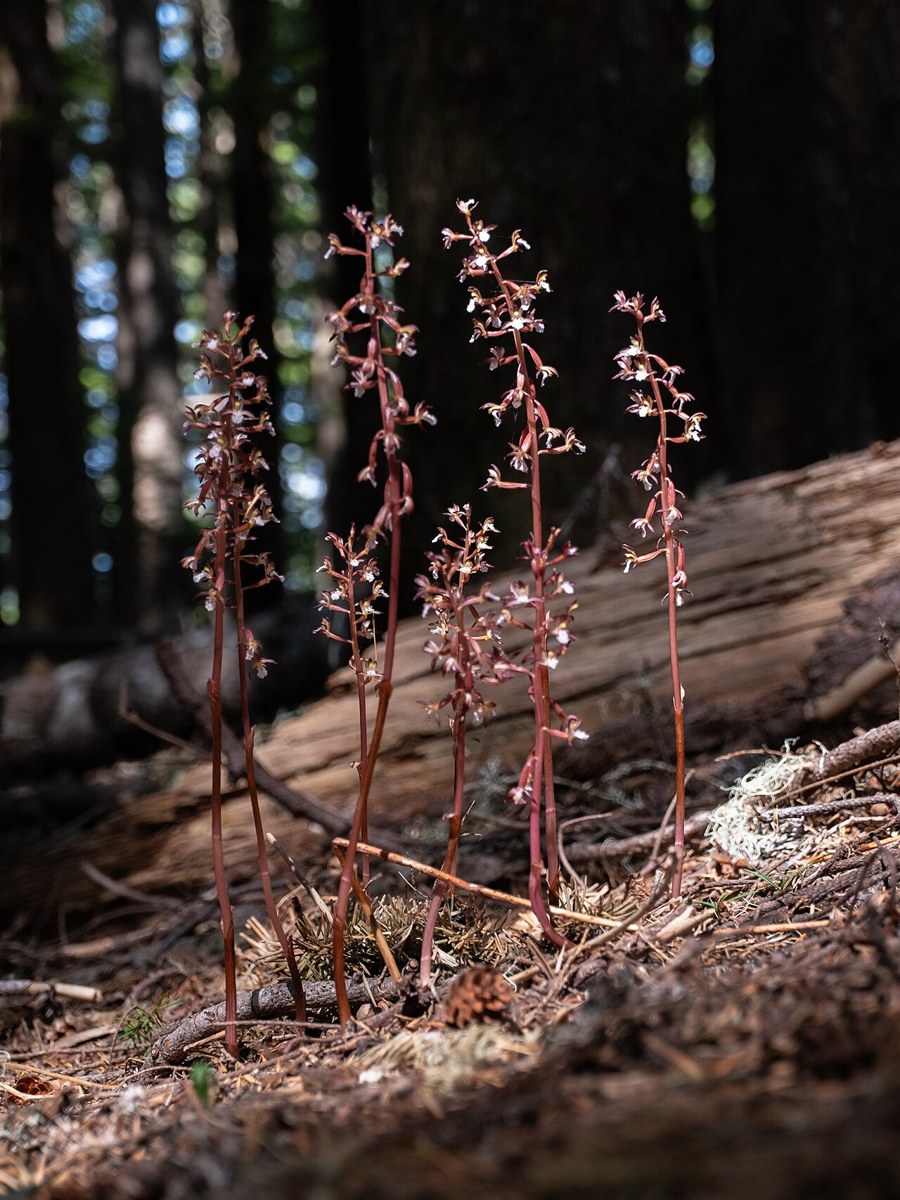
Coralroots (genus Corallorhiza) are native wild orchids that most people walk past without noticing. They have no green leaves at all. Each plant is just a slender, leafless stem, usually reddish-brown, purplish or yellowish, rising a few inches to well over a foot from the forest floor and topped with a spike of small orchid flowers. The rest of the plant lives underground as a branched, knobby rhizome that looks like a piece of coral, which gives the genus its name.
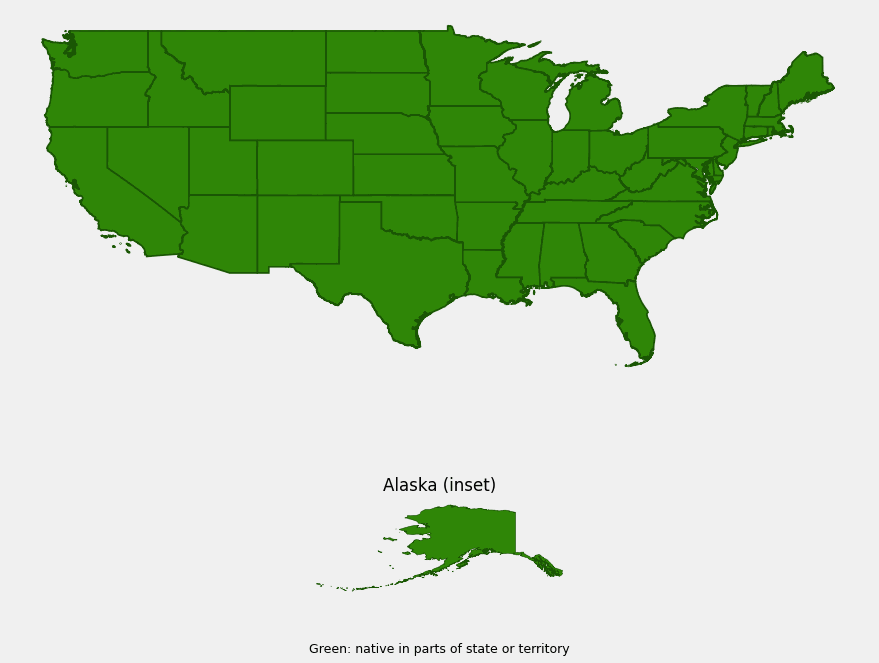
Coralroots are fascinating because of how they feed. Instead of making their own food from sunlight, they are mycoheterotrophs: they take their sugars from soil fungi, which in turn are connected to the roots of forest trees. In effect, coralroots tap into the underground fungal network that links trees and fungi. Seven species are native to the United States, and together they grow in every state except Hawaii, from the coastal forests of the Pacific Northwest and the mountains of Arizona to the hardwood forests of the East and the spruce bogs of Alaska.
This also means coralroots are not garden plants. They cannot be bought from nurseries, cannot be transplanted, and will die if dug, because they depend on a specific partnership with fungi and trees that cannot be recreated in a garden bed. Garden articles sometimes describe “coralroot” as a sunny perennial, a shrub with berries, or even as Indian paintbrush; none of that is correct. This guide explains how to recognize coralroots, where to look for them, and how to protect them where they grow.
Identification
Coralroots are easiest to recognize by what they lack: there are no leaves, only a few thin, tubular sheaths wrapped around the base of the stem. If you find a small orchid-flowered spike with no green leaves in a forest, it is very likely a coralroot.
Stems
The single stem is smooth and fleshy, usually 4 to 20 inches tall depending on species and growing conditions. Colors range from deep reddish-brown and purple to tan and pale yellow; spotted coralroot even has an all-yellow form. Early coralroot (C. trifida) is the exception with a yellow-green stem that contains a little chlorophyll. Several stems often come up together from the same underground rhizome.
Flowers
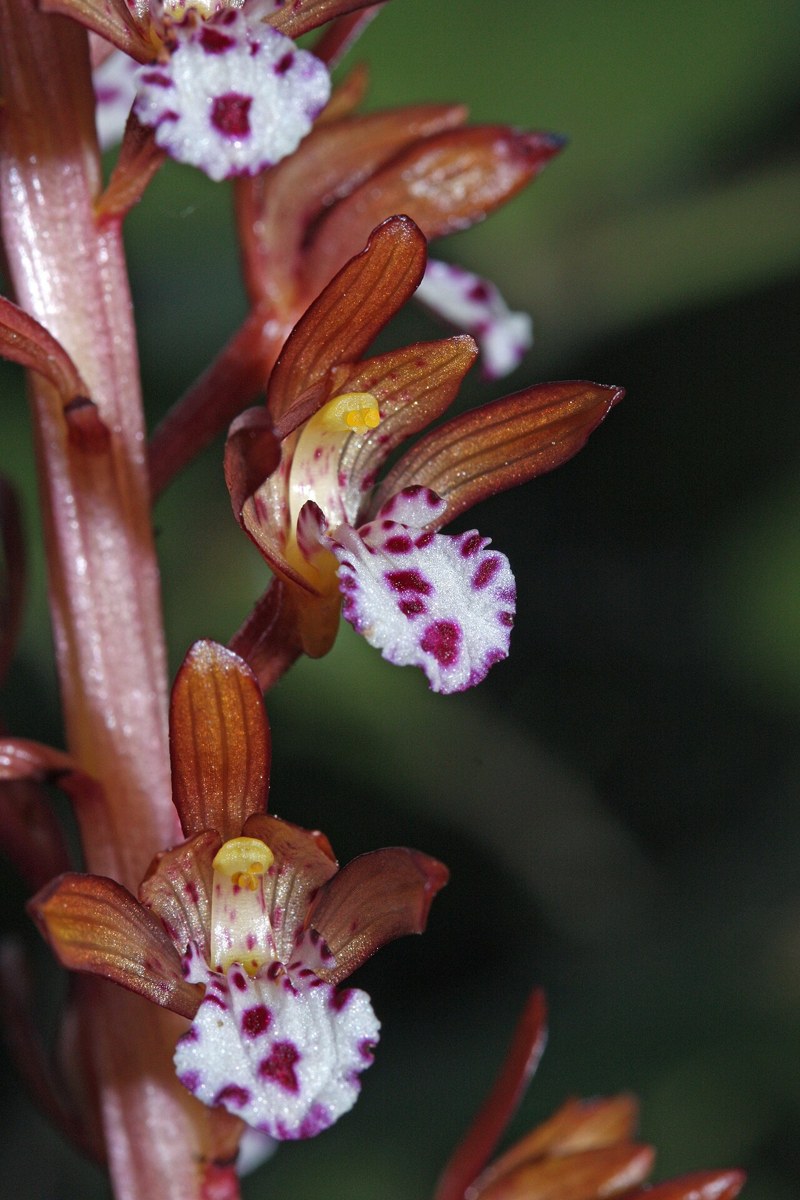
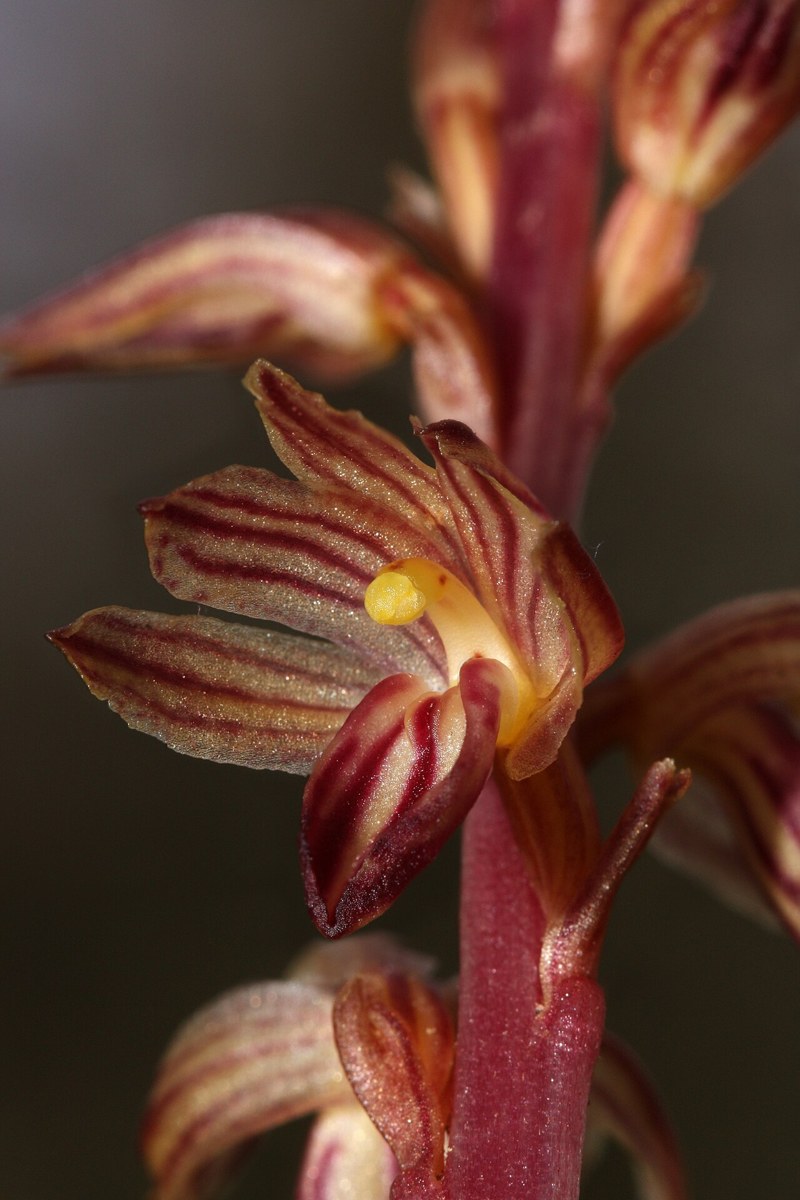
The flowers are small, usually a quarter to half an inch across, with three sepals and two petals that are often the same color as the stem, plus a lower petal (the lip) that is usually white or pale and the best clue to species. Spotted coralroot has a white lip boldly spotted with purple-red. Striped coralroot has larger flowers with dark red-purple stripes on pinkish sepals and petals. Pacific coralroot has a pink to reddish lip with darker lines and few spots. Early and spring coralroots have small whitish lips, sometimes lightly spotted. Autumn coralroot’s flowers are tiny and often never fully open, pollinating themselves inside the bud.
Rhizome
Underground, coralroots form a fleshy, much-branched rhizome without true roots, densely packed with fungal threads. It can live for years without producing a flowering stem and sends up shoots only when it has stored enough energy, so a colony may appear one year and vanish the next.
Fruit & Seeds
Pollinated flowers form drooping, oval capsules about half an inch long that ripen within weeks. Each capsule releases thousands of dust-like seeds with almost no stored food. A seed can only grow if it lands where a suitable fungus will infect it and feed it, which is why coralroots appear in some patches of forest and not others.
Quick Facts
| Scientific Name | Corallorhiza |
| Family | Orchidaceae (Orchid) |
| U.S. Native Species | 7; about a dozen worldwide, most in North and Central America |
| Plant Type | Leafless perennial orchid that feeds on fungi (mycoheterotroph) |
| Mature Height | 4–20 in (flowering stem) |
| Mature Spread | Single stems or small clusters |
| Growth Rate | Erratic; stems appear only in some years |
| Sun Exposure | Part Shade to Shade (forest understory) |
| Water Needs | Moist to fairly dry forest soils; early coralroot in wet bogs and swamps |
| Soil Type | Forest humus and leaf litter with the right fungal partners |
| Soil pH | Acidic to near neutral; striped coralroot often on limestone soils |
| Bloom Time | March – October, depending on species (spring coralroot earliest, autumn coralroot latest) |
| Flower Color | Reddish-brown, purple, pink, tan or yellowish, with white or pink lips |
| Fruit | Small drooping capsules with dust-like seeds |
| Garden Use | None; cannot be cultivated or transplanted |
| Deer Resistant | Not applicable; stems are occasionally eaten by deer and slugs |
| USDA Hardiness Zones | Wild in climates from zone 1 (Alaska) to about zone 9 |
Native Range
Coralroots are native in all 48 contiguous states and Alaska, but which species you can find depends on where you live. Spotted coralroot is the most widespread, growing in forests across much of the U.S. and Canada and south into Mexico and Central America. Early coralroot circles the Northern Hemisphere through the boreal forest, reaching south in the U.S. to the northern states and the Rocky Mountains. Autumn coralroot and spring coralroot are mostly eastern and southern species, though spring coralroot also grows in scattered mountain forests of Colorado, Utah, Arizona and New Mexico.
The West has its own specialties. Pacific coralroot grows in the moist conifer forests of the Pacific Northwest, northern California and the northern Rockies, often in deep shade under Douglas-fir and western hemlock. Striped coralroot is widespread in the West and across southern Canada but scattered and rare in the East, where it is protected in several states. The rarest of all, Bentley’s coralroot (C. bentleyi), was described only in 1999 and is known from a small area of western Virginia and adjacent West Virginia.
Look for coralroots in established forests with a deep layer of leaf litter or conifer needles: oak and beech woods in the East, mixed conifer forests in the West, and wet spruce and cedar swamps in the North. They often appear near the same trees year after year, but individual plants may skip several years between flowering stems.
📋 Regional plant lists for coralroot country: New Hampshire, Maine & Vermont · Connecticut, Massachusetts & Rhode Island · New York, Pennsylvania & Northern New Jersey · Delaware, Southern New Jersey & Long Island · Maryland, Virginia & West Virginia · North Carolina & South Carolina · Georgia, Alabama & Mississippi · Kentucky & Tennessee · Ohio & Indiana · Michigan, Wisconsin & Eastern Minnesota · Illinois, Iowa & Missouri · Arkansas, Louisiana, Eastern Oklahoma & Eastern Texas · North Dakota, South Dakota & Western Minnesota · Nebraska, Kansas & Eastern Colorado · Arizona & New Mexico · Utah & Western Colorado · Montana & Wyoming · Idaho, Eastern Oregon & Eastern Washington · Western Oregon & Western Washington · California & Nevada · Alaska
Native Species
All seven U.S. coralroots are native. Five have full profiles on our site.
- Spotted Coralroot (Corallorhiza maculata): The most common and widespread coralroot, with reddish-brown to yellow stems up to about 20 inches and white lips spotted with purple. Blooms in summer, from June into August, in dry to moist forests across much of the country, including New York and Michigan. Look under oaks and pines in the East and conifers in the West.
- Striped Coralroot (Corallorhiza striata): The showiest coralroot, with larger pinkish to tan flowers boldly striped in dark red-purple. Blooms in late spring and early summer. Widespread in western forests and across southern Canada, but rare in the East, where it grows mainly on limestone soils in the northern states.
- Pacific Coralroot (Corallorhiza mertensiana): A western species with reddish-purple stems and pink to red flowers, found in moist, shady conifer forests from Alaska and British Columbia through Washington, Oregon and northern California and east into the northern Rockies. Summer bloomer.
- Spring Coralroot (Corallorhiza wisteriana): The earliest coralroot, flowering from March in the Deep South to May farther north. Brownish-purple stems with small flowers and white, purple-spotted lips. Found in moist hardwood forests of the East and South, with scattered populations in the southern Rockies and Southwest.
- Autumn Coralroot (Corallorhiza odontorhiza): The latest coralroot, flowering from August into October. A small, slender plant with tiny flowers that often self-pollinate without opening. Grows in dry to moist deciduous woods of the eastern and central U.S. and is easily overlooked among fallen leaves.
- Early Coralroot (Corallorhiza trifida): A small coralroot with yellow-green stems and greenish-yellow flowers with a white lip, blooming in late spring and early summer. Found around the Northern Hemisphere; in the U.S. it grows in cool, wet conifer swamps, bogs and moist forests of Alaska, the northern states and the Rocky Mountains. It is the only U.S. coralroot with a little chlorophyll.
- Bentley’s Coralroot (Corallorhiza bentleyi): A very rare species described in 1999 from a few sites in the Appalachian mountains of western Virginia and nearby West Virginia. Its flowers often stay closed. It is one of the rarest orchids in North America.
Non-Native Look-Alikes
There are no non-native coralroots in the United States, and no coralroots are sold for gardens. The plants most often confused with coralroots are other native forest plants that also lack green leaves:
- Crested coralroot (Hexalectris spicata): A related native leafless orchid of the Southeast and Southwest with larger, brownish-yellow flowers striped in purple and a crested lip. It belongs to a different genus despite the common name.
- Ghost pipe (Monotropa uniflora) and pinesap (Hypopitys monotropa): Native leafless plants in the heath family that also feed on fungi. Ghost pipe is waxy white with a single nodding flower; pinesap is yellow to red with several bell-shaped flowers. Neither has orchid flowers.
- Squawroot (Conopholis americana) and beechdrops (Epifagus virginiana): Native parasitic plants that attach directly to the roots of oaks and beeches. Squawroot looks like a cluster of pinecones; beechdrops is a branched, brownish plant with tiny tubular flowers.
- Indian paintbrush (Castilleja): Sometimes wrongly called coralroot in garden articles. Paintbrushes are green-leaved plants of sunny meadows with red, orange or yellow bracts, and they are not orchids.
A few garden plants share the name “coralroot,” which adds to the confusion; for example, the European bittercress Cardamine bulbifera is sometimes called coralroot in Britain. Always check the scientific name.
Finding & Protecting Coralroots
Since coralroots cannot be grown, the best thing a gardener or landowner can do is recognize and protect them.
Where and When to Look
Walk shady forest trails in spring for spring coralroot, in early summer for striped and early coralroot, in mid-summer for spotted and Pacific coralroot, and in early fall for autumn coralroot. Look for slender reddish or tan spikes standing up out of the leaf litter, often near the bases of trees or along old logging roads and trails. Once you find one, scan nearby; coralroots often grow in loose groups.
Why They Cannot Be Transplanted
A coralroot depends entirely on its fungal partner, and the fungus depends on living tree roots. Digging up a coralroot breaks both connections, and the plant will not survive in a garden or pot, even with forest soil. Wild-collected coralroots offered for sale should be avoided. Several species are protected by state law where they are rare, so picking or digging them can also be illegal.
Protecting Coralroots on Your Land
If coralroots grow on your property, keep the forest canopy intact, leave the leaf litter in place, and avoid tilling, raking, heavy equipment or fertilizer in their area. Do not clear the trees around them, because the trees feed the fungi that feed the orchids. Control invasive plants such as garlic mustard, which disrupts the soil fungi that many forest plants rely on.
Photographing and Recording
Photograph coralroots instead of picking them, and stay on trails to avoid trampling plants that may not be in flower. Sharing location records with state natural heritage programs or community science platforms helps botanists track these easily overlooked orchids, but keep exact locations of rare species private to protect them from collectors.
Wildlife & Ecological Value
Coralroots are small, but they are windows into some of the most important hidden relationships in a forest.
For Pollinators
Coralroot flowers produce little or no nectar. Spotted and striped coralroots are visited by small bees, flies and wasps, though many coralroot populations rely heavily on self-pollination. Autumn coralroot and Bentley’s coralroot often pollinate themselves inside closed flowers, which helps them set seed in shady forests where pollinators are scarce.
Fungal Partnerships
Each coralroot species tends to partner with particular groups of fungi, such as brittlegills (Russula) or Tomentella fungi. These fungi form mycorrhizal partnerships with the roots of oaks, pines, firs and other trees, trading soil nutrients for sugars the trees make. The coralroot taps into that flow, so in a sense it is fed by the trees through the fungus. Scientists use coralroots to study how these underground networks move carbon through forests.
For Wildlife
Deer, rabbits and slugs sometimes eat coralroot stems, and small mammals may disturb the shallow rhizomes. Coralroots are not an important food source for any large animal, but their presence is a good sign of an intact forest floor with healthy fungal communities.
Ecosystem Role
Because they depend on undisturbed leaf litter, mature trees and living fungal networks, coralroots are useful indicators of forest health. They tend to disappear after clearcutting, heavy soil disturbance or invasion by plants that alter soil fungi, and to persist in old, stable woods.
Cultural & Historical Uses
The name Corallorhiza combines the Greek words for “coral” and “root,” describing the branched, coral-like rhizome. The genus was named in the 18th century, and several of its North American species were described by early botanists exploring eastern and western forests; spring coralroot honors Charles J. Wister, a Philadelphia naturalist, and Pacific coralroot honors the German botanist Karl Heinrich Mertens.
Some Native American peoples and early settlers used coralroots in traditional practices. Those are historical uses only; coralroots are too rare and slow to recover to be collected for any purpose today, and they are not food plants. Contrary to some garden articles, coralroots produce no berries.
For modern naturalists, finding coralroots is one of the quiet pleasures of a forest walk. Orchid enthusiasts keep lists of the coralroots they have seen, and the 1999 description of Bentley’s coralroot, from Appalachian forests that had already been well explored by botanists, showed how much may still be waiting to be found in the forest understory.
Frequently Asked Questions
Can I plant coralroot in my garden?
No. Coralroots depend on specific soil fungi connected to living forest trees and cannot be grown in gardens, pots or greenhouses. Transplanted plants die. If you want them on your land, protect existing forest with intact leaf litter where they already grow.
Is coralroot the same as Indian paintbrush?
No. Indian paintbrushes (Castilleja) are green-leaved wildflowers of sunny meadows with colorful bracts. Coralroots are leafless forest orchids with small orchid flowers on reddish, brown or yellow stems.
Does coralroot have berries?
No. Coralroots produce small, dry capsules filled with dust-like seeds, not berries. They are not food plants and should not be eaten or collected.
Why are coralroots not green?
They have little or no chlorophyll because they get their food from soil fungi rather than from sunlight. Early coralroot is the exception, with a yellow-green stem that photosynthesizes a little, but it still relies mainly on fungi.
Are coralroots rare?
Spotted coralroot is fairly common across much of the country, but other species are rare in parts of their range, and Bentley’s coralroot is one of the rarest orchids in North America. Several species are listed as threatened or endangered in individual states. Enjoy them where they grow and leave them undisturbed.

Looking for a nursery that carries native woodland plants?
Coralroots themselves cannot be grown or sold, but you can plant the native trees and shrubs of the forests they need. Browse our native plant nursery directory: Alabama, Alaska, Arizona & Arkansas · California · Colorado, Connecticut, Delaware, Florida & Georgia · Idaho, Illinois, Indiana, Iowa & Kansas · Kentucky, Louisiana, Maine, Maryland, Massachusetts, Michigan, Minnesota, Mississippi, Missouri & Montana · Nebraska, Nevada, New Hampshire, New Jersey, New Mexico, New York, North Carolina, North Dakota, Ohio & Oklahoma · Oregon · Pennsylvania, Rhode Island, South Carolina, South Dakota, Tennessee, Texas, Utah, Vermont & Virginia · Washington · West Virginia, Wisconsin & Wyoming

