
Native Hickories (Carya)
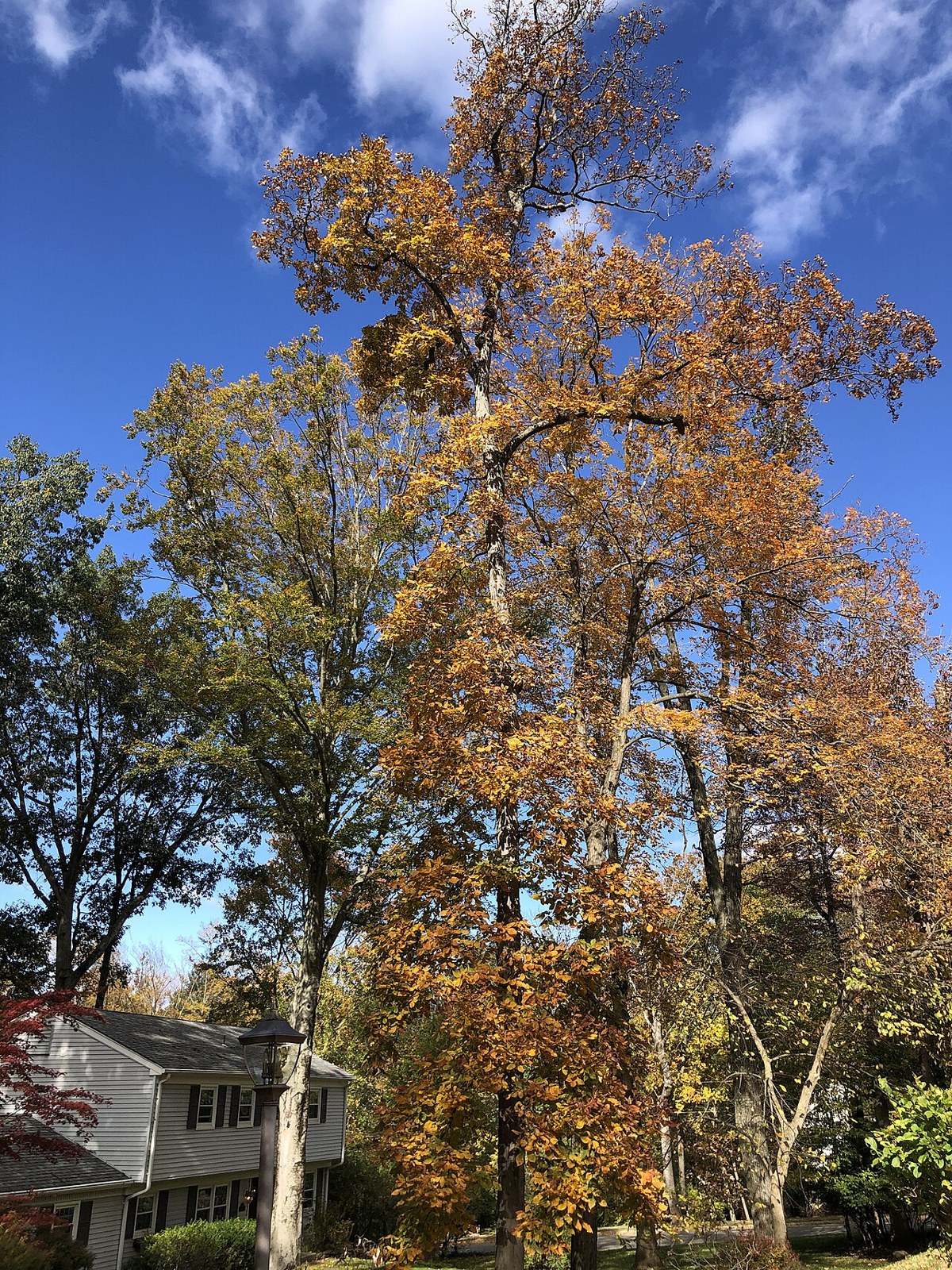
Hickories are large, long-lived nut trees in the genus Carya, part of the walnut family (Juglandaceae). They have big compound leaves, some of the hardest and toughest wood of any North American tree, and hard-shelled nuts held inside a thick husk that splits open in four sections. Eastern and central North America is the world center of hickory diversity: most of the roughly 18 species in the genus grow here, and the rest are in Mexico and eastern Asia.
About a dozen hickories are native to the United States, from the shaggy-barked shagbark hickory of New England and the Midwest to the pecan of the Mississippi Valley and Texas and the shrubby scrub hickory of central Florida’s sand ridges. Botanists disagree on a few of them, so the count ranges from 11 to 13 depending on whether red hickory and southern shagbark hickory are treated as separate species. All of them are native trees; there is no non-native hickory in common cultivation in the United States.
If you came here from our guide to ornamental trees for New York, the hickories to know there are shagbark, bitternut, pignut, mockernut and red hickory, with shellbark in the west of the state. If you came from our guide to nut trees for central Florida, see the section on pecan × hickory hybrids (hicans) below.
Identification
Leaves
Hickory leaves are alternate and pinnately compound: each leaf is a central stalk carrying an odd number of toothed leaflets, with the leaflets near the tip usually the largest. Most hickories have 5–9 leaflets per leaf. Pecan, bitternut, water and nutmeg hickory have more, narrower leaflets, from 7 up to 17 on pecan. Leaves turn yellow to golden brown in fall.
Buds
Buds are the most reliable winter clue. The “true hickories” (shagbark, shellbark, pignut, mockernut, red, sand, black and scrub hickory) have buds covered by overlapping scales. Mockernut has large, fuzzy, tan terminal buds; shagbark and shellbark have big buds with loose outer scales. The “pecan hickories” (pecan, bitternut, water and nutmeg hickory) have buds with a few paired scales that meet edge to edge, and bitternut’s slender buds are a bright sulfur yellow that is easy to spot in winter.
Bark
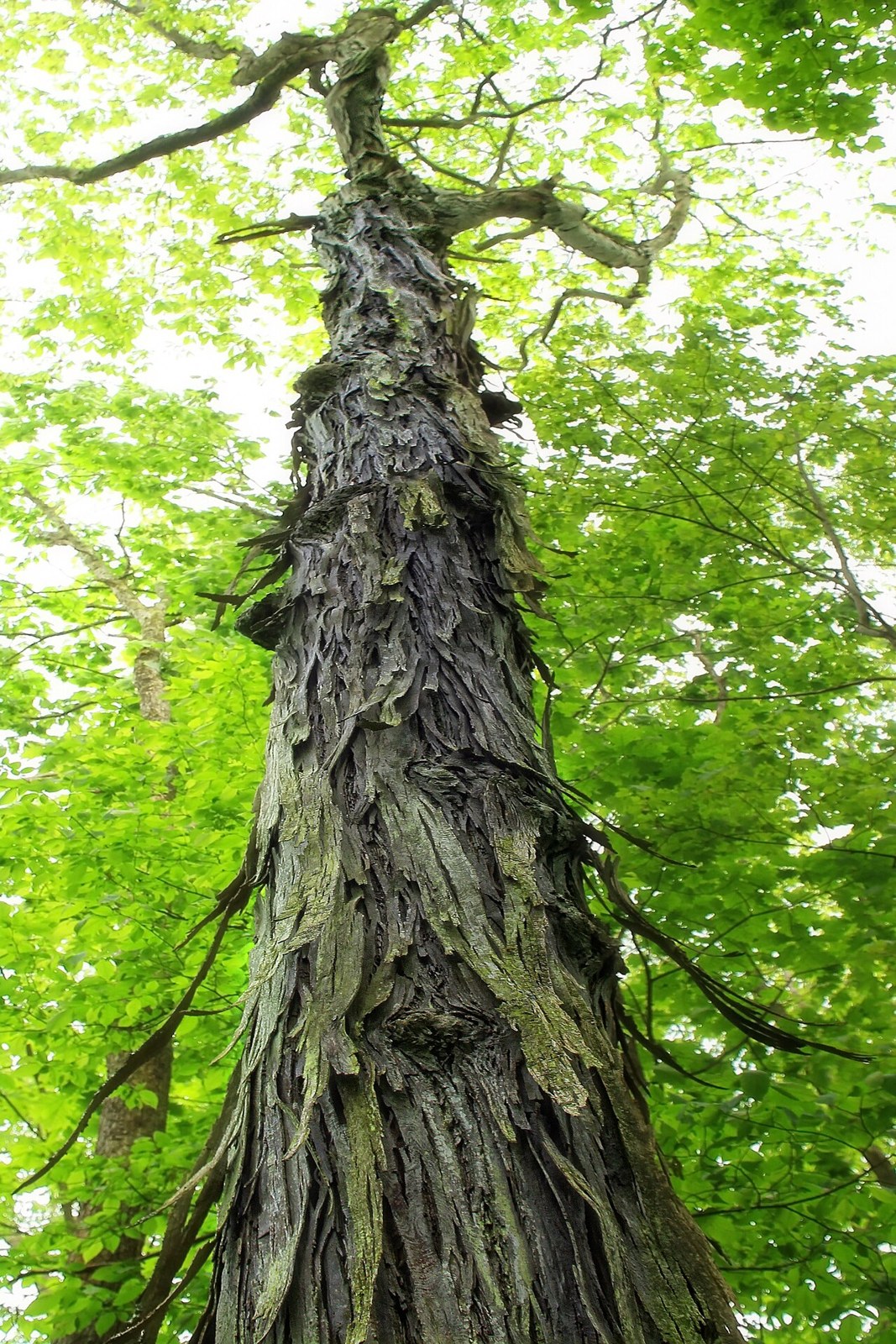
Shagbark and shellbark hickory are famous for gray bark that peels away in long, curling plates loosely attached at the middle, so the trunk looks shaggy. Southern shagbark hickory peels in a similar way. Most other hickories have tight, gray bark with a network of interlacing ridges, and pecan bark becomes scaly with age.
Fruit and nuts
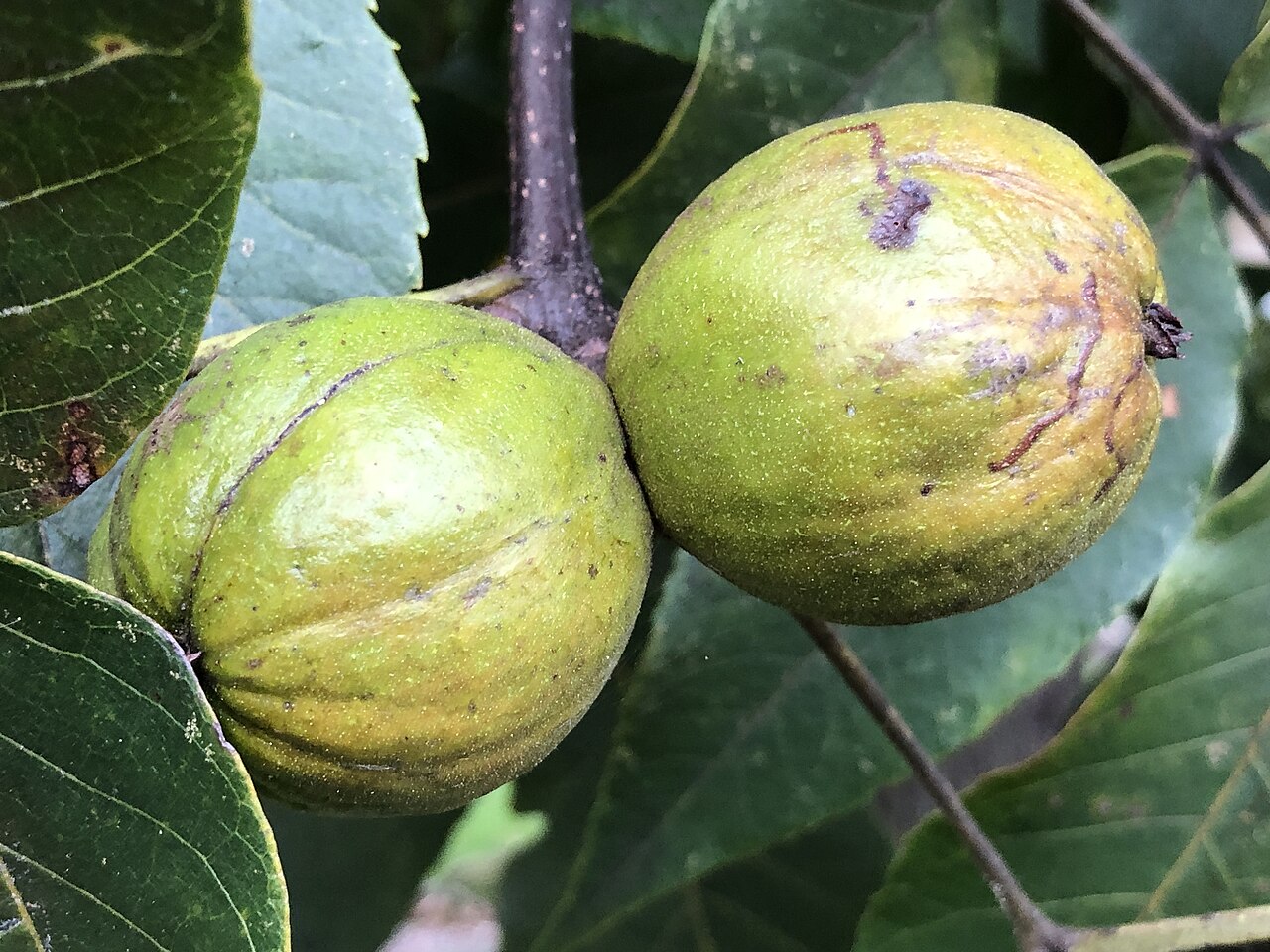
The nut sits inside a green husk that turns brown and splits along four seams in fall. Pecan and the pecan hickories have thin husks with ridges along the seams; shagbark, shellbark and mockernut have thick, woody husks. Pignut often has a pear-shaped husk that only partly splits. Shagbark, shellbark and pecan have sweet kernels; mockernut kernels are sweet but small in a very thick shell; bitternut and water hickory nuts are too bitter to eat.
Not to be confused with
Walnuts and butternut (Juglans) also have compound leaves, but they usually have more leaflets (often 11–23), round or oblong nuts in a husk that does not split into four parts, and a chambered pith you can see when you slice a twig lengthwise. Hickory twigs have solid pith. Ash trees (Fraxinus) have compound leaves arranged opposite each other, not alternate.
Quick Facts
| Scientific Name | Carya (genus) |
| Family | Juglandaceae (Walnut) |
| U.S. Native Species | About 11–13, depending on the treatment; roughly 18 worldwide |
| Plant Type | Large deciduous trees; scrub hickory is often a shrub or small tree |
| Mature Height | Mostly 50–100 ft; scrub hickory under about 30 ft |
| Growth Rate | Slow to moderate; pecan is the fastest |
| Sun Exposure | Full sun to part shade; young trees tolerate some shade |
| Water Needs | Low to moderate for upland species; water hickory and pecan grow on floodplains |
| Soil Type | Deep, well-drained loams for most; sandy soils (sand, scrub hickory) to wet bottomland clays (water hickory) |
| Flowers | Male catkins and inconspicuous female flowers in spring; wind-pollinated |
| Nuts | Ripen in fall inside a husk that splits into four parts |
| Fall Color | Yellow to golden brown |
| Wildlife Value | Nuts feed squirrels, chipmunks, turkeys, deer and bears; leaves host many moth and butterfly caterpillars |
| USDA Hardiness Zones | About 4–9 across the genus |
| Edibility | Shagbark, shellbark, mockernut and pecan nuts are edible; bitternut and water hickory nuts are very bitter |
Native Range
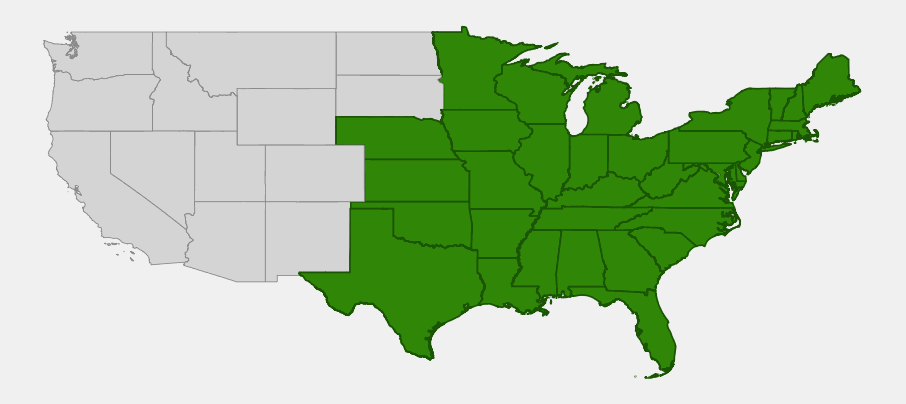
Hickories are trees of the eastern half of the United States. At least one species is native in every state from Maine to Florida and west to Minnesota, eastern Nebraska, eastern Kansas, Oklahoma and Texas. No hickory is native west of the Great Plains.
The northern hickories, shagbark hickory, bitternut hickory, pignut hickory and mockernut hickory, grow through New England, New York, Pennsylvania, the Ohio Valley and the Great Lakes states. Bitternut reaches farthest north and west, into central Minnesota, eastern Nebraska and southern Maine. The Southeast has the most species: in addition to the common upland hickories, it has sand hickory, water hickory, nutmeg hickory, southern shagbark and, in Florida only, scrub hickory.
pecan is native to the Mississippi River valley from Illinois, Indiana and Iowa south to Louisiana, and west through Missouri, Oklahoma and Texas into Mexico. It has been planted so widely in Georgia, Florida, the Carolinas, California, New Mexico and Arizona that many people assume it grows wild there, but in those states it is a cultivated tree, not a native one. Georgia is one of the largest pecan-growing states, yet pecan is not native to Georgia.
📋 Regional plant lists covering native hickory ranges: Maine, New Hampshire & Vermont · Southern New England · New York, Pennsylvania & Northern New Jersey · Delaware, Southern New Jersey & Long Island · Maryland, Virginia & West Virginia · North Carolina & South Carolina · Georgia, Alabama & Mississippi · Arkansas, Louisiana, Eastern Oklahoma & East Texas · Kentucky & Tennessee · Ohio & Indiana · Illinois, Iowa & Missouri · Michigan, Wisconsin & Eastern Minnesota · Nebraska, Kansas & Eastern Colorado · South & West Texas
Native Species
Each of these U.S.-native hickories has its own full growing guide on Plant Native.
Shagbark Hickory (Carya ovata)
The best-known hickory, native from southern Maine and Quebec to Minnesota and south to Georgia and eastern Texas. Its gray bark peels in long strips, and its leaves usually have 5 leaflets. The sweet nuts were a staple food for Native peoples and early settlers. A good shade tree for large yards in New York and the Midwest, growing 60–80 feet tall.
Shellbark Hickory (Carya laciniosa)
Also called kingnut. A bottomland tree of the Midwest and Ohio Valley with shaggy bark like shagbark, but usually 7 leaflets and the largest nuts of any hickory. It tolerates wetter soils than shagbark.
Southern Shagbark Hickory (Carya carolinae-septentrionalis)
A shaggy-barked hickory of the southern Appalachian Piedmont and limestone areas from Virginia and Tennessee to Georgia and Alabama, with smaller leaflets and smaller nuts than shagbark. Many botanists treat it as a variety of shagbark.
Pecan (Carya illinoinensis)
The largest hickory and the most important nut tree native to North America, reaching 100 feet or more on deep river-bottom soils of the Mississippi Valley and Texas. Leaves have 9–17 narrow, slightly curved leaflets. Grafted varieties are grown for nuts across the South.
Bitternut Hickory (Carya cordiformis)
The most widespread hickory, from Maine and Minnesota south to Florida and Texas, often on moist slopes and floodplains. Identify it in winter by its bright sulfur-yellow buds. The nuts are too bitter for people, though some wildlife eat them.
Pignut Hickory (Carya glabra)
A common upland hickory of dry ridges and oak forests across the East, with tight, ridged bark, 5 smooth leaflets and small, thin-husked, often pear-shaped nuts. The kernels vary from bland to bitter.
Red Hickory (Carya ovalis)
Also called sweet pignut. Very close to pignut and often merged with it, it differs in its more rounded nuts with husks that split fully, and its leaves usually have 5–7 leaflets. It grows on dry upland soils from New England and Michigan south.
Mockernut Hickory (Carya tomentosa)
Named for its thick-shelled nuts that “mock” the forager with a small kernel. Mockernut has fuzzy twigs, large tan buds and fragrant leaves with downy undersides. It grows from Massachusetts and southern Michigan to Florida and East Texas and is often the most common hickory in the Southeast.
Sand Hickory (Carya pallida)
A small to medium hickory of dry, sandy uplands from southern New Jersey and Delaware to northern Florida and west to Louisiana and southern Illinois, recognized by silvery scales on the undersides of its leaflets.
Black Hickory (Carya texana)
A hickory of dry, rocky Ozark and Cross Timbers woodlands from southern Indiana and Missouri to Texas and Louisiana, with dark, deeply furrowed bark and rusty-scaled buds.
Water Hickory (Carya aquatica)
A southern swamp and floodplain hickory from Virginia to Florida and west to Texas and southern Illinois. Related to pecan, it has narrow leaflets and flattened, bitter nuts. Wood ducks and other wildlife eat the nuts.
Nutmeg Hickory (Carya myristiciformis)
An uncommon hickory of moist, often limy soils in scattered locations from South Carolina to Texas and Arkansas. Its small, brown nuts are marked like a nutmeg, and the undersides of the leaflets have a bronze to silvery sheen.
Scrub Hickory (Carya floridana)
Found only on the ancient sand ridges and scrub of central Florida, it is often a multi-stemmed shrub, sprouting back after fire. It is one of the few native hickories in central Florida, along with pignut, mockernut and water hickory.
Pecan × Hickory Hybrids (Hicans)
A hican is a hybrid between pecan and another hickory, usually shagbark or shellbark hickory. Hicans arise naturally where pecan grows near those species in the Mississippi and Ohio valleys, and a number of chance seedlings with good nuts have been named and propagated by grafting. ‘Burton’ and ‘Bixby’ are two of the best-known named hicans. The nuts look like large, rounded pecans and are often described as combining pecan’s thin shell with the rich flavor of shagbark. Crops are often light and the nuts are not always well filled, so hicans are grown mainly by nut enthusiasts rather than commercial orchards.
Hicans are not a separate native species, and they are not native to Florida. Central Florida is at the warm, humid edge of where pecans are grown, and the hickory parents of hicans do not grow wild there. We have not found trial data on how hicans perform in central Florida, so treat a hican there as an experiment. Gardeners who want a native nut tree in central Florida can look instead to the local hickories, especially mockernut and pignut on well-drained soils.
Non-Native Look-Alikes
Every hickory you are likely to find in an American yard, park or forest is a native species. Chinese hickory (Carya cathayensis) and other Asian hickories are grown for nuts in China but are essentially absent from cultivation in the United States. The confusion comes from other trees with similar leaves, and from pecans planted outside their native range.
Pecans planted outside their range
Pecan is native only to the Mississippi Valley and Texas, but it has been planted throughout the Southeast and the Southwest. A pecan in a Georgia or Carolina yard is a native American tree, but not a native of that state, and it does not support local wildlife in quite the same way as the oaks and hickories that grow wild there.
Tree-of-heaven (Ailanthus altissima)
This Chinese tree is invasive across most of the United States, spreading along roadsides, railways and forest edges. Its long compound leaves look like a hickory’s at a glance. Tell it apart by its smooth leaflets with one or two blunt teeth near the base, the strong rancid smell of crushed leaves and twigs, and clusters of papery winged seeds instead of nuts.
Walnuts
black walnut is native, not a look-alike to avoid, but it is easy to confuse with hickory. Walnuts have more leaflets, a round nut in a husk that does not split into sections, and chambered pith in the twigs. Black walnut roots release juglone, which harms tomatoes and some other plants growing nearby.
Growing & Care Guide
Light
Hickories grow best and bear the most nuts in full sun. Young trees tolerate partial shade under other trees, which is how they grow up in the wild, but mature trees need open space for a full crown.
Soil & Water
Match the species to your site. Shagbark, mockernut, pignut and red hickory grow on well-drained upland soils and tolerate dry summers once established. Shellbark, pecan and bitternut prefer deep, moist soils of river bottoms. Water hickory is the one to plant on wet, poorly drained ground in the South, and sand and scrub hickory handle deep, droughty sand.
Planting Tips
Hickories grow a deep taproot soon after germination, which makes large trees very difficult to transplant. Plant small seedlings in deep containers, or sow nuts directly where you want the tree, in fall, and protect them from squirrels with a wire cage. Give each tree plenty of room; most hickories eventually spread 40–60 feet or more. Plant away from driveways, patios and parking spots, since falling nuts and husks are hard and messy.
Pruning & Maintenance
Hickories need little pruning beyond removing dead or crossing branches while the tree is young; prune in the dormant season. They are generally strong, long-lived trees. Hickory bark beetle and drought stress can kill weakened trees, and squirrels will harvest most of the nut crop if you let them.
Nuts
Seedling hickories are slow to bear: many take 10–20 years or more to produce nuts, and heavy crops come later and often in alternate years. Grafted pecans and hicans bear sooner. Collect nuts as soon as husks split, dry them for a few weeks, then crack. People with tree-nut allergies should avoid hickory nuts and pecans.
Wildlife & Ecological Value
For Mammals
Hickory nuts are high in fat and are a key fall and winter food for gray and fox squirrels, chipmunks, mice, raccoons, black bears and white-tailed deer. Squirrels bury many more nuts than they recover, which is how hickories spread.
For Birds
Wild turkeys, wood ducks (on water hickory), blue jays and woodpeckers eat hickory nuts or the broken fragments that squirrels leave behind. Woodpeckers and nuthatches forage on the bark for insects.
For Moths and Butterflies
Hickories are host plants for a large number of moth and butterfly caterpillars, including the luna moth and the hickory horned devil, the huge caterpillar of the regal moth. Those caterpillars in turn feed nesting songbirds.
Ecosystem Role
Hickories share eastern forests with oaks, especially white oak, and together they form the oak-hickory forest that covers much of the Ozarks, the Midwest and the Appalachians. The loose bark plates of shagbark hickory are known roosting spots for bats, including the endangered Indiana bat.
Cultural & Historical Uses
The word “hickory” comes from an Algonquian word, recorded in Virginia as pawcohiccora, for a food made from pounded hickory nuts and water. Native peoples across the East gathered hickory nuts in large quantities. Hickory wood is extremely strong and shock-resistant, and it has long been used for tool and axe handles, wagon wheels, sporting goods and smoking meat.
Frequently Asked Questions
How many hickories are native to the United States?
About a dozen. Counts range from 11 to 13 because botanists disagree about whether red hickory and southern shagbark hickory are separate species. All hickories grown in the United States are native species.
Which hickories grow in New York?
shagbark hickory, bitternut hickory, pignut hickory, mockernut hickory and red hickory are native to New York, and shellbark hickory grows in the western part of the state. Pecan is not native to New York.
What is a hican?
A hybrid between pecan and another hickory, usually shagbark or shellbark. Named grafted varieties such as ‘Burton’ and ‘Bixby’ produce large, thin-shelled nuts, but crops can be light. Hicans are not native to Florida, and how well they perform in central Florida is uncertain.
Are hickory nuts edible?
Shagbark, shellbark, mockernut and pecan nuts are edible and were important foods for Native peoples and settlers. Pignut kernels vary from bland to bitter, and bitternut and water hickory nuts are too bitter to eat.
Can I transplant a hickory from the woods?
Usually not successfully. Hickories grow a long taproot very early, and cutting it often kills the tree. Plant nursery seedlings grown in deep pots, or plant nuts where you want the tree to grow.
Is pecan native to Georgia and Florida?
No. Pecan is native to the Mississippi Valley and Texas. It is grown in orchards and yards across Georgia and northern Florida but does not grow wild there naturally.

Looking for a nursery that carries Native Hickories?
Browse our native plant nursery directory: Alabama & Arkansas · Connecticut, Delaware, Florida & Georgia · Illinois, Indiana, Iowa & Kansas · Kentucky, Louisiana, Maine, Maryland, Massachusetts, Michigan, Minnesota, Mississippi & Missouri · Nebraska, New Hampshire, New Jersey, New York, North Carolina, Ohio & Oklahoma · Pennsylvania, Rhode Island, South Carolina, Tennessee, Texas, Vermont & Virginia · West Virginia & Wisconsin

